Map of France showing where the Boyea arms are recorded
The Boyea arms were recorded in Lyonnais, c. 1663.
Lyonnais centred on Lyon, one of the great banking and silk towns of France. Money made in the city bought estates in the countryside around it, and those estates brought arms with them.
This is where the arms were entered in the register. Families often moved to other parts of the country, so the same name can turn up in more than one region.
The body that granted and recorded arms in France in this period.
Louis XIV of France
Sovereign of the period
Louis XIV of France
1643–1715
Reigning in France when the Boyea arms are first recorded.
How Arms Worked in France
In France, a coat of arms was a mark of honor that passed down through the male line to all legitimate descendants. Families often used the same shield without changes to show their shared heritage. If a branch wanted to stand out, they could add a small mark to their shield to show their specific place in the family tree.
Granting authority
The Juge d'armes de France acted as the official authority that regulated and verified coats of arms across the country.
How they got arms
Families typically inherited their arms from ancestors, though they could also receive them through royal grants or by proving their noble status.
Where arms were recorded
Coats of arms were officially recorded in the Armorial Général de France, which began its main collection in the year 1696.
The family's standing
Recorded among the armigerous families of Lyonnais.
Origin & History of the Boyea Family in France
The family name Boyea is a variant of the French surname Boyer, which has deep roots in the historical province of Lyonnais. By the year 1663, records confirm that members of this family were already established in this region, which was a vital center for trade and silk production during the seventeenth century. The name itself is occupational in origin, likely derived from the Old French word "boier," a term used to describe a cowherd or someone who managed oxen. This suggests that the earliest ancestors of the family were likely hardworking rural laborers or farmers who played an essential role in the agricultural economy of eastern France. As the family grew, they became part of the local social fabric of Lyonnais, living through a period of significant cultural and economic development in the French countryside.
Coat of Arms & Family Crest Details
Symbols on this shield
mountThe ground held, and steadfastness upon it
oakGreat age, strength and steadfastness
bearStrength, cunning and protection of kin
treeLife, endurance and deep roots
Colours
Gold (Or)Means: Generosity
Silver (Argent)Means: Peace and sincerity
Green (Vert)Means: Hope
Black (Sable)Means: Constancy
Historical info
Source
J. B. Rietstap, Armorial Général, Gouda: G. B. van Goor Zonen, 1884–87
Blazon (the actual original written record)
“Ec.: aux 1 et 4 d'or à une branche de chêne englantée, au nat., posée en bande; aux 2 et 3 d'arg. à un ours de sa., ramp. contre un tronc écoté au nat., le tout soutenu d'une terrasse de sin. Cq. cour. C.: une queue de paon au nat. L.: à dextre d'or et de sin., à sen. d'arg. et de sa.”
MecklenburgMecklenburg, c. 1749
Digital archive packCoat of arms PNG, gold border print PDF, vector SVG and the certificate of authenticity. Sent to your email in minutes.
Map of Germany showing where the Boyea arms are recorded
The Boyea arms were recorded in Mecklenburg, c. 1749.
Mecklenburg was farming country in the north of Germany, held by a small number of families who kept their estates for generations. Owning land was what entitled a family to arms, so a great many Mecklenburg names ended up in the registers.
This is where the arms were entered in the register. Families often moved to other parts of the country, so the same name can turn up in more than one region.
The body that granted and recorded arms in Germany in this period.
Francis I, Holy Roman Emperor
Sovereign of the period
Francis I, Holy Roman Emperor
1745–1765
Reigning in France when the Boyea arms are first recorded.
How Arms Worked in Germany
In the Holy Roman Empire, coats of arms were often granted to individuals by the Emperor or his representatives. These arms were then passed down through the generations to all legitimate descendants of the original holder. Younger branches of a family usually kept the same shield design without needing to change it, as the arms belonged to the entire lineage.
Granting authority
The Holy Roman Emperor held the sole power to grant new coats of arms throughout his vast imperial territories.
How they got arms
Families typically obtained their coats of arms through a formal imperial grant or by proving their noble status to the authorities.
Where arms were recorded
These grants were officially recorded in the Imperial Chancery registers, which began keeping formal records of such honors during the Middle Ages.
The family's standing
Recorded among the armigerous families of Mecklenburg.
Origin & History of the Boyea Family in Germany
The family name Boyea is deeply rooted in the historical landscape of Mecklenburg, a region in northern Germany known for its vast agricultural plains and coastal influence. By the mid-eighteenth century, records confirm that members of the family were established in this area, living within a society defined by strict social structures and agrarian traditions. During this era, the name likely evolved as a localized variation of regional surnames, reflecting the linguistic shifts common in the Low German dialects spoken across the Baltic coast. Families in Mecklenburg at this time were often tied to the land through manorial systems, meaning the early ancestors of the Boyea line were likely involved in the essential farming or trade activities that sustained the local villages. As these individuals navigated the political and economic changes of the 1700s, their presence in the region became part of the broader demographic history of northern Germany, marking the starting point for the family lineage that would eventually spread far beyond its original borders.
Coat of Arms & Family Crest Details
Symbols on this shield
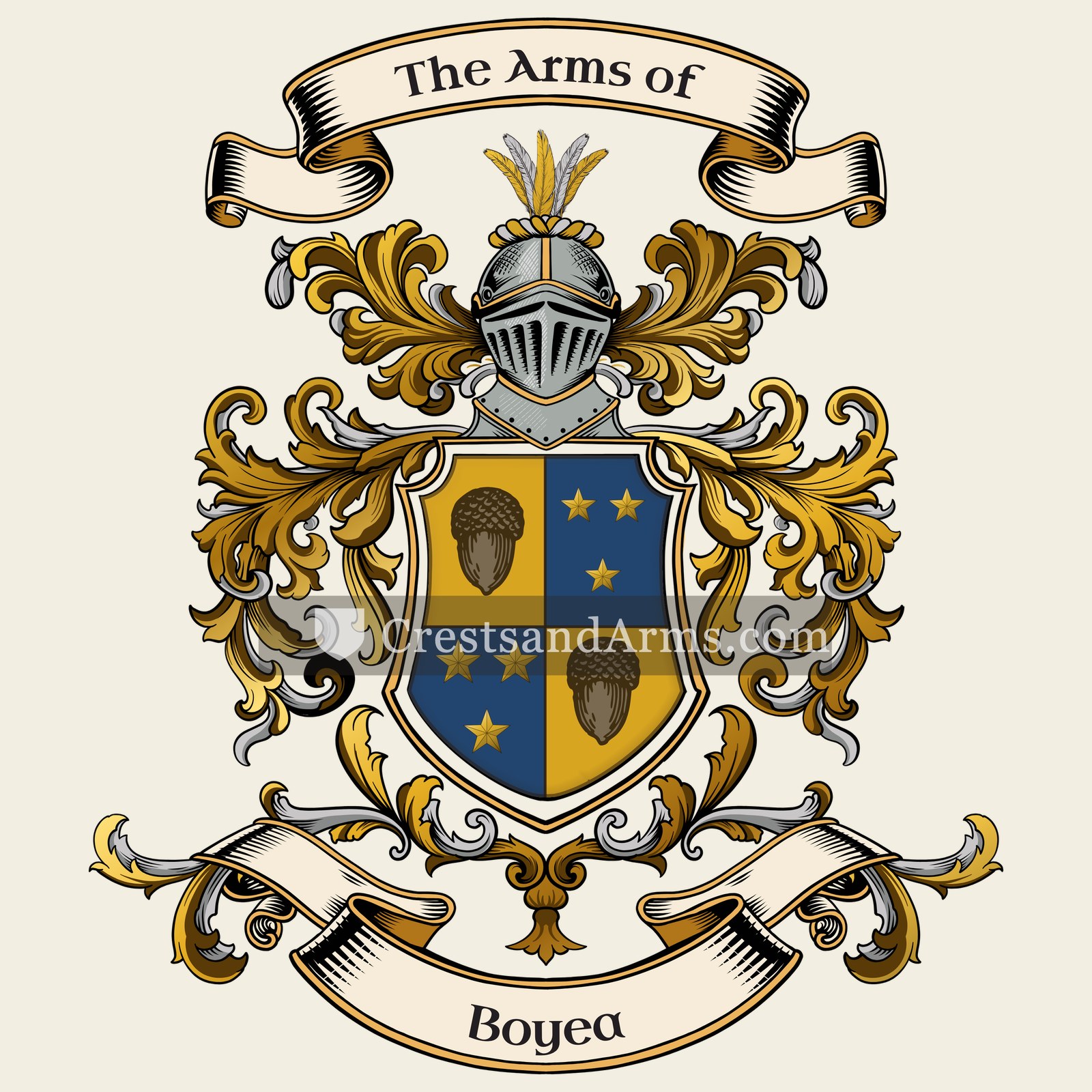
oakGreat age, strength and steadfastness
mulletThe third son, and a divine quality from above
Colours
Gold (Or)Means: Generosity
Blue (Azure)Means: Loyalty and truth
Historical info
Source
J. B. Rietstap, Armorial Général, Gouda: G. B. van Goor Zonen, 1884–87
Blazon (the actual original written record)
“Ec.: aux 1 et 4 d'or à une branche de chêne englantée, au nat., posée en bande; aux 2 et 3 d'azur à trois étoiles d'or, rangées en fasce. Cq. cour. C.: une queue de paon, au nat. L.: à dextre d'or et de sin., à sen. d'or et d'azur.”
Denmarkc. 1771
Digital archive packCoat of arms PNG, gold border print PDF, vector SVG and the certificate of authenticity. Sent to your email in minutes.
Map of Denmark showing where the Boyea arms are recorded
The Boyea arms were recorded in Denmark, c. 1771.
Arms such as these were typically recorded in Sjaælland.
Zealand held the Danish court, the crown's offices and Copenhagen itself. Families who served the king kept estates within reach of it, and royal service was the ordinary route to a coat of arms.
This is where the arms were entered in the register. Families often moved to other parts of the country, so the same name can turn up in more than one region.
The body that granted and recorded arms in Denmark in this period.
Christian VII of Denmark
Sovereign of the period
Christian VII of Denmark
1766–1808
Reigning in France when the Boyea arms are first recorded.
How Arms Worked in Denmark
Danish heraldry during this period was closely tied to noble status and royal favor rather than being open to all citizens. Arms were typically granted by the monarch to individuals, and these symbols were then shared by all members of the noble house. If a family line died out, the right to use those specific arms ended with them.
Granting authority
The Danish royal chancery held the power to issue and regulate official coats of arms for the kingdom.
How they got arms
Families usually received their arms through a formal royal grant that confirmed their noble status and rights.
Where arms were recorded
These grants were officially recorded in the Danish Royal Chancery records starting in the sixteenth century.
The family's standing
Recorded among the armigerous families of Denmark.
Origin & History of the Boyea Family in Denmark
The Boyea family name has deep roots in the island of Sjælland, where records confirm members of the family were living as early as 1771. During this period, Denmark was transitioning from a society based on traditional patronymic naming customs, where a child took their father’s first name as their surname, toward the use of permanent family names. The name Boyea likely emerged as a localized variation of older Germanic or Nordic roots, reflecting the linguistic shifts occurring in rural Danish communities during the late eighteenth century. Families in this region were often tied to the land through agricultural labor or service to local manors, and the survival of the name in church registers suggests a stable presence in the local parish system. By documenting these individuals in the census and parish records, historians can trace how the family adapted to the changing social structures of the Danish monarchy. This era was a time of significant reform for the Danish peasantry, and the Boyea family lived through the early stages of these changes while maintaining their identity in the heart of the kingdom.
Related Branches & Arms
Root word
Boyer
An occupational term for an oxherd or cattle driver.
This name
BoyeaA variant spelling of a surname denoting a person who tended oxen or cattle.
also spelled
Boi
Boy
Documented Sources
J. B. Rietstap, Armorial Général, Gouda: G. B. van Goor Zonen, 1884–87
Dauzat, Albert. Dictionnaire étymologique des noms et prénoms de France. 1951
Archives départementales du Rhône, Registres paroissiaux et d'état civil du Lyonnais. 1663
Digital archive packCoat of arms PNG, gold border print PDF, vector SVG and the certificate of authenticity. Sent to your email in minutes.


 chevronProtection, and faithful service completed
 trefoilPerpetuity, and the Trinity
 chevronProtection, and faithful service completed
 trefoilPerpetuity, and the Trinity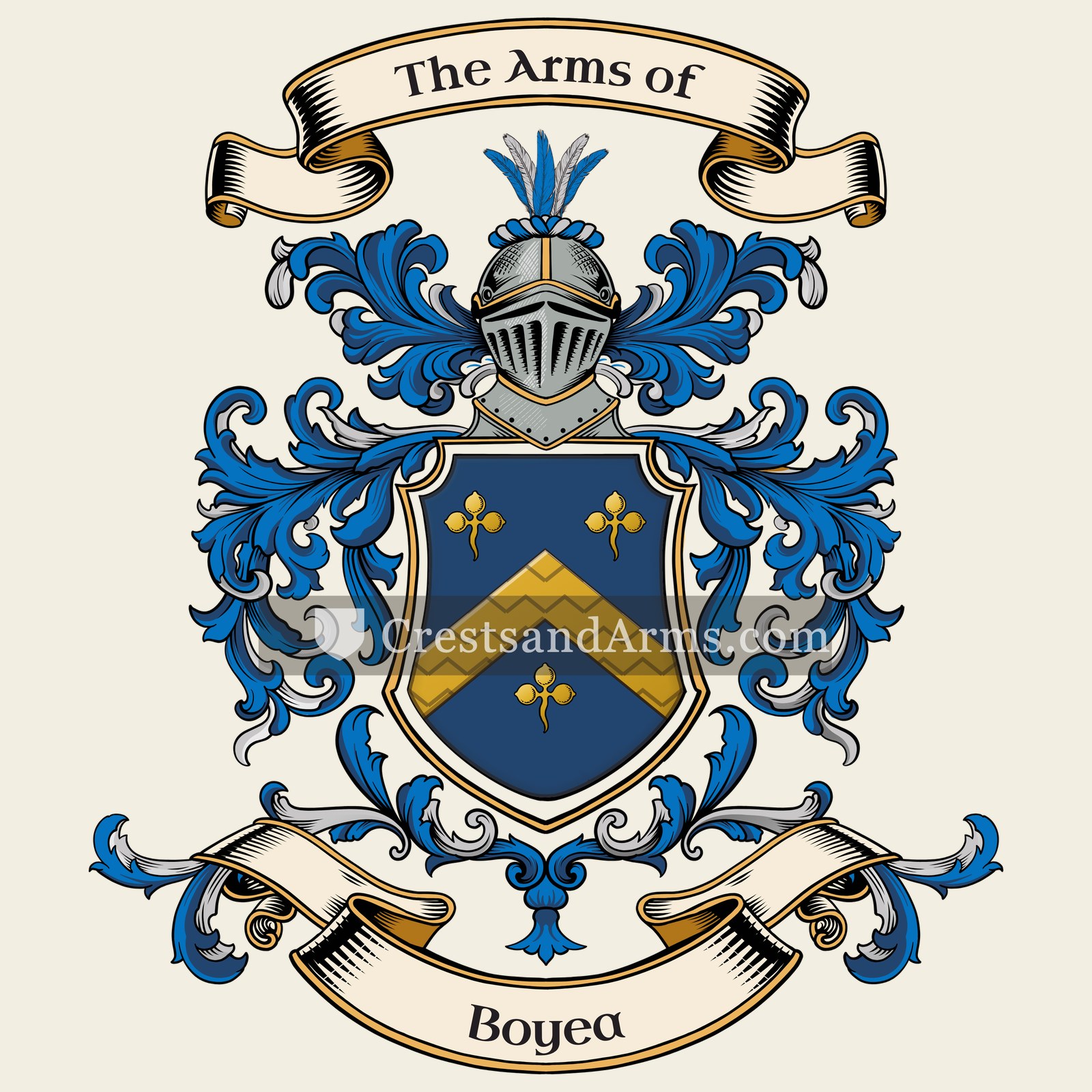


 mountThe ground held, and steadfastness upon it
 oakGreat age, strength and steadfastness
 bearStrength, cunning and protection of kin
 treeLife, endurance and deep roots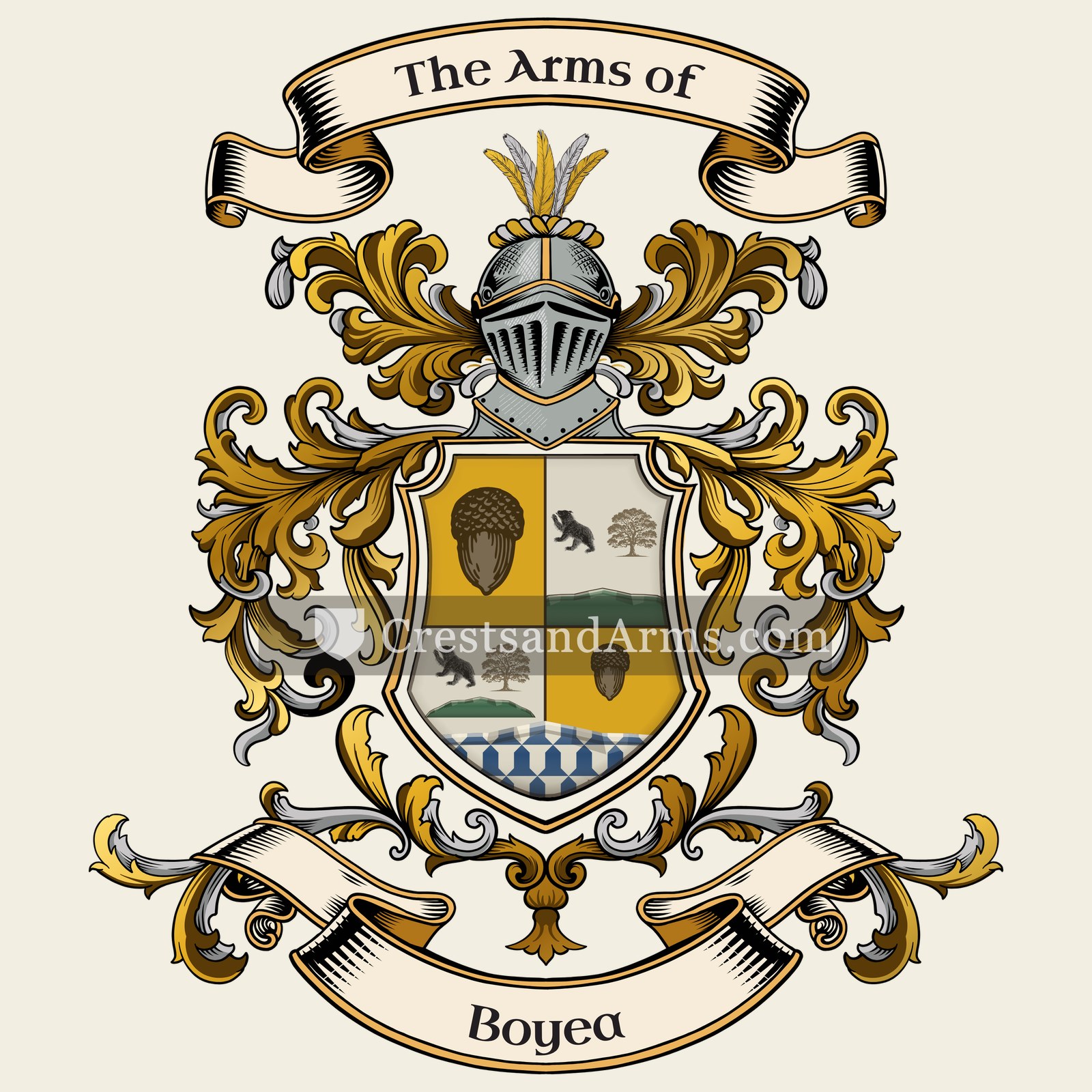


 mulletThe third son, and a divine quality from above