Map of Britain showing where the Brabazon arms are recorded
The Brabazon arms were recorded in Britain, c. 1700.
Arms such as these were typically recorded in Kent.
Kent sits between London and the short crossing to Europe, and the trade passing through made it wealthy. Merchant families bought land with that money, and it was landowners who took coats of arms.
This is where the arms were entered in the register. Families often moved to other parts of the country, so the same name can turn up in more than one region.
The body that granted and recorded arms in Britain in this period.
William III of England
Sovereign of the period
William III of England
1694–1702
Reigning in Britain when the Brabazon arms are first recorded.
How Arms Worked in Britain
English heraldry allowed arms to be shared by all legitimate descendants of the original owner. These symbols were treated as personal property that moved through the generations to all children. While the eldest son kept the original design, other family members could use the same shield without needing to change it or register their own unique versions.
Granting authority
The College of Arms in London has regulated the use of coats of arms throughout England and Wales since 1484.
How they got arms
Families typically obtained their coats of arms through a formal grant from the Crown or by proving their ancient right to them.
Where arms were recorded
All official coats of arms are recorded in the registers kept at the College of Arms, which date back to the fifteenth century.
The family's standing
Recorded among the armigerous families of Britain.
Origin & History of the Brabazon Family in Britain
The Brabazon family name has deep roots that stretch back to the arrival of Norman settlers in England. While the family established a notable presence in the county of Kent by the year 1700, their history in Britain began much earlier as they integrated into the local social and landowning structures. The name itself is thought to be a locative surname, likely originating from the Brabant region in what is now modern-day Belgium. As these early ancestors moved across the English Channel, they transitioned from being associated with their continental origins to becoming firmly embedded in the administrative and agricultural life of the British countryside. Over several centuries, the family moved through different regions, eventually settling into the roles of local gentry and community leaders. By the time they were documented in Kent, they were already part of a long-standing tradition of families who helped shape the development of English rural society.
Coat of Arms & Family Crest Details
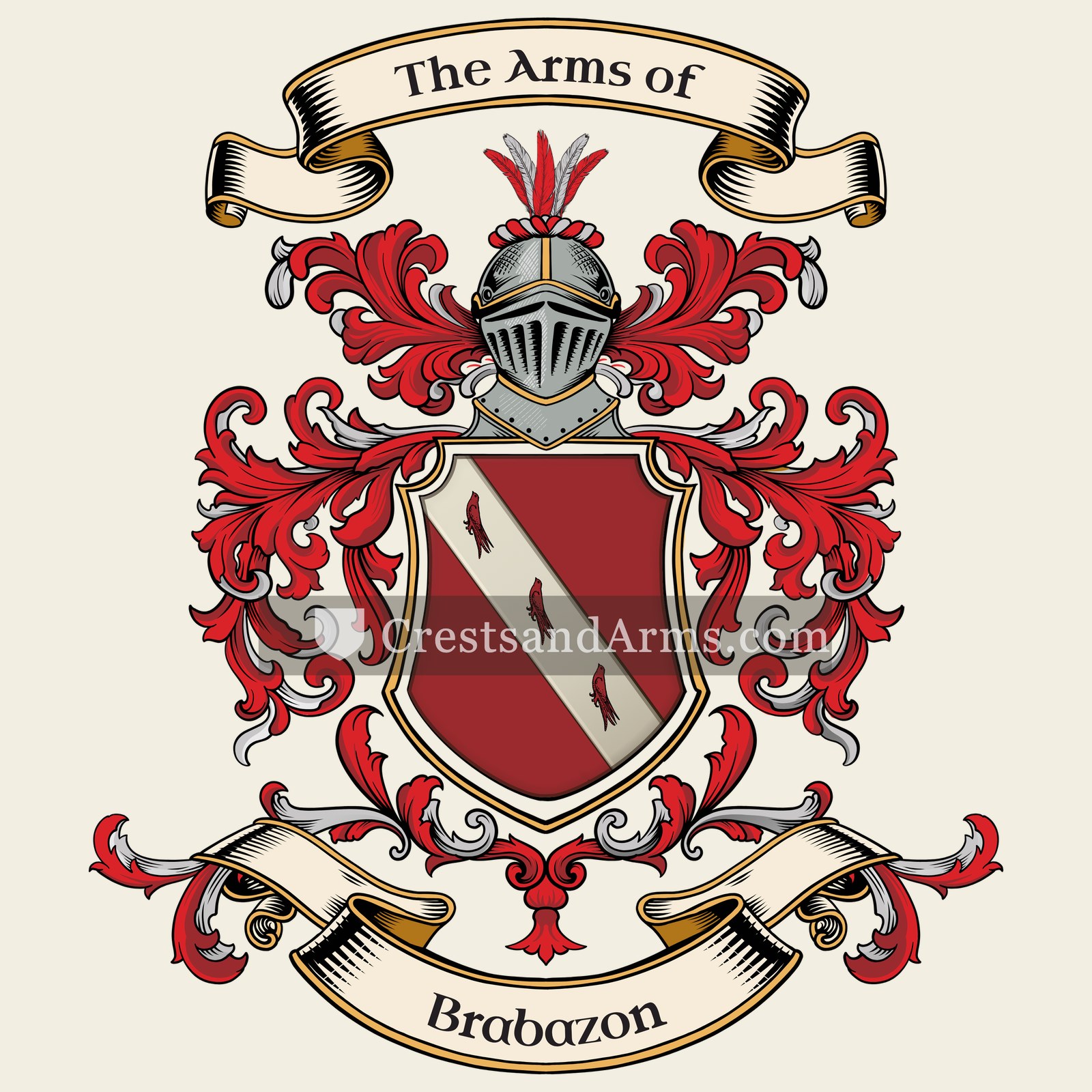
Symbols on this shield
bendDefence, and the scarf of a commander
martletA younger son, who must win his own land
Colours
Red (Gules)Means: Military strength
Silver (Argent)Means: Peace and sincerity
Historical info
Source
Sir Bernard Burke, The General Armory of England, Scotland, Ireland and Wales, London: Harrison & Sons, 1884
Blazon (the actual original written record)
“Gu. on a bend ar. three martlets of the field”
LeicesterSpropton · Leicester, c. 1619
Digital archive packCoat of arms PNG, gold border print PDF, vector SVG and the certificate of authenticity. Sent to your email in minutes.
Map of England showing where the Brabazon arms are recorded
The Brabazon arms were recorded in Leicester, c. 1619.
Leicestershire was grazing country, and wool and cattle made steady money rather than spectacular fortunes. Steady money bought manors, and manors are what brought families into the registers.
This is where the arms were entered in the register. Families often moved to other parts of the country, so the same name can turn up in more than one region.
The body that granted and recorded arms in England in this period.
James VI and I
Sovereign of the period
James VI and I
1603–1625
Reigning in Britain when the Brabazon arms are first recorded.
How Arms Worked in England
English heraldry allowed arms to be shared by all legitimate descendants of the original owner. These symbols were treated as personal property that moved through the generations to all children. While the eldest son kept the original design, other family members could use the same shield without needing to change it or register their own unique versions.
Granting authority
The College of Arms in London has regulated the use of coats of arms throughout England and Wales since 1484.
How they got arms
Families typically obtained their coats of arms through a formal grant from the Crown or by proving their ancient right to them.
Where arms were recorded
All official coats of arms are recorded in the registers kept at the College of Arms, which date back to the fifteenth century.
The family's standing
Recorded among the armigerous families of Leicester.
Origin & History of the Brabazon Family in England
The Brabazon family name traces its roots back to the arrival of Norman settlers in England following the conquest of 1066. The name is believed to have originated as a nickname derived from the Old French word brabancon, which referred to people from the Brabant region of the Low Countries. By the early seventeenth century, the family had established a notable presence in the English Midlands, particularly within the county of Leicestershire. Records from the 1619 visitation of Leicestershire confirm that members of the family were well-integrated into the local gentry by this time. They held lands and played active roles in the social and administrative life of the region, marking their transition from continental arrivals to established English landowners. This period of their history highlights how families often settled into specific counties, building local influence that would sustain their name for generations.
Coat of Arms & Family Crest Details
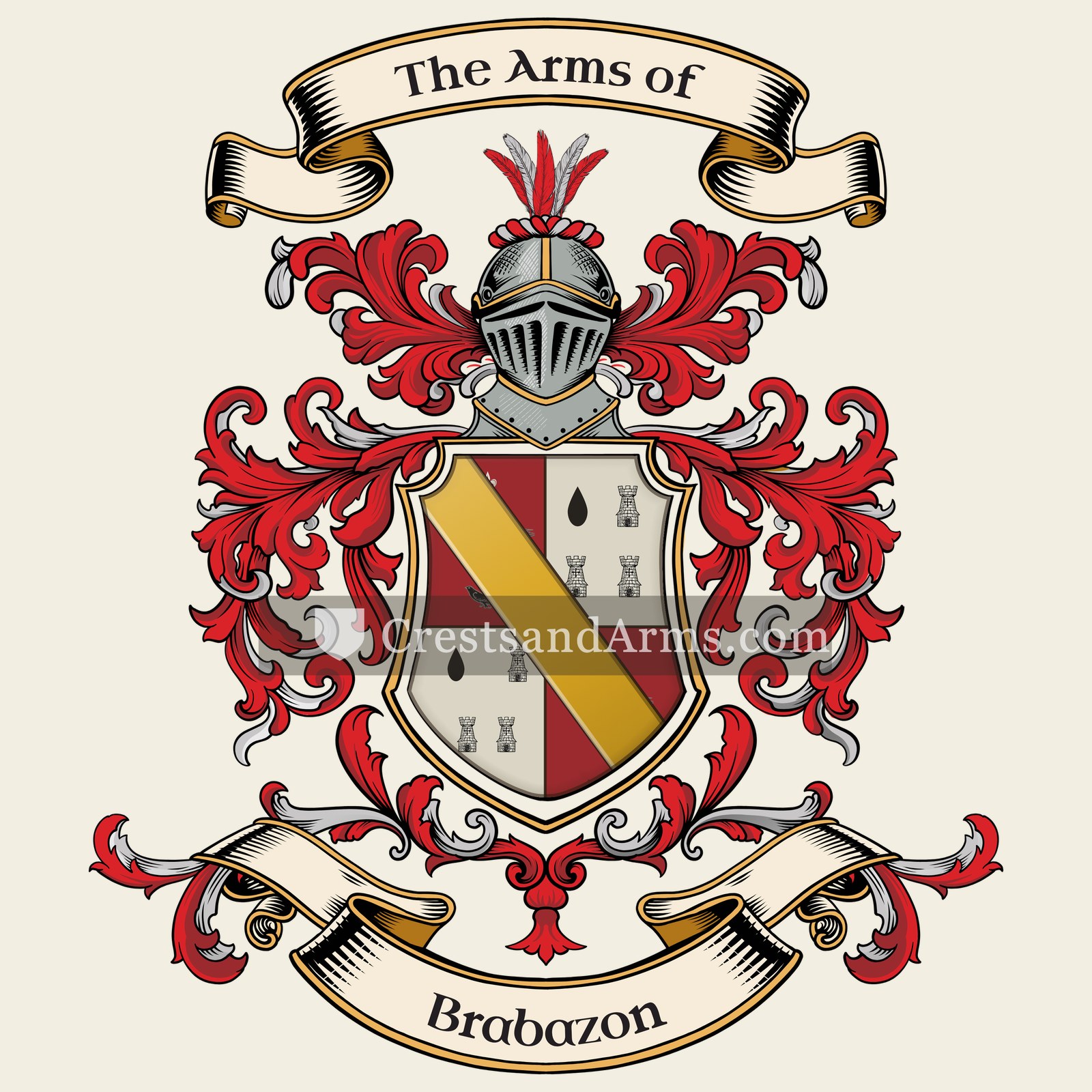
Symbols on this shield
bendDefence, and the scarf of a commander
martletA younger son, who must win his own land
fleur de lisPurity, light, and the sixth son
dropletsTears, and grief borne with patience
towerGrandeur and solidity, and a stronghold defended
Colours
Red (Gules)Means: Military strength
Silver (Argent)Means: Peace and sincerity
Gold (Or)Means: Generosity
Black (Sable)Means: Constancy
Historical info
Source
Sir Bernard Burke, The General Armory of England, Scotland, Ireland and Wales, London: Harrison & Sons, 1884
Blazon (the actual original written record)
“Quarterly, 1st and 4th, gu. on a bend or, three martlets sa. a fleur-de-lis ar. for diff., for BRABAZON; 2nd and 3rd, ar. guttée de poix, on a fesse sa. three towers of the first, for HIGGINS”
MayoBrabazon Park · Mayo, c. 1645
Digital archive packCoat of arms PNG, gold border print PDF, vector SVG and the certificate of authenticity. Sent to your email in minutes.
Map of Ireland showing where the Brabazon arms are recorded
The Brabazon arms were recorded in Mayo, c. 1645.
Mayo was poor western Irish country of bog and mountain, held by a small number of old families. Land changed hands rarely there, and families who held on appear in the records.
This is where the arms were entered in the register. Families often moved to other parts of the country, so the same name can turn up in more than one region.
The body that granted and recorded arms in Ireland in this period.
Charles I of England
Sovereign of the period
Charles I of England
1625–1649
Reigning in Britain when the Brabazon arms are first recorded.
How Arms Worked in Ireland
The Ulster King of Arms granted coats of arms to individuals who proved their social standing and good character. These symbols were typically inherited by all legitimate descendants of the original holder. If a family branch wanted a unique look, they could apply for a specific change to their design through the office to ensure their identity remained distinct.
Granting authority
The Ulster King of Arms acted as the official body that regulated and issued all coats of arms throughout Ireland.
How they got arms
Families obtained their arms through formal grants issued by the office after proving their eligibility and paying the required fees.
Where arms were recorded
All official grants were recorded in the registers held by the Ulster King of Arms starting from the year 1552.
The family's standing
Recorded among the armigerous families of Mayo.
Origin & History of the Brabazon Family in Ireland
The Brabazon family name arrived in Ireland during the late sixteenth century, marking the beginning of a significant influence on the island’s political and social landscape. While the family originated from Normandy, their Irish history is defined by their rapid rise to prominence through land acquisition and government service. By the year 1645, members of the family were firmly established in County Mayo, where they managed vast estates and played a key role in the administration of the region. This period was a time of great upheaval in Ireland, yet the family successfully navigated these challenges to maintain their status and local authority. Their presence in the west of Ireland helped shape the development of the area for generations, as they transitioned from newcomers to central figures in the local history of Mayo.
Brabazon Meaning & Related Branches
Root word
Brabant
A region in the Low Countries historically known as Brabantia.
This name
BrabazonAn inhabitant or person originating from the Duchy of Brabant.
also spelled
Brabason
Brabazoun
Documented Sources
J. B. Rietstap, Armorial Général, Gouda: G. B. van Goor Zonen, 1884–87
Bardsley, Charles Wareing, A Dictionary of English and Welsh Surnames, 1901
Reaney, Percy Hide, A Dictionary of British Surnames, 1958
The National Archives, Records of the Prerogative Court of Canterbury, 1700
Kent History and Library Centre, Parish Records of Kent, 1700
Digital archive packCoat of arms PNG, gold border print PDF, vector SVG and the certificate of authenticity. Sent to your email in minutes.


 bendDefence, and the scarf of a commander
 martletA younger son, who must win his own land
 bendDefence, and the scarf of a commander
 martletA younger son, who must win his own land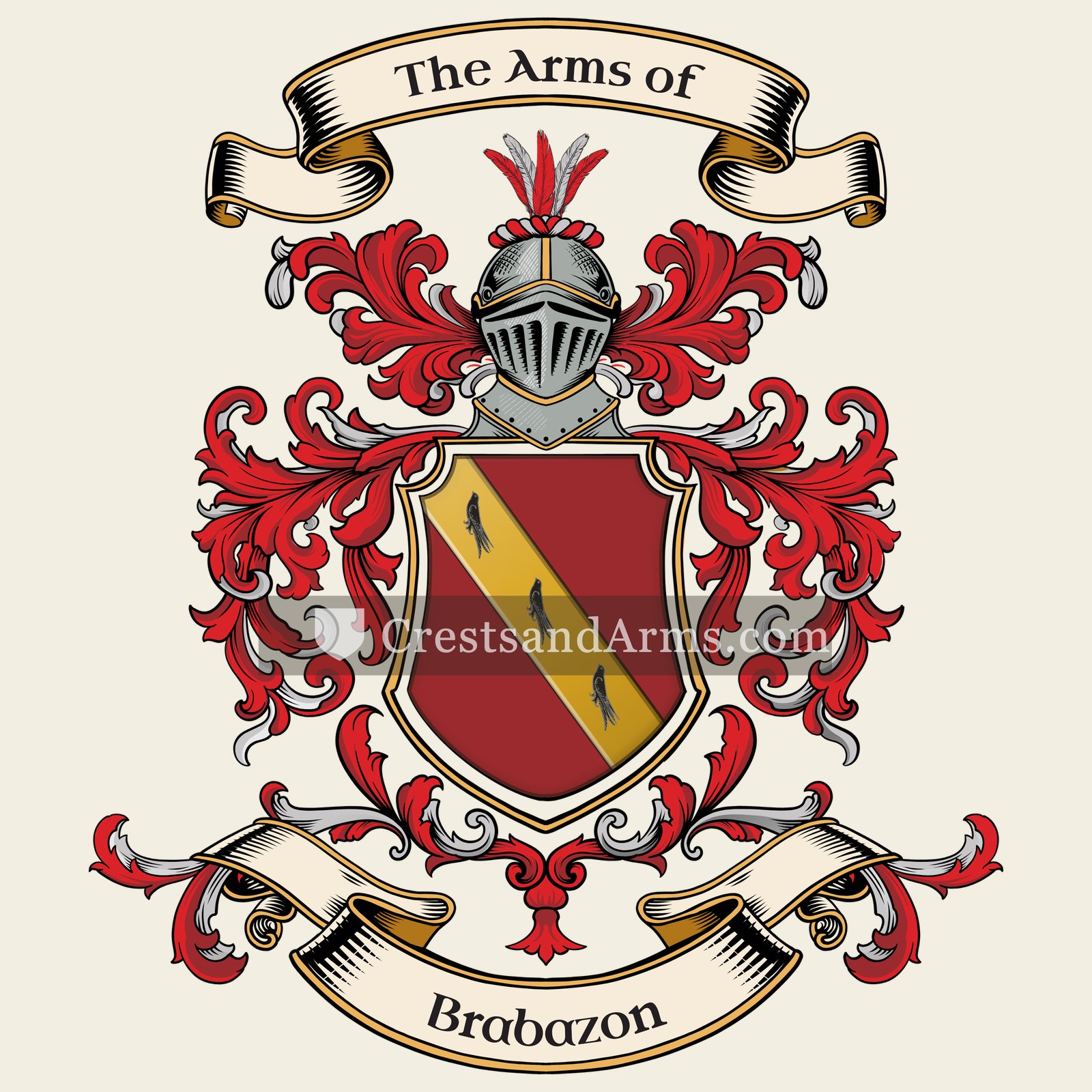



 fleur de lisPurity, light, and the sixth son
 dropletsTears, and grief borne with patience
 towerGrandeur and solidity, and a stronghold defended