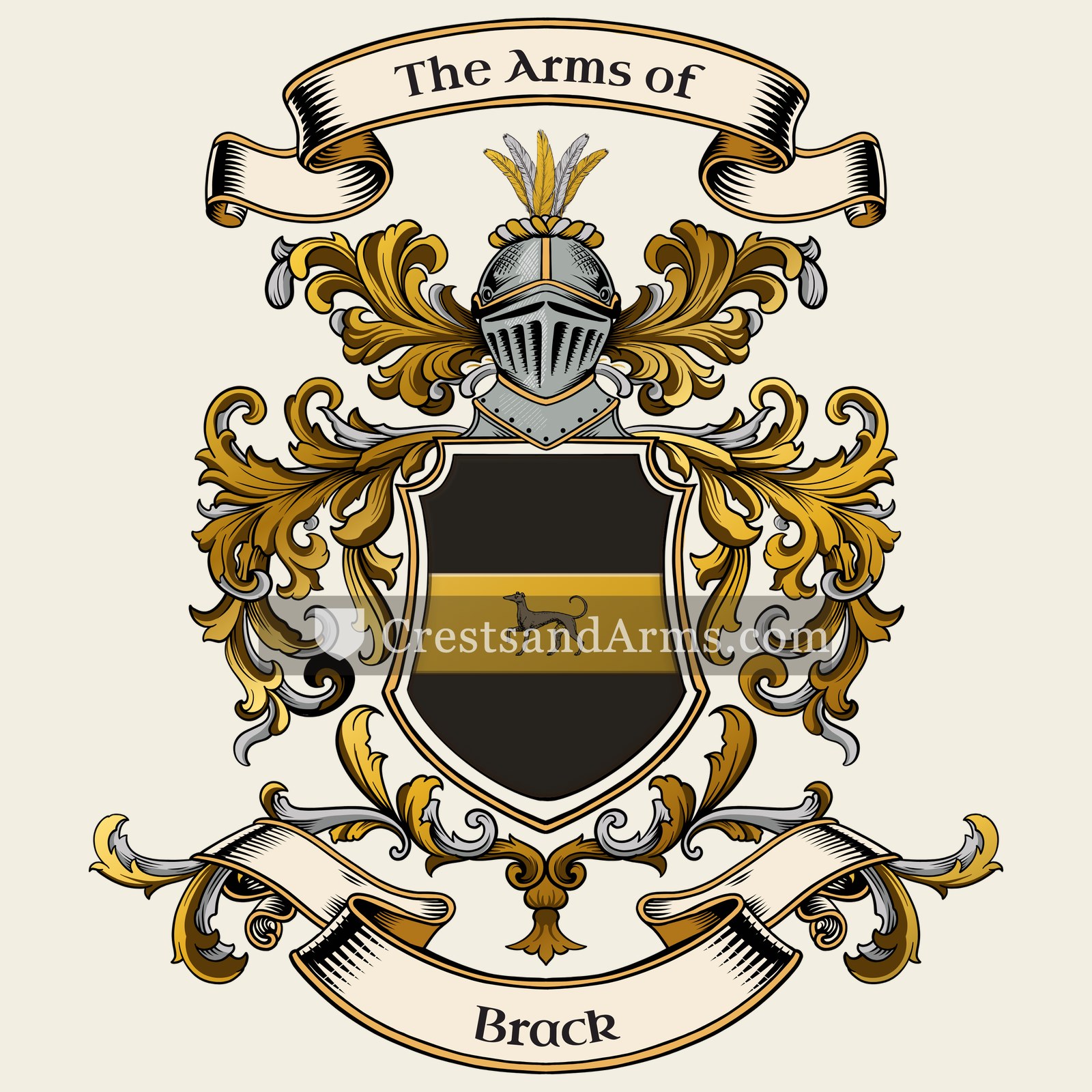
A record of documented arms, meaning and origin, researched for the Brack family of Germany.
Reg. 1437 · German, A–C
Coat of Arms & Family Crest Details
Symbols on this shield
fessThe military belt, and readiness to serve
greyhoundCourage, vigilance and loyalty
Colours
Black (Sable)Means: Constancy
Gold (Or)Means: Generosity
Historical info
Source
J. B. Rietstap, Armorial Général, Gouda: G. B. van Goor Zonen, 1884–87
Blazon (the actual original written record)
“De sa. à la fasce d'or, ch. d'un chien braque au nat., coll. d'or, arrêté, la tête posée de face. C.: le chien, assis, entre deux prob. de sa., chacune d'une fasce d'or.”
GermanyNördlingen Bav, c. 1765
Digital archive packCoat of arms PNG, gold border print PDF, vector SVG and the certificate of authenticity. Sent to your email in minutes.
Map of Germany showing where the Brack arms are recorded
The Brack arms were recorded in Nördlingen Bav, c. 1765.
This is where the arms were entered in the register. Families often moved to other parts of the country, so the same name can turn up in more than one region.
The body that granted and recorded arms in Germany in this period.
Francis I, Holy Roman Emperor
Sovereign of the period
Francis I, Holy Roman Emperor
1745–1765
Reigning in Germany when the Brack arms are first recorded.
How Arms Worked in Germany
In the Holy Roman Empire, coats of arms were often granted to individuals by the Emperor or his representatives. These arms were then passed down through the generations to all legitimate descendants of the original holder. Younger branches of a family usually kept the same shield design without needing to change it, as the arms belonged to the entire lineage.
Granting authority
The Holy Roman Emperor held the sole power to grant new coats of arms throughout his vast imperial territories.
How they got arms
Families typically obtained their coats of arms through a formal imperial grant or by proving their noble status to the authorities.
Where arms were recorded
These grants were officially recorded in the Imperial Chancery registers, which began keeping formal records of such honors during the Middle Ages.
The family's standing
Recorded among the armigerous families of Germany.
Origin & History of the Brack Family in Germany
The surname Brack has deep roots in the German-speaking regions of Europe, where it likely originated as a descriptive name or a reference to a specific location. In the Middle Ages, names were often chosen based on a person’s trade, physical traits, or the landscape where they lived. For the Brack family, historical records confirm their presence in the city of Nördlingen by 1765. During this period, Nördlingen was a significant center for trade and craftsmanship, and families living there were often integrated into the local guild systems. The name itself may be linked to the Middle High German word "bracke," which historically referred to a type of hunting dog or, in some dialects, to marshy or broken land. By the mid-18th century, the Brack family had established themselves within the social and economic fabric of this historic Bavarian town, contributing to the local community as artisans or merchants.
Brack Meaning & Related Branches
Root word
Bracco
An Old Italian or Germanic term referring to a hunting dog.
This name
BrackA topographic name for someone living near a marsh or a nickname for a hound-like hunter.
also spelled
Brac
Related arms
Bracvariant spelling
Brachvariant spelling
Documented Sources
J. B. Rietstap, Armorial Général, Gouda: G. B. van Goor Zonen, 1884–87
Stadtarchiv Nördlingen, Bürgerbuch der Stadt Nördlingen (1750–1800)
Kohlhammer, W., Südwestdeutsche Blätter für Familien- und Wappenkunde, 1965
Bahlow, Hans, Deutsches Namenlexikon: Familien- und Vornamen nach Ursprung und Sinn erklärt, 1967
Digital archive packCoat of arms PNG, gold border print PDF, vector SVG and the certificate of authenticity. Sent to your email in minutes.


 fessThe military belt, and readiness to serve
 greyhoundCourage, vigilance and loyalty
 fessThe military belt, and readiness to serve
 greyhoundCourage, vigilance and loyalty