Map of Ireland showing where the Bradstreet arms are recorded
The Bradstreet arms were recorded in Kildare, c. 1645.
Kildare was flat grazing country close to Dublin, taken early by Norman families. Being near the seat of government meant being near where arms were recorded, which is why so many Kildare names appear.
This is where the arms were entered in the register. Families often moved to other parts of the country, so the same name can turn up in more than one region.
The body that granted and recorded arms in Ireland in this period.
Charles I of England
Sovereign of the period
Charles I of England
1625–1649
Reigning in Ireland when the Bradstreet arms are first recorded.
How Arms Worked in Ireland
The Ulster King of Arms granted coats of arms to individuals who proved their social standing and good character. These symbols were typically inherited by all legitimate descendants of the original holder. If a family branch wanted a unique look, they could apply for a specific change to their design through the office to ensure their identity remained distinct.
Granting authority
The Ulster King of Arms acted as the official body that regulated and issued all coats of arms throughout Ireland.
How they got arms
Families obtained their arms through formal grants issued by the office after proving their eligibility and paying the required fees.
Where arms were recorded
All official grants were recorded in the registers held by the Ulster King of Arms starting from the year 1552.
The family's standing
Recorded among the armigerous families of Kildare.
Origin & History of the Bradstreet Family in Ireland
The family name Bradstreet is of English origin and describes a person who lived near a broad street or a wide road. By the middle of the seventeenth century, members of the family had established themselves in County Kildare, Ireland. Historical records confirm their presence in this region by 1645, a time when many English families were settling in Ireland to manage land and participate in local administration. Over the following decades, the Bradstreets became prominent figures in Kildare society, often serving as landowners and local officials. Their transition from English settlers to established Irish residents reflects the broader patterns of migration and social change that defined the seventeenth century. By rooting themselves in the fertile landscape of Kildare, the family secured a lasting legacy that continued for generations.
Bradstreet Meaning & Related Branches
Root word
Broad Street
A wide or expansive thoroughfare in a town or city.
This name
BradstreetA topographic surname referring to someone who lived on or near a wide street.
also spelled
Bradstrait
Bradstreat
Documented Sources
Sir Bernard Burke, The General Armory of England, Scotland, Ireland and Wales, London: Harrison & Sons, 1884
D’Alton, John. The History of the County of Dublin. 1838
O’Hart, John. Irish Pedigrees; or, The Origin and Stem of the Irish Nation. 1892
National Archives of Ireland, Civil Survey of the County of Kildare. 1654–1656
National Library of Ireland, Genealogical Office Manuscripts
Digital archive packCoat of arms PNG, gold border print PDF, vector SVG and the certificate of authenticity. Sent to your email in minutes.


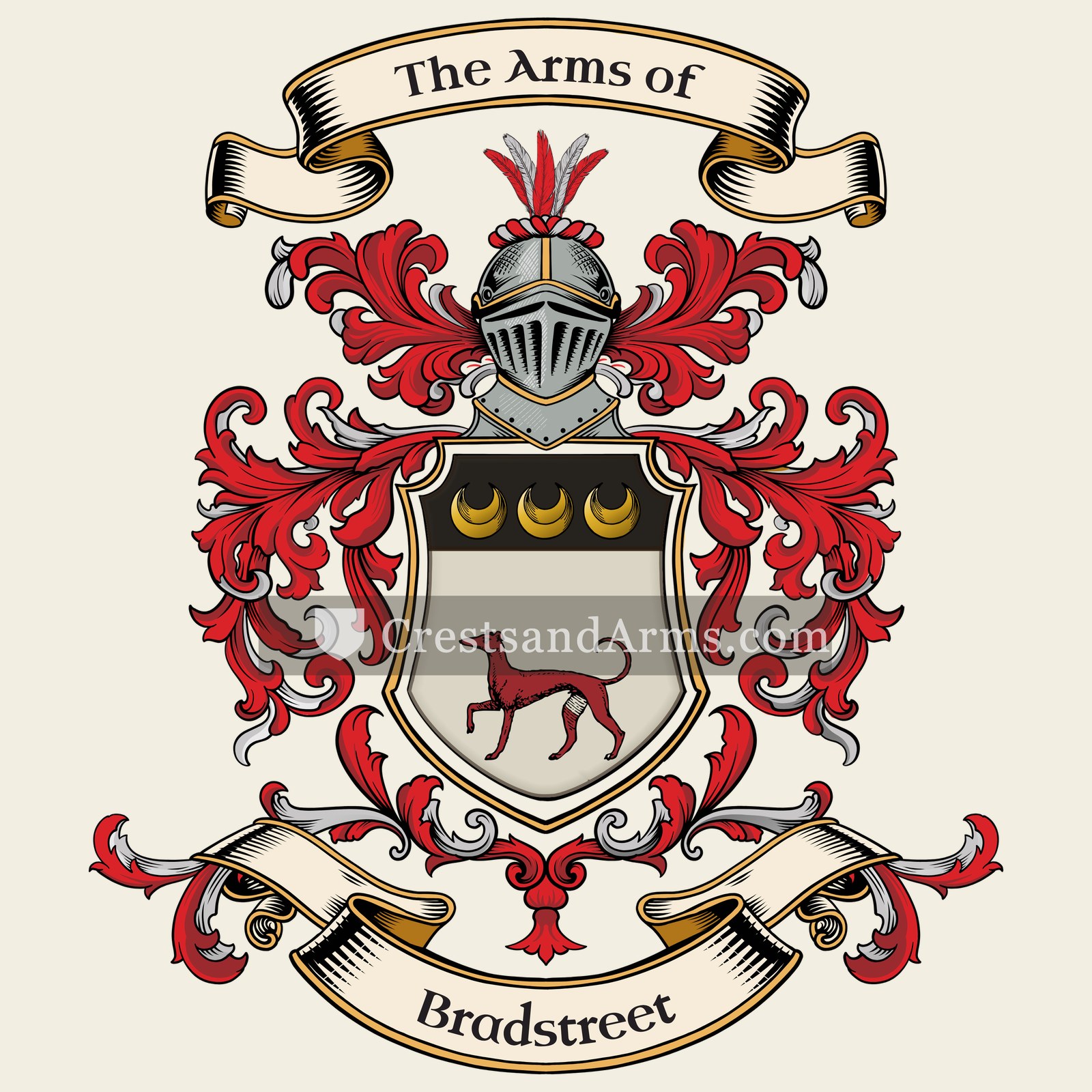
 chiefAuthority, wisdom and dominion
 greyhoundCourage, vigilance and loyalty
 crescentHonour by the sovereign, and the second son
 chiefAuthority, wisdom and dominion
 greyhoundCourage, vigilance and loyalty
 crescentHonour by the sovereign, and the second son