Map of Belgium showing where the Brahm arms are recorded
The Brahm arms were recorded in Brabant, c. 1737.
Brabant lay at the heart of the Low Countries, where the trade routes met. Its towns were wealthy and its landowners many, and both kinds of family kept arms, which is why the region is so heavily represented.
This is where the arms were entered in the register. Families often moved to other parts of the country, so the same name can turn up in more than one region.
The body that granted and recorded arms in Belgium in this period.
Charles VI, Holy Roman Emperor
Sovereign of the period
Charles VI, Holy Roman Emperor
1711–1740
Reigning in Belgium when the Brahm arms are first recorded.
How Arms Worked in Belgium
In Belgium, a coat of arms is considered personal property that is passed down through the male line to legitimate descendants. Families often use the same shield design across generations to show their shared heritage. If a branch of the family wants to change the design, they must apply for an official update to their specific version of the arms.
Granting authority
The Conseil héraldique is the official body that regulates and approves all coats of arms in Belgium.
How they got arms
Families obtain their coats of arms through formal royal grants or by confirming their historical right to use existing designs.
Where arms were recorded
All approved coats of arms are officially recorded in the public registers of the Conseil héraldique since 1844.
The family's standing
Recorded among the armigerous families of Brabant.
Origin & History of the Brahm Family in Belgium
The family name Brahm has deep roots in the historical region of Brabant, where records confirm members of the family were established by 1737. During this era, the region was a center of agricultural and craft activity under the rule of the Austrian Netherlands. Families like the Brahms often lived in rural or semi-urban communities where their surname likely functioned as a descriptor of their trade or their specific place of residence. As the family settled into the local landscape, they became part of the social fabric of the Low Countries, navigating the shifting political borders and economic changes that defined 18th-century Belgium. By maintaining a consistent presence in the Brabant area, the family contributed to the local history of the region through their daily labor and their participation in parish life. Their documented history serves as a window into the lives of ordinary families who helped build the foundations of the modern Belgian state.
Meaning of the Brahm family crest colors & symbols
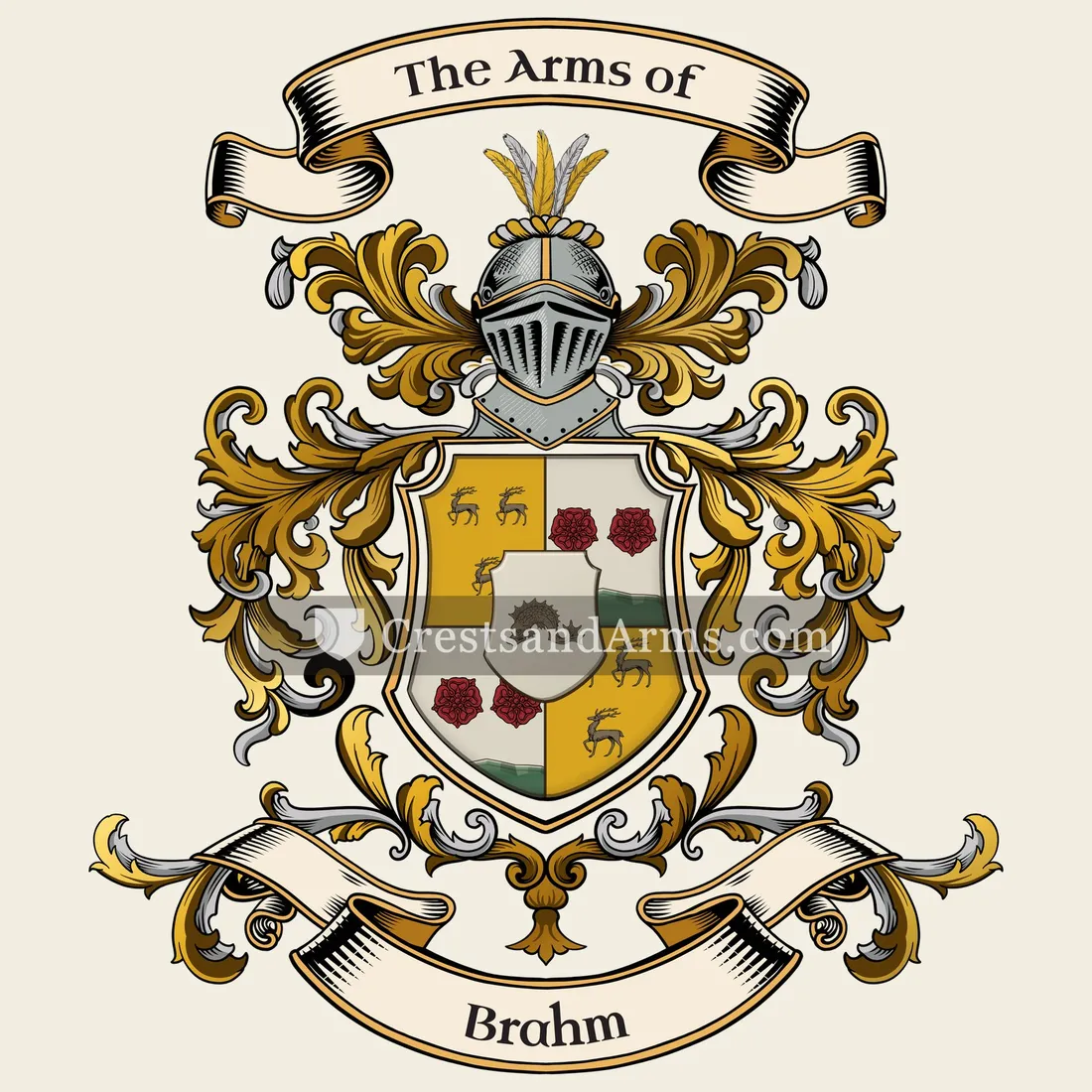
Symbols on this shield
mountThe ground held, and steadfastness upon it
dolphinSwiftness, charity and love
stagPeace and harmony, and one who will not fight unprovoked
roseThe seventh son, and beauty with grace
Colours
Gold (Or)Means: Generosity
Silver (Argent)Means: Peace and sincerity
Green (Vert)Means: Hope
Red (Gules)Means: Military strength
Historical info
Source
J. B. Rietstap, Armorial Général, Gouda: G. B. van Goor Zonen, 1884–87
Blazon (the actual original written record)
“Ec.: aux 1 et 4 d'or à trois têtes de biche au nat.; aux 2 et 3 d'arg. à deux roses de gu., tigées et feuillées de sin., les tiges entrelacées et posées sur une terrasse de sin. Sur le tout d'arg. à une baleine au nat., soufflant de l'eau par ses narines et nageant sur une mer d'arg. Cq. cour. C.: une tête et col de dragon d'arg.”
Denmarkc. 1713
Digital archive packCoat of arms PNG, gold border print PDF, vector SVG and the certificate of authenticity. Sent to your email in minutes.
Map of Denmark showing where the Brahm arms are recorded
The Brahm arms were recorded in Denmark, c. 1713.
Arms such as these were typically recorded in Sjaælland.
Zealand held the Danish court, the crown's offices and Copenhagen itself. Families who served the king kept estates within reach of it, and royal service was the ordinary route to a coat of arms.
This is where the arms were entered in the register. Families often moved to other parts of the country, so the same name can turn up in more than one region.
The body that granted and recorded arms in Denmark in this period.
Frederik IV of Denmark
Sovereign of the period
Frederik IV of Denmark
1699–1730
Reigning in Belgium when the Brahm arms are first recorded.
How Arms Worked in Denmark
Danish heraldry during this period was closely tied to noble status and royal favor rather than being open to all citizens. Arms were typically granted by the monarch to individuals, and these symbols were then shared by all members of the noble house. If a family line died out, the right to use those specific arms ended with them.
Granting authority
The Danish royal chancery held the power to issue and regulate official coats of arms for the kingdom.
How they got arms
Families usually received their arms through a formal royal grant that confirmed their noble status and rights.
Where arms were recorded
These grants were officially recorded in the Danish Royal Chancery records starting in the sixteenth century.
The family's standing
Recorded among the armigerous families of Denmark.
Origin & History of the Brahm Family in Denmark
The history of the Brahm family in Denmark begins with documented records placing members of the lineage on the island of Sjælland as early as 1713. During this period, the name was closely associated with the social and professional shifts occurring in the Danish countryside. Families with this name often integrated into the local administrative and agricultural structures that defined life in the region during the eighteenth century. Because Sjælland served as the political and economic heart of the kingdom, the presence of the Brahm family there suggests they were part of the steady movement of people seeking opportunities near the capital of Copenhagen. Over time, the family name became firmly rooted in the local community, reflecting the broader patterns of migration and settlement that shaped the Danish population during the early modern era.
Meaning of the Brahm family crest colors & symbols
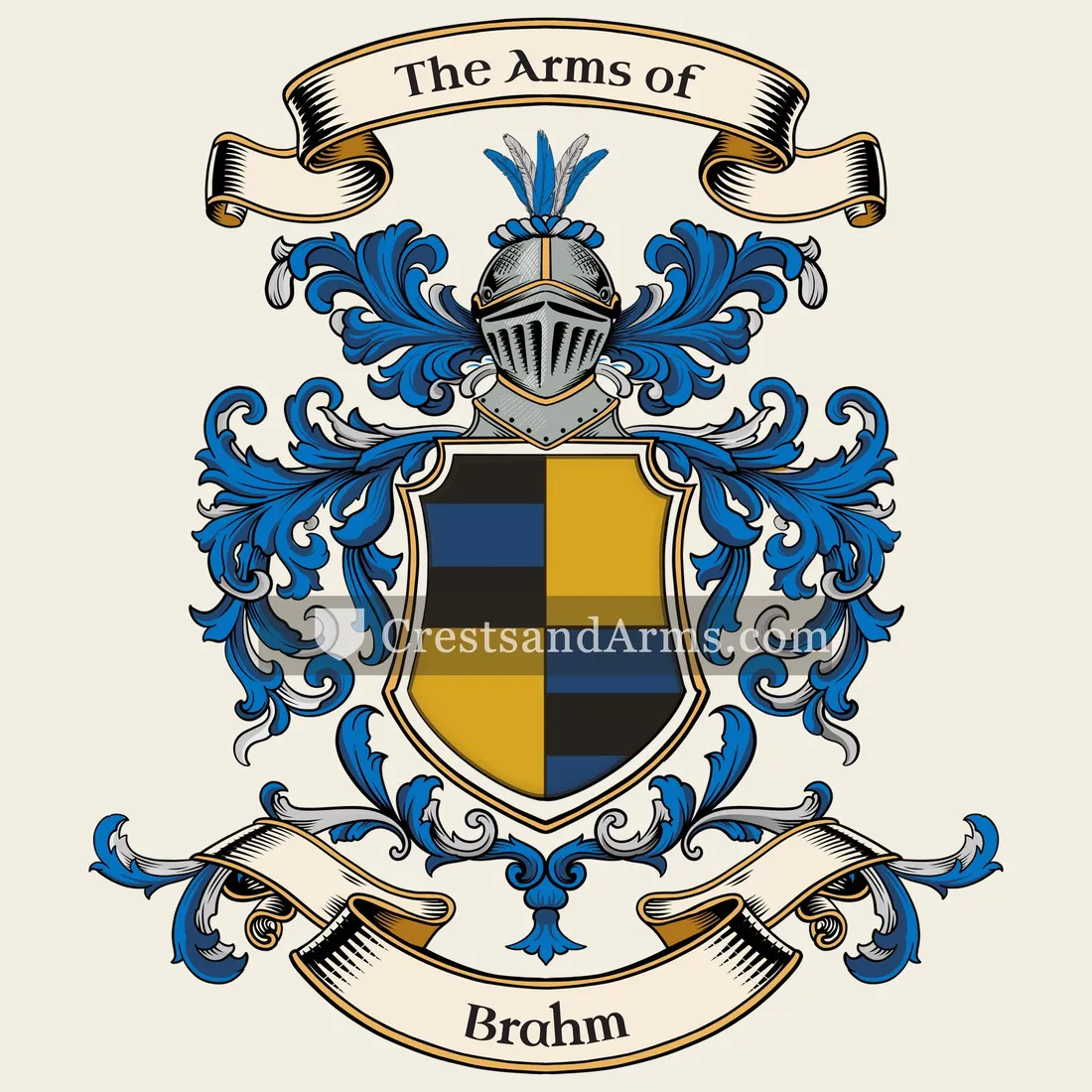
Symbols on this shield
fessThe military belt, and readiness to serve
Colours
Blue (Azure)Means: Loyalty and truth
Gold (Or)Means: Generosity
Black (Sable)Means: Constancy
Historical info
Source
J. B. Rietstap, Armorial Général, Gouda: G. B. van Goor Zonen, 1884–87
Blazon (the actual original written record)
“Ec.: aux 1 et 4 coupé-énté d'azur sur arg.; aux 2 et 3 fascé d'or et de sa., de six pièces.”
Francec. 1663
Digital archive packCoat of arms PNG, gold border print PDF, vector SVG and the certificate of authenticity. Sent to your email in minutes.
Map of France showing where the Brahm arms are recorded
The Brahm arms were recorded in France, c. 1663.
Arms such as these were typically recorded in Bretagne.
More families held coats of arms in Bretagne than anywhere else in France. The land was divided into many small estates rather than a few large ones, so far more households counted as gentry, and each needed a shield of its own to be told apart.
This is where the arms were entered in the register. Families often moved to other parts of the country, so the same name can turn up in more than one region.
The body that granted and recorded arms in France in this period.
Louis XIV of France
Sovereign of the period
Louis XIV of France
1643–1715
Reigning in Belgium when the Brahm arms are first recorded.
How Arms Worked in France
In France, a coat of arms was a mark of honor that passed down through the male line to all legitimate descendants. Families often used the same shield without changes to show their shared heritage. If a branch wanted to stand out, they could add a small mark to their shield to show their specific place in the family tree.
Granting authority
The Juge d'armes de France acted as the official authority that regulated and verified coats of arms across the country.
How they got arms
Families typically inherited their arms from ancestors, though they could also receive them through royal grants or by proving their noble status.
Where arms were recorded
Coats of arms were officially recorded in the Armorial Général de France, which began its main collection in the year 1696.
The family's standing
Recorded among the armigerous families of France.
Origin & History of the Brahm Family in France
The family name Brahm has roots that trace back to the coastal region of Bretagne in western France. By the year 1663, records confirm that members of the family were already established within this rugged and culturally distinct province. During the seventeenth century, Bretagne was a region defined by its strong maritime traditions and its unique linguistic heritage. Families living in this area often relied on the land or the sea for their livelihoods, and the Brahm name likely became integrated into the local social fabric through these traditional trades. As the family settled into the rural parishes of the region, they became part of the long history of Breton society, which was characterized by close-knit communities and a deep connection to the local landscape. Over time, the presence of the name in these early parish registers serves as a testament to the family's endurance and their role in the historical development of the French northwest.
Brahm Meaning & Related Branches
Root word
Abraham
Exalted father of a multitude
This name
BrahmA shortened patronymic form derived from the biblical name Abraham
also spelled
Braim
Brahm
Bram
Braime
Documented Sources
J. B. Rietstap, Armorial Général, Gouda: G. B. van Goor Zonen, 1884–87
State Archives in Belgium (Rijksarchief te België), Parochieregisters van de provincie Brabant
De Smet, A., Geschiedenis van Brabant, 1974
Verhulst, A., Précis d'histoire rurale de la Belgique, 1990
Digital archive packCoat of arms PNG, gold border print PDF, vector SVG and the certificate of authenticity. Sent to your email in minutes.


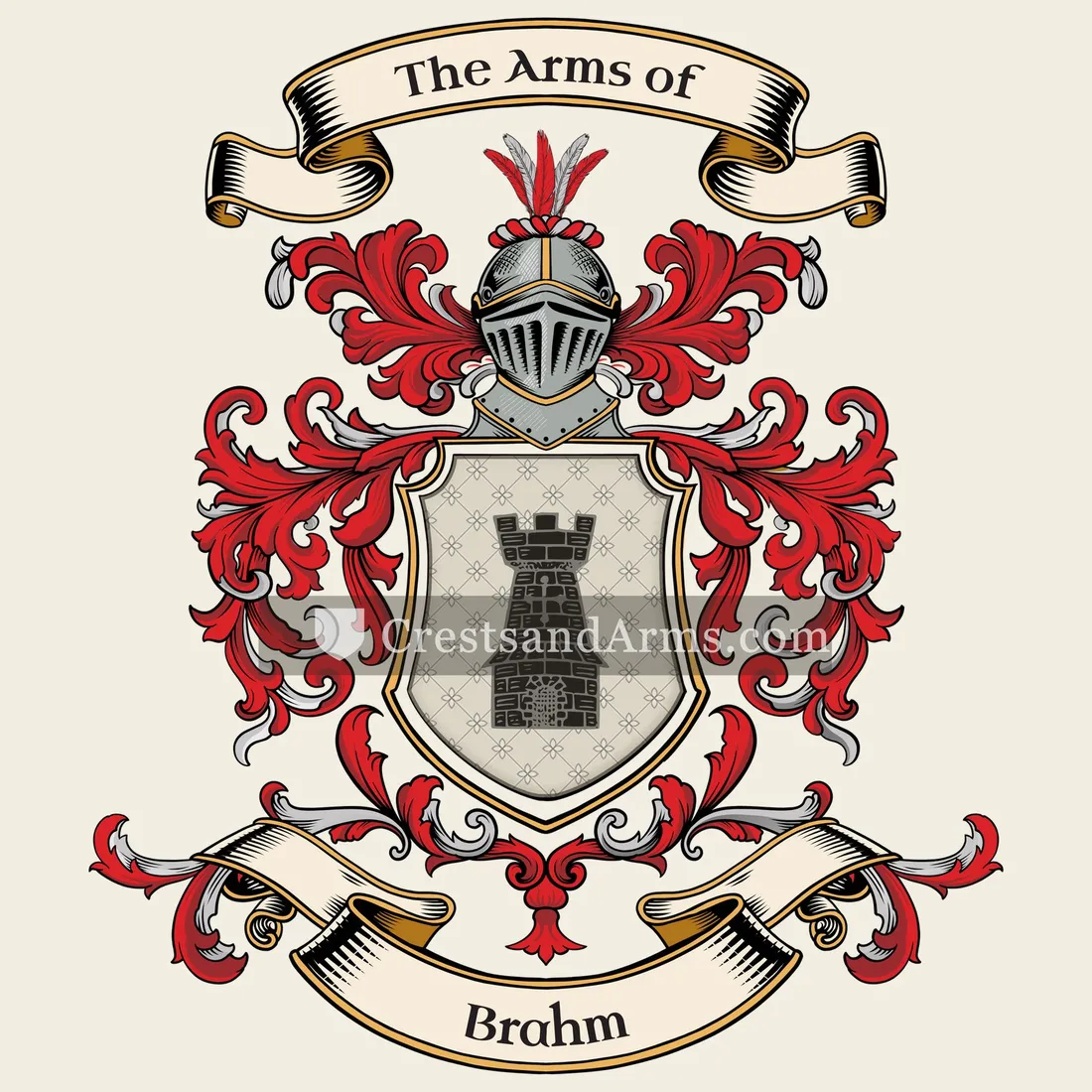
 towerGrandeur and solidity, and a stronghold defended
 towerGrandeur and solidity, and a stronghold defended


 mountThe ground held, and steadfastness upon it
 dolphinSwiftness, charity and love
 stagPeace and harmony, and one who will not fight unprovoked
 roseThe seventh son, and beauty with grace


 fessThe military belt, and readiness to serve