Map of Germany showing where the Brait arms are recorded
The Brait arms were recorded in Bavaria, c. 1615.
Bavaria was a country of old landed families and walled market towns. Estates passed down the same line for centuries, and both the landowners and the leading townsmen kept arms, which is why so many Bavarian names sit in the registers.
This is where the arms were entered in the register. Families often moved to other parts of the country, so the same name can turn up in more than one region.
The body that granted and recorded arms in Germany in this period.
Matthias, Holy Roman Emperor
Sovereign of the period
Matthias, Holy Roman Emperor
1612–1619
Reigning in Germany when the Brait arms are first recorded.
How Arms Worked in Germany
In the Holy Roman Empire, coats of arms were often granted to individuals by the Emperor or his representatives. These arms were then passed down through the generations to all legitimate descendants of the original holder. Younger branches of a family usually kept the same shield design without needing to change it, as the arms belonged to the entire lineage.
Granting authority
The Holy Roman Emperor held the sole power to grant new coats of arms throughout his vast imperial territories.
How they got arms
Families typically obtained their coats of arms through a formal imperial grant or by proving their noble status to the authorities.
Where arms were recorded
These grants were officially recorded in the Imperial Chancery registers, which began keeping formal records of such honors during the Middle Ages.
The family's standing
Recorded among the armigerous families of Bavaria.
Origin & History of the Brait Family in Germany
The surname Brait has deep roots in the historical region of Bavaria, where records confirm the family was established as early as 1615. During the seventeenth century, the name was likely linked to the Middle High German word "breit," which translates to "broad" or "wide." In medieval naming customs, such descriptive terms were frequently used as nicknames to identify individuals based on their physical stature or the specific layout of the land they farmed. Because Bavaria was a central hub for trade and agriculture during this period, families with this name were often integrated into local village life as landowners or skilled laborers. Over time, the spelling evolved to reflect the regional dialects of southern Germany, helping the name persist through centuries of social and political change within the Holy Roman Empire.
Brait Meaning & Related Branches
Root word
Breit
A German adjective meaning wide or broad.
This name
BraitA topographic name for someone who lived on a wide piece of land or a broad field.
also spelled
Brayt
Documented Sources
J. B. Rietstap, Armorial Général, Gouda: G. B. van Goor Zonen, 1884–87
Bahlow, Hans, Deutsches Namenlexikon: Familien- und Vornamen nach Ursprung und Sinn erklärt, 1967
Heintze, Albert, Die deutschen Familien-Namen: geschichtlich, geographisch, sprachlich, 1903


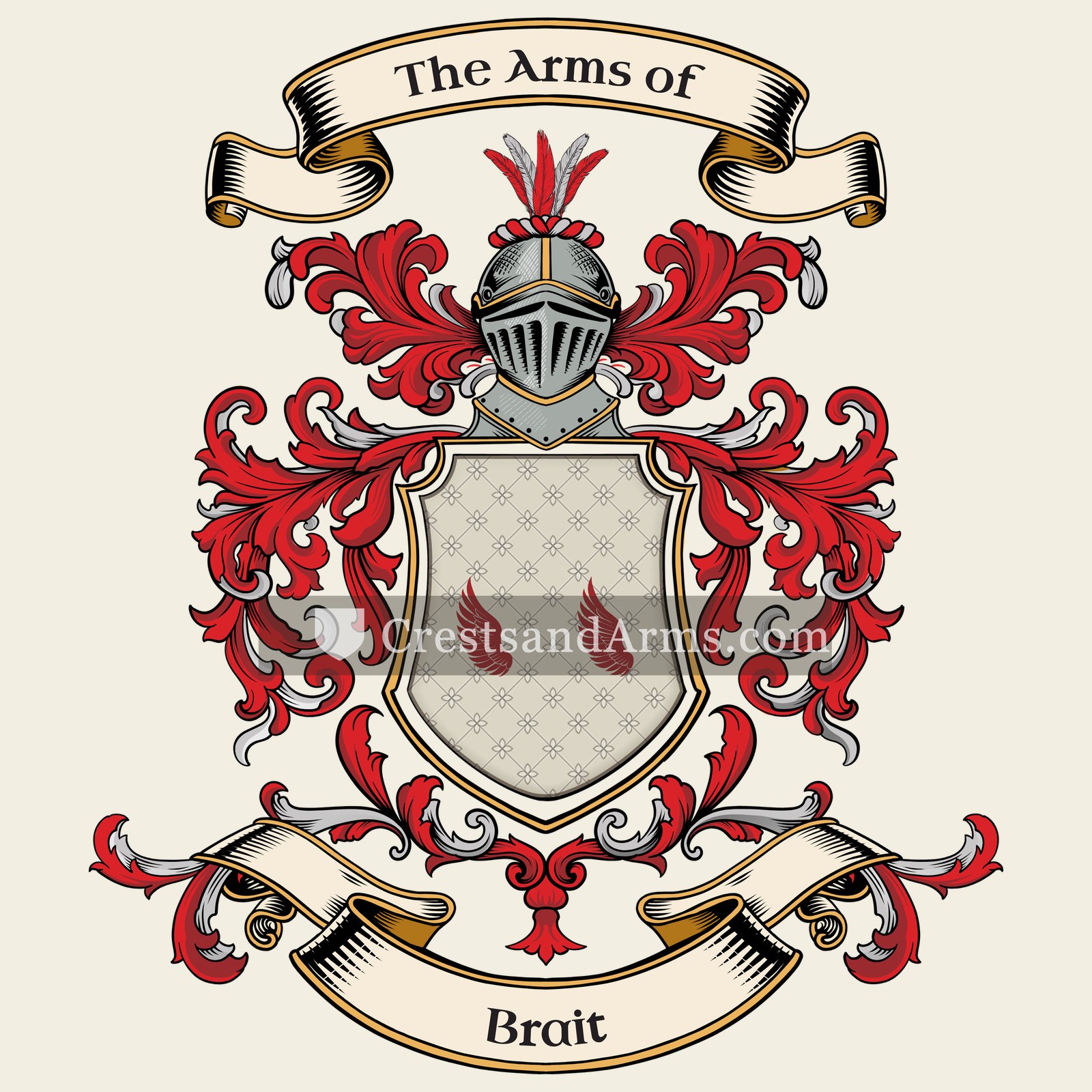
 wingSwiftness, and protection under a raised wing
 wingSwiftness, and protection under a raised wing