A record of documented arms, meaning and origin, researched for the Brambila family lines. Documented in 2 countries.
Reg. 4430 · Italian, A–C
Coat of Arms & Family Crest Details
Symbols on this shield
shipEnterprise, and a great voyage undertaken
eagleNobility, strength and a keen mind
lionCourage, strength and royalty
Colours
Gold (Or)Means: Generosity
Red (Gules)Means: Military strength
Black (Sable)Means: Constancy
Historical info
Source
J. B. Rietstap, Armorial Général, Gouda: G. B. van Goor Zonen, 1884–87
Blazon (the actual original written record)
“Coupé: au 1 parti: a. d'or à l'aigle de sa., cour. du champ; b. d'arg. à une tête et col de lion de gu.; au 2 de gu. à un chariot d'or. C.: une tête d'aigle d'or, cour. du même. D.: SPERO.”
ItalyMilan, c. 1775
Digital archive packCoat of arms PNG, gold border print PDF, vector SVG and the certificate of authenticity. Sent to your email in minutes.
Map of Italy showing where the Brambila arms are recorded
The Brambila arms were recorded in Milan, c. 1775.
This is where the arms were entered in the register. Families often moved to other parts of the country, so the same name can turn up in more than one region.
The body that granted and recorded arms in Italy in this period.
Alvise Giovanni Mocenigo
Sovereign of the period
Alvise Giovanni Mocenigo
1763–1778
Reigning in Italy when the Brambila arms are first recorded.
How Arms Worked in Italy
In the Italian states, coats of arms were often used by noble families to show their status and history. These symbols were passed down through the generations to all legitimate male descendants. Younger branches of a family usually kept the original design but sometimes added small changes to distinguish their specific line from the main branch.
Granting authority
Various local rulers and city governments controlled the use of coats of arms across the different Italian states.
How they got arms
Families often assumed their own arms or received them as official grants from local lords, popes, or city councils.
Where arms were recorded
Arms were recorded in local city archives or private family books rather than in one single national register.
The family's standing
Recorded among the armigerous families of Italy.
Origin & History of the Brambila Family in Italy
The family name Brambila finds its historical roots in the Lombardy region of Northern Italy, with a significant presence established in the city of Milan by the late eighteenth century. The name is believed to be a variation of the local dialect term *brambilla*, which historically referred to a type of thorny shrub or bramble found in the Italian countryside. During the mid-1700s, families bearing this name were often integrated into the urban fabric of Milan, a city then thriving under the influence of the Habsburg monarchy. As the family settled into the local community, they became part of the social and economic life of the region, likely participating in the traditional trades and civic duties that defined life in a bustling European center of commerce. By 1775, the Brambila name was well-documented in local administrative records, marking the family as established residents who contributed to the growth and history of the Milanese territory during the Enlightenment era.
Coat of Arms & Family Crest Details
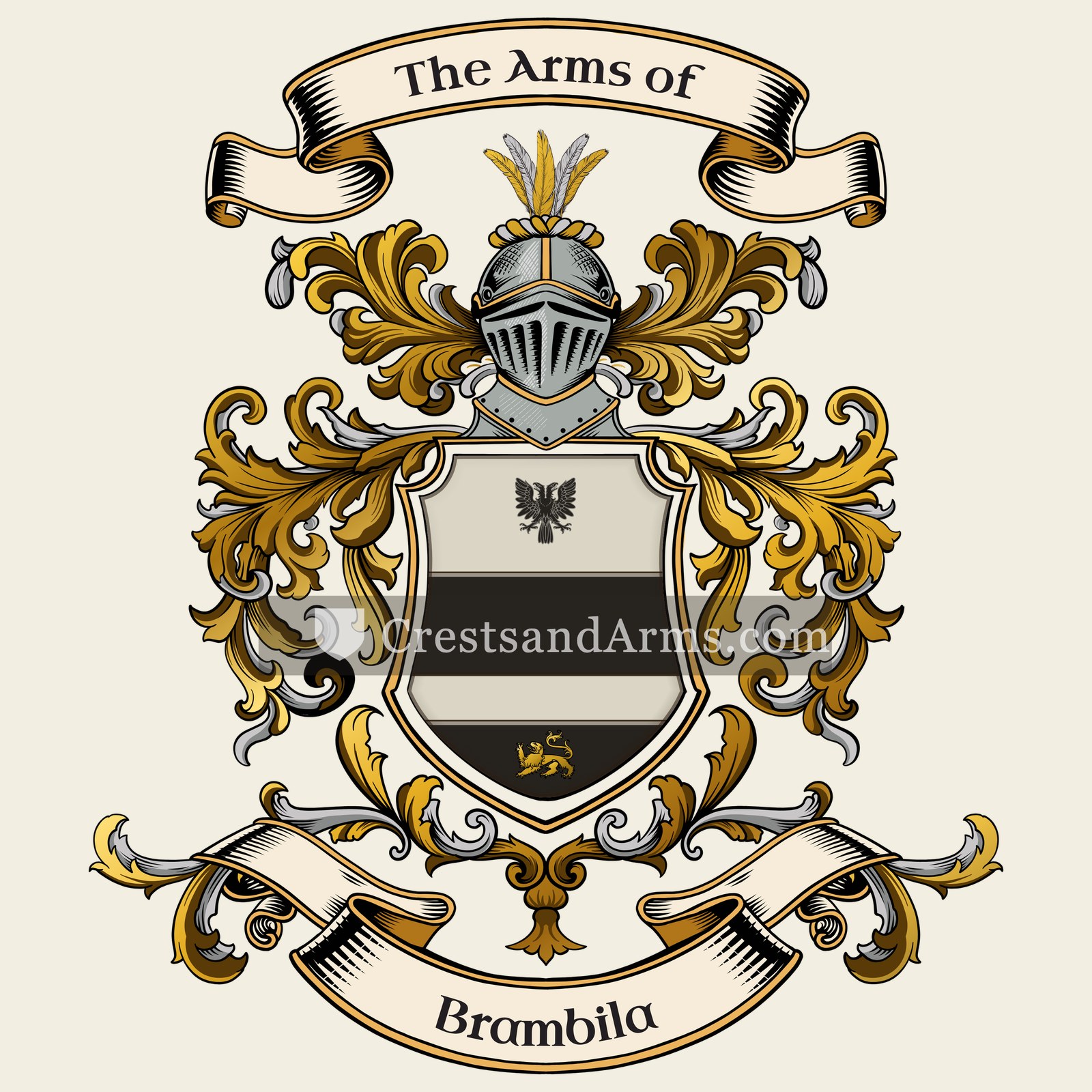
Symbols on this shield
fessThe military belt, and readiness to serve
eagleNobility, strength and a keen mind
lionCourage, strength and royalty
Colours
Silver (Argent)Means: Peace and sincerity
Black (Sable)Means: Constancy
Gold (Or)Means: Generosity
Historical info
Source
J. B. Rietstap, Armorial Général, Gouda: G. B. van Goor Zonen, 1884–87
Blazon (the actual original written record)
“D'arg. à une fasce de sa. et une champagne du même; en chef une aigle du sec., soutenue de la fasce; en p. un lion d'or, soutenu de la champagne, la tête br. sur la fasce. Deux cq. cour. C.: 1º l'aigle, la tête cont.; 2º le lion. L. d'arg. et de sa.”
BrabantBrabant, c. 1784
Digital archive packCoat of arms PNG, gold border print PDF, vector SVG and the certificate of authenticity. Sent to your email in minutes.
Map of Spain showing where the Brambila arms are recorded
The Brambila arms were recorded in Brabant, c. 1784.
Brabant lay at the heart of the Low Countries, where the trade routes met. Its towns were wealthy and its landowners many, and both kinds of family kept arms, which is why the region is so heavily represented.
This is where the arms were entered in the register. Families often moved to other parts of the country, so the same name can turn up in more than one region.
The body that granted and recorded arms in Spain in this period.
Charles III of Spain
Sovereign of the period
Charles III of Spain
1759–1788
Reigning in Italy when the Brambila arms are first recorded.
How Arms Worked in Spain
In Spain, a coat of arms was considered a form of property that belonged to the entire family line. These arms were passed down from a father to all his children equally. Younger branches of the family usually kept the original design without needing to add any special marks to distinguish their specific line.
Granting authority
The Cronista Rey de Armas was the official body that regulated and granted coats of arms throughout Spain.
How they got arms
Families often obtained their arms through royal grants or by proving their noble status to the official heraldic authority.
Where arms were recorded
Coats of arms were officially recorded in the registers of the Cronista Rey de Armas starting in 1496.
The family's standing
Recorded among the armigerous families of Brabant.
Origin & History of the Brambila Family in Spain
The Brambila family name carries a history that bridges the gap between Mediterranean roots and Northern European influence. While the name is often associated with Spanish regions, historical evidence places early members of the family in the Duchy of Brabant by 1784. This suggests that the family was part of a mobile class of individuals who moved across the European continent during the late eighteenth century. Many families with similar surnames were involved in trade, military service, or diplomatic missions that required them to travel between the Spanish territories and the Low Countries. By establishing a presence in Brabant, the Brambila family became part of the complex social landscape of the Holy Roman Empire, likely adapting to the local customs while maintaining their distinct cultural identity. This migration pattern highlights how families of that era often expanded their reach far beyond their original geographic starting points to pursue new opportunities in commerce and administration.
Related Branches & Arms
Root word
Bramare
To yearn for, desire, or crave intensely.
This name
BrambilaA nickname for an ambitious or longing person, derived from the verb to desire.
also spelled
Brambila
Documented Sources
J. B. Rietstap, Armorial Général, Gouda: G. B. van Goor Zonen, 1884–87
Casanova, Cesare. Milano e i suoi dintorni. 1889
Fumagalli, Giuseppe. Dizionario dei cognomi e delle denominazioni comunali di Lombardia. 1912
Archivio di Stato di Milano, Stato Civile della Restaurazione
Digital archive packCoat of arms PNG, gold border print PDF, vector SVG and the certificate of authenticity. Sent to your email in minutes.


 shipEnterprise, and a great voyage undertaken
 eagleNobility, strength and a keen mind
 lionCourage, strength and royalty
 shipEnterprise, and a great voyage undertaken
 eagleNobility, strength and a keen mind
 lionCourage, strength and royalty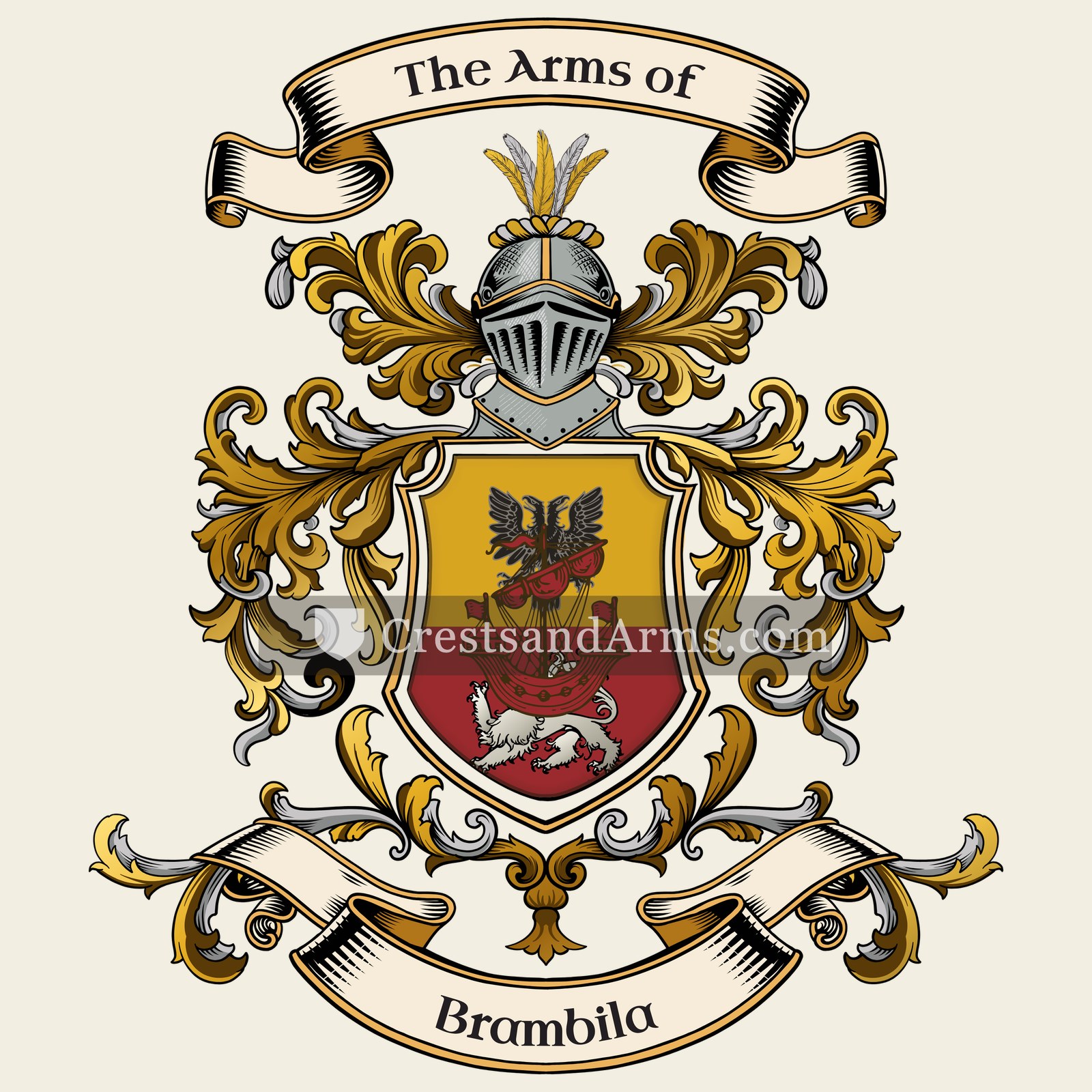


 fessThe military belt, and readiness to serve