A record of documented arms, meaning and origin, researched for the Brambilla family lines. Documented in 2 countries.
Reg. 5094 · Italian, A–C
Coat of Arms & Family Crest Details
Symbols on this shield
shipEnterprise, and a great voyage undertaken
eagleNobility, strength and a keen mind
lionCourage, strength and royalty
Colours
Gold (Or)Means: Generosity
Red (Gules)Means: Military strength
Black (Sable)Means: Constancy
Historical info
Source
J. B. Rietstap, Armorial Général, Gouda: G. B. van Goor Zonen, 1884–87
Blazon (the actual original written record)
“Coupé: au 1 parti: a. d'or à l'aigle de sa., cour. du champ; b. d'arg. à une tête et col de lion de gu.; au 2 de gu. à un chariot d'or. C.: une tête d'aigle d'or, cour. du même. D.: SPERO.”
ItalyMilan, c. 1775
Digital archive packCoat of arms PNG, gold border print PDF, vector SVG and the certificate of authenticity. Sent to your email in minutes.
Map of Italy showing where the Brambilla arms are recorded
The Brambilla arms were recorded in Milan, c. 1775.
This is where the arms were entered in the register. Families often moved to other parts of the country, so the same name can turn up in more than one region.
The body that granted and recorded arms in Italy in this period.
Alvise Giovanni Mocenigo
Sovereign of the period
Alvise Giovanni Mocenigo
1763–1778
Reigning in Italy when the Brambilla arms are first recorded.
How Arms Worked in Italy
In the Italian states, coats of arms were often used by noble families to show their status and history. These symbols were passed down through the generations to all legitimate male descendants. Younger branches of a family usually kept the original design but sometimes added small changes to distinguish their specific line from the main branch.
Granting authority
Various local rulers and city governments controlled the use of coats of arms across the different Italian states.
How they got arms
Families often assumed their own arms or received them as official grants from local lords, popes, or city councils.
Where arms were recorded
Arms were recorded in local city archives or private family books rather than in one single national register.
The family's standing
Recorded among the armigerous families of Italy.
Origin & History of the Brambilla Family in Italy
The Brambilla family name is deeply rooted in the Lombardy region of northern Italy, particularly within the city of Milan. The name itself is derived from the local dialect word "brambilla," which historically referred to a thicket or a patch of thorny brambles. This suggests that the earliest ancestors likely lived near a specific landmark or a piece of land defined by dense vegetation. By the late 18th century, the family was well-established in Milanese society, as evidenced by records from 1775. During this period, the family was integrated into the urban fabric of Milan, often participating in the local trades and civic life that defined the city during the Enlightenment. As the family grew, they became a recognized part of the regional identity, reflecting the agricultural and linguistic heritage of the Italian countryside that eventually merged into the bustling life of the city.
Coat of Arms & Family Crest Details
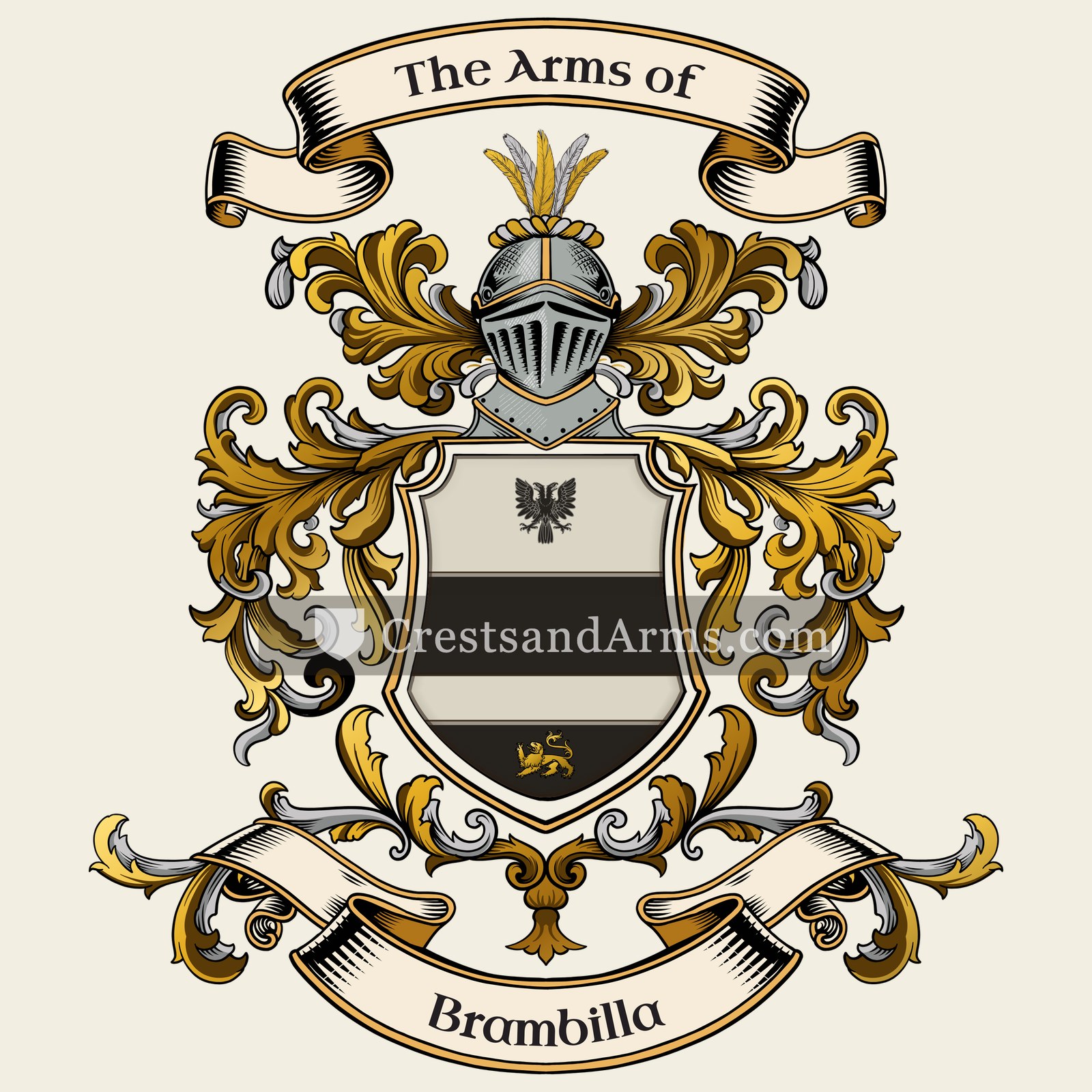
Symbols on this shield
fessThe military belt, and readiness to serve
eagleNobility, strength and a keen mind
lionCourage, strength and royalty
Colours
Silver (Argent)Means: Peace and sincerity
Black (Sable)Means: Constancy
Gold (Or)Means: Generosity
Historical info
Source
J. B. Rietstap, Armorial Général, Gouda: G. B. van Goor Zonen, 1884–87
Blazon (the actual original written record)
“D'arg. à une fasce de sa. et une champagne du même; en chef une aigle du sec., soutenue de la fasce; en p. un lion d'or, soutenu de la champagne, la tête br. sur la fasce. Deux cq. cour. C.: 1º l'aigle, la tête cont.; 2º le lion. L. d'arg. et de sa.”
BrabantBrabant, c. 1784
Digital archive packCoat of arms PNG, gold border print PDF, vector SVG and the certificate of authenticity. Sent to your email in minutes.
Map of Spain showing where the Brambilla arms are recorded
The Brambilla arms were recorded in Brabant, c. 1784.
Brabant lay at the heart of the Low Countries, where the trade routes met. Its towns were wealthy and its landowners many, and both kinds of family kept arms, which is why the region is so heavily represented.
This is where the arms were entered in the register. Families often moved to other parts of the country, so the same name can turn up in more than one region.
The body that granted and recorded arms in Spain in this period.
Charles III of Spain
Sovereign of the period
Charles III of Spain
1759–1788
Reigning in Italy when the Brambilla arms are first recorded.
How Arms Worked in Spain
In Spain, a coat of arms was considered a form of property that belonged to the entire family line. These arms were passed down from a father to all his children equally. Younger branches of the family usually kept the original design without needing to add any special marks to distinguish their specific line.
Granting authority
The Cronista Rey de Armas was the official body that regulated and granted coats of arms throughout Spain.
How they got arms
Families often obtained their arms through royal grants or by proving their noble status to the official heraldic authority.
Where arms were recorded
Coats of arms were officially recorded in the registers of the Cronista Rey de Armas starting in 1496.
The family's standing
Recorded among the armigerous families of Brabant.
Origin & History of the Brambilla Family in Spain
The history of the Brambilla family is deeply connected to the movement of people across Europe during the late eighteenth century. While the name is often associated with Italian roots, historical records confirm that members of the family were firmly established in the region of Brabant by 1784. During this period, the shifting political borders and trade routes of the Spanish Netherlands encouraged families to relocate for economic and professional opportunities. As the Spanish Crown maintained administrative influence over these territories, families like the Brambillas often integrated into the local bureaucracy and merchant classes. Their presence in Brabant suggests a history defined by migration and adaptation, as they navigated the complex social structures of a region caught between local traditions and the broader reach of the Spanish Empire.
Brambilla Meaning & Related Branches
Root word
Bramare
To yearn for, desire, or crave intensely.
This name
BrambillaA topographical or occupational surname referring to someone who lived near or worked with brambles or thorny thickets.
also spelled
Brambila
Related arms
Cortivisimilar arms
Panzinisimilar arms
Documented Sources
J. B. Rietstap, Armorial Général, Gouda: G. B. van Goor Zonen, 1884–87
Dante Olivieri, Dizionario dei cognomi italiani, 2001
Emidio De Felice, Dizionario dei cognomi italiani, 1978
Archivio di Stato di Milano, Stato civile della Restaurazione, 1815–1865
Digital archive packCoat of arms PNG, gold border print PDF, vector SVG and the certificate of authenticity. Sent to your email in minutes.


 shipEnterprise, and a great voyage undertaken
 eagleNobility, strength and a keen mind
 lionCourage, strength and royalty
 shipEnterprise, and a great voyage undertaken
 eagleNobility, strength and a keen mind
 lionCourage, strength and royalty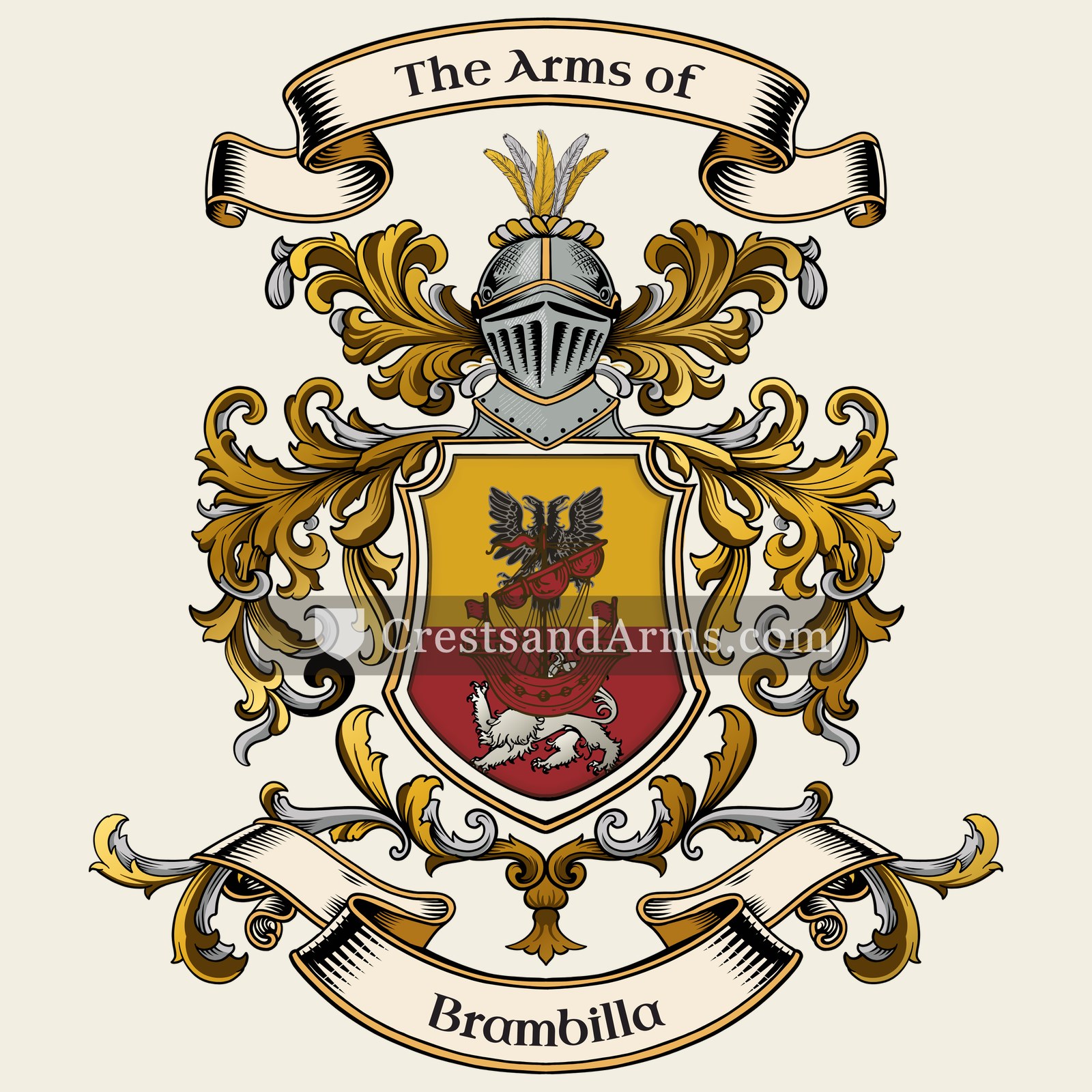


 fessThe military belt, and readiness to serve