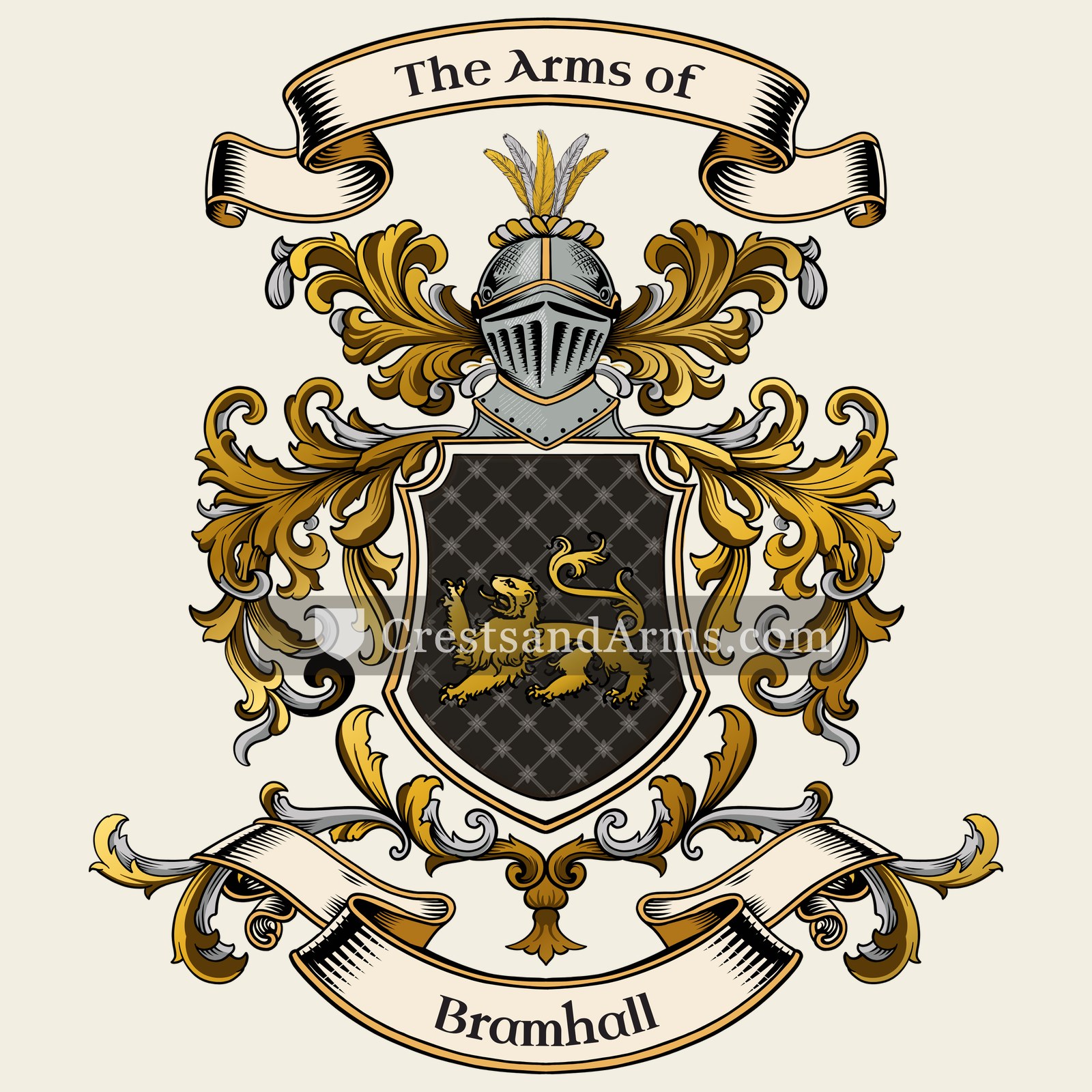
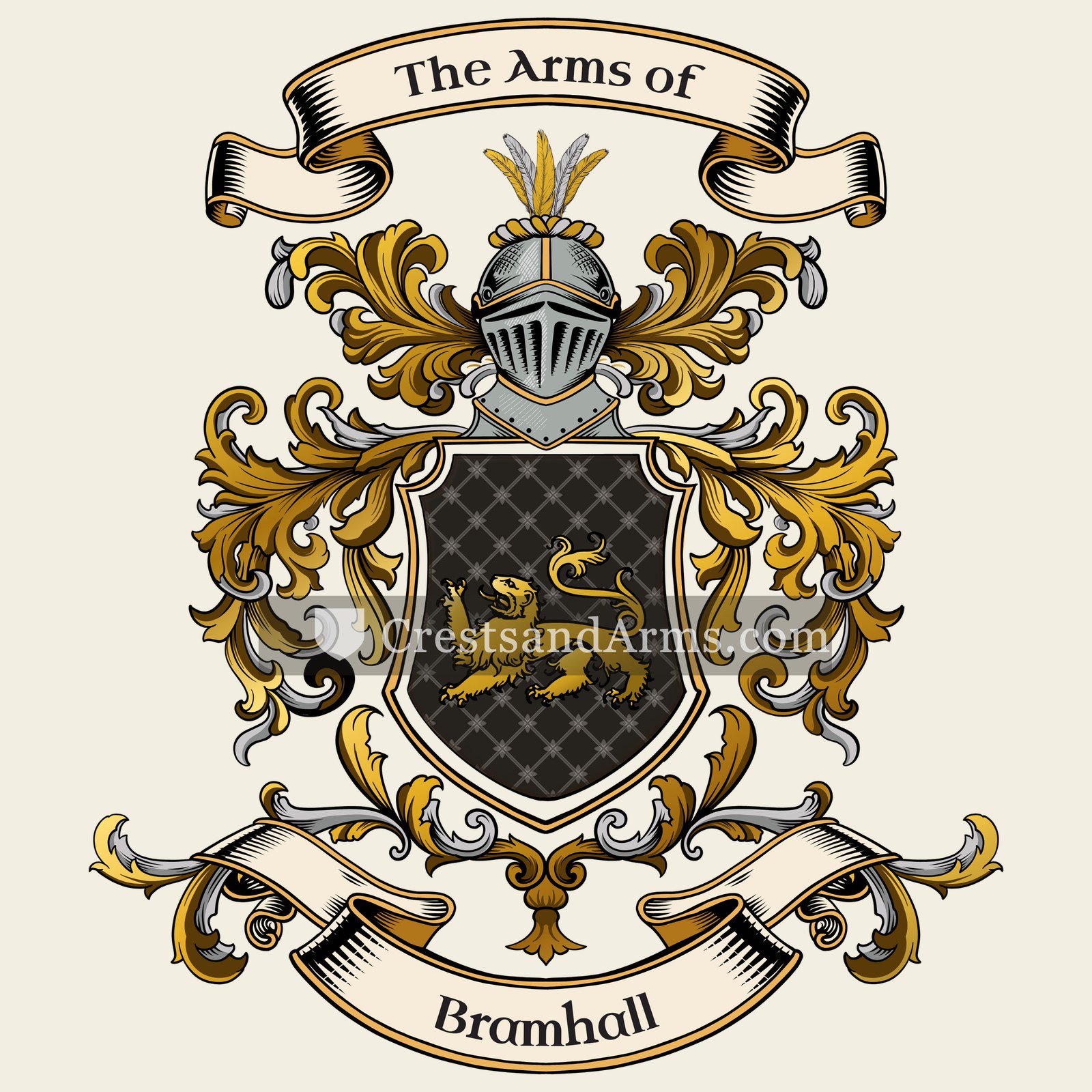
Map of Britain showing where the Bramhall arms are recorded
The Bramhall arms were recorded in Britain, c. 1662.
Arms such as these were typically recorded in Kent.
Kent sits between London and the short crossing to Europe, and the trade passing through made it wealthy. Merchant families bought land with that money, and it was landowners who took coats of arms.
This is where the arms were entered in the register. Families often moved to other parts of the country, so the same name can turn up in more than one region.
The body that granted and recorded arms in Britain in this period.
Charles II of England
Sovereign of the period
Charles II of England
1660–1685
Reigning in Britain when the Bramhall arms are first recorded.
How Arms Worked in Britain
English heraldry allowed arms to be shared by all legitimate descendants of the original owner. These symbols were treated as personal property that moved through the generations to all children. While the eldest son kept the original design, other family members could use the same shield without needing to change it or register their own unique versions.
Granting authority
The College of Arms in London has regulated the use of coats of arms throughout England and Wales since 1484.
How they got arms
Families typically obtained their coats of arms through a formal grant from the Crown or by proving their ancient right to them.
Where arms were recorded
All official coats of arms are recorded in the registers kept at the College of Arms, which date back to the fifteenth century.
The family's standing
Recorded among the armigerous families of Britain.
Origin & History of the Bramhall Family in Britain
The name Bramhall originates from the Old English words for broom, a type of shrub, and haugh, which refers to a nook or a piece of flat land near a river. This indicates that the family likely took their name from a specific geographic location where they lived or worked during the medieval period. While the name is famously tied to a manor in Cheshire, members of the family eventually spread across the country as they sought new opportunities. By 1662, records confirm that the family had established a presence in Kent. During this era, families often moved to follow trade routes or agricultural work, and the Bramhalls were part of this wider movement of people across the English landscape. Their history reflects the common experience of families who built their lives in local communities and left behind traces in parish registers and legal documents that allow us to track their path through the centuries.
Coat of Arms & Family Crest Details
Symbols on this shield
lionCourage, strength and royalty
Colours
Black (Sable)Means: Constancy
Gold (Or)Means: Generosity
Historical info
Source
Sir Bernard Burke, The General Armory of England, Scotland, Ireland and Wales, London: Harrison & Sons, 1884
Blazon (the actual original written record)
“Sa. a lion ramp. or”
YorkPontefract · York, c. 1602
Digital archive packCoat of arms PNG, gold border print PDF, vector SVG and the certificate of authenticity. Sent to your email in minutes.
Map of England showing where the Bramhall arms are recorded
The Bramhall arms were recorded in York, c. 1602.
Yorkshire is the largest of the English counties, and it held more gentry families than any other. Land there was split among a great many households rather than a few, so a great many of them carried arms.
This is where the arms were entered in the register. Families often moved to other parts of the country, so the same name can turn up in more than one region.
The body that granted and recorded arms in England in this period.
Elizabeth I of England
Sovereign of the period
Elizabeth I of England
1558–1603
Reigning in Britain when the Bramhall arms are first recorded.
How Arms Worked in England
English heraldry allowed arms to be shared by all legitimate descendants of the original owner. These symbols were treated as personal property that moved through the generations to all children. While the eldest son kept the original design, other family members could use the same shield without needing to change it or register their own unique versions.
Granting authority
The College of Arms in London has regulated the use of coats of arms throughout England and Wales since 1484.
How they got arms
Families typically obtained their coats of arms through a formal grant from the Crown or by proving their ancient right to them.
Where arms were recorded
All official coats of arms are recorded in the registers kept at the College of Arms, which date back to the fifteenth century.
The family's standing
Recorded among the armigerous families of York.
Origin & History of the Bramhall Family in England
The surname Bramhall is a locative name, meaning it originated from a specific place in England rather than from a trade or a personal characteristic. The name is derived from the township of Bramhall in Cheshire, which was historically recorded in the Domesday Book as "Bramale." This place name comes from the Old English words for broom, a type of shrub, and nook or corner. While the family name is deeply rooted in the geography of Cheshire, records confirm that members of the Bramhall family had established themselves in the city of York by 1602. During this period, families often moved from rural areas to growing urban centers for trade or administrative opportunities. As the family settled in York, they became part of the social and economic fabric of the city, transitioning from their origins in the Cheshire countryside to becoming documented citizens of one of England’s most historic northern hubs.
Bramhall Meaning & Related Branches
Root word
Brom-halh
Broom plant and a nook or hollow of land.
This name
BramhallA topographical name referring to someone who lived in a hollow where broom shrubs grew.
also spelled
Bramhal
Bramall
Brammell
Related arms
Dobsonrecorded with Bramhall, same area
Hepworthrecorded with Bramhall, same area
Tetleyrecorded with Bramhall, same area
Thylyrecorded with Bramhall, same area
Documented Sources
J. B. Rietstap, Armorial Général, Gouda: G. B. van Goor Zonen, 1884–87
Bardsley, Charles Wareing, A Dictionary of English and Welsh Surnames, 1901
Ekwall, Eilert, The Concise Oxford Dictionary of English Place-names, 1960
The National Archives, Prerogative Court of Canterbury and related Probate Jurisdictions: Will Registers, 1662
Kent History and Library Centre, Parish Registers of Kent, 1662
Digital archive packCoat of arms PNG, gold border print PDF, vector SVG and the certificate of authenticity. Sent to your email in minutes.


 lionCourage, strength and royalty
 lionCourage, strength and royalty