Map of Germany showing where the Brammer arms are recorded
The Brammer arms were recorded in Germany, c. 1765.
Arms such as these were typically recorded in Bavaria.
Bavaria was a country of old landed families and walled market towns. Estates passed down the same line for centuries, and both the landowners and the leading townsmen kept arms, which is why so many Bavarian names sit in the registers.
This is where the arms were entered in the register. Families often moved to other parts of the country, so the same name can turn up in more than one region.
The body that granted and recorded arms in Germany in this period.
Francis I, Holy Roman Emperor
Sovereign of the period
Francis I, Holy Roman Emperor
1745–1765
Reigning in Germany when the Brammer arms are first recorded.
How Arms Worked in Germany
In the Holy Roman Empire, coats of arms were often granted to individuals by the Emperor or his representatives. These arms were then passed down through the generations to all legitimate descendants of the original holder. Younger branches of a family usually kept the same shield design without needing to change it, as the arms belonged to the entire lineage.
Granting authority
The Holy Roman Emperor held the sole power to grant new coats of arms throughout his vast imperial territories.
How they got arms
Families typically obtained their coats of arms through a formal imperial grant or by proving their noble status to the authorities.
Where arms were recorded
These grants were officially recorded in the Imperial Chancery registers, which began keeping formal records of such honors during the Middle Ages.
The family's standing
Recorded among the armigerous families of Germany.
Origin & History of the Brammer Family in Germany
The name Brammer is deeply rooted in the historical landscape of Germany, where it evolved as a descriptive surname linked to the geography of the region. In the German language, the name is closely associated with the word "Bram," which refers to broom or gorse, a hardy shrub that grows in wild, open fields. This suggests that the earliest ancestors to carry the name likely lived near these distinctive patches of vegetation or worked on land characterized by such growth. By the mid-18th century, records confirm that families bearing this name were well-established in the southern state of Bavaria. Life in 1765 Bavaria was largely defined by agricultural traditions and local village communities, where a family name served as a vital link to one’s ancestral home and local identity. As these families moved through the German states, the name remained a testament to their connection to the rural landscape and the specific environments where they first settled.
Coat of Arms & Family Crest Details
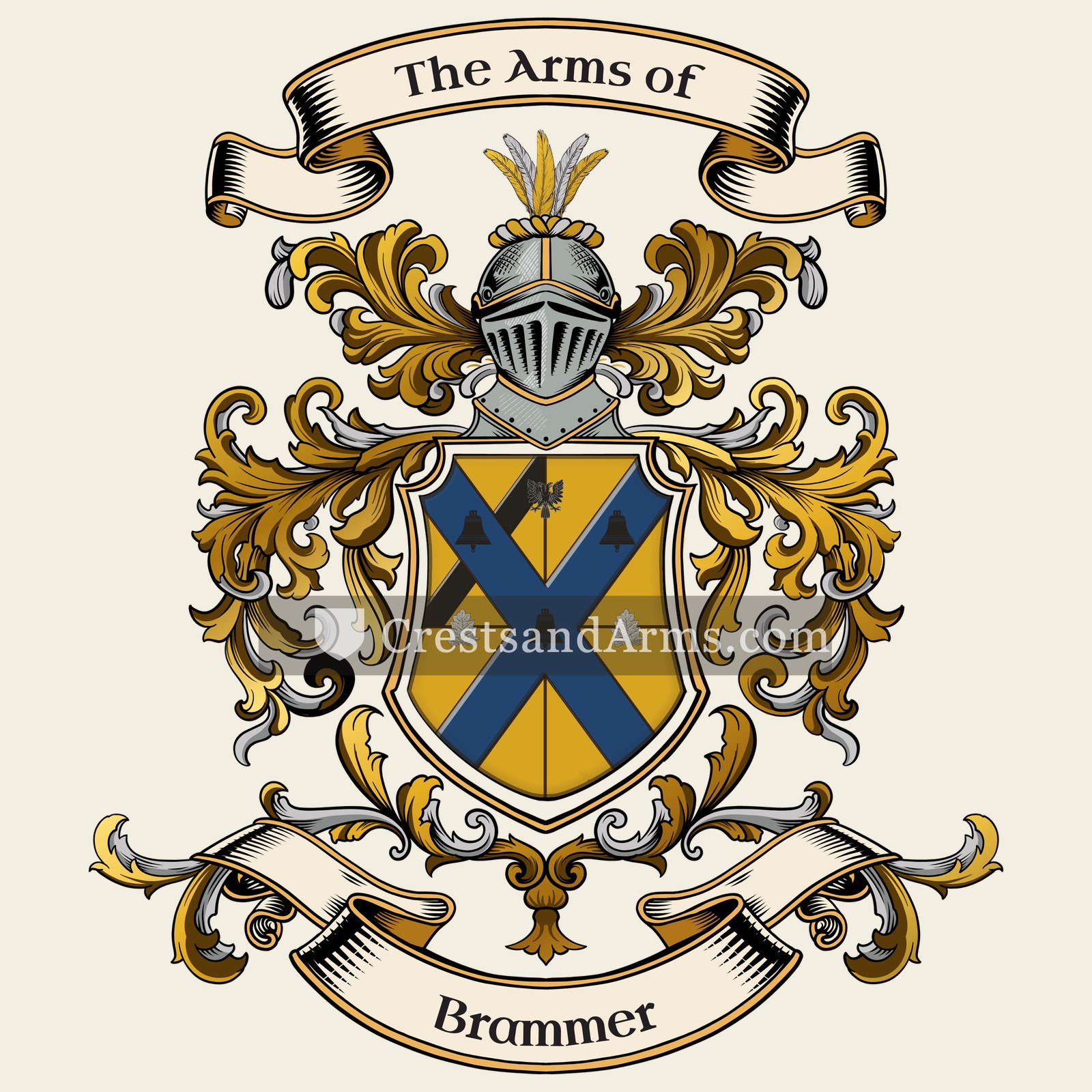
Symbols on this shield
bellA call to prayer, and a warning given
Colours
Gold (Or)Means: Generosity
Silver (Argent)Means: Peace and sincerity
Historical info
Source
J. B. Rietstap, Armorial Général, Gouda: G. B. van Goor Zonen, 1884–87
Blazon (the actual original written record)
“D'or à trois cloches d'arg. C.: une cloche d'arg., entre un vol du même.”
Finlandc. 1719
Digital archive packCoat of arms PNG, gold border print PDF, vector SVG and the certificate of authenticity. Sent to your email in minutes.
Map of Finland showing where the Brammer arms are recorded
The Brammer arms were recorded in Finland, c. 1719.
Arms such as these were typically recorded in Uusimaa.
Uusimaa was the Finnish coast facing Sweden, and the part of the country most closely tied to Stockholm. Its landowners and officers served the Swedish crown, and that service is what put their arms on record.
This is where the arms were entered in the register. Families often moved to other parts of the country, so the same name can turn up in more than one region.
The body that granted and recorded arms in Finland in this period.
How Arms Worked in Finland
Nobility in Finland held the exclusive right to register their coats of arms with the House of Nobility. These symbols were tied to the family name and were inherited by all members of the noble house. If a family branch moved or changed status, they kept their original design to maintain their identity within the official records.
Granting authority
The Finnish House of Nobility served as the official body that managed and protected all noble coats of arms.
How they got arms
Families received their arms through formal letters of nobility or by having their existing ancestral symbols confirmed by the House.
Where arms were recorded
All approved coats of arms were officially recorded in the Finnish House of Nobility Armorial starting in 1818.
The family's standing
Recorded among the armigerous families of Finland.
Origin & History of the Brammer Family in Finland
The Brammer family name in Finland has deep roots that trace back to the early eighteenth century, specifically within the Uusimaa region. Historical records confirm that members of the family were established in this coastal area by 1719, a time when Finland was still under Swedish rule. The name itself likely arrived in the region through trade connections or military service, as Uusimaa served as a vital hub for movement between the Finnish interior and the Baltic Sea. During this period, families often settled in rural parishes or growing port towns where they integrated into the local agricultural and administrative systems. By maintaining a presence in Uusimaa, the early Brammers became part of the social fabric of southern Finland, living through the significant political shifts that defined the eighteenth century. Their survival and growth in this region reflect the broader patterns of migration and settlement that shaped the Finnish population during the early modern era.
Coat of Arms & Family Crest Details
Symbols on this shield
saltireResolution, and St Andrew's cross
eagleNobility, strength and a keen mind
leafHappiness and abundance
bellA call to prayer, and a warning given
Colours
Gold (Or)Means: Generosity
Blue (Azure)Means: Loyalty and truth
Black (Sable)Means: Constancy
Silver (Argent)Means: Peace and sincerity
Historical info
Source
J. B. Rietstap, Armorial Général, Gouda: G. B. van Goor Zonen, 1884–87
Blazon (the actual original written record)
“Ec.: au 1 d'or à la demi-aigle de sa., bq., m. et cour. d'or, mouv. du parti; au 2 d'arg. au saut. alésé d'azur, ch. d'une représentation de N. S. de carn.; au 3 de gu. à un clou de la passion d'arg., accosté de deux feuilles d'ortie du même. Sur le tout d'or à trois cloches de sa., bataillées d'arg. Trois cq. cour. C.: 1° et 3° une tête et col d'aigle de sa., sommée d'une couronne princière, la tête du 1 cont.; 2° une cloche de l'écu, entre un vol de sa. L.: à dextre d'or et de sa., à sen. d'arg. et d'azur.”
LivoniaLivonia, c. 1744
Digital archive packCoat of arms PNG, gold border print PDF, vector SVG and the certificate of authenticity. Sent to your email in minutes.
Map of Poland showing where the Brammer arms are recorded
The Brammer arms were recorded in Livonia, c. 1744.
Livonia was Baltic country held by a small number of landed families who kept their estates for centuries. Land there passed down whole rather than being divided, and long unbroken tenure is what fills a register.
This is where the arms were entered in the register. Families often moved to other parts of the country, so the same name can turn up in more than one region.
Region
Livonia
First recorded
1744
Granting Authority for the Brammer Arms
Ennoblement by the Sejm
Author: Olek Remesz · CC BY-SA 3.0
The body that granted and recorded arms in Poland in this period.
Augustus III of Poland
Sovereign of the period
Augustus III of Poland
1733–1763
Reigning in Germany when the Brammer arms are first recorded.
How Arms Worked in Poland
Polish noble families shared a single coat of arms across many different surnames, creating large clans rather than individual designs. These symbols were held collectively by all members of the clan regardless of their specific family name. When a new family joined the nobility, they were adopted into an existing clan and began using that group's established shield.
Granting authority
The Sejm, which was the Polish parliament, held the power to grant noble status and the right to bear arms.
How they got arms
Families typically received their coat of arms through a formal act of ennoblement granted by the Sejm for distinguished service.
Where arms were recorded
These grants were officially recorded in the Crown Metrica, which served as the central archive for state documents starting in the sixteenth century.
The family's standing
Recorded among the armigerous families of Livonia.
Origin & History of the Brammer Family in Poland
The history of the Brammer family in the Baltic region is deeply tied to the shifting borders and cultural exchanges of the eighteenth century. While the name has roots that stretch across Northern Europe, records confirm that family members were established in Livonia by 1744. At that time, Livonia was a territory under the influence of the Russian Empire, though it maintained strong historical connections to German and Polish administrative traditions. Because the region served as a crossroads for trade and military movement, the Brammer family likely functioned as part of the local professional or landholding class that navigated the complex social hierarchies of the era. As they moved through these territories, the family name became associated with the administrative and agricultural development of the Baltic lands. This presence in 1744 places the family at a pivotal moment in history when the region was transitioning between different imperial powers, which often required families to adapt their livelihoods and legal status to survive in a changing political landscape.
Related Branches & Arms
Root word
Bram
A thorny shrub or bramble bush.
This name
BrammerAn occupational or topographical name for someone who lived near a thicket of brambles.
also spelled
Brumer
Documented Sources
J. B. Rietstap, Armorial Général, Gouda: G. B. van Goor Zonen, 1884–87
Bahlow, Hans, Deutsches Namenlexikon: Familien- und Vornamen nach Ursprung und Sinn erklärt, 1967
Heintze, Albert, Die deutschen Familiennamen: geschichtlich, geographisch, sprachlich, 1903
Bayerisches Hauptstaatsarchiv, Kurbayern Hofkammer: Steuer- und Katasterwesen, 1765
Digital archive packCoat of arms PNG, gold border print PDF, vector SVG and the certificate of authenticity. Sent to your email in minutes.


 mountThe ground held, and steadfastness upon it
 leafHappiness and abundance
 mountThe ground held, and steadfastness upon it
 leafHappiness and abundance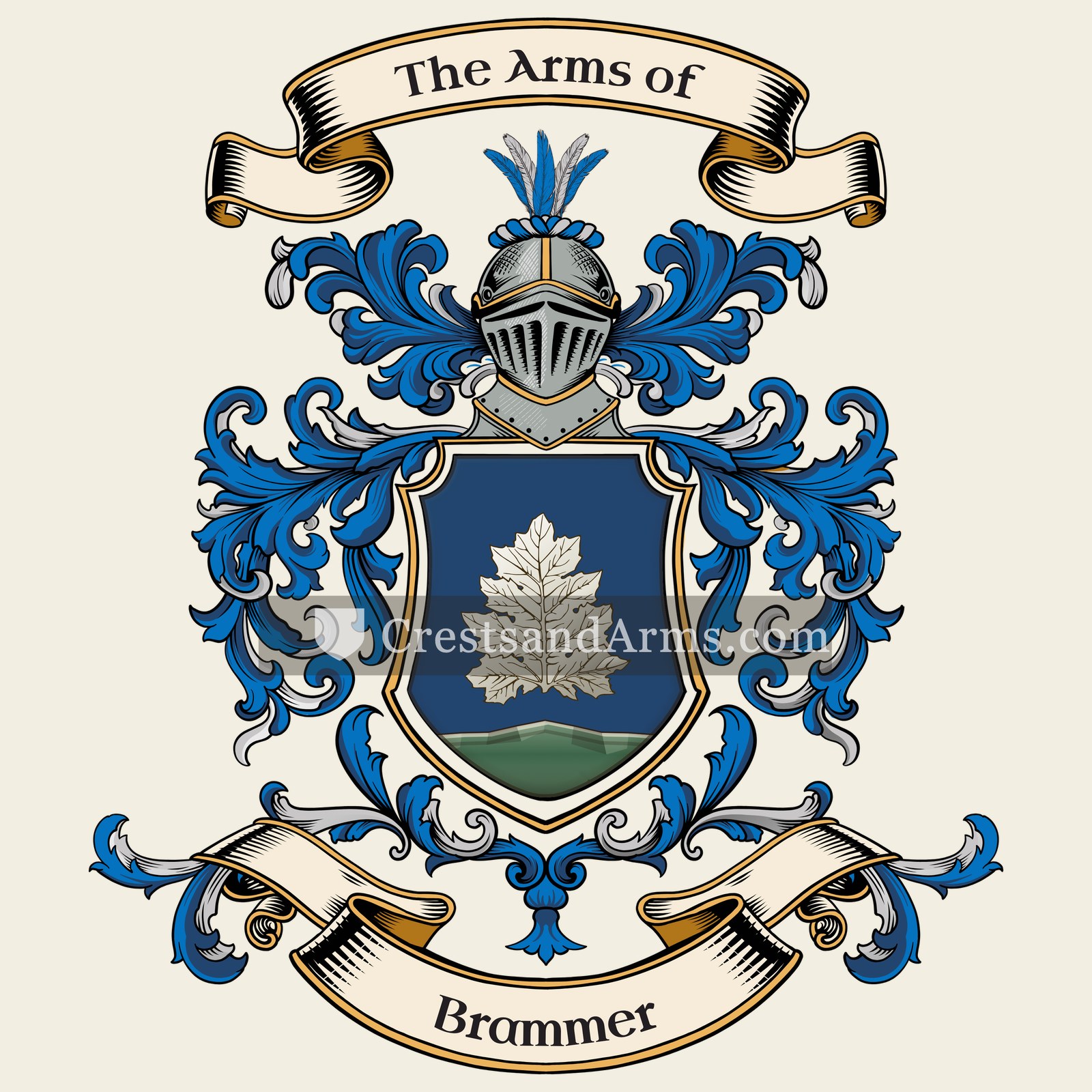


 bellA call to prayer, and a warning given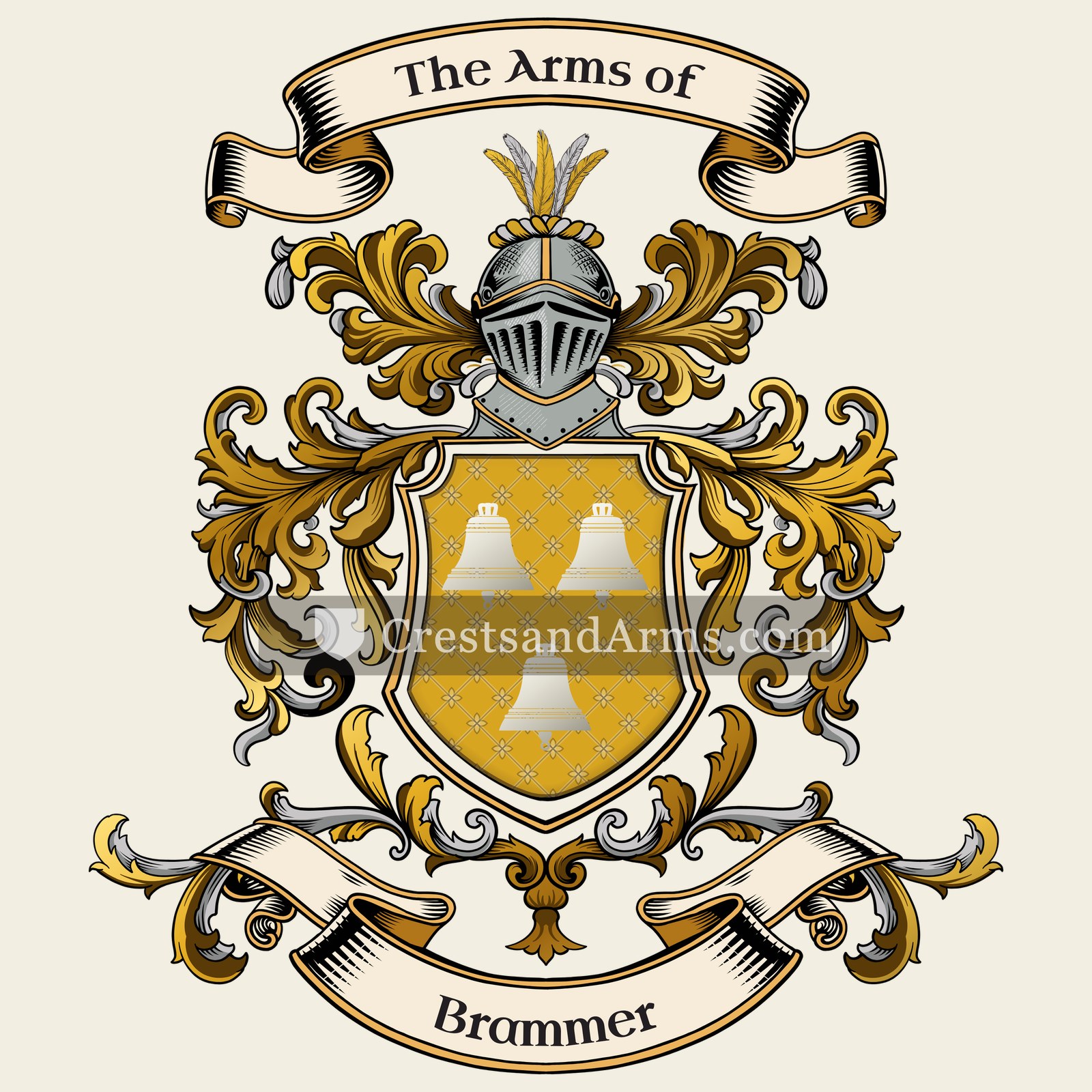

 saltireResolution, and St Andrew's cross
 eagleNobility, strength and a keen mind