A record of documented arms, meaning and origin, researched for the Branca family lines. Documented in 2 countries.
Reg. 1849 · Italian, A–C
Coat of Arms & Family Crest Details
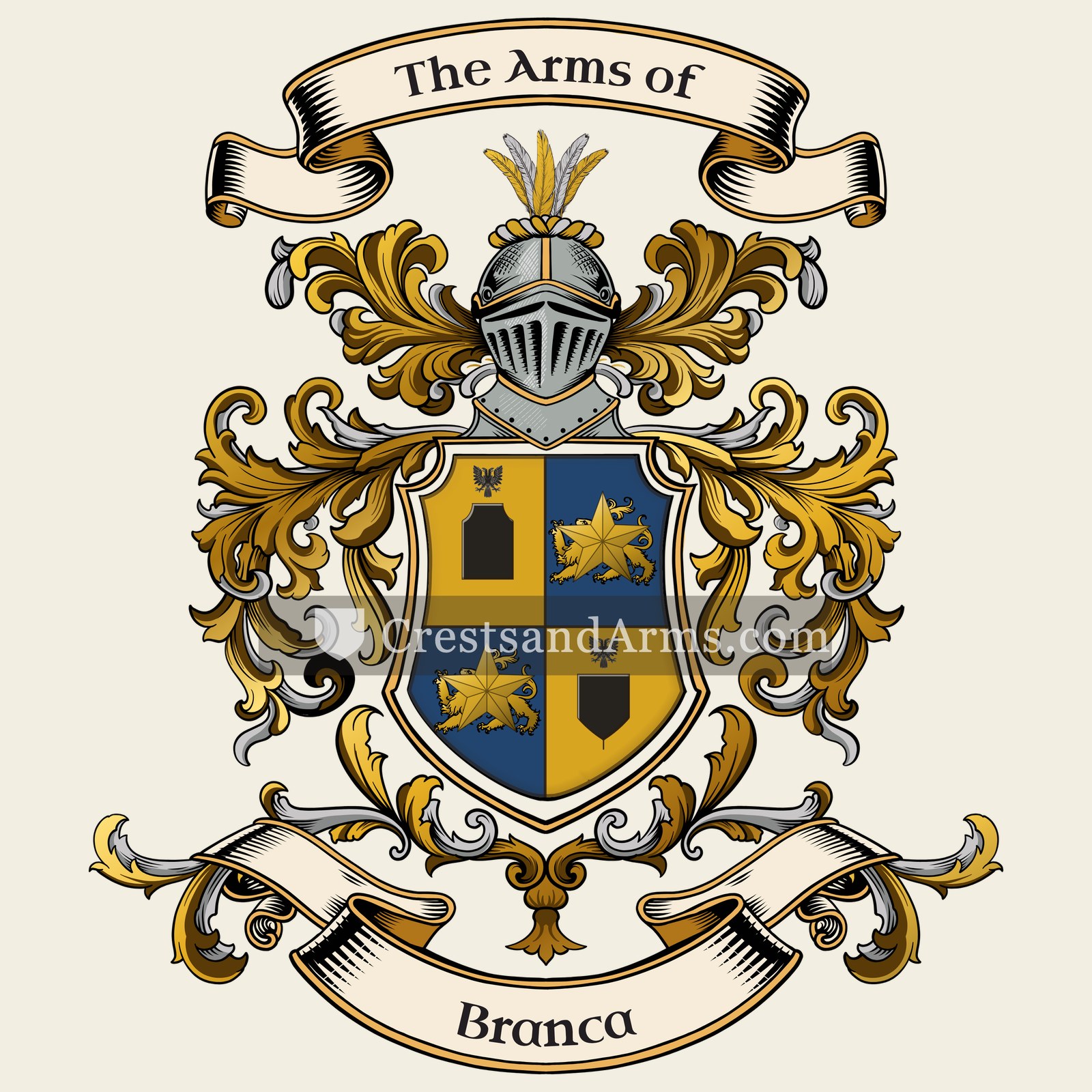
Symbols on this shield
lionCourage, strength and royalty
eagleNobility, strength and a keen mind
Colours
Gold (Or)Means: Generosity
Blue (Azure)Means: Loyalty and truth
Black (Sable)Means: Constancy
Historical info
Source
J. B. Rietstap, Armorial Général, Gouda: G. B. van Goor Zonen, 1884–87
Blazon (the actual original written record)
“Coupé: au 1 d'or à une aigle de sa., bq., m. et cour. d'or; au 2 taillé d'azur sur gu., au lion d'or, br. sur le taillé, tenant de sa patte dextre une étoile d'or surm. d'une couronne du même.”
ItalyMilan, c. 1775
Digital archive packCoat of arms PNG, gold border print PDF, vector SVG and the certificate of authenticity. Sent to your email in minutes.
Map of Italy showing where the Branca arms are recorded
The Branca arms were recorded in Milan, c. 1775.
This is where the arms were entered in the register. Families often moved to other parts of the country, so the same name can turn up in more than one region.
The body that granted and recorded arms in Italy in this period.
Alvise Giovanni Mocenigo
Sovereign of the period
Alvise Giovanni Mocenigo
1763–1778
Reigning in Italy when the Branca arms are first recorded.
How Arms Worked in Italy
In the Italian states, coats of arms were often used by noble families to show their status and history. These symbols were passed down through the generations to all legitimate male descendants. Younger branches of a family usually kept the original design but sometimes added small changes to distinguish their specific line from the main branch.
Granting authority
Various local rulers and city governments controlled the use of coats of arms across the different Italian states.
How they got arms
Families often assumed their own arms or received them as official grants from local lords, popes, or city councils.
Where arms were recorded
Arms were recorded in local city archives or private family books rather than in one single national register.
The family's standing
Recorded among the armigerous families of Italy.
Origin & History of the Branca Family in Italy
The surname Branca has deep roots in the Italian peninsula, where it likely originated as a descriptive nickname derived from the word for a claw or a branch. By the late eighteenth century, the family was firmly established in the bustling city of Milan, a major center for trade and culture in Northern Italy. Records confirm their presence in the city by 1775, a time when Milan was undergoing significant social and administrative changes under the influence of the Habsburg monarchy. During this era, families like the Brancas were often involved in the professional and mercantile life of the city, contributing to the growth of the region’s economy. While the name is found in various parts of Italy, the Milanese branch represents a clear example of a family integrated into the urban fabric of one of Europe’s most important historical cities.
Coat of Arms & Family Crest Details
Symbols on this shield
eagleNobility, strength and a keen mind
lionCourage, strength and royalty
mulletThe third son, and a divine quality from above
Colours
Gold (Or)Means: Generosity
Blue (Azure)Means: Loyalty and truth
Black (Sable)Means: Constancy
Historical info
Source
J. B. Rietstap, Armorial Général, Gouda: G. B. van Goor Zonen, 1884–87
Blazon (the actual original written record)
“Ec.: aux 1 et 4 d'or à l'aigle de sa., cour. du champ, celle du 1 cont.; aux 2 et 3 taillé d'azur sur gu., au lion d'or, br. sur le taillé, tenant de sa patte dextre une étoile d'or, sommée d'une couronne à l'antique du même, le lion du 3 cont. Deux cq. cour. C.: 1º l'aigle du 1, iss.; 2º le lion, iss. S.: deux lions reg. d'or. L. d'or et d'azur.”
BavariaBavaria, c. 1775
Digital archive packCoat of arms PNG, gold border print PDF, vector SVG and the certificate of authenticity. Sent to your email in minutes.
Map of Germany showing where the Branca arms are recorded
The Branca arms were recorded in Bavaria, c. 1775.
Bavaria was a country of old landed families and walled market towns. Estates passed down the same line for centuries, and both the landowners and the leading townsmen kept arms, which is why so many Bavarian names sit in the registers.
This is where the arms were entered in the register. Families often moved to other parts of the country, so the same name can turn up in more than one region.
The body that granted and recorded arms in Germany in this period.
Joseph II, Holy Roman Emperor
Sovereign of the period
Joseph II, Holy Roman Emperor
1765–1790
Reigning in Italy when the Branca arms are first recorded.
How Arms Worked in Germany
In the Holy Roman Empire, coats of arms were often granted to individuals by the Emperor or his representatives. These arms were then passed down through the generations to all legitimate descendants of the original holder. Younger branches of a family usually kept the same shield design without needing to change it, as the arms belonged to the entire lineage.
Granting authority
The Holy Roman Emperor held the sole power to grant new coats of arms throughout his vast imperial territories.
How they got arms
Families typically obtained their coats of arms through a formal imperial grant or by proving their noble status to the authorities.
Where arms were recorded
These grants were officially recorded in the Imperial Chancery registers, which began keeping formal records of such honors during the Middle Ages.
The family's standing
Recorded among the armigerous families of Bavaria.
Origin & History of the Branca Family in Germany
The history of the Branca family in Germany is deeply rooted in the cultural landscape of Bavaria, where records confirm their presence by the year 1775. The name itself is thought to have origins linked to the Italian word for branch, which suggests that early ancestors may have been associated with forestry, land management, or the physical division of property. As the family established themselves in the Bavarian region during the late eighteenth century, they integrated into the local social and economic structures of the time. This period was marked by significant shifts in German society, and the Branca family likely played a role in the agricultural or administrative life of their community. By settling in this specific part of Southern Germany, they became part of a long tradition of families who helped shape the regional identity through their daily work and local contributions.
Branca Meaning & Related Branches
Root word
Biancus
Latin term meaning white or fair-skinned.
This name
BrancaRefers to a person with a fair complexion or light-colored hair.
also spelled
Branka
Documented Sources
J. B. Rietstap, Armorial Général, Gouda: G. B. van Goor Zonen, 1884–87
De Felice, Emidio. Dizionario dei cognomi italiani. 1978
Fumagalli, Giuseppe. La fortuna di Milano. 1910
Archivio di Stato di Milano, Stato civile della Restaurazione
Archivio Storico Civico di Milano, Anagrafe storica
Digital archive packCoat of arms PNG, gold border print PDF, vector SVG and the certificate of authenticity. Sent to your email in minutes.


 lionCourage, strength and royalty
 eagleNobility, strength and a keen mind
 lionCourage, strength and royalty
 eagleNobility, strength and a keen mind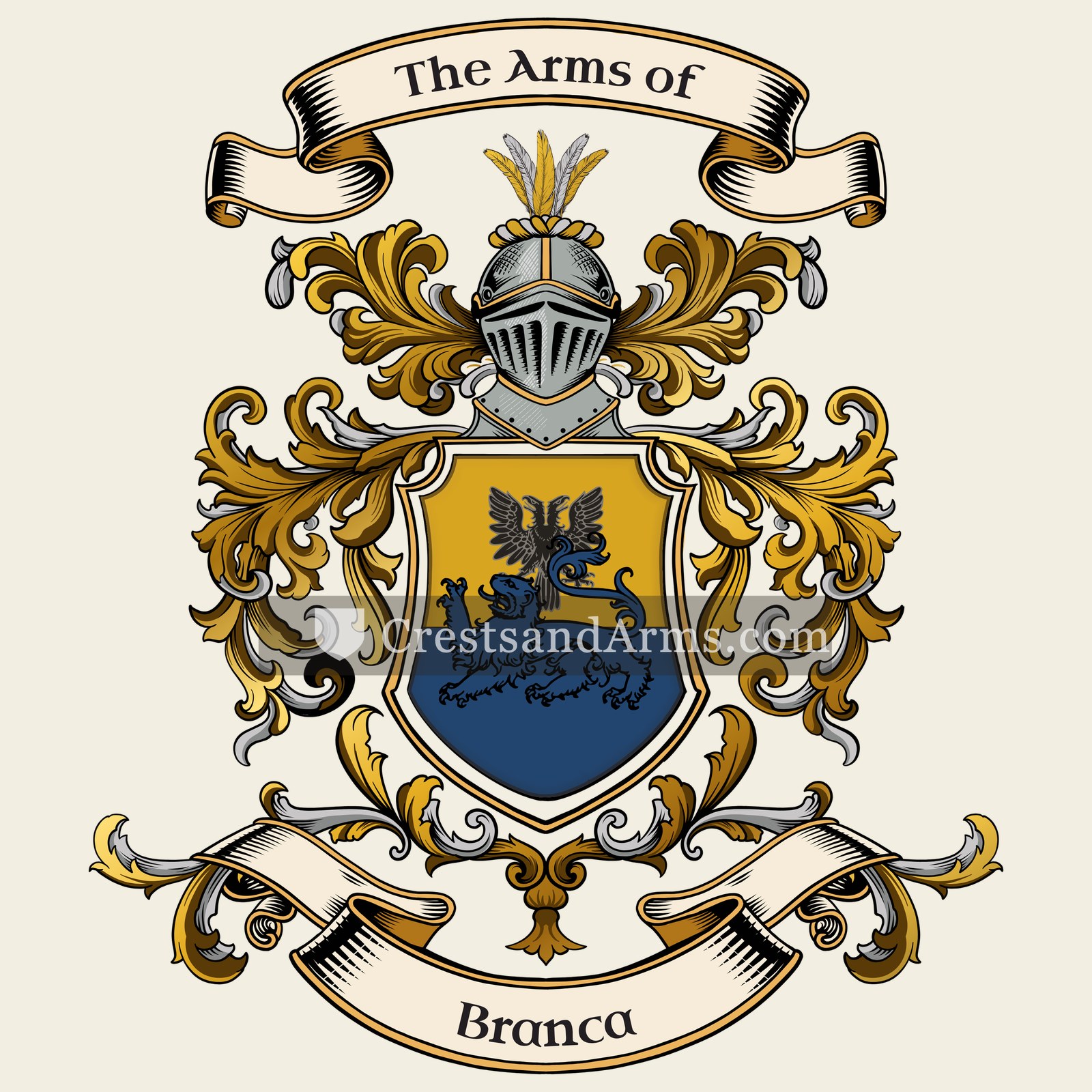


 mulletThe third son, and a divine quality from above