Map of Britain showing where the Braose arms are recorded
The Braose arms were recorded in Britain, c. 1700.
Arms such as these were typically recorded in Kent.
Kent sits between London and the short crossing to Europe, and the trade passing through made it wealthy. Merchant families bought land with that money, and it was landowners who took coats of arms.
This is where the arms were entered in the register. Families often moved to other parts of the country, so the same name can turn up in more than one region.
The body that granted and recorded arms in Britain in this period.
William III of England
Sovereign of the period
William III of England
1694–1702
Reigning in Britain when the Braose arms are first recorded.
How Arms Worked in Britain
English heraldry allowed arms to be shared by all legitimate descendants of the original owner. These symbols were treated as personal property that moved through the generations to all children. While the eldest son kept the original design, other family members could use the same shield without needing to change it or register their own unique versions.
Granting authority
The College of Arms in London has regulated the use of coats of arms throughout England and Wales since 1484.
How they got arms
Families typically obtained their coats of arms through a formal grant from the Crown or by proving their ancient right to them.
Where arms were recorded
All official coats of arms are recorded in the registers kept at the College of Arms, which date back to the fifteenth century.
The family's standing
Recorded among the armigerous families of Britain.
Origin & History of the Braose Family in Britain
The family name Braose, also historically spelled as Brewes or Braose, traces its roots back to the arrival of Norman settlers in Britain following the conquest of 1066. The name originates from the village of Briouze in Normandy, France, and it was brought to England by followers of William the Conqueror who were granted lands as a reward for their service. While the family rose to great prominence in the Welsh Marches during the medieval period, the name also spread across various English counties over the centuries. By the year 1700, members of the family were well established in Kent, where they lived as part of the local community. This transition from high-ranking feudal lords to settled residents reflects the broader historical pattern of noble families integrating into the English countryside as their political influence shifted over time.
Coat of Arms & Family Crest Details
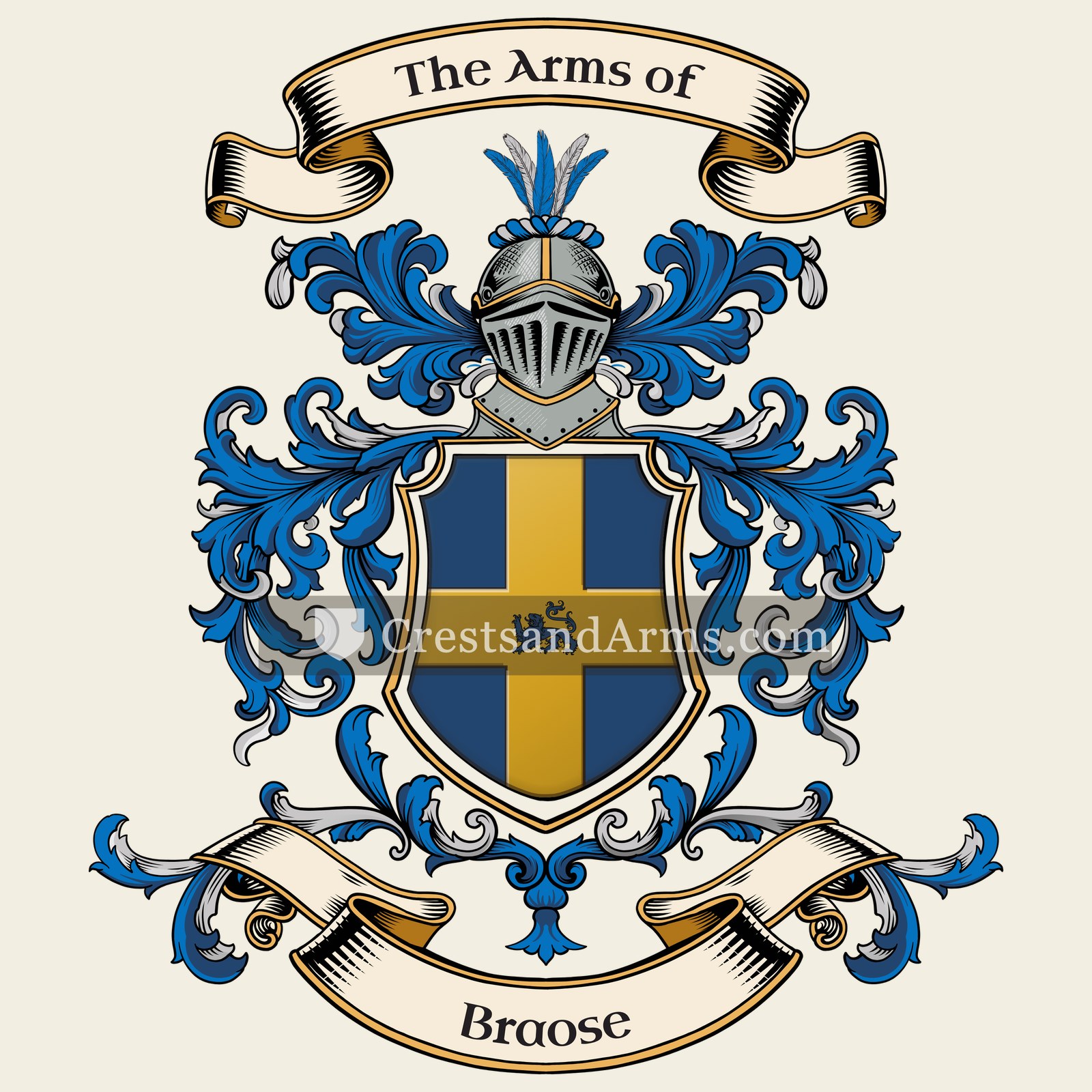
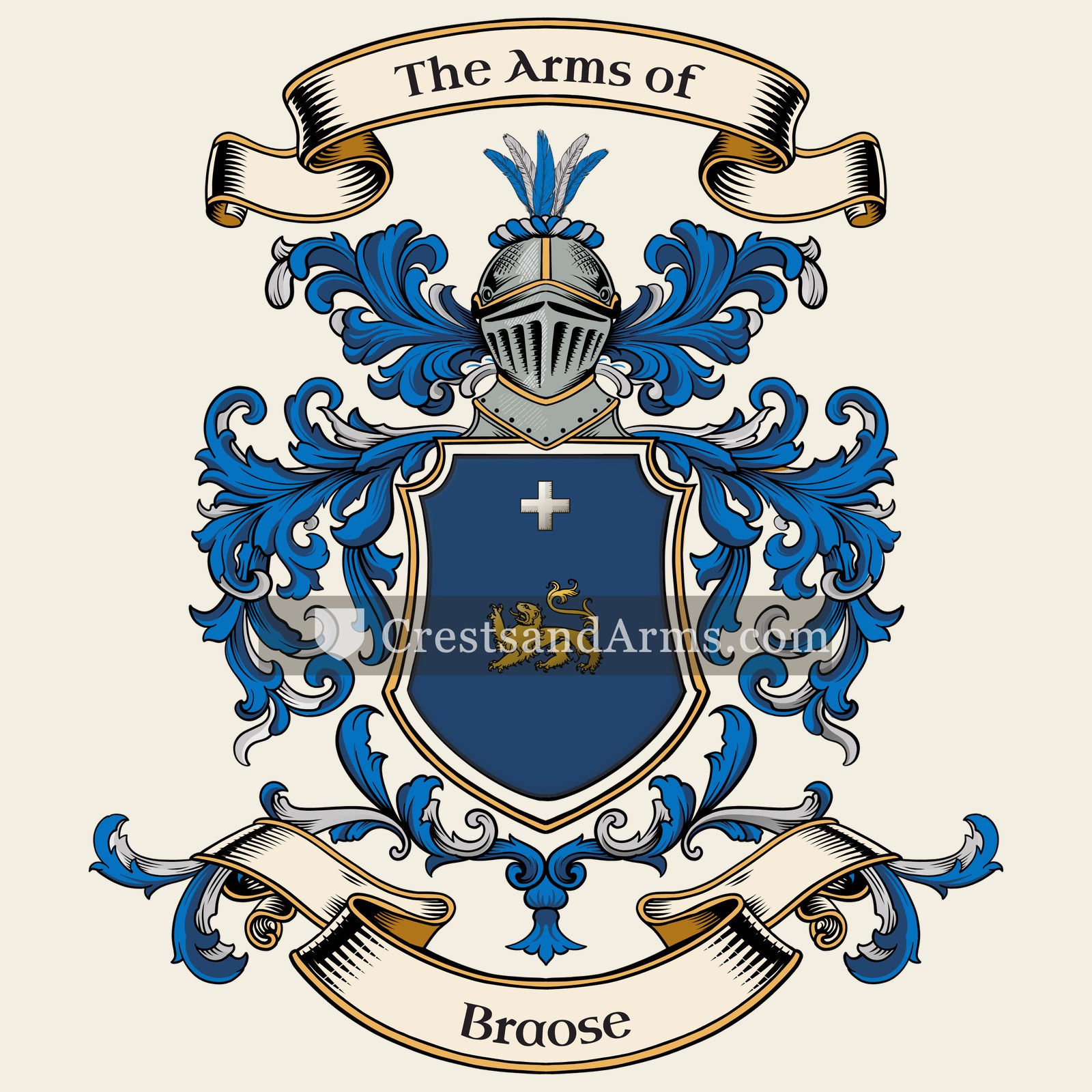
Symbols on this shield
cross symbolChristian faith and service
lionCourage, strength and royalty
Colours
Blue (Azure)Means: Loyalty and truth
Gold (Or)Means: Generosity
Historical info
Source
Sir Bernard Burke, The General Armory of England, Scotland, Ireland and Wales, London: Harrison & Sons, 1884
Blazon (the actual original written record)
“Az. semée of cross crosslets, a lion ramp. or, armed and langued gu”
Englandc. 1299
Digital archive packCoat of arms PNG, gold border print PDF, vector SVG and the certificate of authenticity. Sent to your email in minutes.
Map of England showing where the Braose arms are recorded
The Braose arms were recorded in England, c. 1299.
Arms such as these were typically recorded in York.
Yorkshire is the largest of the English counties, and it held more gentry families than any other. Land there was split among a great many households rather than a few, so a great many of them carried arms.
This is where the arms were entered in the register. Families often moved to other parts of the country, so the same name can turn up in more than one region.
The body that granted and recorded arms in England in this period.
Edward I of England
Sovereign of the period
Edward I of England
1272–1307
Reigning in Britain when the Braose arms are first recorded.
How Arms Worked in England
English heraldry allowed arms to be shared by all legitimate descendants of the original owner. These symbols were treated as personal property that moved through the generations to all children. While the eldest son kept the original design, other family members could use the same shield without needing to change it or register their own unique versions.
Granting authority
The College of Arms in London has regulated the use of coats of arms throughout England and Wales since 1484.
How they got arms
Families typically obtained their coats of arms through a formal grant from the Crown or by proving their ancient right to them.
Where arms were recorded
All official coats of arms are recorded in the registers kept at the College of Arms, which date back to the fifteenth century.
The family's standing
Recorded among the armigerous families of England.
Origin & History of the Braose Family in England
The Braose family, also known as de Braose, established a significant presence in England following the Norman Conquest of 1066. Originally hailing from the village of Briouze in Normandy, the family rose to prominence as powerful marcher lords who held vast estates along the border between England and Wales. They were deeply involved in the political and military affairs of the medieval period, often serving as trusted advisors or sometimes rebellious rivals to the English monarchs. By the late thirteenth century, the family line had expanded across the country, with records confirming their presence in York by 1299. This move to northern England highlights how the family integrated into different regions of the kingdom beyond their traditional strongholds. Their history reflects the broader patterns of land ownership and social mobility that defined the lives of the Anglo-Norman nobility during the Middle Ages.
Braose Meaning & Related Branches
Root word
Briouze
A place name derived from the Old French word for heather.
This name
BraoseRefers to a family originating from the town of Briouze in Normandy, France.
also spelled
Brewes
Brayos
Breuse
Related arms
Breusevariant spelling
Brewesvariant spelling
Documented Sources
J. B. Rietstap, Armorial Général, Gouda: G. B. van Goor Zonen, 1884–87
Coplestone-Crow, Bruce, The Lordship of Brycheiniog, 1982
Mason, Emma, The House of Godwine: The History of a Dynasty, 2004
Round, John Horace, Feudal England: Historical Studies on the Eleventh and Twelfth Centuries, 1895
The National Archives, Curia Regis Rolls, 1189–1272
The National Archives, Pipe Rolls, 1154–1189
Digital archive packCoat of arms PNG, gold border print PDF, vector SVG and the certificate of authenticity. Sent to your email in minutes.


 cross symbolChristian faith and service
 lionCourage, strength and royalty
 cross symbolChristian faith and service
 lionCourage, strength and royalty