Map of Belgium showing where the Brassard arms are recorded
The Brassard arms were recorded in Tournaisis, c. 1737.
This is where the arms were entered in the register. Families often moved to other parts of the country, so the same name can turn up in more than one region.
The body that granted and recorded arms in Belgium in this period.
Charles VI, Holy Roman Emperor
Sovereign of the period
Charles VI, Holy Roman Emperor
1711–1740
Reigning in Belgium when the Brassard arms are first recorded.
How Arms Worked in Belgium
In Belgium, a coat of arms is considered personal property that is passed down through the male line to legitimate descendants. Families often use the same shield design across generations to show their shared heritage. If a branch of the family wants to change the design, they must apply for an official update to their specific version of the arms.
Granting authority
The Conseil héraldique is the official body that regulates and approves all coats of arms in Belgium.
How they got arms
Families obtain their coats of arms through formal royal grants or by confirming their historical right to use existing designs.
Where arms were recorded
All approved coats of arms are officially recorded in the public registers of the Conseil héraldique since 1844.
The family's standing
Recorded among the armigerous families of Belgium.
Origin & History of the Brassard Family in Belgium
The surname Brassard has deep roots in the historical region of Tournaisis, where records confirm the family was well-established by 1737. The name itself is thought to derive from the Old French word *bras*, which refers to an arm or a piece of armor covering the arm. In the context of medieval Belgium, such names often began as nicknames for individuals who were either particularly strong or who worked as armorers. By the eighteenth century, families bearing this name were integrated into the local agricultural and artisanal life of the villages surrounding Tournai. These early ancestors lived through a period of significant transition as the region shifted between various European powers, yet they remained anchored to the land and their local communities. The presence of the Brassard name in these early parish and tax registers highlights a family that was deeply connected to the social and economic fabric of the Belgian borderlands.
Meaning of the Brassard family crest colors & symbols
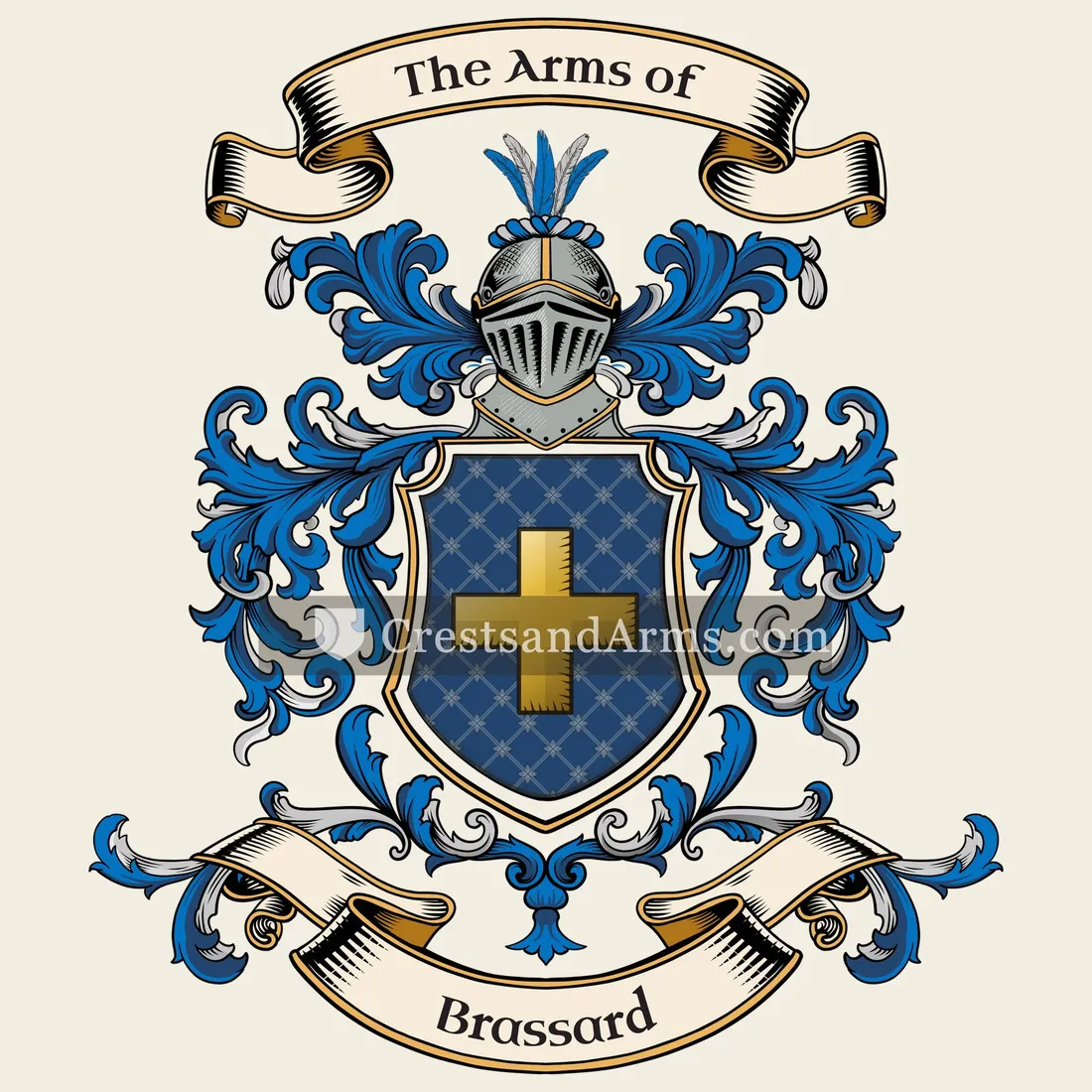
Symbols on this shield
cross symbolChristian faith and service
Colours
Blue (Azure)Means: Loyalty and truth
Gold (Or)Means: Generosity
Historical info
Source
J. B. Rietstap, Armorial Général, Gouda: G. B. van Goor Zonen, 1884–87
Blazon (the actual original written record)
“D'azur à la croix ancrée d'or. C.: un vol, aux armes de l'écu.”
WestphaliaCambr · Westphalia, c. 1663
Digital archive packCoat of arms PNG, gold border print PDF, vector SVG and the certificate of authenticity. Sent to your email in minutes.
Map of France showing where the Brassard arms are recorded
The Brassard arms were recorded in Westphalia, c. 1663.
Westphalia was a land of small estates and fortified farmhouses in western Germany. Its families were numerous and not especially rich, but each held its own ground, and holding ground was what brought arms.
This is where the arms were entered in the register. Families often moved to other parts of the country, so the same name can turn up in more than one region.
The body that granted and recorded arms in France in this period.
Louis XIV of France
Sovereign of the period
Louis XIV of France
1643–1715
Reigning in Belgium when the Brassard arms are first recorded.
How Arms Worked in France
In France, a coat of arms was a mark of honor that passed down through the male line to all legitimate descendants. Families often used the same shield without changes to show their shared heritage. If a branch wanted to stand out, they could add a small mark to their shield to show their specific place in the family tree.
Granting authority
The Juge d'armes de France acted as the official authority that regulated and verified coats of arms across the country.
How they got arms
Families typically inherited their arms from ancestors, though they could also receive them through royal grants or by proving their noble status.
Where arms were recorded
Coats of arms were officially recorded in the Armorial Général de France, which began its main collection in the year 1696.
The family's standing
Recorded among the armigerous families of Westphalia.
Origin & History of the Brassard Family in France
The surname Brassard finds its roots in the French language, where it is derived from the word "bras," meaning arm. Historically, this name was often used as a descriptive nickname for a person who possessed great physical strength or for a soldier who wore a specific type of protective armor known as a brassart. While the name is deeply connected to French culture, the family history extends across borders into the region of Westphalia. By 1663, records confirm that members of the Brassard family were established in this area, which was then part of the Holy Roman Empire. This suggests that the family was mobile and likely involved in the military or trade networks that connected France to the German territories during the seventeenth century. The presence of the family in Westphalia highlights how names often traveled alongside individuals who sought new opportunities or served in the various conflicts that defined European life during that era.
Brassard Meaning & Related Branches
Root word
bras
Old French term for arm or strength.
This name
BrassardAn occupational name for an armorer or a maker of protective arm coverings.
also spelled
Brassard
Documented Sources
J. B. Rietstap, Armorial Général, Gouda: G. B. van Goor Zonen, 1884–87
Archives de l'État à Tournai, Registres paroissiaux de l'ancien comté de Hainaut, 1737
Herbillon, Jules and Germain, Jean, Dictionnaire des noms de famille en Belgique romane et dans les régions limitrophes, 1996
Digital archive packCoat of arms PNG, gold border print PDF, vector SVG and the certificate of authenticity. Sent to your email in minutes.


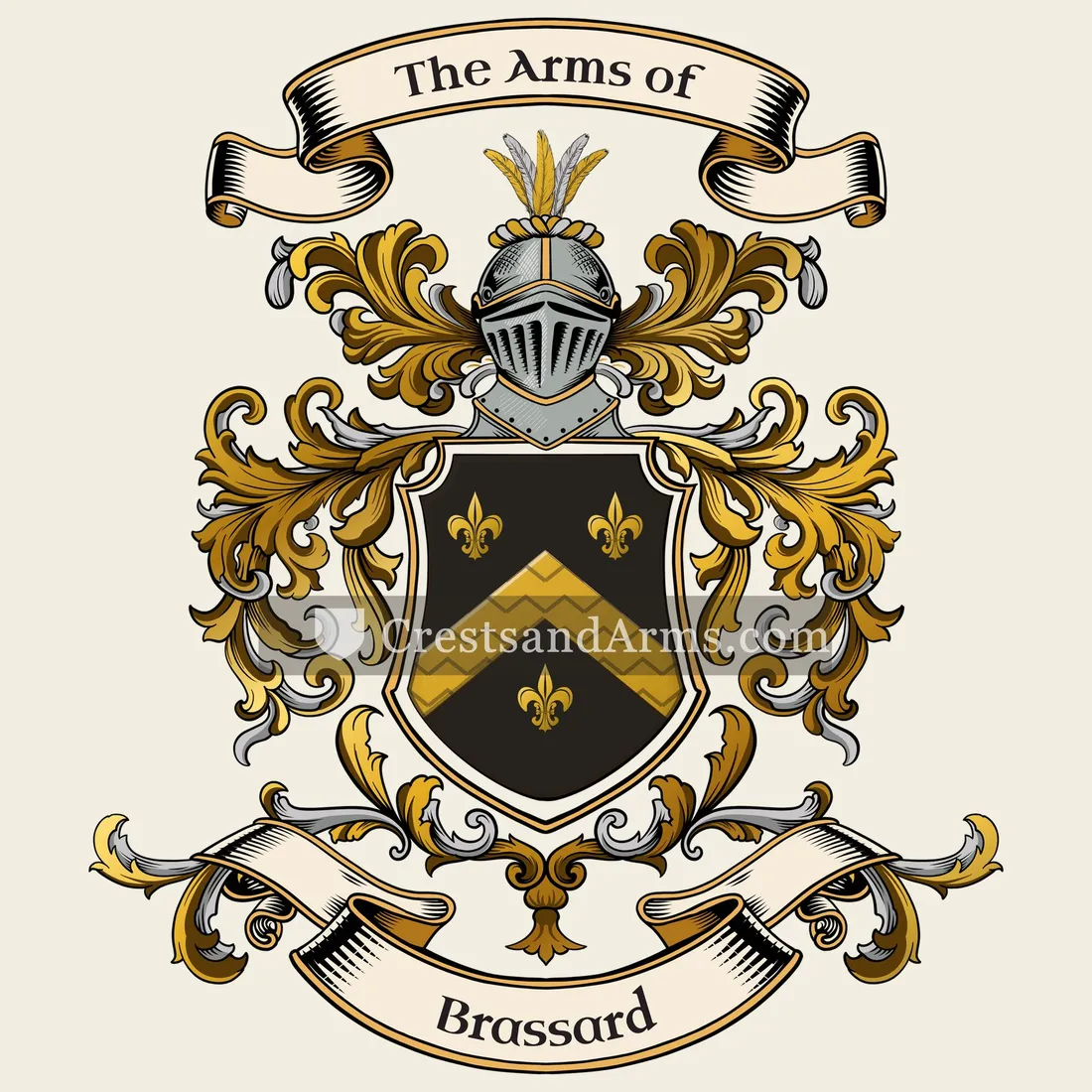
 chevronProtection, and faithful service completed
 fleur de lisPurity, light, and the sixth son
 chevronProtection, and faithful service completed
 fleur de lisPurity, light, and the sixth son


 cross symbolChristian faith and service