Map of Italy showing where the Breda arms are recorded
The Breda arms were recorded in Vérone, c. 1775.
This is where the arms were entered in the register. Families often moved to other parts of the country, so the same name can turn up in more than one region.
The body that granted and recorded arms in Italy in this period.
Alvise Giovanni Mocenigo
Sovereign of the period
Alvise Giovanni Mocenigo
1763–1778
Reigning in Italy when the Breda arms are first recorded.
How Arms Worked in Italy
In the Italian states, coats of arms were often used by noble families to show their status and history. These symbols were passed down through the generations to all legitimate male descendants. Younger branches of a family usually kept the original design but sometimes added small changes to distinguish their specific line from the main branch.
Granting authority
Various local rulers and city governments controlled the use of coats of arms across the different Italian states.
How they got arms
Families often assumed their own arms or received them as official grants from local lords, popes, or city councils.
Where arms were recorded
Arms were recorded in local city archives or private family books rather than in one single national register.
The family's standing
Recorded among the armigerous families of Italy.
Origin & History of the Breda Family in Italy
The history of the Breda family in Italy is deeply rooted in the cultural landscape of the Veneto region, with documented evidence placing members of the family in Verona by 1775. The name itself is thought to be topographical in origin, likely derived from the Germanic word *breit*, which refers to a wide or open field. During the late eighteenth century, families with this name were often associated with the management of land and agricultural estates in Northern Italy. As the family established themselves in Verona, they became part of the local urban fabric during a period of significant political transition. Their presence in the city suggests they were integrated into the professional or merchant classes that helped sustain the region’s economy. By settling in such a historically significant hub, the early Breda family members participated in the social and civic life of the city, leaving behind a legacy that reflects the broader patterns of migration and settlement in the Italian peninsula.
Coat of Arms & Family Crest Details
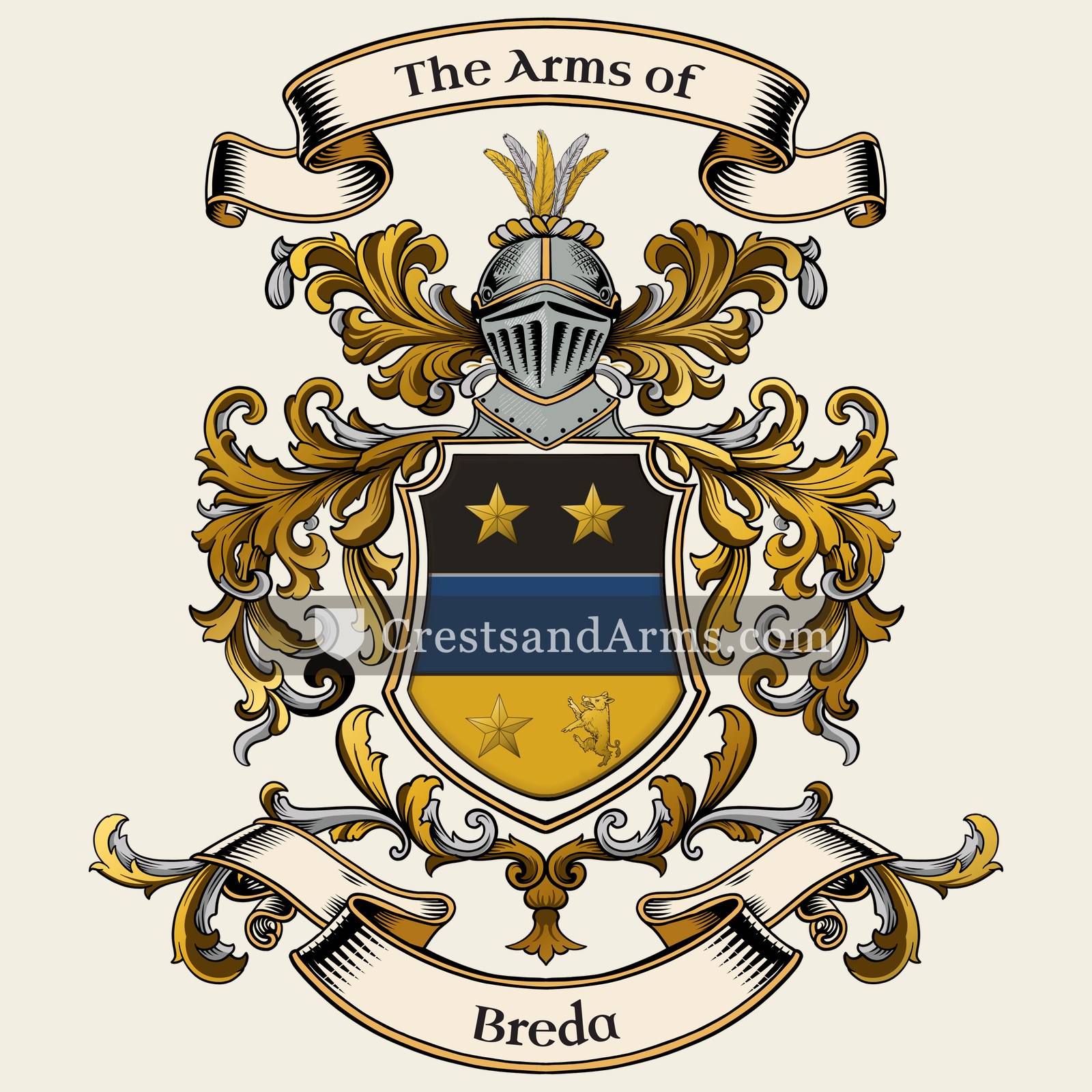
Symbols on this shield
fessThe military belt, and readiness to serve
mulletThe third son, and a divine quality from above
boarA fierce fighter who battles to the end
Colours
Black (Sable)Means: Constancy
Gold (Or)Means: Generosity
Blue (Azure)Means: Loyalty and truth
Historical info
Source
J. B. Rietstap, Armorial Général, Gouda: G. B. van Goor Zonen, 1884–87
Blazon (the actual original written record)
“Coupé, de sa. à trois étoiles rangées (5) d'or, sur or à un porc pass. de sa., à la fasce d'azur, br. sur le coupé. Cq. cour. C.: un vol d'or. L. d'or et de sa. S.: deux lions reg. d'or, arm. et lamp. de gu.”
Belgiumc. 1737
Digital archive packCoat of arms PNG, gold border print PDF, vector SVG and the certificate of authenticity. Sent to your email in minutes.
Map of Belgium showing where the Breda arms are recorded
The Breda arms were recorded in Belgium, c. 1737.
Arms such as these were typically recorded in Brabant.
Brabant lay at the heart of the Low Countries, where the trade routes met. Its towns were wealthy and its landowners many, and both kinds of family kept arms, which is why the region is so heavily represented.
This is where the arms were entered in the register. Families often moved to other parts of the country, so the same name can turn up in more than one region.
The body that granted and recorded arms in Belgium in this period.
Charles VI, Holy Roman Emperor
Sovereign of the period
Charles VI, Holy Roman Emperor
1711–1740
Reigning in Italy when the Breda arms are first recorded.
How Arms Worked in Belgium
In Belgium, a coat of arms is considered personal property that is passed down through the male line to legitimate descendants. Families often use the same shield design across generations to show their shared heritage. If a branch of the family wants to change the design, they must apply for an official update to their specific version of the arms.
Granting authority
The Conseil héraldique is the official body that regulates and approves all coats of arms in Belgium.
How they got arms
Families obtain their coats of arms through formal royal grants or by confirming their historical right to use existing designs.
Where arms were recorded
All approved coats of arms are officially recorded in the public registers of the Conseil héraldique since 1844.
The family's standing
Recorded among the armigerous families of Belgium.
Origin & History of the Breda Family in Belgium
The family name Breda is deeply rooted in the historical region of Brabant, a former duchy that now spans parts of modern-day Belgium and the Netherlands. By 1737, records confirm that members of the family were well-established within this territory, living in a landscape defined by shifting political borders and agricultural development. During the eighteenth century, the people of Brabant lived under the rule of the Austrian Netherlands, a period marked by significant administrative organization and the growth of local parish records. Families like the Breda line often played roles in the local economy, which relied heavily on the fertile soil and the busy trade routes connecting cities like Brussels and Antwerp. Because the name itself is linked to the geography of the Low Countries, it suggests that early ancestors were likely tied to the land or the regional centers of commerce that defined life in the duchy. This era required families to be resilient as they navigated the complexities of life in a region that served as a crossroads for European culture and trade.
Breda Meaning & Related Branches
Root word
pratum
Latin term referring to a meadow or an open field.
This name
BredaA topographic surname denoting someone who lived near a meadow or pasture.
also spelled
Bredah
Bredas
Bredda
Related arms
Bourgognerecorded with Breda, same area
Namurrecorded with Breda, same area
Documented Sources
J. B. Rietstap, Armorial Général, Gouda: G. B. van Goor Zonen, 1884–87
Archivio di Stato di Verona, Anagrafe della popolazione di Verona, 1775
Olivieri, Dante, Dizionario di toponomastica veneta, 1961


 eagleNobility, strength and a keen mind
 eagleNobility, strength and a keen mind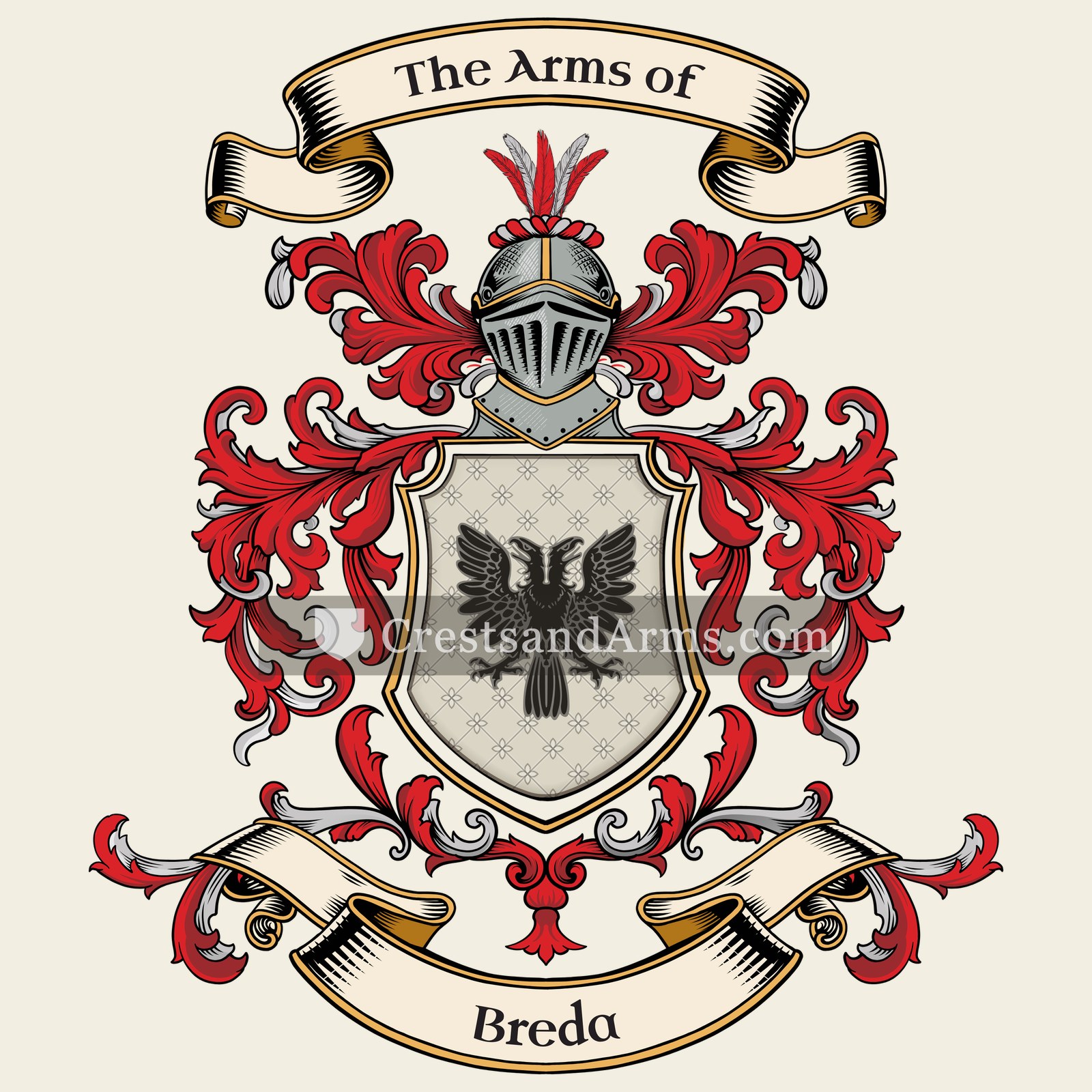


 fessThe military belt, and readiness to serve
 mulletThe third son, and a divine quality from above
 boarA fierce fighter who battles to the end