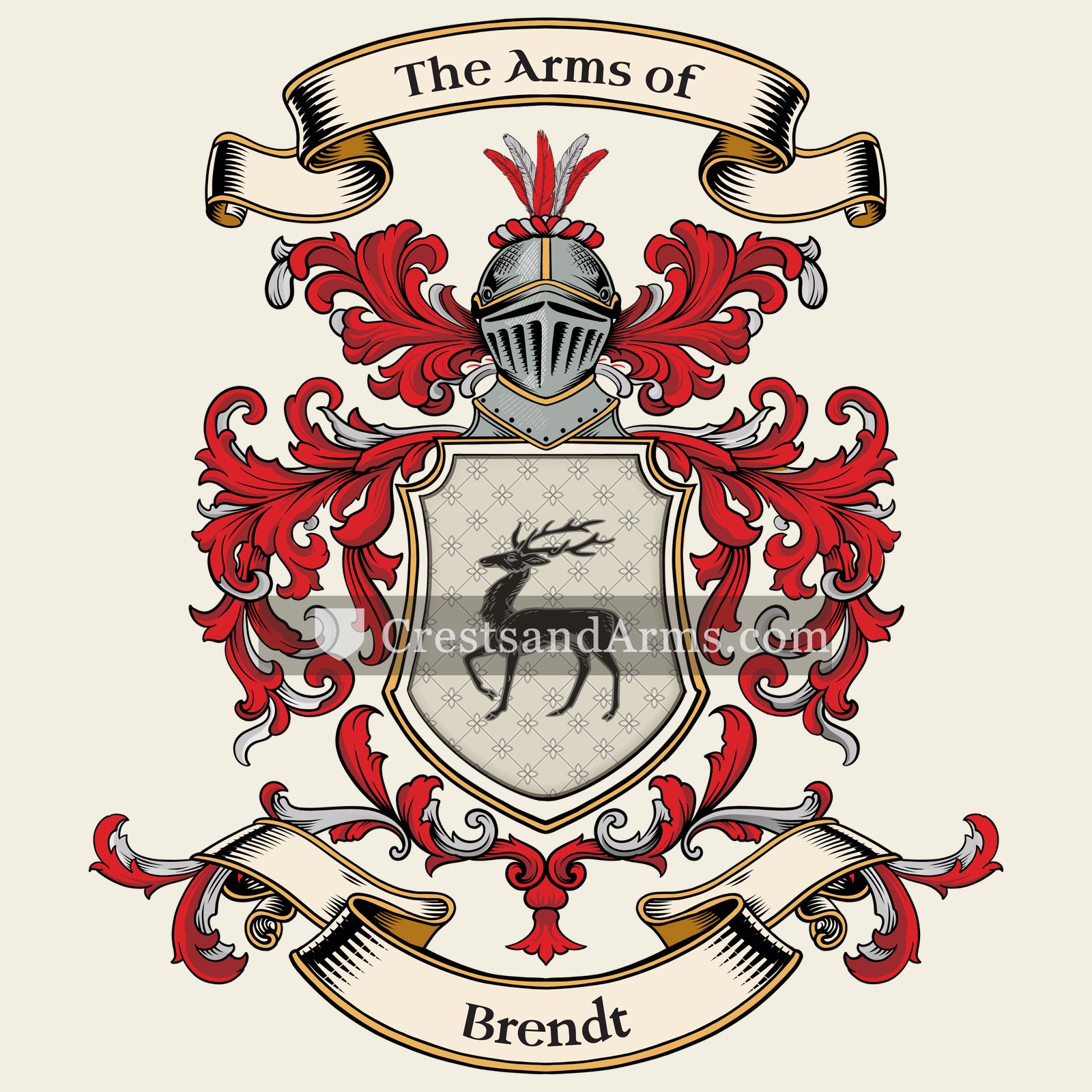
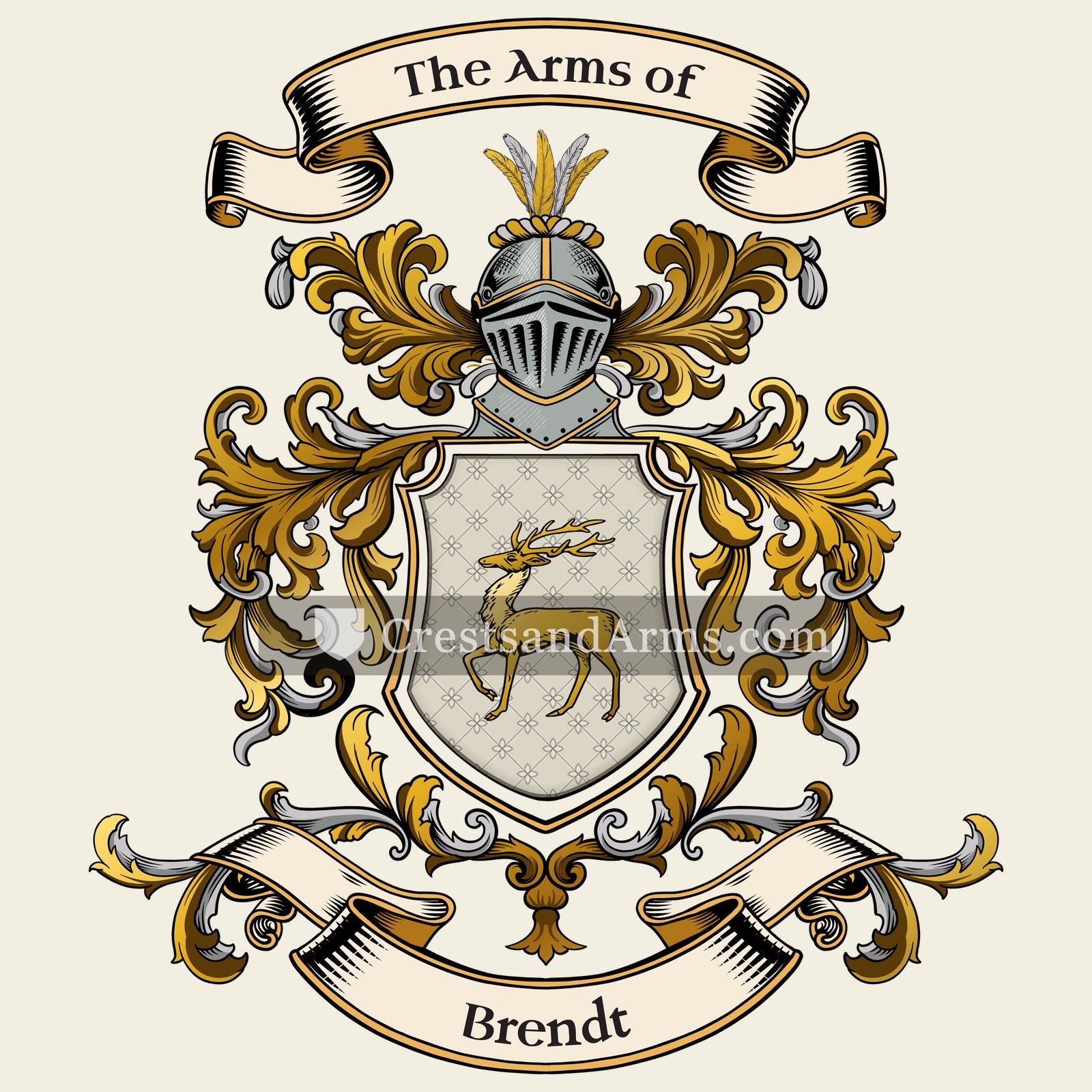
A record of documented arms, meaning and origin, researched for the Brendt family lines. Documented in 2 countries.
Reg. 6395 · German, A–C
Coat of Arms & Family Crest Details
Symbols on this shield
stagPeace and harmony, and one who will not fight unprovoked
Colours
Silver (Argent)Means: Peace and sincerity
Black (Sable)Means: Constancy
Historical info
Source
J. B. Rietstap, Armorial Général, Gouda: G. B. van Goor Zonen, 1884–87
Blazon (the actual original written record)
“D'arg. au massacre de cerf de sa. C.: une ramure de cerf de sa.”
FranconiaFranconia, c. 1765
Where the Brendt Arms Were Recorded
Franconia
Map of Germany showing where the Brendt arms are recorded
The Brendt arms were recorded in Franconia, c. 1765.
Franconia was a patchwork of small territories in central Germany, full of minor landowners and prosperous market towns. So many separate households held land there that the region produced a great many coats of arms.
This is where the arms were entered in the register. Families often moved to other parts of the country, so the same name can turn up in more than one region.
The body that granted and recorded arms in Germany in this period.
Francis I, Holy Roman Emperor
Sovereign of the period
Francis I, Holy Roman Emperor
1745–1765
Reigning in Germany when the Brendt arms are first recorded.
How Arms Worked in Germany
In the Holy Roman Empire, coats of arms were often granted to individuals by the Emperor or his representatives. These arms were then passed down through the generations to all legitimate descendants of the original holder. Younger branches of a family usually kept the same shield design without needing to change it, as the arms belonged to the entire lineage.
Granting authority
The Holy Roman Emperor held the sole power to grant new coats of arms throughout his vast imperial territories.
How they got arms
Families typically obtained their coats of arms through a formal imperial grant or by proving their noble status to the authorities.
Where arms were recorded
These grants were officially recorded in the Imperial Chancery registers, which began keeping formal records of such honors during the Middle Ages.
The family's standing
Recorded among the armigerous families of Franconia.
Origin & History of the Brendt Family in Germany
The surname Brendt is a variant of the German name Brandt, which traces its roots back to the Middle Ages as a descriptive term for a person who lived near a site cleared by fire. In the German language, the root word *brand* refers to a burning or a scorched area of forest that had been cleared for farming. By the time members of the family were documented in the region of Franconia in 1765, the name had become a well-established identifier for families living in the rural landscapes of central Germany. During the eighteenth century, Franconia was a patchwork of small territories where families like the Brendts were often tied to the land through agriculture or local trade. As the family grew, they became part of the social fabric of the Holy Roman Empire, living through a period of significant agricultural development and regional stability. This history reflects the broader movement of German families who settled in the fertile river valleys of the Franconian region, where their name served as a permanent link to the ancestral work of clearing and cultivating the land.
Coat of Arms & Family Crest Details
Symbols on this shield
stagPeace and harmony, and one who will not fight unprovoked
Colours
Silver (Argent)Means: Peace and sincerity
Gold (Or)Means: Generosity
Historical info
Source
Sir Bernard Burke, The General Armory of England, Scotland, Ireland and Wales, London: Harrison & Sons, 1884
Blazon (the actual original written record)
“Ar. a stag's attire fixed to the scalp or”
Irelandc. 1645
Where the Brendt Arms Were Recorded
Dublin
Map of Ireland showing where the Brendt arms are recorded
The Brendt arms were recorded in Ireland, c. 1645.
Arms such as these were typically recorded in Dublin.
Dublin was the seat of government in Ireland and the place where grants were sought and recorded. Families with business at the castle or the courts settled nearby, and settling there put their arms on record.
This is where the arms were entered in the register. Families often moved to other parts of the country, so the same name can turn up in more than one region.
The body that granted and recorded arms in Ireland in this period.
Charles I of England
Sovereign of the period
Charles I of England
1625–1649
Reigning in Germany when the Brendt arms are first recorded.
How Arms Worked in Ireland
The Ulster King of Arms granted coats of arms to individuals who proved their social standing and good character. These symbols were typically inherited by all legitimate descendants of the original holder. If a family branch wanted a unique look, they could apply for a specific change to their design through the office to ensure their identity remained distinct.
Granting authority
The Ulster King of Arms acted as the official body that regulated and issued all coats of arms throughout Ireland.
How they got arms
Families obtained their arms through formal grants issued by the office after proving their eligibility and paying the required fees.
Where arms were recorded
All official grants were recorded in the registers held by the Ulster King of Arms starting from the year 1552.
The family's standing
Recorded among the armigerous families of Ireland.
Origin & History of the Brendt Family in Ireland
The family name Brendt first appears in the historical record of Dublin during the mid-seventeenth century, a period defined by significant social and political upheaval in Ireland. By 1645, members of the Brendt family were established residents within the city, likely drawn to the capital by its role as a bustling center of trade and administration. During this era, Dublin was a melting pot of diverse populations, and families like the Brendts often integrated into the urban fabric by participating in local commerce or skilled trades. While the name itself may have roots in Germanic or northern European naming traditions, its presence in Dublin suggests that these early ancestors were part of the growing community of merchants and settlers who navigated the complex religious and economic shifts of the time. Their residency in the city during the 1640s places them in the heart of a transformative era, marking the beginning of the family’s long-standing connection to the Irish capital.
Related Branches & Arms
Root word
Brant
Derived from the Old High German word for a sword or fire.
This name
BrendtA topographic or occupational name referring to someone who lived near a burnt clearing.
also spelled
Brent
Brend
Related arms
Brentvariant spelling
Documented Sources
J. B. Rietstap, Armorial Général, Gouda: G. B. van Goor Zonen, 1884–87
Bahlow, Hans. Deutsches Namenlexikon: Familien- und Vornamen nach Ursprung und Sinn erklärt. 1967
Heintze, Albert. Die deutschen Familien-Namen: geschichtlich, geographisch, sprachlich. 1903
Staatsarchiv Bamberg, Standesamtliche Unterlagen und Kirchenbücher der Region Franken
Bayerisches Hauptstaatsarchiv, Generalakten der fränkischen Reichskreise
Digital archive packCoat of arms PNG, gold border print PDF, vector SVG and the certificate of authenticity. Sent to your email in minutes.


 stagPeace and harmony, and one who will not fight unprovoked
 stagPeace and harmony, and one who will not fight unprovoked