A record of documented arms, meaning and origin, researched for the Brentano family lines. Documented in 2 countries.
Reg. 4393 · German, A–C
Coat of Arms & Family Crest Details
Symbols on this shield
paleMilitary strength, and a fortified defence
cupFaith, office, and a trust discharged
anchorHope, and steadfastness in trouble
eagleNobility, strength and a keen mind
wingSwiftness, and protection under a raised wing
Colours
Gold (Or)Means: Generosity
Red (Gules)Means: Military strength
Black (Sable)Means: Constancy
Historical info
Source
J. B. Rietstap, Armorial Général, Gouda: G. B. van Goor Zonen, 1884–87
Blazon (the actual original written record)
“D'or au pal de gu., ch. d'un seau d'or, cerclé de sa., suspendu à une ancre d'or; ledit pal adextré d'une demi-aigle de sa., bq. d'or, mouv. du pal, et senestré d'une los. d'azur entre deux demi-vols adossés de sa. Deux cq. cour. C.: 1° un griffon iss. et cont. de sa., entre deux prob. coupées alt. d'or et de gu.; l. d'or et d'azur; 2° une los. d'azur supp. une ancre d'or, le tout entre un vol de sa.; l. d'or et de sa.”
Germanyc. 1765
Digital archive packCoat of arms PNG, gold border print PDF, vector SVG and the certificate of authenticity. Sent to your email in minutes.
Map of Germany showing where the Brentano arms are recorded
The Brentano arms were recorded in Germany, c. 1765.
Arms such as these were typically recorded in Bavaria.
Bavaria was a country of old landed families and walled market towns. Estates passed down the same line for centuries, and both the landowners and the leading townsmen kept arms, which is why so many Bavarian names sit in the registers.
This is where the arms were entered in the register. Families often moved to other parts of the country, so the same name can turn up in more than one region.
The body that granted and recorded arms in Germany in this period.
Francis I, Holy Roman Emperor
Sovereign of the period
Francis I, Holy Roman Emperor
1745–1765
Reigning in Germany when the Brentano arms are first recorded.
How Arms Worked in Germany
In the Holy Roman Empire, coats of arms were often granted to individuals by the Emperor or his representatives. These arms were then passed down through the generations to all legitimate descendants of the original holder. Younger branches of a family usually kept the same shield design without needing to change it, as the arms belonged to the entire lineage.
Granting authority
The Holy Roman Emperor held the sole power to grant new coats of arms throughout his vast imperial territories.
How they got arms
Families typically obtained their coats of arms through a formal imperial grant or by proving their noble status to the authorities.
Where arms were recorded
These grants were officially recorded in the Imperial Chancery registers, which began keeping formal records of such honors during the Middle Ages.
The family's standing
Recorded among the armigerous families of Germany.
Origin & History of the Brentano Family in Germany
The Brentano family name originated in the northern regions of Italy before establishing a significant presence in the German-speaking lands during the eighteenth century. By 1765, members of the family were well-settled in Bavaria, where they transitioned from their Italian mercantile roots into influential roles within German society. The family became particularly famous for their deep involvement in the Romantic movement, as they were central figures in the intellectual and literary circles of the time. Their migration from Italy to Germany allowed them to bridge two distinct cultures, blending Mediterranean traditions with the philosophical and artistic developments occurring in the German states. This unique position helped the family gain prominence as merchants, writers, and thinkers who left a lasting mark on the cultural history of the region.
Coat of Arms & Family Crest Details
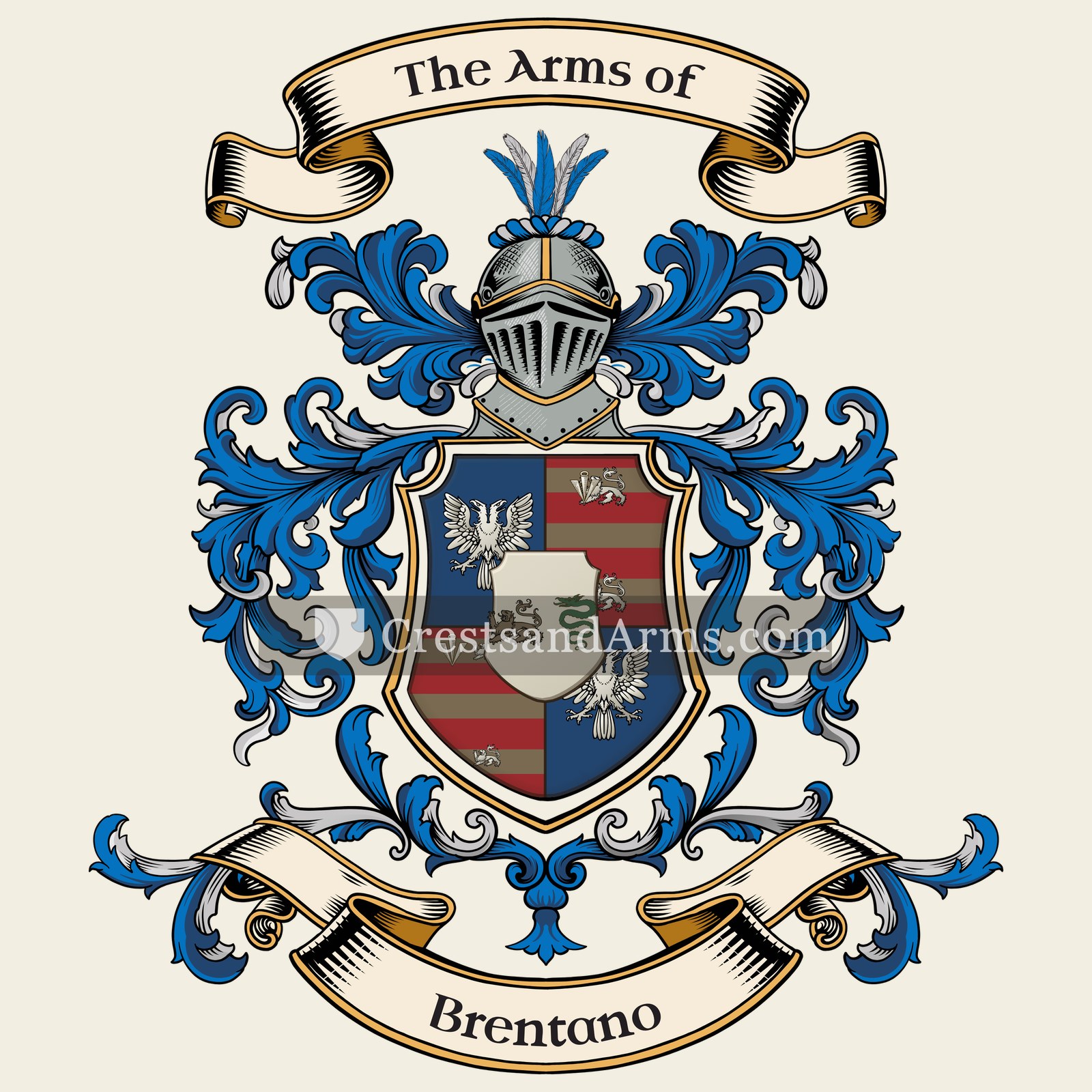
Symbols on this shield
lionCourage, strength and royalty
serpentWisdom, healing and prudence
eagleNobility, strength and a keen mind
arrowReadiness for battle, and affliction endured
Colours
Blue (Azure)Means: Loyalty and truth
Red (Gules)Means: Military strength
Silver (Argent)Means: Peace and sincerity
Green (Vert)Means: Hope
Historical info
Source
J. B. Rietstap, Armorial Général, Gouda: G. B. van Goor Zonen, 1884–87
Blazon (the actual original written record)
“Parti d'un trait, coupé de deux autres, qui font six quartiers: aux 1 et 4 à l'aigle ép. d'azur, chaque tête cour. du champ; aux 2 et 5 coupé-enclavé de gu. sur azur, à deux léopards pass. au nat., l'un sur l'autre; le tout acc. au canton dextre du chef d'un carreau d'arg., ch. d'une fleur-de-lis d'azur; aux 3 et 6 d'arg. à trois barres de gu. Sur le tout d'arg. à une hotte au nat., adextrée d'un lion cont. au nat. et senestrée d'une couleuvre ondoyante en pal de sin. Cq. cour. C.: l'aigle ép. L.: à dextre d'or et d'azur, à sen. d'arg. et d'azur. S.: à dextre un lion, à sen. un léopard, tous deux au nat. D.: IN FORTITUDINE PRUDENTIA.”
Austriac. 1857
Digital archive packCoat of arms PNG, gold border print PDF, vector SVG and the certificate of authenticity. Sent to your email in minutes.
Map of Austria showing where the Brentano arms are recorded
The Brentano arms were recorded in Austria, c. 1857.
Arms such as these were typically recorded in Tyrol.
Tyrol was mountain country in western Austria, where the valleys were held by families who had been there a very long time. Old tenure counted for more than money, and old families carried arms.
This is where the arms were entered in the register. Families often moved to other parts of the country, so the same name can turn up in more than one region.
Region
Tyrol
First recorded
1857
Granting Authority for the Brentano Arms
Imperial and Royal chancery
Sodacan · CC BY-SA 3.0
The body that granted and recorded arms in Austria in this period.
Franz Joseph I of Austria
Sovereign of the period
Franz Joseph I of Austria
1848–1916
Reigning in Germany when the Brentano arms are first recorded.
How Arms Worked in Austria
Austrian coats of arms were often linked directly to noble titles granted by the Emperor. These symbols belonged to the entire family line rather than just one individual. When a family grew, new branches kept the original design without needing to change it. This system allowed all members of a noble house to share the same identity across many generations.
Granting authority
The Imperial and Royal chancery managed all heraldic matters and controlled the official granting of arms throughout the Austrian lands.
How they got arms
Families typically received their arms through a formal imperial decree that often accompanied the elevation of a person to noble status.
Where arms were recorded
Official records of these grants were kept in the Imperial Register of Nobility which began its formal documentation process in 1453.
The family's standing
Recorded among the armigerous families of Austria.
Origin & History of the Brentano Family in Austria
The Brentano family name traces its roots to the alpine regions of northern Italy before establishing a significant presence in the Austrian province of Tyrol. By the mid-19th century, members of the family were well-integrated into the social and economic fabric of the region, particularly around the year 1857. The family was known for its involvement in trade and commerce, which allowed them to move across borders between the Italian-speaking territories and the German-speaking lands of the Austrian Empire. This mobility was common for merchant families of the era who sought to expand their business networks through the mountain passes. As they settled in Tyrol, the Brentanos became part of a growing class of families that bridged different cultures and languages. Their presence in the region reflects the broader history of migration and economic development that defined the Austrian Empire during the 1800s.
Brentano Meaning & Related Branches
Root word
Brenta
A river name derived from the Celtic word for high or steep.
This name
BrentanoAn Italian-originated habitational name for someone living near the Brenta river.
also spelled
Brentani
Brentan
Brentanoe
Related arms
Faustrecorded with Brentano, same area
Fuchsrecorded with Brentano, same area
Gaudyrecorded with Brentano, same area
Gruberrecorded with Brentano, same area
Documented Sources
J. B. Rietstap, Armorial Général, Gouda: G. B. van Goor Zonen, 1884–87
Brenner, Peter J., Brentano: Leben und Werk, 1990
Schulz, Gerhard, Die deutsche Literatur zwischen Französischer Revolution und Restauration, 1983


 paleMilitary strength, and a fortified defence
 cupFaith, office, and a trust discharged
 anchorHope, and steadfastness in trouble
 eagleNobility, strength and a keen mind
 wingSwiftness, and protection under a raised wing
 paleMilitary strength, and a fortified defence
 cupFaith, office, and a trust discharged
 anchorHope, and steadfastness in trouble
 eagleNobility, strength and a keen mind
 wingSwiftness, and protection under a raised wing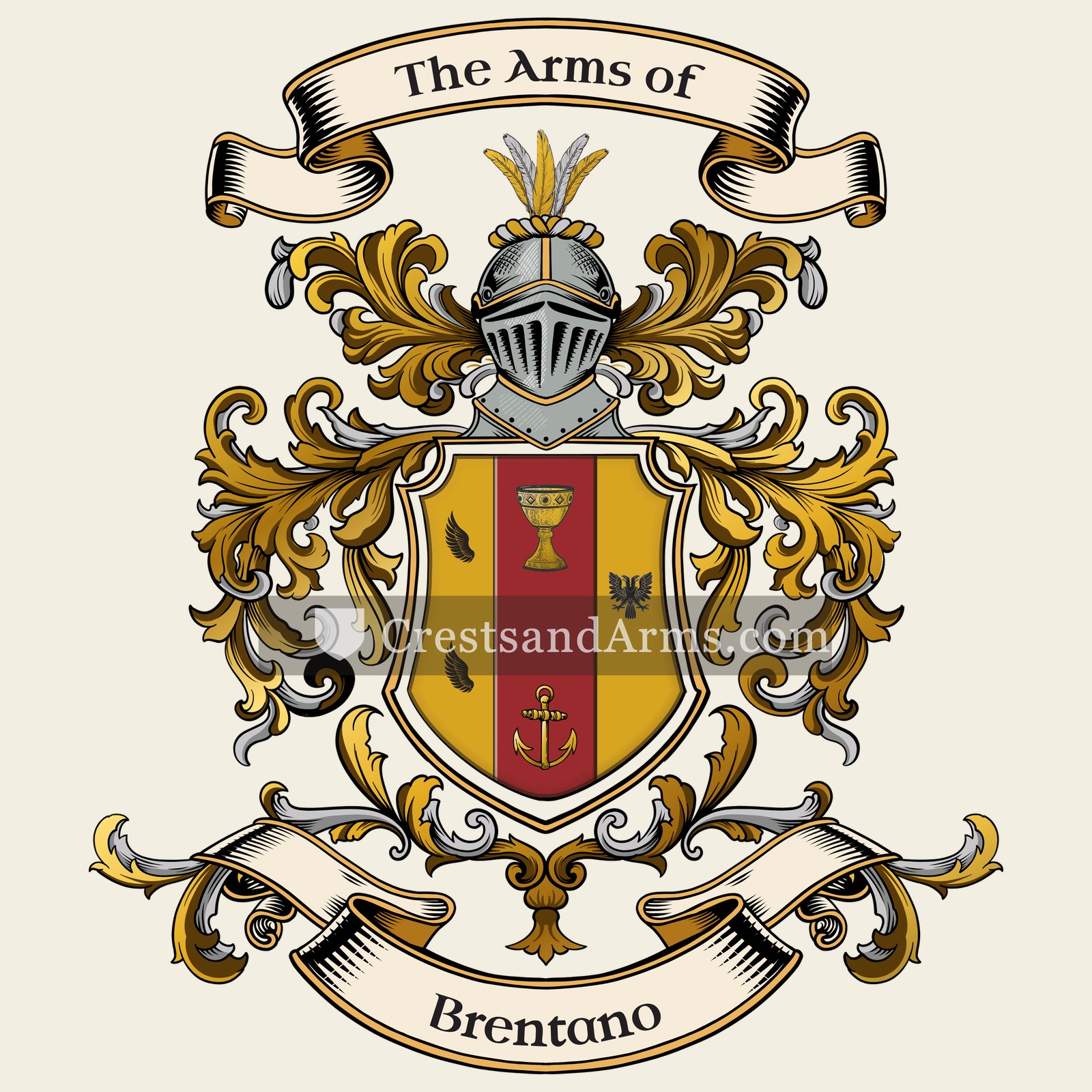


 lionCourage, strength and royalty
 serpentWisdom, healing and prudence
 arrowReadiness for battle, and affliction endured