Map of Netherlands showing where the Bressi arms are recorded
The Bressi arms were recorded in Dordrecht, c. 1815.
This is where the arms were entered in the register. Families often moved to other parts of the country, so the same name can turn up in more than one region.
Region
Dordrecht
Town
Dordrecht
First recorded
1815
Granting Authority for the Bressi Arms
Hoge Raad van Adel
Photograph made by me · CC BY-SA 3.0
The body that granted and recorded arms in Netherlands in this period.
William I of the Netherlands
Sovereign of the period
William I of the Netherlands
1815–1840
Reigning in Netherlands when the Bressi arms are first recorded.
How Arms Worked in Netherlands
In the Netherlands, coats of arms were often used by noble families and those who held specific public offices. These arms were passed down through the generations to legitimate descendants. Younger branches of a family usually kept the original design without needing to add special marks. This system ensured that the family identity remained clear and consistent over many years.
Granting authority
The Hoge Raad van Adel is the official body that regulates and manages noble titles and coats of arms in the Netherlands.
How they got arms
Families typically obtained their coats of arms through official royal grants or by proving their long-standing historical use of the symbols.
Where arms were recorded
Coats of arms are officially recorded in the registers held by the Hoge Raad van Adel, which began its work in 1814.
The family's standing
Recorded among the armigerous families of Netherlands.
Origin & History of the Bressi Family in Netherlands
The family name Bressi appears in the historical records of the Netherlands during the early nineteenth century, with documented evidence of family members living in the city of Dordrecht by 1815. Dordrecht was a major hub for trade and shipping at this time, making it a common destination for families moving across European borders. The name likely arrived in the region through the movement of people involved in the bustling river commerce that defined the city’s economy. During this period, the Netherlands underwent significant administrative changes under the new United Kingdom of the Netherlands, which led to more formal registration of family names in civil records. As these families settled into the urban life of Dordrecht, they became part of the local community, contributing to the city’s long history as a center for industry and maritime activity. By establishing roots in such a prominent port town, the Bressi family became part of the diverse social fabric that characterized the Dutch landscape during the post-Napoleonic era.
Coat of Arms & Family Crest Details
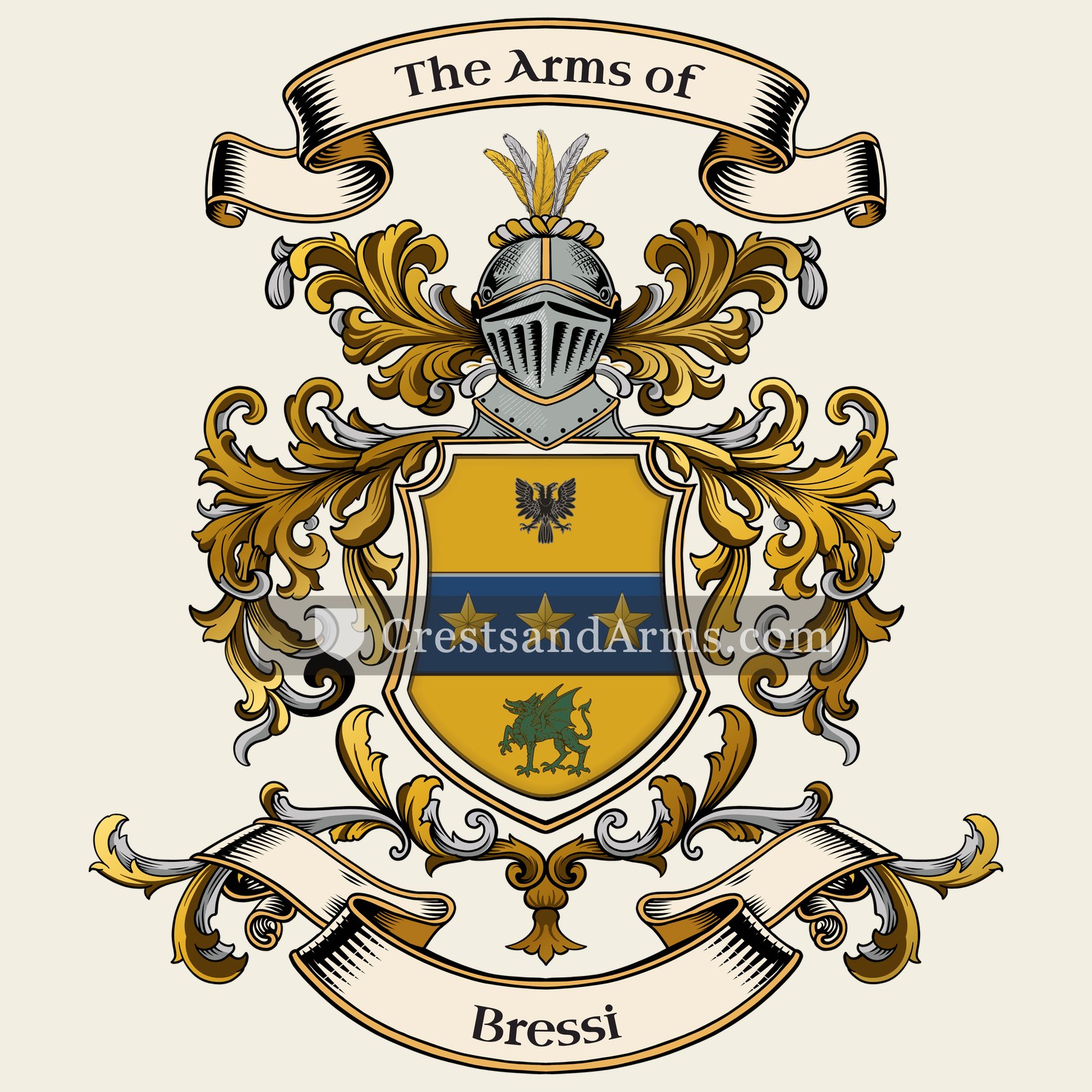
Symbols on this shield
fessThe military belt, and readiness to serve
mulletThe third son, and a divine quality from above
eagleNobility, strength and a keen mind
dragonA most valiant defender of treasure
Colours
Gold (Or)Means: Generosity
Blue (Azure)Means: Loyalty and truth
Black (Sable)Means: Constancy
Green (Vert)Means: Hope
Historical info
Source
J. B. Rietstap, Armorial Général, Gouda: G. B. van Goor Zonen, 1884–87
Blazon (the actual original written record)
“D'or à la fasce d'azur, ch. de trois étoiles (8) du champ et acc. en chef d'une aigle de sa. et en p. d'un dragon ailé à deux pattes de sin., crété et barbé de gu. Cq. cour. C.: une aigle iss. de sa. L.: à dextre d'or et de sa., à sen. d'arg. et d'azur.”
ItalyMilan, c. 1775
Digital archive packCoat of arms PNG, gold border print PDF, vector SVG and the certificate of authenticity. Sent to your email in minutes.
Map of Italy showing where the Bressi arms are recorded
The Bressi arms were recorded in Milan, c. 1775.
This is where the arms were entered in the register. Families often moved to other parts of the country, so the same name can turn up in more than one region.
The body that granted and recorded arms in Italy in this period.
Alvise Giovanni Mocenigo
Sovereign of the period
Alvise Giovanni Mocenigo
1763–1778
Reigning in Netherlands when the Bressi arms are first recorded.
How Arms Worked in Italy
In the Italian states, coats of arms were often used by noble families to show their status and history. These symbols were passed down through the generations to all legitimate male descendants. Younger branches of a family usually kept the original design but sometimes added small changes to distinguish their specific line from the main branch.
Granting authority
Various local rulers and city governments controlled the use of coats of arms across the different Italian states.
How they got arms
Families often assumed their own arms or received them as official grants from local lords, popes, or city councils.
Where arms were recorded
Arms were recorded in local city archives or private family books rather than in one single national register.
The family's standing
Recorded among the armigerous families of Italy.
Origin & History of the Bressi Family in Italy
The Bressi family name is deeply rooted in the historical landscape of Northern Italy, particularly within the bustling urban center of Milan. By the late eighteenth century, the family had established a documented presence in this region, which served as a major crossroads for trade, culture, and political change under the influence of the Austrian Empire. During this period, Milan was undergoing a transformation that favored the growth of professional and merchant classes, providing an environment where families like the Bressis could integrate into the local social fabric. The name itself likely evolved from regional dialects and naming conventions common to the Lombardy area, reflecting the linguistic shifts that occurred as Italy moved toward unification. By 1775, the family was already well-situated within the city, participating in the daily life and economic development of a region known for its industrious spirit and historical significance.
Bressi Meaning & Related Branches
Root word
Brescia
Derived from the ancient city name in Northern Italy.
This name
BressiAn occupational or habitational name referring to someone originating from the city of Brescia.
also spelled
Bressie
Bressy
Bresi
Related arms
Buissonsimilar arms
Caensimilar arms
Casiersimilar arms
Lieb von und zu Liebenheimsimilar arms
Documented Sources
J. B. Rietstap, Armorial Général, Gouda: G. B. van Goor Zonen, 1884–87


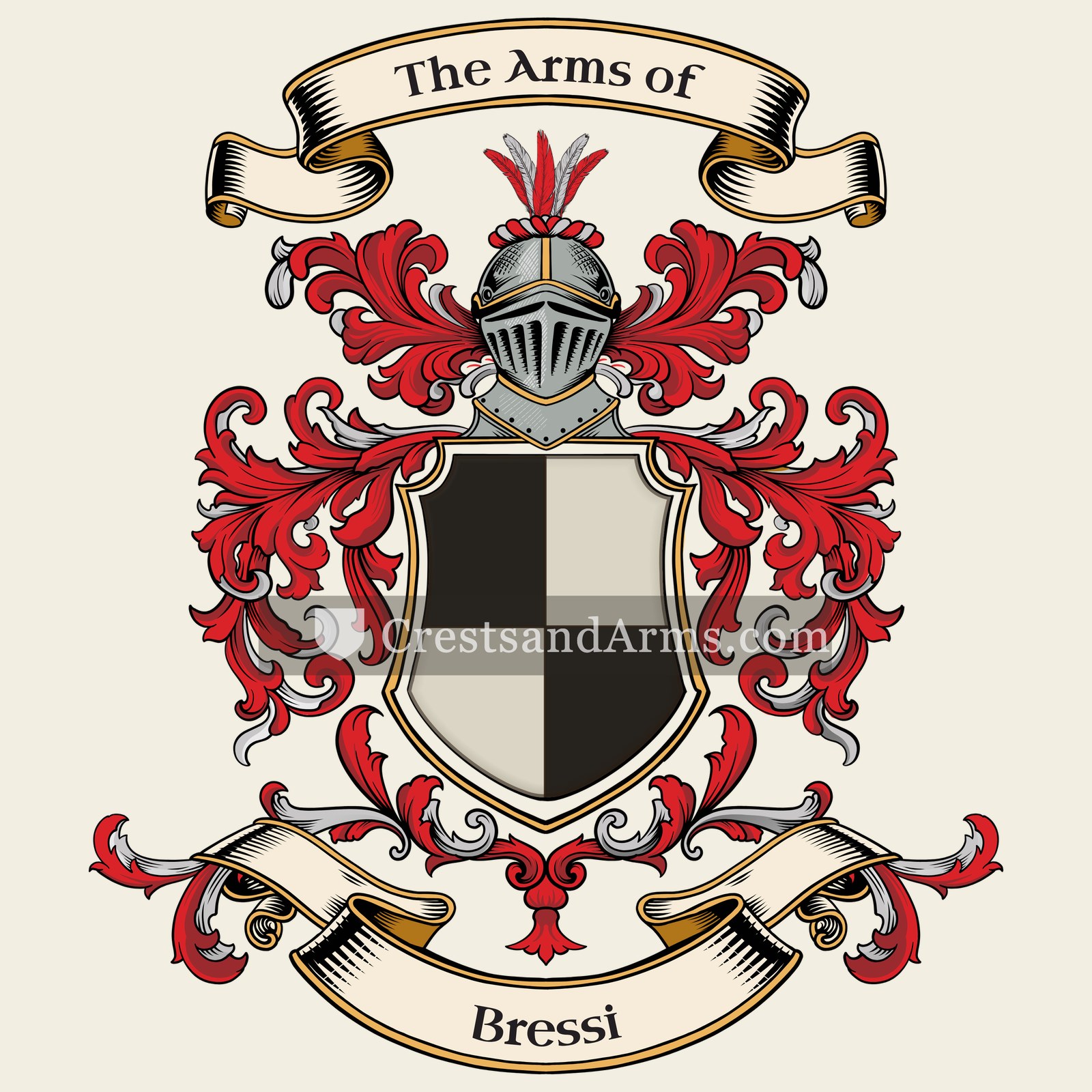


 fessThe military belt, and readiness to serve
 mulletThe third son, and a divine quality from above
 eagleNobility, strength and a keen mind
 dragonA most valiant defender of treasure