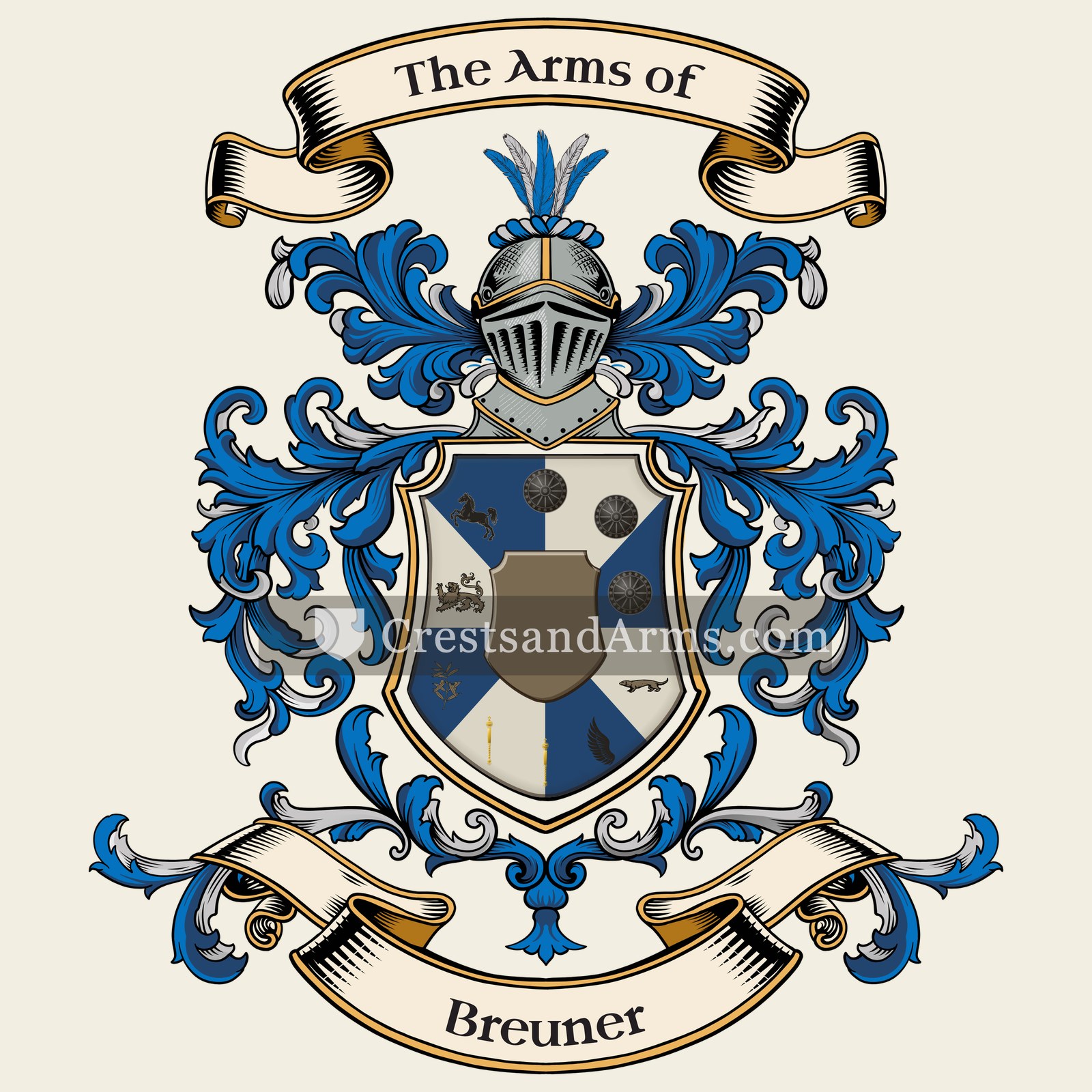
A record of documented arms, meaning and origin, researched for the Breuner family of Austria.
Reg. 1053 · Austrian, A–C
Coat of Arms & Family Crest Details
Symbols on this shield
roundelA coin, and one who has been to the crusades
otterOne who lives life to the full
wingSwiftness, and protection under a raised wing
sceptreRoyal authority and justice
branchPeace, and new growth
lionCourage, strength and royalty
horseReadiness to serve king and country
Colours
Silver (Argent)Means: Peace and sincerity
Black (Sable)Means: Constancy
Gold (Or)Means: Generosity
Historical info
Source
J. B. Rietstap, Armorial Général, Gouda: G. B. van Goor Zonen, 1884–87
Blazon (the actual original written record)
“Gironné: au 1 parti de sa. et de gu.; à trois bes. d'arg., rangés en pal, br. sur le parti; au 2 d'or au castor ramp. au nat.; au 3 d'arg. au demi-vol de sa.; au 4 d'azur au chapeau de cardinal de gu., surm. d'un poisson nageant d'arg.; au 5 de gu. à deux sceptres d'or, passés en saut.; au 6 d'or au chicot au nat. en barre, feuillé de trois pièces de sin., deux à dextre et une à sen.; au 7 d'arg. à la tête de lion au nat., cour. d'or, iss. d'une autre couronne d'or; au 8 d'azur au cheval sautant de sa., bridé de gu. Sur le tout d'arg. au pal échiq. d'or et de sa. Quatre cq. cour.; entre les deux cq. du milieu se trouve un écusson de gu., ch. d'une fasce d'arg., surch. de la lettre L d'or; cet écusson timbré de la couronne impériale et entouré du collier de l'Ordre de la Toison d'Or. C.: 1° un vol cont. d'arg., ch. d'un pal échiq. d'or et de sa.; l. d'arg. et de sa.; 2° un castor assis et cont. au nat.; l. d'arg. et de sa.; 3° le cheval de l'écu, iss.; l. d'arg. et d'azur; 4° un vol à l'antique de gu., ch. de deux sceptres d'or, passés en saut.; l. d'arg. et de gu. T.: à dextre une ange, hab. d'arg., cour. de feuillage, foulant aux pieds un dragon de sin. rehaussé d'or, tenant une bannière d'azur, frangée d'or et ch. d'une croix de Lorraine du même, entourée d'un serpent de sin., cour. d'or et courbé en cercle; — à sen. un chevalier, posé sur un lion couché, la cuirasse d'arg. chargée à dextre du pal du surtout; hab. d'une jupe de pourpre retr. d'herm., et recouvert d'un manteau de gu. doublé d'herm.; le casque, dont la visière est levée, panaché de six pl. d'aut., ait. de gu. et d'arg.; de sa main dextre le chevalier tient une bannière d'arg., frangée d'or et ch. d'un écusson de gu. à la fasce d'arg.”
StyriaStyria, c. 1550
Digital archive packCoat of arms PNG, gold border print PDF, vector SVG and the certificate of authenticity. Sent to your email in minutes.
Map of Austria showing where the Breuner arms are recorded
The Breuner arms were recorded in Styria, c. 1550.
Styria was mountain and forest country in southern Austria, with iron in its hills. Mining and landholding both made money, and families who held either kind of property took arms to seal their papers with.
This is where the arms were entered in the register. Families often moved to other parts of the country, so the same name can turn up in more than one region.
Region
Styria
First recorded
1550
Granting Authority for the Breuner Arms
Imperial and Royal chancery
Sodacan · CC BY-SA 3.0
The body that granted and recorded arms in Austria in this period.
Charles V
Sovereign of the period
Charles V
1519–1556
Reigning in Austria when the Breuner arms are first recorded.
How Arms Worked in Austria
Austrian coats of arms were often linked directly to noble titles granted by the Emperor. These symbols belonged to the entire family line rather than just one individual. When a family grew, new branches kept the original design without needing to change it. This system allowed all members of a noble house to share the same identity across many generations.
Granting authority
The Imperial and Royal chancery managed all heraldic matters and controlled the official granting of arms throughout the Austrian lands.
How they got arms
Families typically received their arms through a formal imperial decree that often accompanied the elevation of a person to noble status.
Where arms were recorded
Official records of these grants were kept in the Imperial Register of Nobility which began its formal documentation process in 1453.
The family's standing
Recorded among the armigerous families of Styria.
Origin & History of the Breuner Family in Austria
The Breuner family name has deep roots in the history of Styria, a region located in modern-day Austria. By the year 1550, the family had already established a significant presence in this area as members of the landed nobility. They were deeply involved in the political and social life of the region, often serving in important administrative and military roles for the local rulers. The name itself is thought to be linked to the German word for a brewer, suggesting that the family’s ancestors may have originally held a position of importance in the production or trade of beer. As they gained wealth and influence, the Breuners expanded their landholdings and became key figures in the development of Styrian society during the sixteenth century. Their rise to prominence reflects the broader history of noble families who helped shape the governance and culture of the Holy Roman Empire.
Breuner Meaning & Related Branches
Root word
Brun
A Germanic term referring to the color brown or dark-colored.
This name
BreunerAn occupational or descriptive name for someone with brown hair or a dark complexion.
also spelled
Breunere
Brooner
Documented Sources
J. B. Rietstap, Armorial Général, Gouda: G. B. van Goor Zonen, 1884–87


 roundelA coin, and one who has been to the crusades
 otterOne who lives life to the full
 wingSwiftness, and protection under a raised wing
 sceptreRoyal authority and justice
 branchPeace, and new growth
 lionCourage, strength and royalty
 horseReadiness to serve king and country