A record of documented arms, meaning and origin, researched for the Breuning family lines. Documented in 2 countries.
Reg. 8725 · French, A–C
Coat of Arms & Family Crest Details
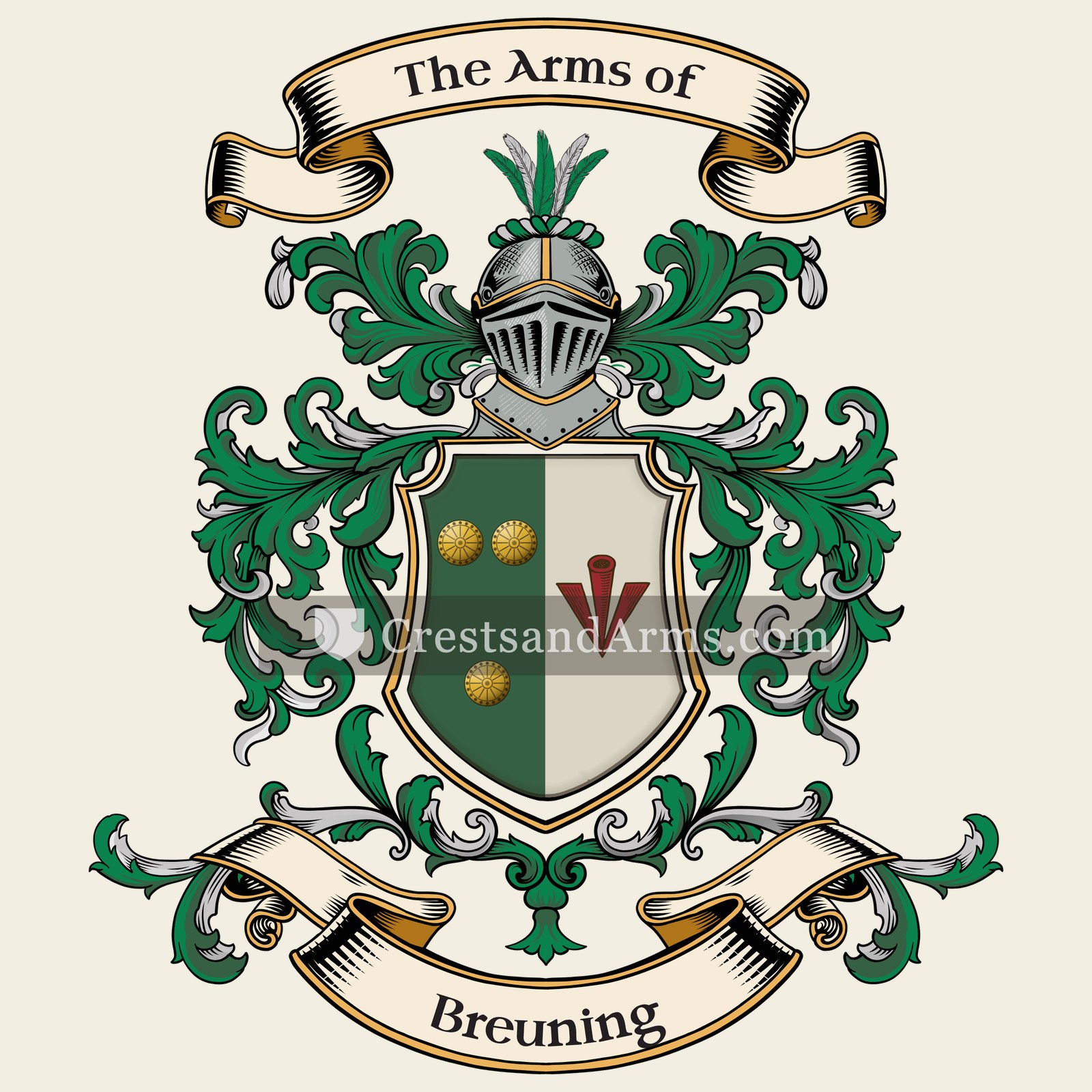
Symbols on this shield
chevronProtection, and faithful service completed
fleur de lisPurity, light, and the sixth son
Colours
Silver (Argent)Means: Peace and sincerity
Blue (Azure)Means: Loyalty and truth
Historical info
Source
J. B. Rietstap, Armorial Général, Gouda: G. B. van Goor Zonen, 1884–87
Blazon (the actual original written record)
“D'arg. à trois chev. d'azur, surm. chacun d'une fleur-de-lis du même. Cq. cour. C.: un vol de sa., chaque aile ch. d'un pal d'arg. aux armes de l'écu.”
Francec. 1737
Digital archive packCoat of arms PNG, gold border print PDF, vector SVG and the certificate of authenticity. Sent to your email in minutes.
Map of France showing where the Breuning arms are recorded
The Breuning arms were recorded in France, c. 1737.
Arms such as these were typically recorded in Bretagne.
More families held coats of arms in Bretagne than anywhere else in France. The land was divided into many small estates rather than a few large ones, so far more households counted as gentry, and each needed a shield of its own to be told apart.
This is where the arms were entered in the register. Families often moved to other parts of the country, so the same name can turn up in more than one region.
The body that granted and recorded arms in France in this period.
Louis XV of France
Sovereign of the period
Louis XV of France
1715–1774
Reigning in France when the Breuning arms are first recorded.
How Arms Worked in France
In France, a coat of arms was a mark of honor that passed down through the male line to all legitimate descendants. Families often used the same shield without changes to show their shared heritage. If a branch wanted to stand out, they could add a small mark to their shield to show their specific place in the family tree.
Granting authority
The Juge d'armes de France acted as the official authority that regulated and verified coats of arms across the country.
How they got arms
Families typically inherited their arms from ancestors, though they could also receive them through royal grants or by proving their noble status.
Where arms were recorded
Coats of arms were officially recorded in the Armorial Général de France, which began its main collection in the year 1696.
The family's standing
Recorded among the armigerous families of France.
Origin & History of the Breuning Family in France
The family name Breuning has deep roots that connect to the unique cultural landscape of the Brittany region in France. By the year 1737, records confirm that members of the family were already established in this coastal area, which was known for its distinct linguistic traditions and maritime history. The name itself likely originated from Germanic roots, reflecting the movement of people across European borders during periods of migration and trade. As the family settled into the Breton social structure, they became part of a community defined by its strong local identity and agricultural lifestyle. Over time, the family integrated into the local parish records and civic life, marking their transition from newcomers to long-term residents of the province. Their presence in Brittany highlights how families often moved between different regions of Europe to find new opportunities while maintaining the heritage of their original surnames.
Coat of Arms & Family Crest Details
Symbols on this shield
roundelA coin, and one who has been to the crusades
arrowReadiness for battle, and affliction endured
Colours
Green (Vert)Means: Hope
Silver (Argent)Means: Peace and sincerity
Gold (Or)Means: Generosity
Red (Gules)Means: Military strength
Historical info
Source
J. B. Rietstap, Armorial Général, Gouda: G. B. van Goor Zonen, 1884–87
Blazon (the actual original written record)
“Parti: au 1 de sin. à trois bes. d'or; au 2 d'arg. à un faisceau de trois flèches de gu., les pointes en bas, armées d'azur, chaque flèche empennée à dextre d'arg. et à sen. d'azur. Deux cq. cour. C.: 1° les hes. du 1, entre un vol de sa.; l. d'or et de sin.; 2° un buste de vieillard barbu, posé de profil, hab. de gu., coiffé d'un bonnet albanais du même, retr. d'azur; l. d'or et de sa.”
WurttembergWurttemberg, c. 1806
Digital archive packCoat of arms PNG, gold border print PDF, vector SVG and the certificate of authenticity. Sent to your email in minutes.
Map of Germany showing where the Breuning arms are recorded
The Breuning arms were recorded in Wurttemberg, c. 1806.
Wurttemberg was southern German country of small estates and well-off market towns. Both landowners and leading townsmen kept arms there, so the region carries far more names than its size suggests.
This is where the arms were entered in the register. Families often moved to other parts of the country, so the same name can turn up in more than one region.
The body that granted and recorded arms in Germany in this period.
Frederick William III of Prussia
Sovereign of the period
Frederick William III of Prussia
1797–1840
Reigning in France when the Breuning arms are first recorded.
How Arms Worked in Germany
Prussian heraldry was strictly tied to social rank and noble status rather than being a free choice for every citizen. These symbols were treated as permanent family property that moved through the generations to all legitimate heirs. If a family branch wanted to change their design to stand out, they had to apply for official permission to alter their specific version of the shield.
Granting authority
The Prussian Heroldsamt acted as the central state office that managed and strictly controlled all noble titles and coats of arms.
How they got arms
Families usually obtained their arms through formal royal grants or by proving their long-standing noble status to the state authorities.
Where arms were recorded
All official coats of arms were kept in the rolls of the Prussian Heroldsamt, which functioned from 1706 until 1918.
The family's standing
Recorded among the armigerous families of Wurttemberg.
Origin & History of the Breuning Family in Germany
The family name Breuning has deep roots in the southwestern region of Germany, particularly within the historical territory of Württemberg. The name is derived from the Middle High German word "brun," which was often used to describe someone with brown hair or a dark complexion. By the time the region transitioned into the Kingdom of Württemberg in 1806, the Breuning family was already well-established as part of the local social fabric. During this period, families with this surname were frequently found in professional and civic roles, contributing to the administrative and cultural life of the Swabian landscape. As the region moved through the political shifts of the early nineteenth century, the Breunings remained tied to the local traditions and the evolving identity of the German states. Their history reflects the broader movement of families who settled in the fertile lands of the Neckar valley and built lasting legacies through community service and local industry.
Breuning Meaning & Related Branches
Root word
Brun
A Germanic term referring to the color brown or dark.
This name
BreuningA diminutive or patronymic form describing someone with brown hair or a dark complexion.
also spelled
Breuninge
Bruning
Brooning
Documented Sources
J. B. Rietstap, Armorial Général, Gouda: G. B. van Goor Zonen, 1884–87
Archives Départementales du Finistère, Registres paroissiaux et d'état civil
Pottier, Jean, Histoire de la Bretagne, 1995
Tanguy, Bernard, Dictionnaire des noms de communes, trèves et paroisses du Finistère, 1990
Digital archive packCoat of arms PNG, gold border print PDF, vector SVG and the certificate of authenticity. Sent to your email in minutes.


 chevronProtection, and faithful service completed
 fleur de lisPurity, light, and the sixth son
 chevronProtection, and faithful service completed
 fleur de lisPurity, light, and the sixth son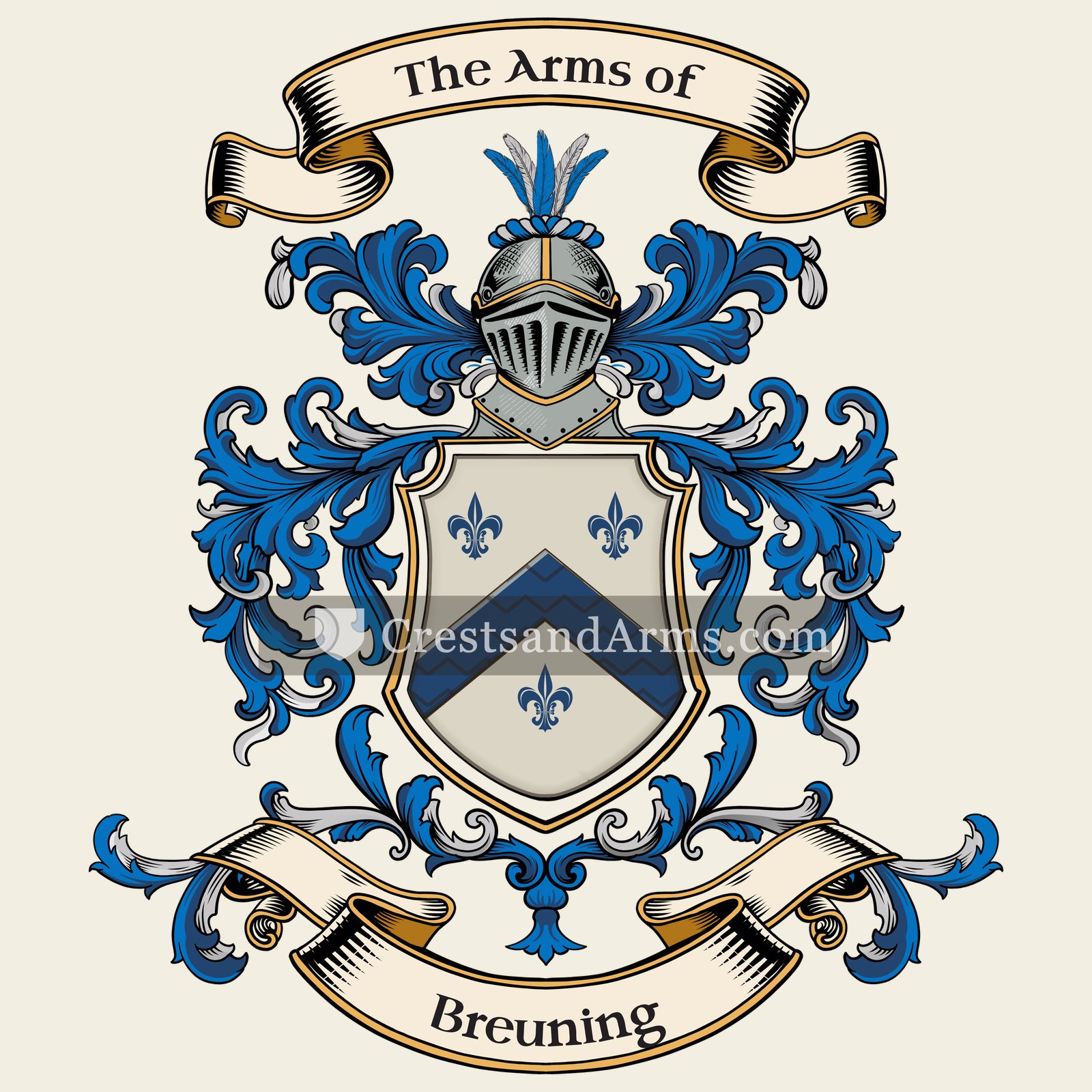


 roundelA coin, and one who has been to the crusades
 arrowReadiness for battle, and affliction endured