Map of France showing where the Brey arms are recorded
The Brey arms were recorded in France, c. 1663.
Arms such as these were typically recorded in Bretagne.
More families held coats of arms in Bretagne than anywhere else in France. The land was divided into many small estates rather than a few large ones, so far more households counted as gentry, and each needed a shield of its own to be told apart.
This is where the arms were entered in the register. Families often moved to other parts of the country, so the same name can turn up in more than one region.
The body that granted and recorded arms in France in this period.
Louis XIV of France
Sovereign of the period
Louis XIV of France
1643–1715
Reigning in France when the Brey arms are first recorded.
How Arms Worked in France
In France, a coat of arms was a mark of honor that passed down through the male line to all legitimate descendants. Families often used the same shield without changes to show their shared heritage. If a branch wanted to stand out, they could add a small mark to their shield to show their specific place in the family tree.
Granting authority
The Juge d'armes de France acted as the official authority that regulated and verified coats of arms across the country.
How they got arms
Families typically inherited their arms from ancestors, though they could also receive them through royal grants or by proving their noble status.
Where arms were recorded
Coats of arms were officially recorded in the Armorial Général de France, which began its main collection in the year 1696.
The family's standing
Recorded among the armigerous families of France.
Origin & History of the Brey Family in France
The family name Brey finds its early roots in the rugged landscape of Bretagne, where records confirm the presence of family members as far back as 1663. During this period, the region was defined by a distinct cultural identity and a strong connection to the maritime traditions of northwestern France. Families living in Bretagne at this time often worked closely with the land or the sea, navigating the complex social structures of a province that maintained its own unique customs and legal traditions. The name likely evolved as a way to identify individuals within these tight-knit rural communities, reflecting the specific linguistic patterns common to the Breton people. By establishing themselves in this region during the seventeenth century, the early Brey ancestors became part of a long history of resilience and local development that shaped the character of the area for generations to come.
Coat of Arms & Family Crest Details
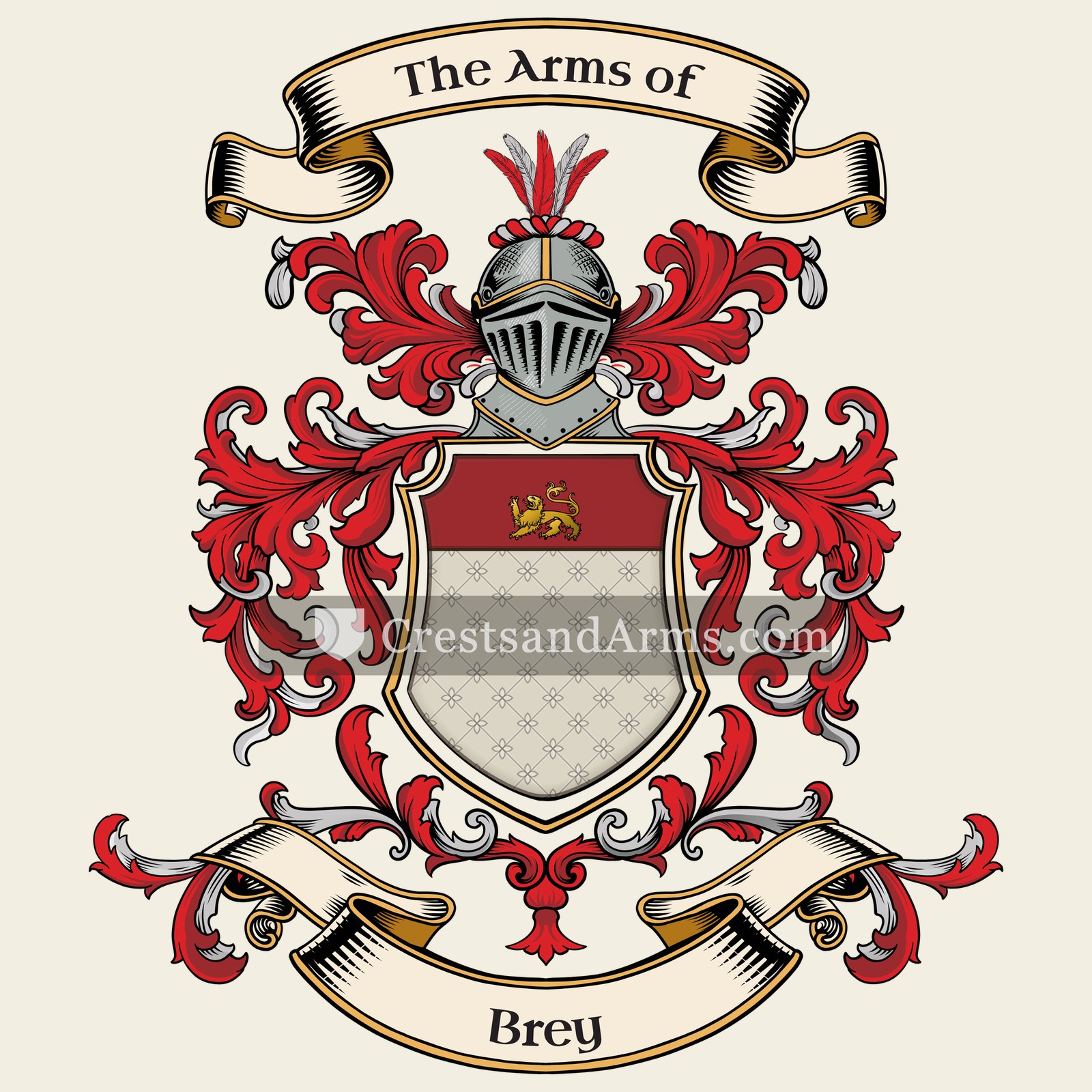
Symbols on this shield
chiefAuthority, wisdom and dominion
lionCourage, strength and royalty
Colours
Silver (Argent)Means: Peace and sincerity
Red (Gules)Means: Military strength
Gold (Or)Means: Generosity
Historical info
Source
Sir Bernard Burke, The General Armory of England, Scotland, Ireland and Wales, London: Harrison & Sons, 1884
Blazon (the actual original written record)
“Ar. on a chief gu. a lion pass. guard. or”
Irelandc. 1645
Digital archive packCoat of arms PNG, gold border print PDF, vector SVG and the certificate of authenticity. Sent to your email in minutes.
Map of Ireland showing where the Brey arms are recorded
The Brey arms were recorded in Ireland, c. 1645.
Arms such as these were typically recorded in Dublin.
Dublin was the seat of government in Ireland and the place where grants were sought and recorded. Families with business at the castle or the courts settled nearby, and settling there put their arms on record.
This is where the arms were entered in the register. Families often moved to other parts of the country, so the same name can turn up in more than one region.
The body that granted and recorded arms in Ireland in this period.
Charles I of England
Sovereign of the period
Charles I of England
1625–1649
Reigning in France when the Brey arms are first recorded.
How Arms Worked in Ireland
The Ulster King of Arms granted coats of arms to individuals who proved their social standing and good character. These symbols were typically inherited by all legitimate descendants of the original holder. If a family branch wanted a unique look, they could apply for a specific change to their design through the office to ensure their identity remained distinct.
Granting authority
The Ulster King of Arms acted as the official body that regulated and issued all coats of arms throughout Ireland.
How they got arms
Families obtained their arms through formal grants issued by the office after proving their eligibility and paying the required fees.
Where arms were recorded
All official grants were recorded in the registers held by the Ulster King of Arms starting from the year 1552.
The family's standing
Recorded among the armigerous families of Ireland.
Origin & History of the Brey Family in Ireland
The history of the Brey family in Ireland is rooted in the mid-seventeenth century, a period defined by significant political and social upheaval. Records confirm that members of the family were established in Dublin by 1645, a time when the city was a central hub for trade and administration during the Irish Confederate Wars. Because the name is not of Gaelic origin, it is likely that the family arrived in Ireland as part of the broader migration patterns of the era, potentially linked to mercantile activities or administrative roles within the English-controlled Pale. Living in Dublin during the 1640s meant that the family would have experienced the intense pressures of the city’s defensive preparations and the shifting loyalties of the time. While the name remained relatively uncommon, its presence in the capital suggests that the early Brey family members were part of the urban middle class who helped shape the city’s development during one of the most turbulent centuries in Irish history.
Brey Meaning & Related Branches
Root word
Brai
Old French term referring to a marshy or swampy area.
This name
BreyA topographic name for someone who lived near a marsh or wetland.
also spelled
Bray
Breye
Brei
Breyer
Related arms
Brayvariant spelling
Brayevariant spelling
Breevariant spelling
Documented Sources
J. B. Rietstap, Armorial Général, Gouda: G. B. van Goor Zonen, 1884–87
Archives départementales du Morbihan, Registres paroissiaux et d'état civil, 1663
Archives départementales du Finistère, Registres paroissiaux et d'état civil, 1663
Galliot, Marcel, Histoire de la Bretagne, 1964
Le Moyne de La Borderie, Arthur, Histoire de Bretagne, 1896
Digital archive packCoat of arms PNG, gold border print PDF, vector SVG and the certificate of authenticity. Sent to your email in minutes.


 chequyConstancy, and the counting-board
 bendDefence, and the scarf of a commander
 chequyConstancy, and the counting-board
 bendDefence, and the scarf of a commander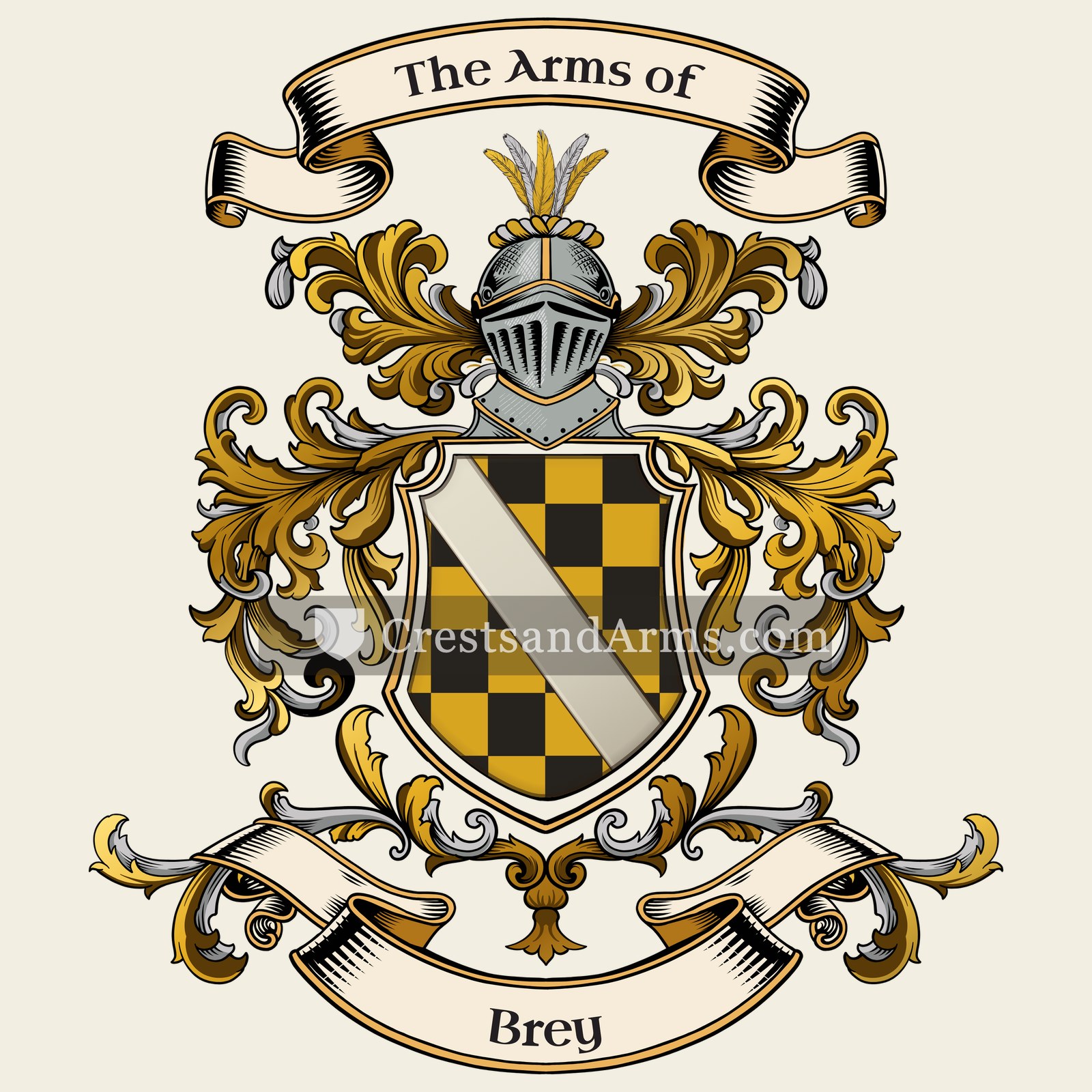


 chiefAuthority, wisdom and dominion
 lionCourage, strength and royalty