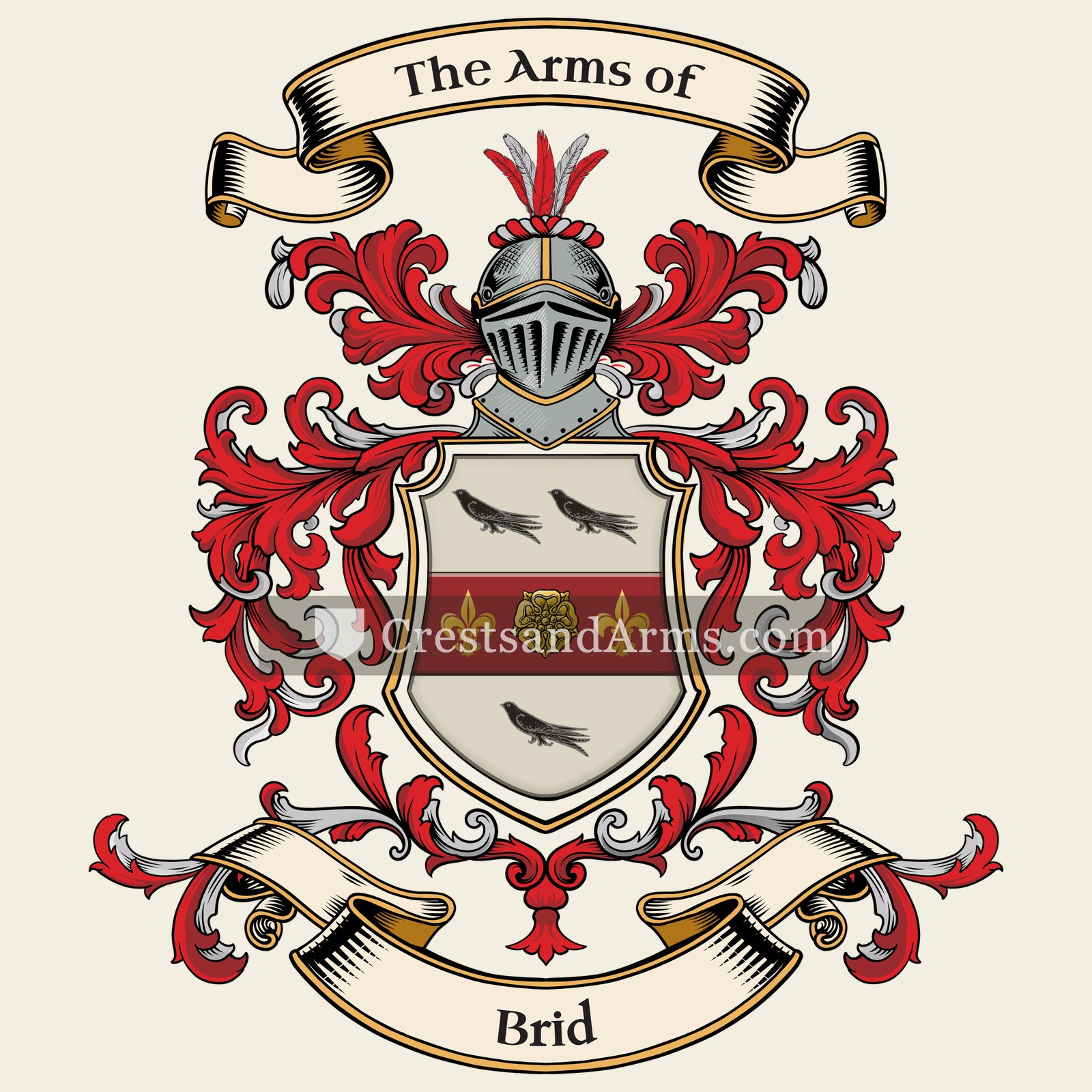
A record of documented arms, meaning and origin, researched for the Brid family of England.
Reg. 0924 · English, A–C
Coat of Arms & Family Crest Details
Symbols on this shield
fessThe military belt, and readiness to serve
roseThe seventh son, and beauty with grace
martletA younger son, who must win his own land
fleur de lisPurity, light, and the sixth son
Colours
Silver (Argent)Means: Peace and sincerity
Red (Gules)Means: Military strength
Gold (Or)Means: Generosity
Historical info
Source
Sir Bernard Burke, The General Armory of England, Scotland, Ireland and Wales, London: Harrison & Sons, 1884
Blazon (the actual original written record)
“Ar. on a fesse gu. betw. three birds a rose betw. two fleurs-de-lis or”
EnglandLondon, c. 1620
Where the Brid Arms Were Recorded
London
Map of England showing where the Brid arms are recorded
The Brid arms were recorded in London, c. 1620.
This is where the arms were entered in the register. Families often moved to other parts of the country, so the same name can turn up in more than one region.
The body that granted and recorded arms in England in this period.
James VI and I
Sovereign of the period
James VI and I
1603–1625
Reigning in England when the Brid arms are first recorded.
How Arms Worked in England
English heraldry allowed arms to be shared by all legitimate descendants of the original owner. These symbols were treated as personal property that moved through the generations to all children. While the eldest son kept the original design, other family members could use the same shield without needing to change it or register their own unique versions.
Granting authority
The College of Arms in London has regulated the use of coats of arms throughout England and Wales since 1484.
How they got arms
Families typically obtained their coats of arms through a formal grant from the Crown or by proving their ancient right to them.
Where arms were recorded
All official coats of arms are recorded in the registers kept at the College of Arms, which date back to the fifteenth century.
The family's standing
Recorded among the armigerous families of England.
Origin & History of the Brid Family in England
The family name Brid has roots that stretch back to the bustling streets of seventeenth-century London. By 1620, records show that members of the Brid family were already established residents within the city, living during a time of great social change and urban growth. The name itself is thought to be a variation of older occupational or descriptive terms, often linked to the Middle English word for a bird or a person with a lively personality. As London expanded into a global center for trade and culture, the Brid family likely participated in the daily life of the city, working as merchants, tradespeople, or laborers. Their presence in the capital during this era suggests they were part of the growing middle class that helped shape the city’s identity before the major historical upheavals of the mid-1600s.
Related Branches & Arms
Root word
Brigid
Derived from the Celtic goddess name meaning exalted one or high.
This name
BridAn English locational or occupational surname referring to someone living near a bridge.
also spelled
Bryd
Bryde
Bridde
Documented Sources
Sir Bernard Burke, The General Armory of England, Scotland, Ireland and Wales, London: Harrison & Sons, 1884
London Metropolitan Archives, London, England, Church of England Baptisms, Marriages and Burials, 1538–1812
The National Archives, State Papers Domestic, James I, 1619–1623
Digital archive packCoat of arms PNG, gold border print PDF, vector SVG and the certificate of authenticity. Sent to your email in minutes.


 fessThe military belt, and readiness to serve
 roseThe seventh son, and beauty with grace
 martletA younger son, who must win his own land
 fleur de lisPurity, light, and the sixth son
 fessThe military belt, and readiness to serve
 roseThe seventh son, and beauty with grace
 martletA younger son, who must win his own land
 fleur de lisPurity, light, and the sixth son