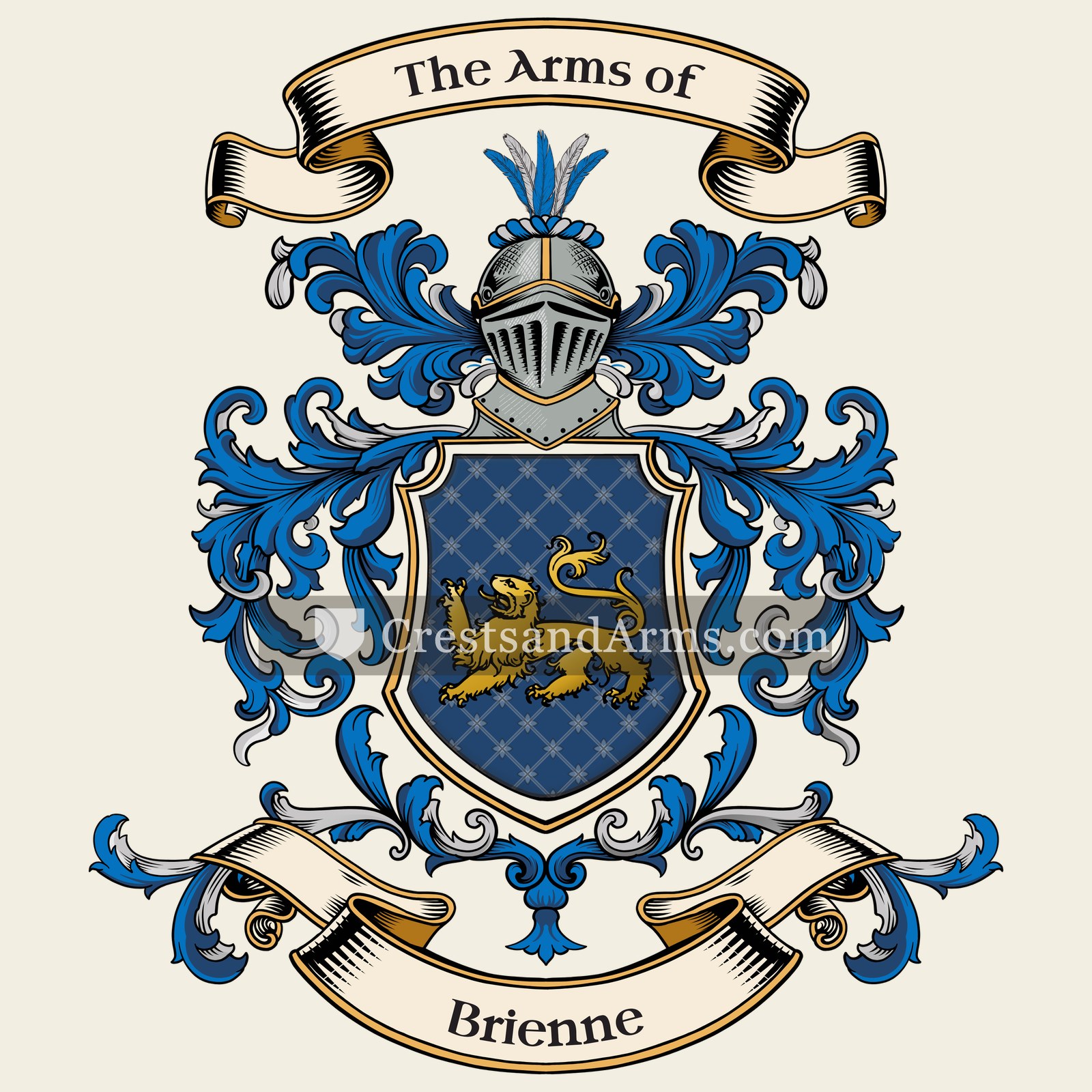
A record of documented arms, meaning and origin, researched for the Brienne family of France.
Reg. 9091 · French, A–C
Coat of Arms & Family Crest Details
Symbols on this shield
lionCourage, strength and royalty
Colours
Blue (Azure)Means: Loyalty and truth
Gold (Or)Means: Generosity
Historical info
Source
J. B. Rietstap, Armorial Général, Gouda: G. B. van Goor Zonen, 1884–87
Blazon (the actual original written record)
“D'azur au lion d'or.”
ChampagneChampagne, c. 1219
Where the Brienne Arms Were Recorded
Champagne
Map of France showing where the Brienne arms are recorded
The Brienne arms were recorded in Champagne, c. 1219.
Champagne made its money at its great trade fairs, where merchants from across Europe met. Wealth of that kind bought land, and land brought arms, so the region carries a lot of names.
This is where the arms were entered in the register. Families often moved to other parts of the country, so the same name can turn up in more than one region.
The body that granted and recorded arms in France in this period.
Philip II of France
Sovereign of the period
Philip II of France
1180–1223
Reigning in France when the Brienne arms are first recorded.
How Arms Worked in France
In France, a coat of arms was a mark of honor that passed down through the male line to all legitimate descendants. Families often used the same shield without changes to show their shared heritage. If a branch wanted to stand out, they could add a small mark to their shield to show their specific place in the family tree.
Granting authority
The Juge d'armes de France acted as the official authority that regulated and verified coats of arms across the country.
How they got arms
Families typically inherited their arms from ancestors, though they could also receive them through royal grants or by proving their noble status.
Where arms were recorded
Coats of arms were officially recorded in the Armorial Général de France, which began its main collection in the year 1696.
The family's standing
Recorded among the armigerous families of Champagne.
Origin & History of the Brienne Family in France
The family name Brienne originates from the town of Brienne-le-Château in the Champagne region of France. By the early thirteenth century, the family had established itself as a powerful noble house with significant influence over local lands and politics. Members of the family were active in the region by 1219, often serving as prominent lords who managed estates and participated in the complex feudal systems of the time. Because of their strategic location in Champagne, they were frequently involved in regional governance and military affairs. The family name became synonymous with the prestige of the area, as they held titles that linked them to both local administration and broader European crusading movements. Their rise to prominence during this era helped secure their legacy as one of the most notable families in medieval French history.
Related Branches & Arms
Root word
Briga
A Celtic term referring to a hill, fortress, or elevated place.
This name
BrienneDerived from a place name in France, signifying someone who lived near a hill or fortified settlement.
also spelled
Brien
Bryenne
Bree-en
Related arms
Artoisrecorded with Brienne, same area
* **Champagnerecorded with Brienne, same area
Clevesrecorded with Brienne, same area
Guyennerecorded with Brienne, same area
Documented Sources
J. B. Rietstap, Armorial Général, Gouda: G. B. van Goor Zonen, 1884–87
Evergates, Theodore, Feudal Society in the Bailliage of Troyes under the Counts of Champagne, 1152-1284, 1975
Longnon, Auguste, Documents relatifs au comté de Champagne et de Brie, 1172-1361, 1901
Archives Nationales, Trésor des chartes, série J, 1219
Digital archive packCoat of arms PNG, gold border print PDF, vector SVG and the certificate of authenticity. Sent to your email in minutes.


 lionCourage, strength and royalty
 lionCourage, strength and royalty