A record of documented arms, meaning and origin, researched for the Briers family lines. Documented in 3 countries.
Reg. 0732 · Belgian, A–C
Meaning of the Briers family crest colors & symbols
Symbols on this shield
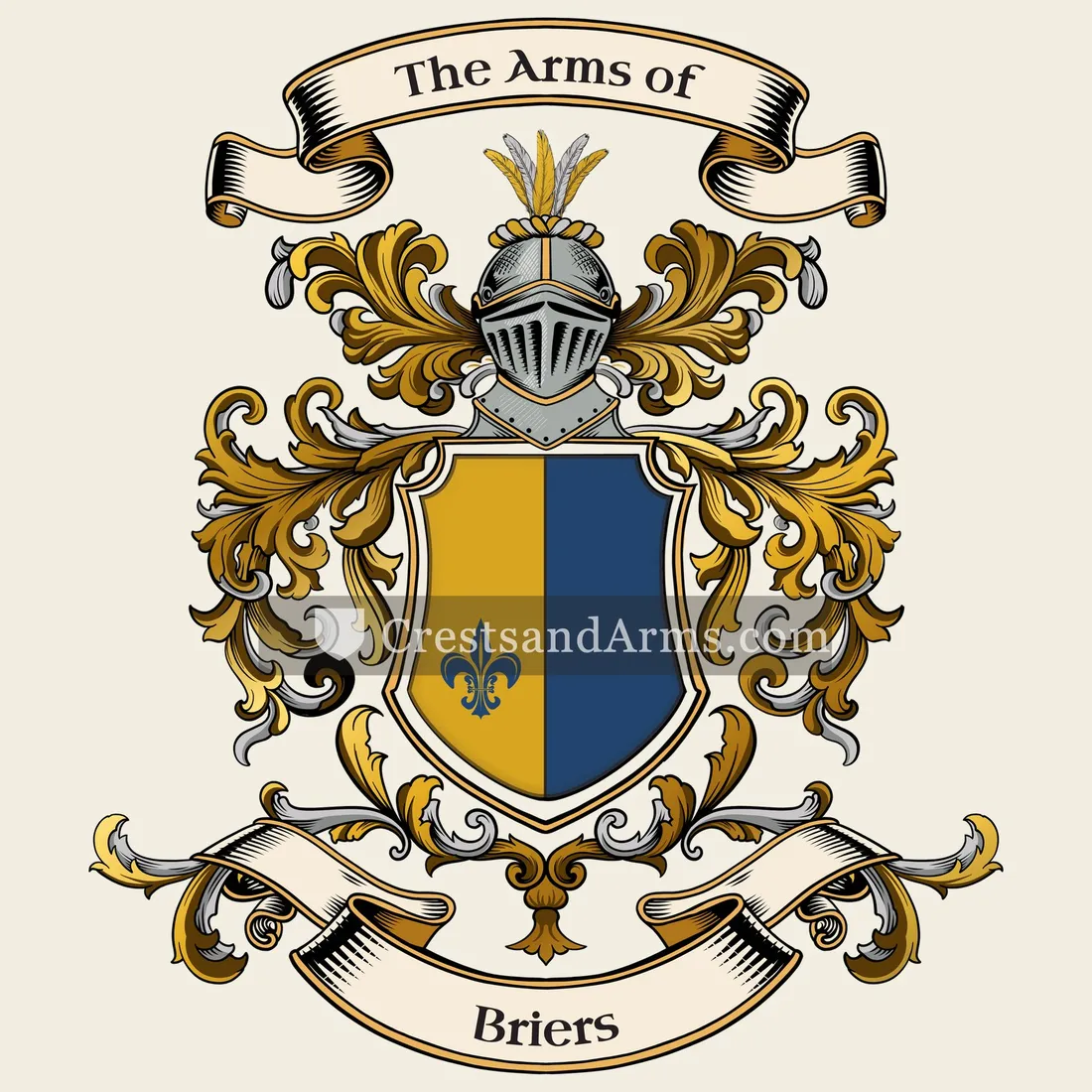
fleur de lisPurity, light, and the sixth son
Colours
Gold (Or)Means: Generosity
Blue (Azure)Means: Loyalty and truth
Historical info
Source
J. B. Rietstap, Armorial Général, Gouda: G. B. van Goor Zonen, 1884–87
Blazon (the actual original written record)
“Parti d'or et d'azur, semé de fleurs-de-lis de l'un à l'autre. C.: un Neptune, tenant de sa main dextre un diamant et de sa sen. un trident sommé d'un dauphin.”
BelgiumMalines, c. 1681
Digital archive packCoat of arms PNG, gold border print PDF, vector SVG and the certificate of authenticity. Sent to your email in minutes.
Map of Belgium showing where the Briers arms are recorded
The Briers arms were recorded in Malines, c. 1681.
This is where the arms were entered in the register. Families often moved to other parts of the country, so the same name can turn up in more than one region.
The body that granted and recorded arms in Belgium in this period.
Charles II of Spain
Sovereign of the period
Charles II of Spain
1665–1700
Reigning in Belgium when the Briers arms are first recorded.
How Arms Worked in Belgium
In Belgium, a coat of arms is considered personal property that is passed down through the male line to legitimate descendants. Families often use the same shield design across generations to show their shared heritage. If a branch of the family wants to change the design, they must apply for an official update to their specific version of the arms.
Granting authority
The Conseil héraldique is the official body that regulates and approves all coats of arms in Belgium.
How they got arms
Families obtain their coats of arms through formal royal grants or by confirming their historical right to use existing designs.
Where arms were recorded
All approved coats of arms are officially recorded in the public registers of the Conseil héraldique since 1844.
The family's standing
Recorded among the armigerous families of Belgium.
Origin & History of the Briers Family in Belgium
The history of the Briers family in Belgium is deeply rooted in the historic city of Malines, also known as Mechelen. By the year 1681, members of the family were already established residents within this influential center of trade and religion. During this period, Malines served as a vital hub in the Southern Netherlands, and families like the Briers often integrated into the local urban economy through craftsmanship or civic service. The name itself likely evolved from regional linguistic roots related to the local landscape or specific trade roles common in the Flemish provinces. As the family grew, they became part of the social fabric of the city, navigating the complex political shifts that defined the region under various European powers. Their presence in 17th-century records highlights a long-standing connection to the urban development and cultural life of the Low Countries.
Meaning of the Briers family crest colors & symbols
Symbols on this shield
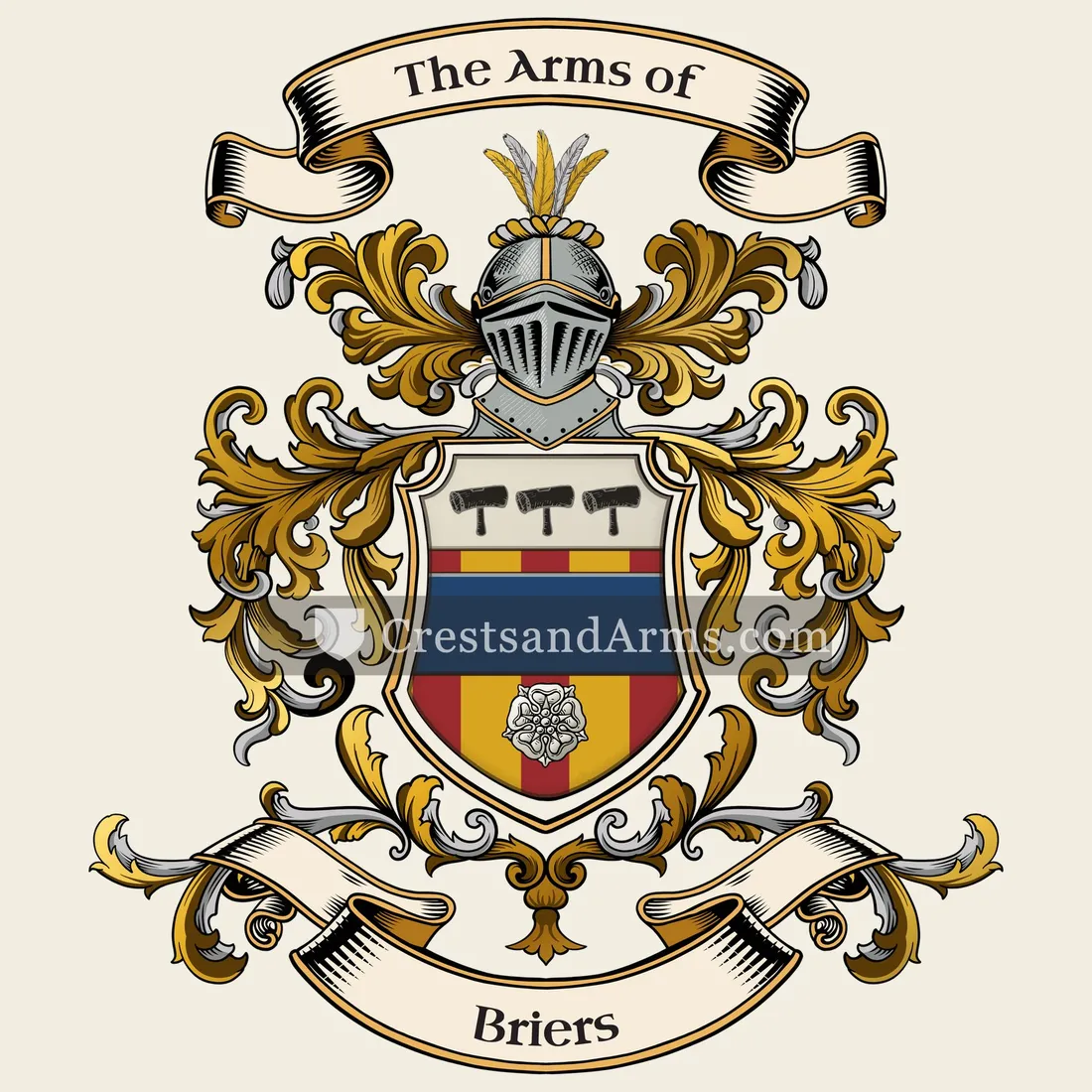
paleMilitary strength, and a fortified defence
fessThe military belt, and readiness to serve
chiefAuthority, wisdom and dominion
roseThe seventh son, and beauty with grace
hammerHonest labour, and the smith's craft
Colours
Gold (Or)Means: Generosity
Red (Gules)Means: Military strength
Silver (Argent)Means: Peace and sincerity
Blue (Azure)Means: Loyalty and truth
Black (Sable)Means: Constancy
Historical info
Source
J. B. Rietstap, Armorial Général, Gouda: G. B. van Goor Zonen, 1884–87
Blazon (the actual original written record)
“D'or à trois pals de gu.; à la fasce d'azur, br. sur le tout, ch. d'une rose d'arg.; au chef d'arg., ch. de trois maillets penchés de sa.”
FlandreFlandre, c. 1663
Digital archive packCoat of arms PNG, gold border print PDF, vector SVG and the certificate of authenticity. Sent to your email in minutes.
Map of France showing where the Briers arms are recorded
The Briers arms were recorded in Flandre, c. 1663.
Flandre grew rich on cloth, and its towns were among the busiest in Europe. Merchant families bought land with their profits and took arms to go with it, so trade put as many names in the registers here as land did.
This is where the arms were entered in the register. Families often moved to other parts of the country, so the same name can turn up in more than one region.
The body that granted and recorded arms in France in this period.
Louis XIV of France
Sovereign of the period
Louis XIV of France
1643–1715
Reigning in Belgium when the Briers arms are first recorded.
How Arms Worked in France
In France, a coat of arms was a mark of honor that passed down through the male line to all legitimate descendants. Families often used the same shield without changes to show their shared heritage. If a branch wanted to stand out, they could add a small mark to their shield to show their specific place in the family tree.
Granting authority
The Juge d'armes de France acted as the official authority that regulated and verified coats of arms across the country.
How they got arms
Families typically inherited their arms from ancestors, though they could also receive them through royal grants or by proving their noble status.
Where arms were recorded
Coats of arms were officially recorded in the Armorial Général de France, which began its main collection in the year 1696.
The family's standing
Recorded among the armigerous families of Flandre.
Origin & History of the Briers Family in France
The family name Briers finds its historical roots in the northern regions of France and the neighboring territories of Flanders. By the year 1663, records confirm that members of the family were well-established within the social and administrative fabric of the Flemish lands. During this era, the name was closely tied to the geography of the region, as the term often referred to people living near thickets or wild, thorny patches of land. As the family grew, they became integrated into the local communities of the French-Flemish border, where they participated in the agricultural and merchant life that defined the seventeenth century. This period was marked by shifting borders and complex loyalties between the French Crown and the Spanish Netherlands, which likely influenced how the family moved and settled across the landscape. The presence of the Briers name in these early records suggests a family that was deeply rooted in the rural traditions and the evolving local governance of the northern provinces.
Meaning of the Briers family crest colors & symbols
Symbols on this shield
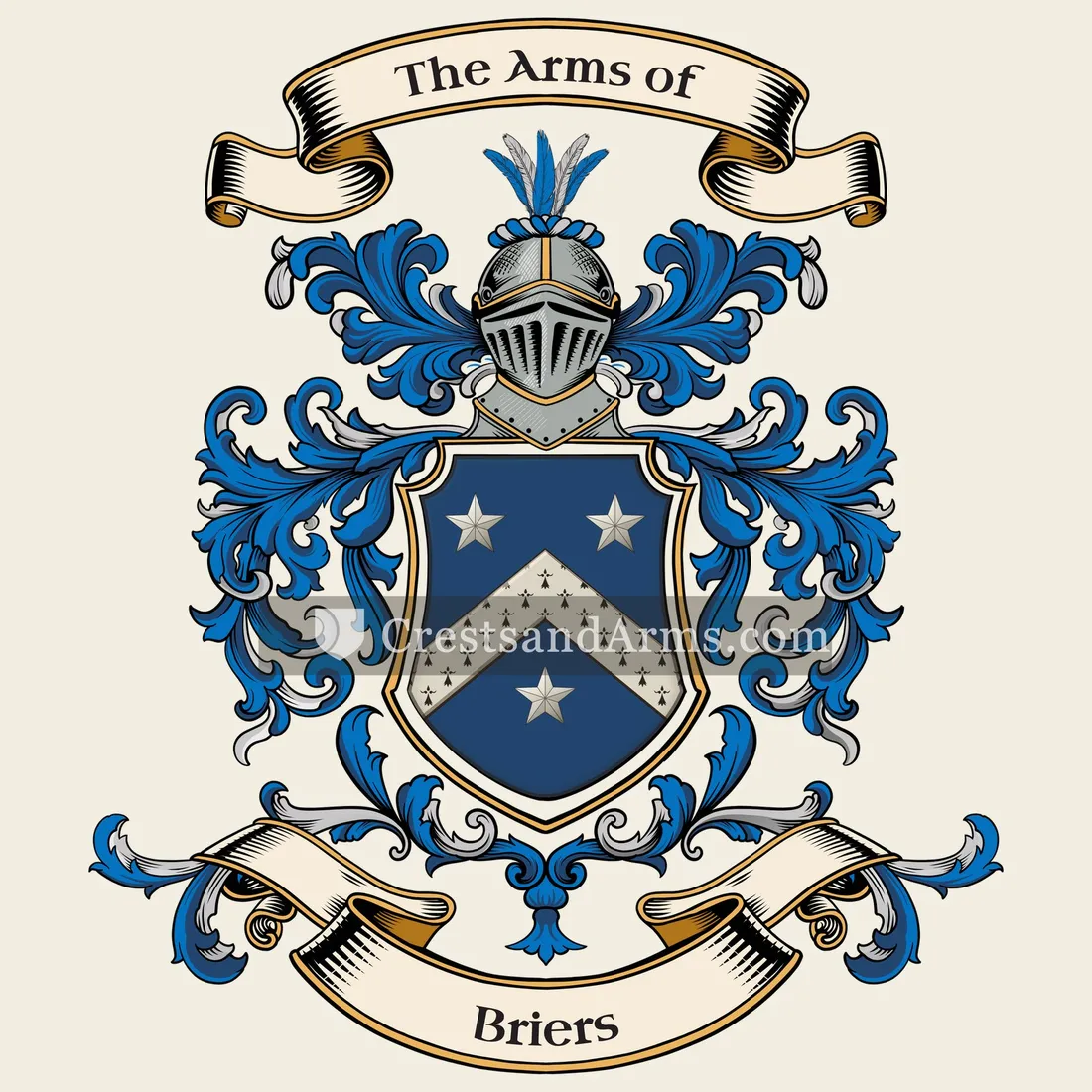
chevronProtection, and faithful service completed
mulletThe third son, and a divine quality from above
Colours
Blue (Azure)Means: Loyalty and truth
ErmineMeans: Dignity
Silver (Argent)Means: Peace and sincerity
Historical info
Source
Sir Bernard Burke, The General Armory of England, Scotland, Ireland and Wales, London: Harrison & Sons, 1884
Blazon (the actual original written record)
“Az. a chev. flory counterflory erm. betw. three mullets pierced ar”
BedfordshireBedfordshire, c. 1620
Digital archive packCoat of arms PNG, gold border print PDF, vector SVG and the certificate of authenticity. Sent to your email in minutes.
Map of England showing where the Briers arms are recorded
The Briers arms were recorded in Bedfordshire, c. 1620.
This is where the arms were entered in the register. Families often moved to other parts of the country, so the same name can turn up in more than one region.
The body that granted and recorded arms in England in this period.
James VI and I
Sovereign of the period
James VI and I
1603–1625
Reigning in Belgium when the Briers arms are first recorded.
How Arms Worked in England
English heraldry allowed arms to be shared by all legitimate descendants of the original owner. These symbols were treated as personal property that moved through the generations to all children. While the eldest son kept the original design, other family members could use the same shield without needing to change it or register their own unique versions.
Granting authority
The College of Arms in London has regulated the use of coats of arms throughout England and Wales since 1484.
How they got arms
Families typically obtained their coats of arms through a formal grant from the Crown or by proving their ancient right to them.
Where arms were recorded
All official coats of arms are recorded in the registers kept at the College of Arms, which date back to the fifteenth century.
The family's standing
Recorded among the armigerous families of Bedfordshire.
Origin & History of the Briers Family in England
The surname Briers is a locative name, which means it was originally used to describe people who lived near a patch of wild briars or thorny thickets. In medieval England, surnames often developed from the natural features of a person’s surroundings, and those who settled near these rugged, overgrown areas were identified by their neighbors as living by the briars. By the early 17th century, the family had established a notable presence in the county of Bedfordshire. Records from 1620 confirm that members of the Briers family were active in this region, where they likely worked as farmers or tradespeople. During this period, the family became integrated into the local community, leaving traces in parish registers and legal documents that highlight their steady growth and settlement in the English countryside.
Briers Meaning & Related Branches
Root word
Bruyère
A French term referring to heath or heather plants.
This name
BriersAn occupational or topographic name for someone who lived near a heath or grew heather.
also spelled
Bryers
Brieres
Breers
Bryeres
Related arms
Bryersvariant spelling
Documented Sources
J. B. Rietstap, Armorial Général, Gouda: G. B. van Goor Zonen, 1884–87
De Brouwer, J., De bevolking van Mechelen in de 17e eeuw, 1970
Stadsarchief Mechelen, Registers van de Burgerlijke Stand en Bevolkingsregisters, 1681
Digital archive packCoat of arms PNG, gold border print PDF, vector SVG and the certificate of authenticity. Sent to your email in minutes.


 fleur de lisPurity, light, and the sixth son
 fleur de lisPurity, light, and the sixth son


 paleMilitary strength, and a fortified defence
 fessThe military belt, and readiness to serve
 chiefAuthority, wisdom and dominion
 roseThe seventh son, and beauty with grace
 hammerHonest labour, and the smith's craft


 chevronProtection, and faithful service completed
 mulletThe third son, and a divine quality from above