A record of documented arms, meaning and origin, researched for the Brinkmann family lines. Documented in 2 countries.
Reg. 0909 · Swedish, A–C
Coat of Arms & Family Crest Details
Symbols on this shield
roundelA coin, and one who has been to the crusades
owlWisdom and vigilance by night
lozengeHonour and nobility, and the arms of a woman
mulletThe third son, and a divine quality from above
crownSovereignty, authority and just reward
maceAuthority, and the officer who bears it
heronPatience and quiet watchfulness
Colours
Gold (Or)Means: Generosity
Silver (Argent)Means: Peace and sincerity
Blue (Azure)Means: Loyalty and truth
Red (Gules)Means: Military strength
Black (Sable)Means: Constancy
Historical info
Source
J. B. Rietstap, Armorial Général, Gouda: G. B. van Goor Zonen, 1884–87
Blazon (the actual original written record)
“Ec.: au 1 d'or à la chouette de sa., la patte dextre levée; au 2 d'arg. à la losange de gu., ch. d'une étoile (5) d'arg.; au 3 de gu. à une couronne de roses d'or, br. sur deux masses à picotons du même, passées en saut., les manches en bas; au 4 d'or à une grue cont. d'azur, avec sa vigilance du même. L'écu entouré d'une bord. d'or, ch. de seize tourt. alt. de gu. et d'azur. Sur le tout d'azur à la barre de gu., bordée d'or et ch. de trois étoiles (5) du même. Deux cq. cour. C.: 1° une lyre à l'antique d'or; 2° un buste de More, tort. d'arg. et orné d'un collier du même. Entre lesdits cimiers une piramide d'or, accolée d'un rameau de laurier de sin. qui fait trois tours, et accosté de deux bannières, celle à dextre d'azur au cerf pass. d'or et celle à sen. de gu. à une épée d'arg., en bande, la pointe en bas, accolée d'un rameau d'olivier d'arg. S.: à dextre un griffon reg. d'or, surm. d'une étoile (5) du même; à sen. une aigle reg. de sa., le vol levé, surm. d'une étoile (5) d'or. D.: AEQUAM SEVARE MENTEM.”
Swedenc. 1835
Digital archive packCoat of arms PNG, gold border print PDF, vector SVG and the certificate of authenticity. Sent to your email in minutes.
Map of Sweden showing where the Brinkmann arms are recorded
The Brinkmann arms were recorded in Sweden, c. 1835.
Arms such as these were typically recorded in Stockholm.
Stockholm held the Swedish court and the House of Nobility, where every noble family's arms were entered and kept. Families ennobled for service registered there, which is why so many are recorded around the city.
This is where the arms were entered in the register. Families often moved to other parts of the country, so the same name can turn up in more than one region.
The body that granted and recorded arms in Sweden in this period.
Charles XIV John of Sweden
Sovereign of the period
Charles XIV John of Sweden
1818–1844
Reigning in Sweden when the Brinkmann arms are first recorded.
How Arms Worked in Sweden
In Sweden, a coat of arms belonged to a noble family as a whole rather than just one individual. These arms were passed down through the generations to all legitimate descendants. Younger branches of the family used the same shield without needing to change it. This system ensured that the entire lineage shared the same identity and status under the law.
Granting authority
The Riddarhuset, or House of Nobility, regulated all noble coats of arms in Sweden under royal authority.
How they got arms
Families received their coats of arms through royal grants of nobility which were then officially registered with the House.
Where arms were recorded
Coats of arms were officially recorded in the Swedish House of Nobility register starting in the year 1626.
The family's standing
Recorded among the armigerous families of Sweden.
Origin & History of the Brinkmann Family in Sweden
The name Brinkmann carries a legacy that reflects the movement of people across Northern Europe during the nineteenth century. While the name has deep roots in German-speaking regions, its presence in Sweden became firmly established by 1835 when members of the family were documented living in Stockholm. During this era, Stockholm was a growing hub for trade and craftsmanship, attracting skilled individuals from abroad who integrated into the local urban economy. Families like the Brinkmanns often arrived as part of a wave of migration that brought new professional expertise to the Swedish capital. By settling in the city, these early ancestors helped weave their name into the fabric of Swedish society, transitioning from newcomers to established residents within the bustling streets of the growing metropolis.
Coat of Arms & Family Crest Details
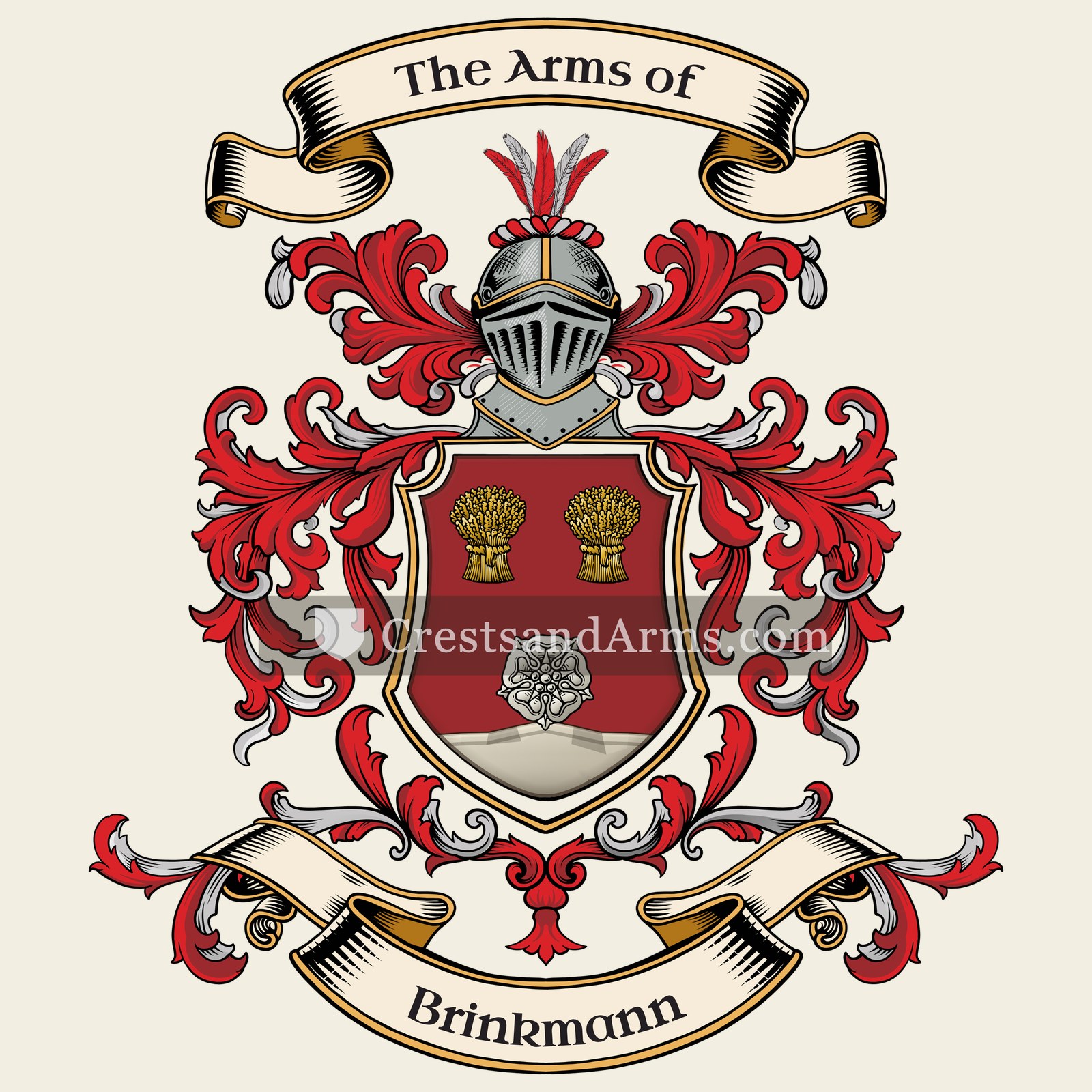
Symbols on this shield
mountThe ground held, and steadfastness upon it
roseThe seventh son, and beauty with grace
wheatsheafPlenty, and the harvest of one's own labour
Colours
Red (Gules)Means: Military strength
Silver (Argent)Means: Peace and sincerity
Gold (Or)Means: Generosity
Historical info
Source
J. B. Rietstap, Armorial Général, Gouda: G. B. van Goor Zonen, 1884–87
Blazon (the actual original written record)
“De gu. à une fleur tigée d'arg., entre deux épis d'or, le tout soutenu d'une terrasse de sin. C.: les meubles de l'écu. L. d'or et de gu.”
GermanyNuremberg, c. 1765
Digital archive packCoat of arms PNG, gold border print PDF, vector SVG and the certificate of authenticity. Sent to your email in minutes.
Map of Germany showing where the Brinkmann arms are recorded
The Brinkmann arms were recorded in Nuremberg, c. 1765.
This is where the arms were entered in the register. Families often moved to other parts of the country, so the same name can turn up in more than one region.
The body that granted and recorded arms in Germany in this period.
Francis I, Holy Roman Emperor
Sovereign of the period
Francis I, Holy Roman Emperor
1745–1765
Reigning in Sweden when the Brinkmann arms are first recorded.
How Arms Worked in Germany
In the Holy Roman Empire, coats of arms were often granted to individuals by the Emperor or his representatives. These arms were then passed down through the generations to all legitimate descendants of the original holder. Younger branches of a family usually kept the same shield design without needing to change it, as the arms belonged to the entire lineage.
Granting authority
The Holy Roman Emperor held the sole power to grant new coats of arms throughout his vast imperial territories.
How they got arms
Families typically obtained their coats of arms through a formal imperial grant or by proving their noble status to the authorities.
Where arms were recorded
These grants were officially recorded in the Imperial Chancery registers, which began keeping formal records of such honors during the Middle Ages.
The family's standing
Recorded among the armigerous families of Germany.
Origin & History of the Brinkmann Family in Germany
The surname Brinkmann is a classic example of a topographic name, which means it was originally used to describe where a person lived. In the German language, the word "Brink" refers to a grassy edge, a ridge, or the border of a village common. Therefore, the name was likely given to someone who lived on the outskirts of a settlement or near a distinct boundary of land. By the time the family was established in Nuremberg in 1765, the name had already been in use for generations across northern and central Germany. During this era, Nuremberg was a major center for trade and craftsmanship, and families like the Brinkmanns often moved to such cities to pursue specialized work in guilds. As they settled into urban life, they helped shape the social fabric of the region by transitioning from rural landholders to skilled members of the growing city population.
Brinkmann Meaning & Related Branches
Root word
Brink
A grassy edge, border, or bank of a field or stream.
This name
BrinkmannA person who lived near a grassy edge or the border of a field.
also spelled
Brinkman
Brinckmann
Documented Sources
J. B. Rietstap, Armorial Général, Gouda: G. B. van Goor Zonen, 1884–87
Stockholm City Archives (Stockholms stadsarkiv), Mantalslängder (Tax Census Records) for 1835
National Archives of Sweden (Riksarkivet), Inflyttningslängder (Parish Arrival Records) for Stockholm City
Sveriges Släktforskarförbund, Sveriges befolkning 1880, 2003
Lennart Andersson Palm, Folkmängden i Sveriges socknar och städer 1571–1850, 2001
Digital archive packCoat of arms PNG, gold border print PDF, vector SVG and the certificate of authenticity. Sent to your email in minutes.


 roundelA coin, and one who has been to the crusades
 owlWisdom and vigilance by night
 lozengeHonour and nobility, and the arms of a woman
 mulletThe third son, and a divine quality from above
 crownSovereignty, authority and just reward
 maceAuthority, and the officer who bears it
 heronPatience and quiet watchfulness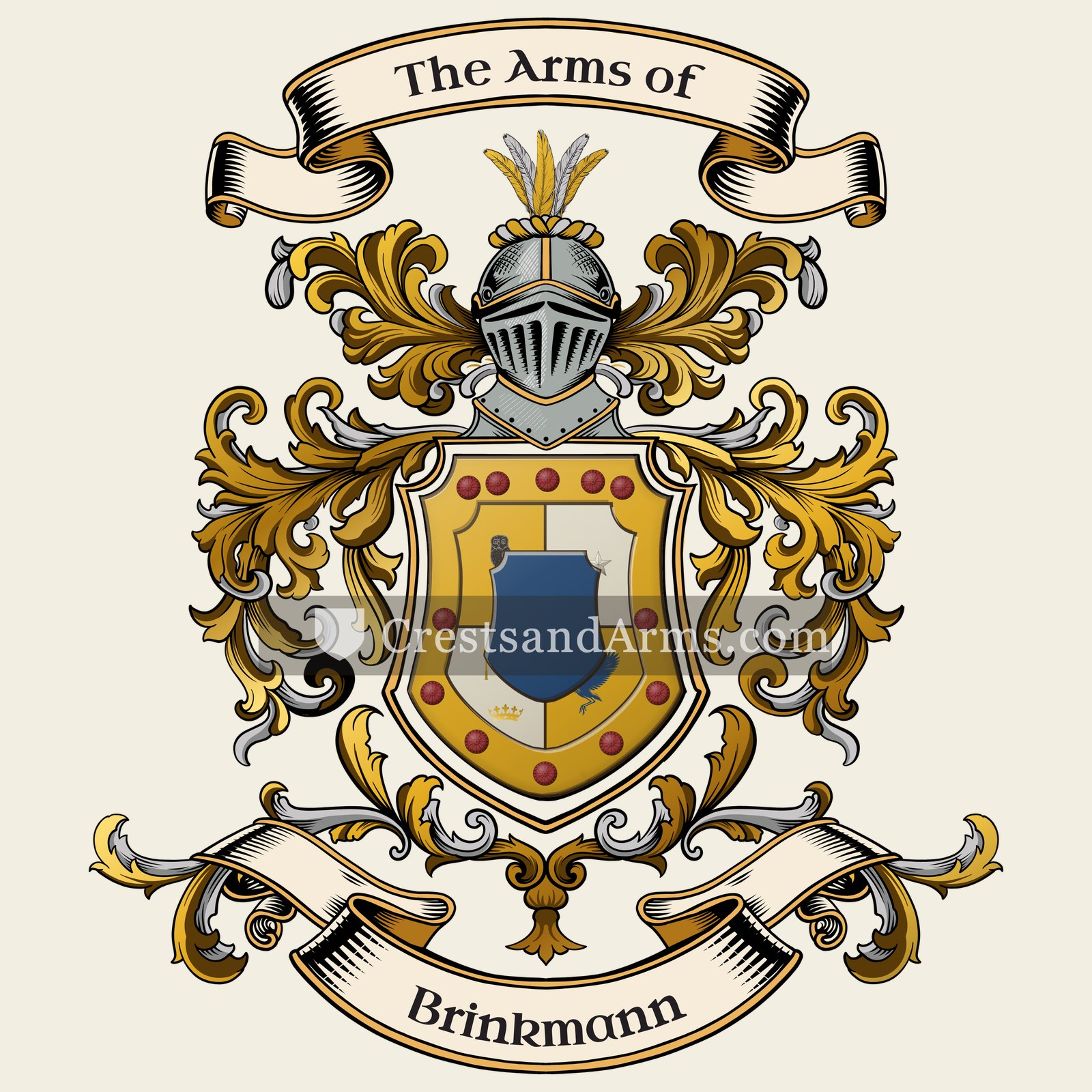


 mountThe ground held, and steadfastness upon it
 roseThe seventh son, and beauty with grace
 wheatsheafPlenty, and the harvest of one's own labour