Map of England showing where the Brit arms are recorded
The Brit arms were recorded in Devon, c. 1568.
Devon was a county of small manors and seafaring families. Its gentry were spread thickly across the countryside, and money made at sea often bought an estate, which in turn brought a coat of arms.
This is where the arms were entered in the register. Families often moved to other parts of the country, so the same name can turn up in more than one region.
The body that granted and recorded arms in England in this period.
Elizabeth I of England
Sovereign of the period
Elizabeth I of England
1558–1603
Reigning in England when the Brit arms are first recorded.
How Arms Worked in England
English heraldry allowed arms to be shared by all legitimate descendants of the original owner. These symbols were treated as personal property that moved through the generations to all children. While the eldest son kept the original design, other family members could use the same shield without needing to change it or register their own unique versions.
Granting authority
The College of Arms in London has regulated the use of coats of arms throughout England and Wales since 1484.
How they got arms
Families typically obtained their coats of arms through a formal grant from the Crown or by proving their ancient right to them.
Where arms were recorded
All official coats of arms are recorded in the registers kept at the College of Arms, which date back to the fifteenth century.
The family's standing
Recorded among the armigerous families of Devon.
Origin & History of the Brit Family in England
The surname Brit is deeply rooted in the southwestern landscape of England, particularly within the county of Devon. Historical records confirm that members of the family were well-established in this region by 1568. The name likely originated as a descriptive nickname or a locative identifier, potentially referring to someone of Breton descent or an individual who traveled from the Brittany region of France across the English Channel. During the sixteenth century, families in Devon were often deeply connected to the local agricultural economy and the growing maritime trade centered in ports like Plymouth and Exeter. As the name appears in parish registers and local tax rolls from this era, it suggests that the Brit family were settled members of their community who participated in the social and economic life of Elizabethan England. The persistence of the name in Devon records over several centuries highlights the family's long-standing stability within the rural parishes of the West Country.
Meaning of the Brit family crest colors & symbols
Symbols on this shield
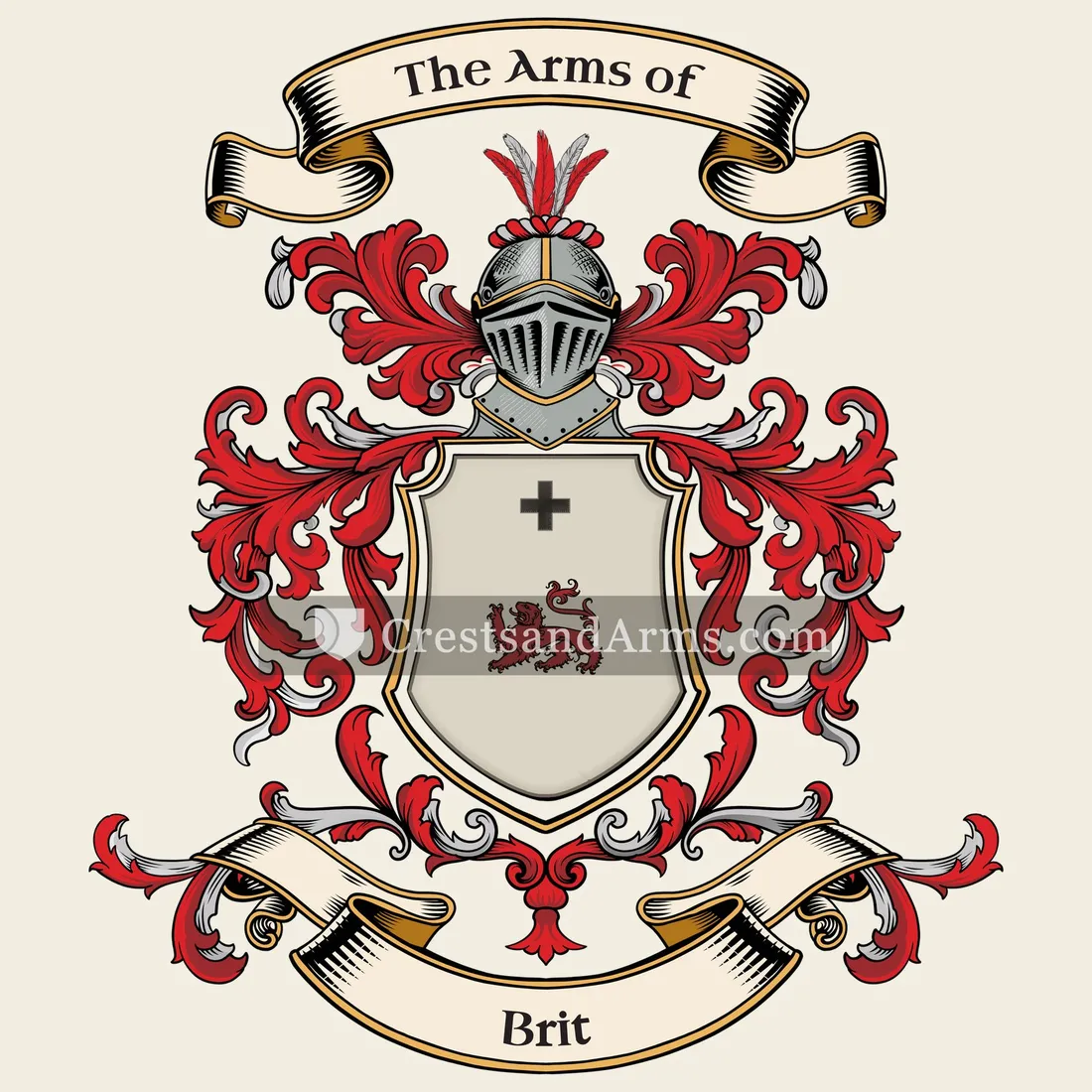
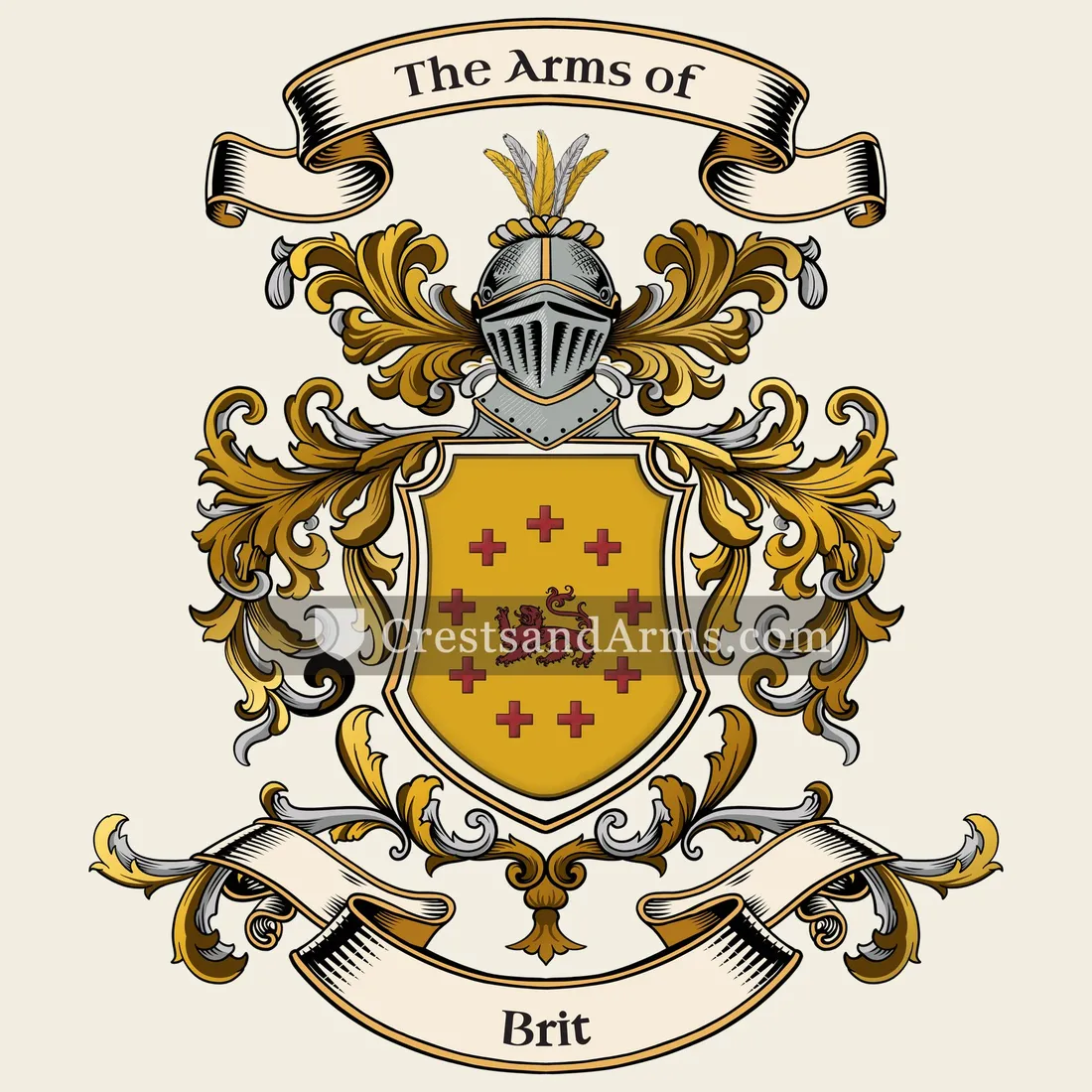
cross symbolChristian faith and service
lionCourage, strength and royalty
Colours
Gold (Or)Means: Generosity
Red (Gules)Means: Military strength
Historical info
Source
Sir Bernard Burke, The General Armory of England, Scotland, Ireland and Wales, London: Harrison & Sons, 1884
Blazon (the actual original written record)
“Or, a lion ramp. betw. nine cross crosslets fitchée gu”
KentDenbigh House · Kent, c. 1647
Digital archive packCoat of arms PNG, gold border print PDF, vector SVG and the certificate of authenticity. Sent to your email in minutes.
Map of Wales showing where the Brit arms are recorded
The Brit arms were recorded in Kent, c. 1647.
Kent sits between London and the short crossing to Europe, and the trade passing through made it wealthy. Merchant families bought land with that money, and it was landowners who took coats of arms.
This is where the arms were entered in the register. Families often moved to other parts of the country, so the same name can turn up in more than one region.
The body that granted and recorded arms in Wales in this period.
Charles I of England
Sovereign of the period
Charles I of England
1625–1649
Reigning in England when the Brit arms are first recorded.
How Arms Worked in Wales
English heraldry allowed arms to be shared by all legitimate descendants of the original owner. These symbols were treated as personal property that moved through the generations to all children. While the eldest son kept the original design, other family members could use the same shield without needing to change it or register their own unique versions.
Granting authority
The College of Arms in London has regulated the use of coats of arms throughout England and Wales since 1484.
How they got arms
Families typically obtained their coats of arms through a formal grant from the Crown or by proving their ancient right to them.
Where arms were recorded
All official coats of arms are recorded in the registers kept at the College of Arms, which date back to the fifteenth century.
The family's standing
Recorded among the armigerous families of Kent.
Origin & History of the Brit Family in Wales
The surname Brit is primarily associated with the historical region of Kent, where records confirm the family was established by 1647. While the name is often linked to the Anglo-Saxon term for a Briton, its presence in Wales suggests a deep connection to the ancient Celtic populations of Britain. In the Welsh context, the name likely served as a descriptor for individuals who maintained distinct cultural or linguistic ties to the native Brythonic people during periods of significant migration and social change. As families moved between the borderlands and the Welsh interior, the name acted as a marker of identity that distinguished these individuals from the incoming Germanic settlers. By the mid-17th century, the family had integrated into the local administrative and social structures of southern England, yet their ancestral roots remained tied to the complex ethnic landscape of early medieval Wales.
Meaning of the Brit family crest colors & symbols
Symbols on this shield
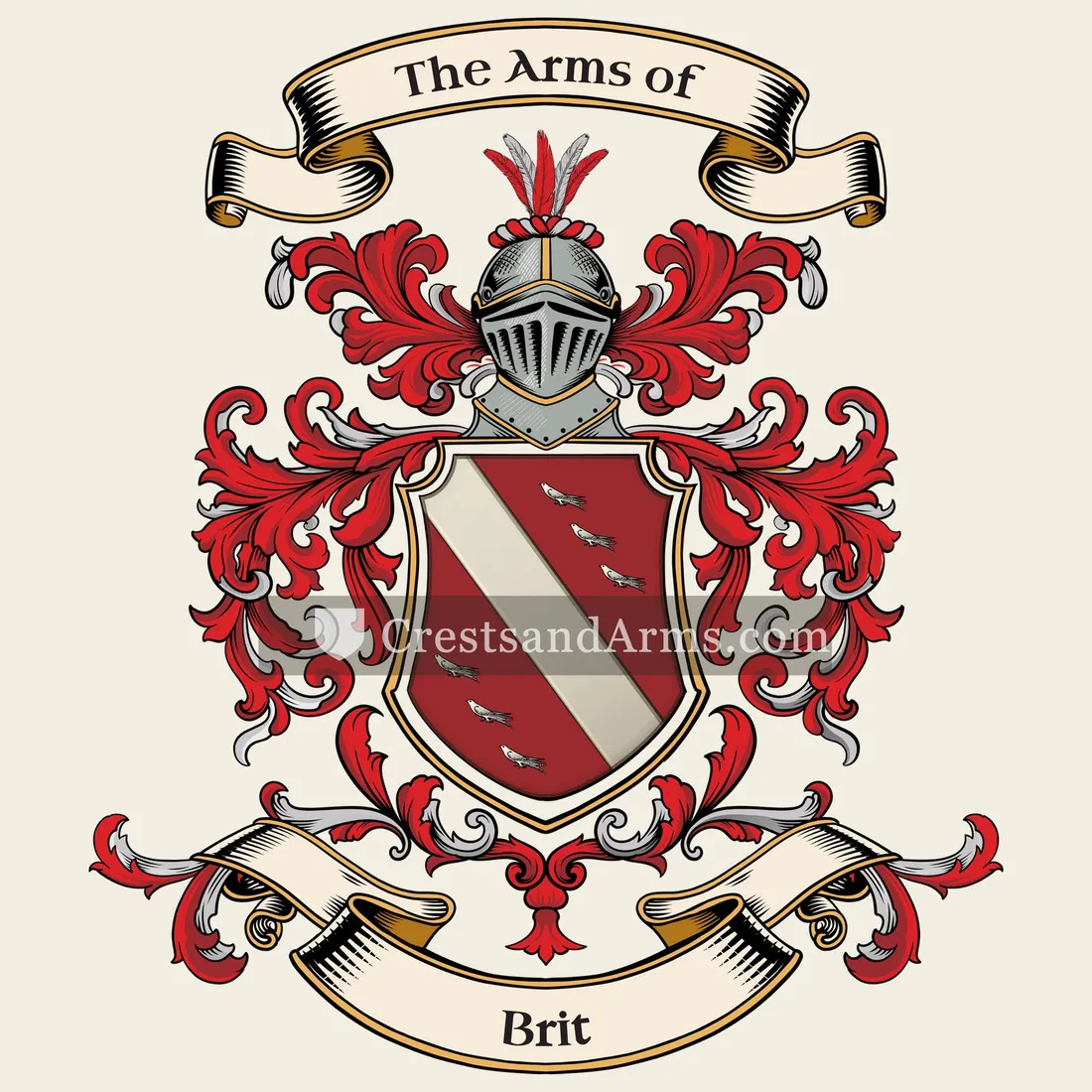
bendDefence, and the scarf of a commander
martletA younger son, who must win his own land
Colours
Red (Gules)Means: Military strength
Silver (Argent)Means: Peace and sincerity
Historical info
Source
Sir Bernard Burke, The General Armory of England, Scotland, Ireland and Wales, London: Harrison & Sons, 1884
Blazon (the actual original written record)
“Gu. a bend betw. six martlets ar”
Irelandc. 1645
Digital archive packCoat of arms PNG, gold border print PDF, vector SVG and the certificate of authenticity. Sent to your email in minutes.
Map of Ireland showing where the Brit arms are recorded
The Brit arms were recorded in Ireland, c. 1645.
Arms such as these were typically recorded in Dublin.
Dublin was the seat of government in Ireland and the place where grants were sought and recorded. Families with business at the castle or the courts settled nearby, and settling there put their arms on record.
This is where the arms were entered in the register. Families often moved to other parts of the country, so the same name can turn up in more than one region.
The body that granted and recorded arms in Ireland in this period.
Charles I of England
Sovereign of the period
Charles I of England
1625–1649
Reigning in England when the Brit arms are first recorded.
How Arms Worked in Ireland
The Ulster King of Arms granted coats of arms to individuals who proved their social standing and good character. These symbols were typically inherited by all legitimate descendants of the original holder. If a family branch wanted a unique look, they could apply for a specific change to their design through the office to ensure their identity remained distinct.
Granting authority
The Ulster King of Arms acted as the official body that regulated and issued all coats of arms throughout Ireland.
How they got arms
Families obtained their arms through formal grants issued by the office after proving their eligibility and paying the required fees.
Where arms were recorded
All official grants were recorded in the registers held by the Ulster King of Arms starting from the year 1552.
The family's standing
Recorded among the armigerous families of Ireland.
Origin & History of the Brit Family in Ireland
The family name Brit has roots in Ireland that stretch back to the mid-seventeenth century, with documented evidence placing members of the family in Dublin by 1645. During this period, Dublin was a bustling center of trade and political transition, serving as a primary hub for families navigating the complex social landscape of the era. The name itself is often associated with the historical term for a person of British or Breton origin, suggesting that the family may have arrived in Ireland through migration patterns common to the coastal regions of the British Isles. By establishing themselves in the capital city during the 1640s, the Brit family became part of the urban fabric of Dublin at a time when the city was undergoing significant demographic shifts. Their presence in official records from this time indicates that they were integrated into the local community, likely participating in the economic life of a city that acted as the gateway between Ireland and the wider world.
Brit Meaning & Related Branches
Root word
Brittus
Latin term referring to a person from Britain or Brittany.
This name
BritAn ethnic or topographic name denoting someone who originated from Britain.
also spelled
Bret
Brette
Brit
Documented Sources
Sir Bernard Burke, The General Armory of England, Scotland, Ireland and Wales, London: Harrison & Sons, 1884
Hoskins, W.G., Devon, 1954
Reaney, P.H., A Dictionary of British Surnames, 1958
The National Archives, Exchequer: King's Remembrancer: Lay Subsidy Rolls, E 179
Digital archive packCoat of arms PNG, gold border print PDF, vector SVG and the certificate of authenticity. Sent to your email in minutes.


 cross symbolChristian faith and service
 lionCourage, strength and royalty
 cross symbolChristian faith and service
 lionCourage, strength and royalty



 bendDefence, and the scarf of a commander
 martletA younger son, who must win his own land