Map of Netherlands showing where the Brock arms are recorded
The Brock arms were recorded in Bois-le, c. 1815.
This is where the arms were entered in the register. Families often moved to other parts of the country, so the same name can turn up in more than one region.
Region
Bois-le
Town
Bois-le
First recorded
1815
Granting Authority for the Brock Arms
Hoge Raad van Adel
Photograph made by me · CC BY-SA 3.0
The body that granted and recorded arms in Netherlands in this period.
William I of the Netherlands
Sovereign of the period
William I of the Netherlands
1815–1840
Reigning in Netherlands when the Brock arms are first recorded.
How Arms Worked in Netherlands
In the Netherlands, coats of arms were often used by noble families and those who held specific public offices. These arms were passed down through the generations to legitimate descendants. Younger branches of a family usually kept the original design without needing to add special marks. This system ensured that the family identity remained clear and consistent over many years.
Granting authority
The Hoge Raad van Adel is the official body that regulates and manages noble titles and coats of arms in the Netherlands.
How they got arms
Families typically obtained their coats of arms through official royal grants or by proving their long-standing historical use of the symbols.
Where arms were recorded
Coats of arms are officially recorded in the registers held by the Hoge Raad van Adel, which began its work in 1814.
The family's standing
Recorded among the armigerous families of Netherlands.
Origin & History of the Brock Family in Netherlands
The surname Brock has deep roots in the Low Countries, where it often functioned as a topographical name for families living near a marsh or a brook. In the Dutch language, the term "broek" refers to a low-lying, swampy piece of land, which suggests that early ancestors likely settled in these fertile but damp regions to farm or manage the local waterways. By the early nineteenth century, the family had established a clear presence in the city of Bois-le-Duc, which is known locally as 's-Hertogenbosch. During this period, the region was undergoing significant political shifts following the Napoleonic Wars. Families like the Brocks were often recorded in official civil registers as the Dutch government began to standardize naming conventions and track residency more closely. These early records from the Brabant region highlight how the family integrated into the local urban landscape, transitioning from rural origins to becoming part of the established community in a major administrative center.
Coat of Arms & Family Crest Details
Symbols on this shield
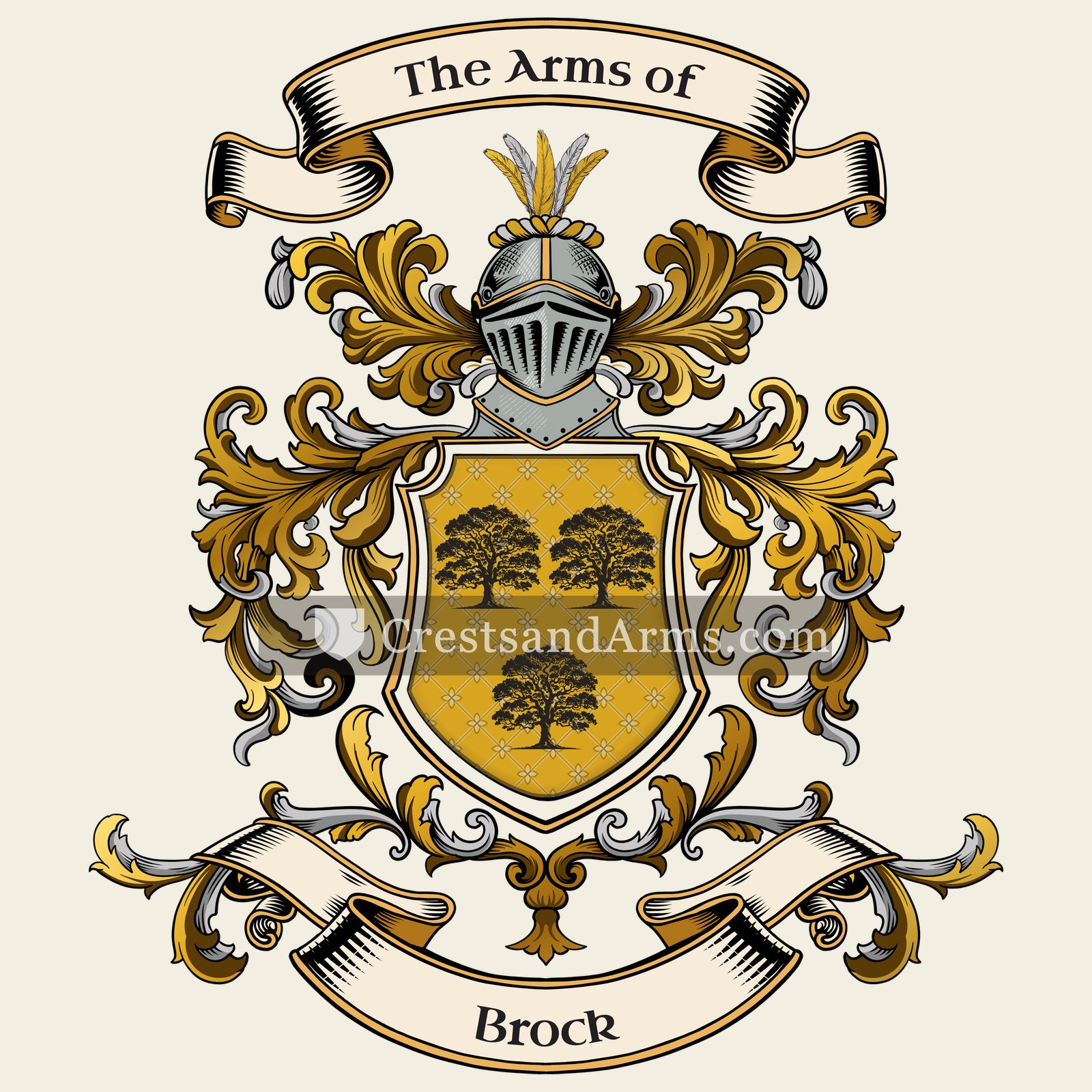
treeLife, endurance and deep roots
Colours
Gold (Or)Means: Generosity
Black (Sable)Means: Constancy
Historical info
Source
J. B. Rietstap, Armorial Général, Gouda: G. B. van Goor Zonen, 1884–87
Blazon (the actual original written record)
“D'or à trois troncs coupes et écotes de sa., accostés. Cq. cour. C.: l'un des trones de l'écu [Comp. vam Brocke.]”
Germanyc. 1765
Digital archive packCoat of arms PNG, gold border print PDF, vector SVG and the certificate of authenticity. Sent to your email in minutes.
Map of Germany showing where the Brock arms are recorded
The Brock arms were recorded in Germany, c. 1765.
Arms such as these were typically recorded in Bavaria.
Bavaria was a country of old landed families and walled market towns. Estates passed down the same line for centuries, and both the landowners and the leading townsmen kept arms, which is why so many Bavarian names sit in the registers.
This is where the arms were entered in the register. Families often moved to other parts of the country, so the same name can turn up in more than one region.
The body that granted and recorded arms in Germany in this period.
Francis I, Holy Roman Emperor
Sovereign of the period
Francis I, Holy Roman Emperor
1745–1765
Reigning in Netherlands when the Brock arms are first recorded.
How Arms Worked in Germany
In the Holy Roman Empire, coats of arms were often granted to individuals by the Emperor or his representatives. These arms were then passed down through the generations to all legitimate descendants of the original holder. Younger branches of a family usually kept the same shield design without needing to change it, as the arms belonged to the entire lineage.
Granting authority
The Holy Roman Emperor held the sole power to grant new coats of arms throughout his vast imperial territories.
How they got arms
Families typically obtained their coats of arms through a formal imperial grant or by proving their noble status to the authorities.
Where arms were recorded
These grants were officially recorded in the Imperial Chancery registers, which began keeping formal records of such honors during the Middle Ages.
The family's standing
Recorded among the armigerous families of Germany.
Origin & History of the Brock Family in Germany
The name Brock has deep roots in the German language, where it is traditionally linked to the Middle High German word *broc*, meaning a marsh or a swampy area. Families who carried this name often lived near these damp, low-lying lands or worked as farmers in such regions. By the time the name appears in Bavarian records in 1765, it was already well-established among the local population. During this period, the family likely lived as part of the rural community, where surnames were often used to identify a person by their specific home or the landscape features surrounding their property. Because Bavaria was a region defined by its dense forests and river valleys, the name Brock served as a practical way to distinguish one family from another based on their connection to the natural environment.
Coat of Arms & Family Crest Details
Symbols on this shield
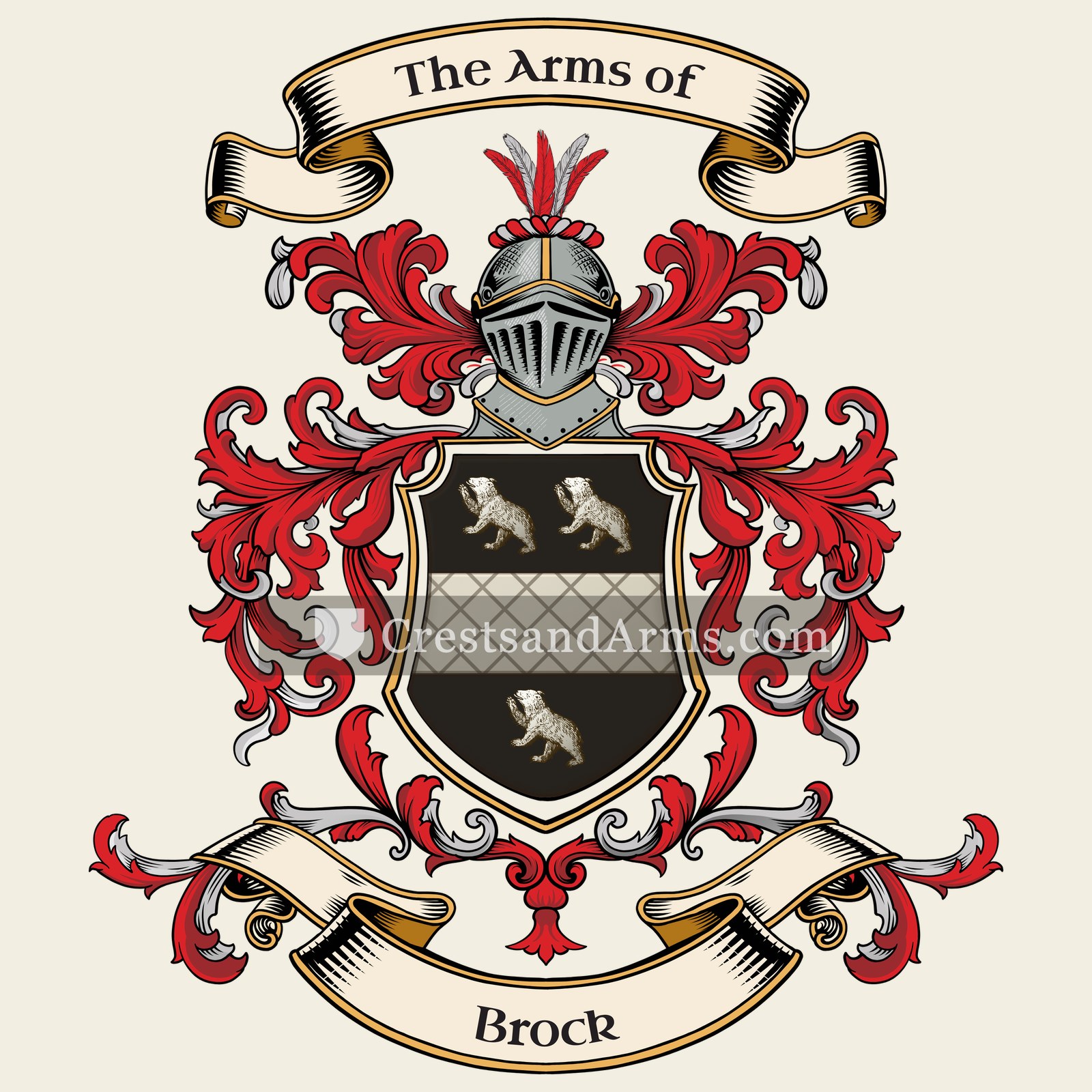
fessThe military belt, and readiness to serve
bearStrength, cunning and protection of kin
Colours
Black (Sable)Means: Constancy
Silver (Argent)Means: Peace and sincerity
Historical info
Source
Sir Bernard Burke, The General Armory of England, Scotland, Ireland and Wales, London: Harrison & Sons, 1884
Blazon (the actual original written record)
“Sa. a fesse humettée, betw. three bears' heads erased ar”
CheshireCheshire, c. 1580
Digital archive packCoat of arms PNG, gold border print PDF, vector SVG and the certificate of authenticity. Sent to your email in minutes.
Map of England showing where the Brock arms are recorded
The Brock arms were recorded in Cheshire, c. 1580.
This is where the arms were entered in the register. Families often moved to other parts of the country, so the same name can turn up in more than one region.
The body that granted and recorded arms in England in this period.
Elizabeth I of England
Sovereign of the period
Elizabeth I of England
1558–1603
Reigning in Netherlands when the Brock arms are first recorded.
How Arms Worked in England
English heraldry allowed arms to be shared by all legitimate descendants of the original owner. These symbols were treated as personal property that moved through the generations to all children. While the eldest son kept the original design, other family members could use the same shield without needing to change it or register their own unique versions.
Granting authority
The College of Arms in London has regulated the use of coats of arms throughout England and Wales since 1484.
How they got arms
Families typically obtained their coats of arms through a formal grant from the Crown or by proving their ancient right to them.
Where arms were recorded
All official coats of arms are recorded in the registers kept at the College of Arms, which date back to the fifteenth century.
The family's standing
Recorded among the armigerous families of Cheshire.
Origin & History of the Brock Family in England
The surname Brock has deep roots in the English landscape, with its origins tied to the Old English word for a badger. In early medieval times, surnames were often adopted based on a person’s nickname, a specific physical trait, or their proximity to local wildlife. By the time the family was firmly established in Cheshire by 1580, the name had become a permanent fixture of the regional identity. Families in this area often lived as yeoman farmers or local landowners who played a steady role in the growth of their rural communities. Because Cheshire was a major center for trade and agriculture during the late sixteenth century, families like the Brocks were well-positioned to integrate into the social and economic fabric of the county. Their presence in historical records from this period reflects a transition from simple descriptive nicknames to established family lineages that helped shape the local history of Northwest England.
Brock Meaning & Related Branches
Root word
broek
A marshy or swampy piece of land.
This name
BrockRefers to someone who lived near a marsh, swamp, or wetland area.
also spelled
Brok
Brocck
Brocke
Broc
Related arms
Le Broogsame arms
Bortonsimilar arms
Burtonsimilar arms
Brocvariant spelling
Documented Sources
J. B. Rietstap, Armorial Général, Gouda: G. B. van Goor Zonen, 1884–87
Beekman, A. A., Geschiedkundige atlas van Nederland, 1913
Huizinga, A., Encyclopedie van namen, 1959
Nationaal Archief, Burgerlijke Stand van de provincie Noord-Brabant, 1815
Digital archive packCoat of arms PNG, gold border print PDF, vector SVG and the certificate of authenticity. Sent to your email in minutes.


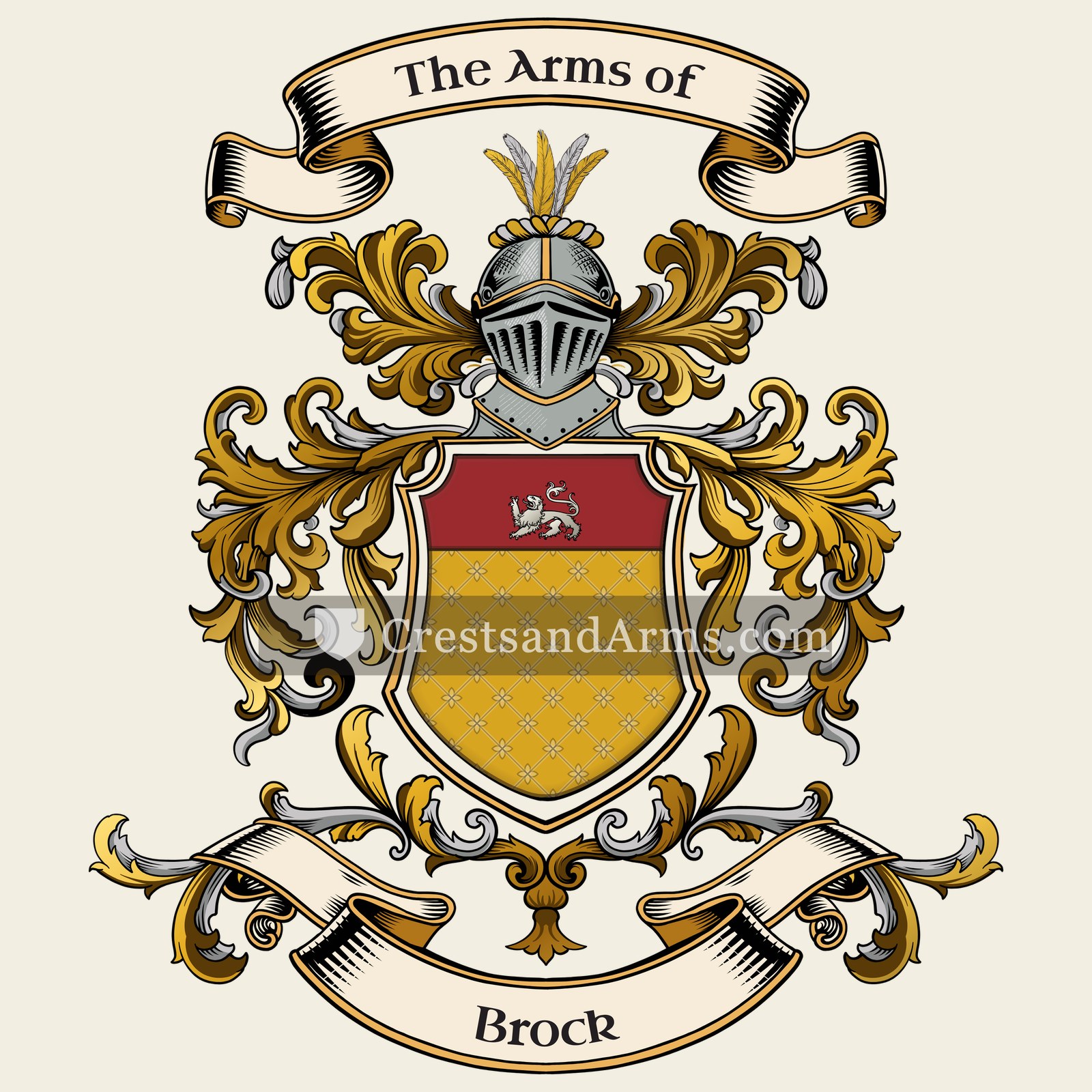
 chiefAuthority, wisdom and dominion
 lionCourage, strength and royalty
 chiefAuthority, wisdom and dominion
 lionCourage, strength and royalty


 treeLife, endurance and deep roots


 fessThe military belt, and readiness to serve
 bearStrength, cunning and protection of kin