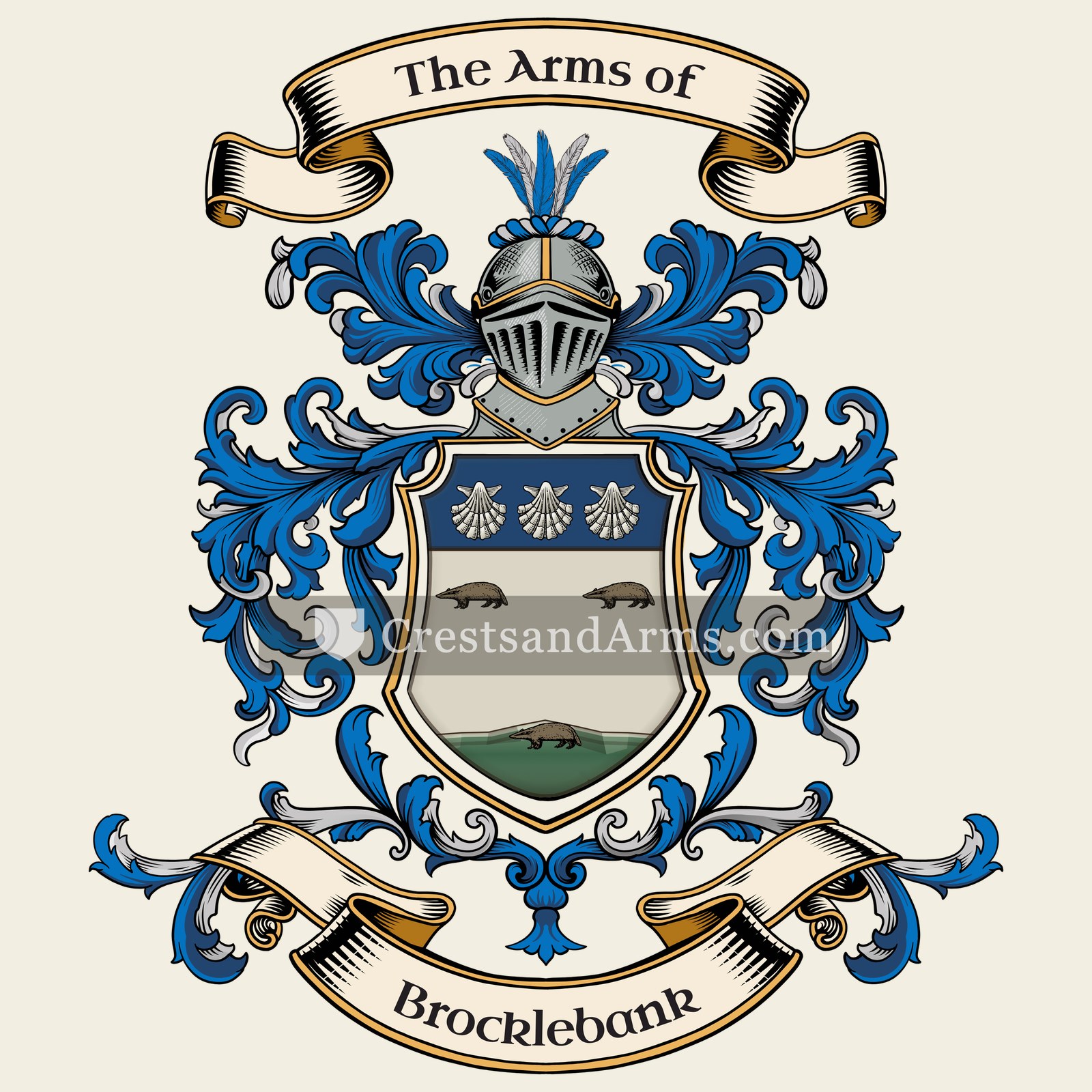
A record of documented arms, meaning and origin, researched for the Brocklebank family of France.
Reg. 6839 · French, A–C
Coat of Arms & Family Crest Details
Symbols on this shield
mountThe ground held, and steadfastness upon it
chiefAuthority, wisdom and dominion
badgerSteadfastness and persistence
escallopThe pilgrim's shell, and a long journey made
Colours
Silver (Argent)Means: Peace and sincerity
Blue (Azure)Means: Loyalty and truth
Green (Vert)Means: Hope
Historical info
Source
J. B. Rietstap, Armorial Général, Gouda: G. B. van Goor Zonen, 1884–87
Blazon (the actual original written record)
“D'arg. à trois blaireaux au nat., 2 et 1, posés chacun sur une terrasse isolée de sin.; au chef d'azur, ch. de trois coquilles d'arg. C.: un coq d'arg., crêté et barbé de gu., ch. sur la poitrine d'une coquille de sa. et perché sur la stangue d'une ancre de sa., posée en fasce. D.: GOD SEND GRACE.”
CumberlandCumberland, c. 1885
Digital archive packCoat of arms PNG, gold border print PDF, vector SVG and the certificate of authenticity. Sent to your email in minutes.
Map of France showing where the Brocklebank arms are recorded
The Brocklebank arms were recorded in Cumberland, c. 1885.
Cumberland was rough border country in the north-west, facing Scotland across a disputed line. Its families held land in return for keeping it defended, and men who fought carried shields of their own.
This is where the arms were entered in the register. Families often moved to other parts of the country, so the same name can turn up in more than one region.
The body that granted and recorded arms in France in this period.
How Arms Worked in France
In France, a coat of arms was a mark of honor that passed down through the male line to all legitimate descendants. Families often used the same shield without changes to show their shared heritage. If a branch wanted to stand out, they could add a small mark to their shield to show their specific place in the family tree.
Granting authority
The Juge d'armes de France acted as the official authority that regulated and verified coats of arms across the country.
How they got arms
Families typically inherited their arms from ancestors, though they could also receive them through royal grants or by proving their noble status.
Where arms were recorded
Coats of arms were officially recorded in the Armorial Général de France, which began its main collection in the year 1696.
The family's standing
Recorded among the armigerous families of Cumberland.
Origin & History of the Brocklebank Family in France
The surname Brocklebank is a locative name, meaning it originated from a specific place rather than a trade or a personal characteristic. It is derived from the Old Norse words "brokkr," meaning a badger, and "banke," which refers to a hillside or a ridge. This suggests that the first people to use the name lived near a badger-settled slope in the rugged landscape of Northern England. The family has deep roots in the historic county of Cumberland, where the name appears in local records dating back several centuries before the late 1800s. Because the region was heavily influenced by Viking settlers, the name reflects the unique linguistic heritage of the area. Over time, families with this name became well-established in the local community, often working as farmers or landowners in the valleys near the Lake District.
Brocklebank Meaning & Related Branches
Root word
brocc and bank
Old English for badger and a ridge or embankment.
This name
BrocklebankA dweller on a ridge or bank frequented by badgers.
also spelled
Brocklebanck
Broklebank
Brockbank
Documented Sources
J. B. Rietstap, Armorial Général, Gouda: G. B. van Goor Zonen, 1884–87
Ekwall, Eilert, The Concise Oxford Dictionary of English Place-names, 1960
Reaney, P.H., A Dictionary of British Surnames, 1958
Cumbria Archive Service, Kendal Archive Centre: Records of the Brocklebank family of Cumberland, reference WDB/86
Digital archive packCoat of arms PNG, gold border print PDF, vector SVG and the certificate of authenticity. Sent to your email in minutes.


 mountThe ground held, and steadfastness upon it
 chiefAuthority, wisdom and dominion
 badgerSteadfastness and persistence
 escallopThe pilgrim's shell, and a long journey made
 mountThe ground held, and steadfastness upon it
 chiefAuthority, wisdom and dominion
 badgerSteadfastness and persistence
 escallopThe pilgrim's shell, and a long journey made