Map of Netherlands showing where the Broers arms are recorded
The Broers arms were recorded in Harlem, c. 1815.
This is where the arms were entered in the register. Families often moved to other parts of the country, so the same name can turn up in more than one region.
Region
Harlem
Town
Harlem
First recorded
1815
Granting Authority for the Broers Arms
Hoge Raad van Adel
Photograph made by me · CC BY-SA 3.0
The body that granted and recorded arms in Netherlands in this period.
William I of the Netherlands
Sovereign of the period
William I of the Netherlands
1815–1840
Reigning in Netherlands when the Broers arms are first recorded.
How Arms Worked in Netherlands
In the Netherlands, coats of arms were often used by noble families and those who held specific public offices. These arms were passed down through the generations to legitimate descendants. Younger branches of a family usually kept the original design without needing to add special marks. This system ensured that the family identity remained clear and consistent over many years.
Granting authority
The Hoge Raad van Adel is the official body that regulates and manages noble titles and coats of arms in the Netherlands.
How they got arms
Families typically obtained their coats of arms through official royal grants or by proving their long-standing historical use of the symbols.
Where arms were recorded
Coats of arms are officially recorded in the registers held by the Hoge Raad van Adel, which began its work in 1814.
The family's standing
Recorded among the armigerous families of Netherlands.
Origin & History of the Broers Family in Netherlands
The surname Broers originates from the Dutch language and functions as a patronymic name, meaning it was originally used to identify someone as the son of a man named Broer. The name Broer itself is an old Germanic term that translates directly to brother, and it was often used as a nickname or a given name in the Netherlands centuries ago. By the time members of the family were documented living in Haarlem in 1815, the name had transitioned from a simple descriptor into a formal hereditary surname passed down through generations. During this period, families in urban centers like Haarlem were often recorded in civil registries as the Dutch government began standardizing naming practices to improve tax collection and military conscription. This shift helped solidify the identity of the Broers family as a distinct lineage within the local community.
Broers Meaning & Related Branches
Root word
Broeder
A male sibling or a member of a religious brotherhood.
This name
BroersPatronymic surname indicating the son of a brother or a religious brother.
also spelled
Broerss
Broerse
Broors
Documented Sources
J. B. Rietstap, Armorial Général, Gouda: G. B. van Goor Zonen, 1884–87
Meertens, P.J., Voornamen in Nederland, 1966
Van der Schaar, J., Woordenboek van voornamen, 1964
Noord-Hollands Archief, Bevolkingsregister van Haarlem, 1815
Digital archive packCoat of arms PNG, gold border print PDF, vector SVG and the certificate of authenticity. Sent to your email in minutes.


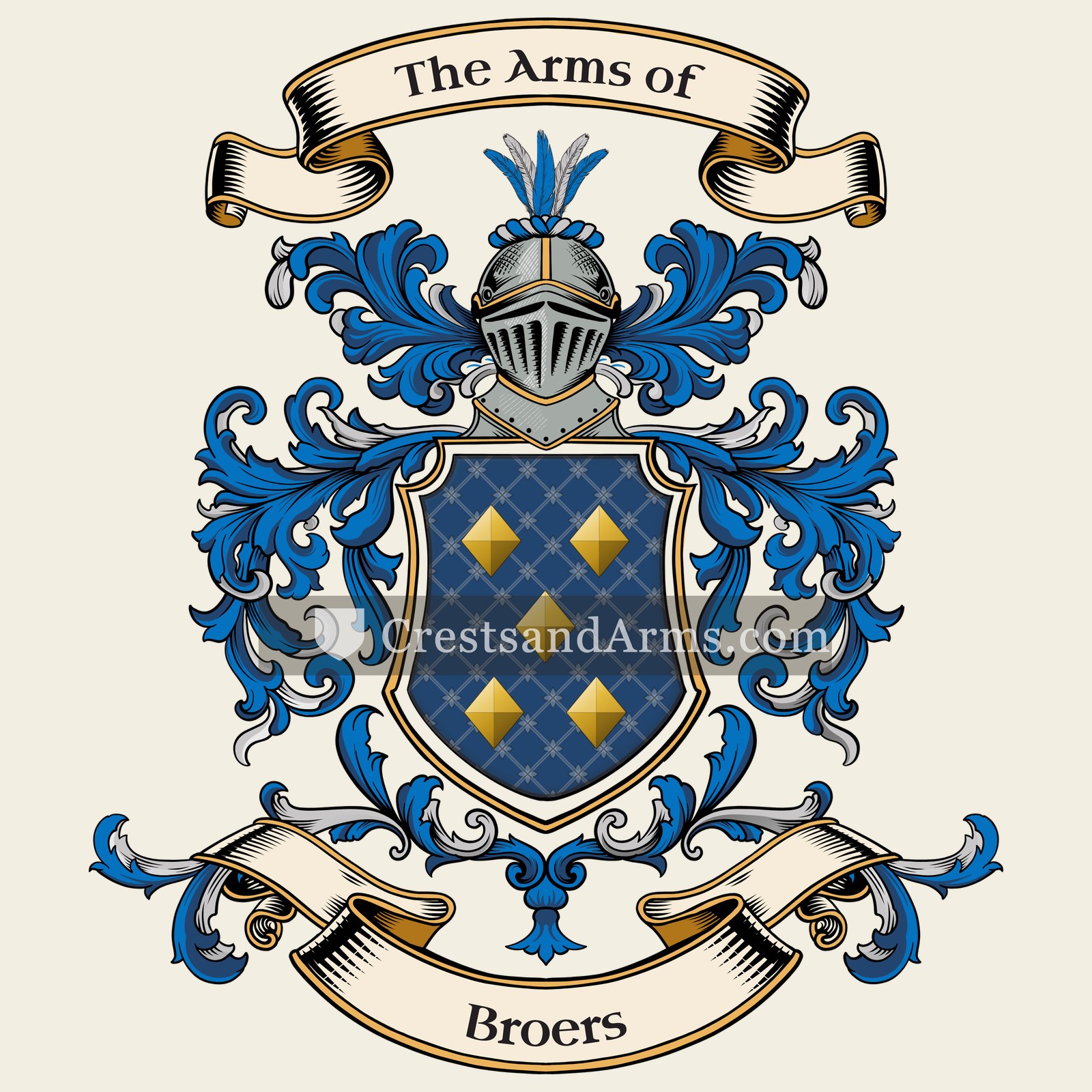
 fusilTravail and industry
 lozengeHonour and nobility, and the arms of a woman
 fusilTravail and industry
 lozengeHonour and nobility, and the arms of a woman