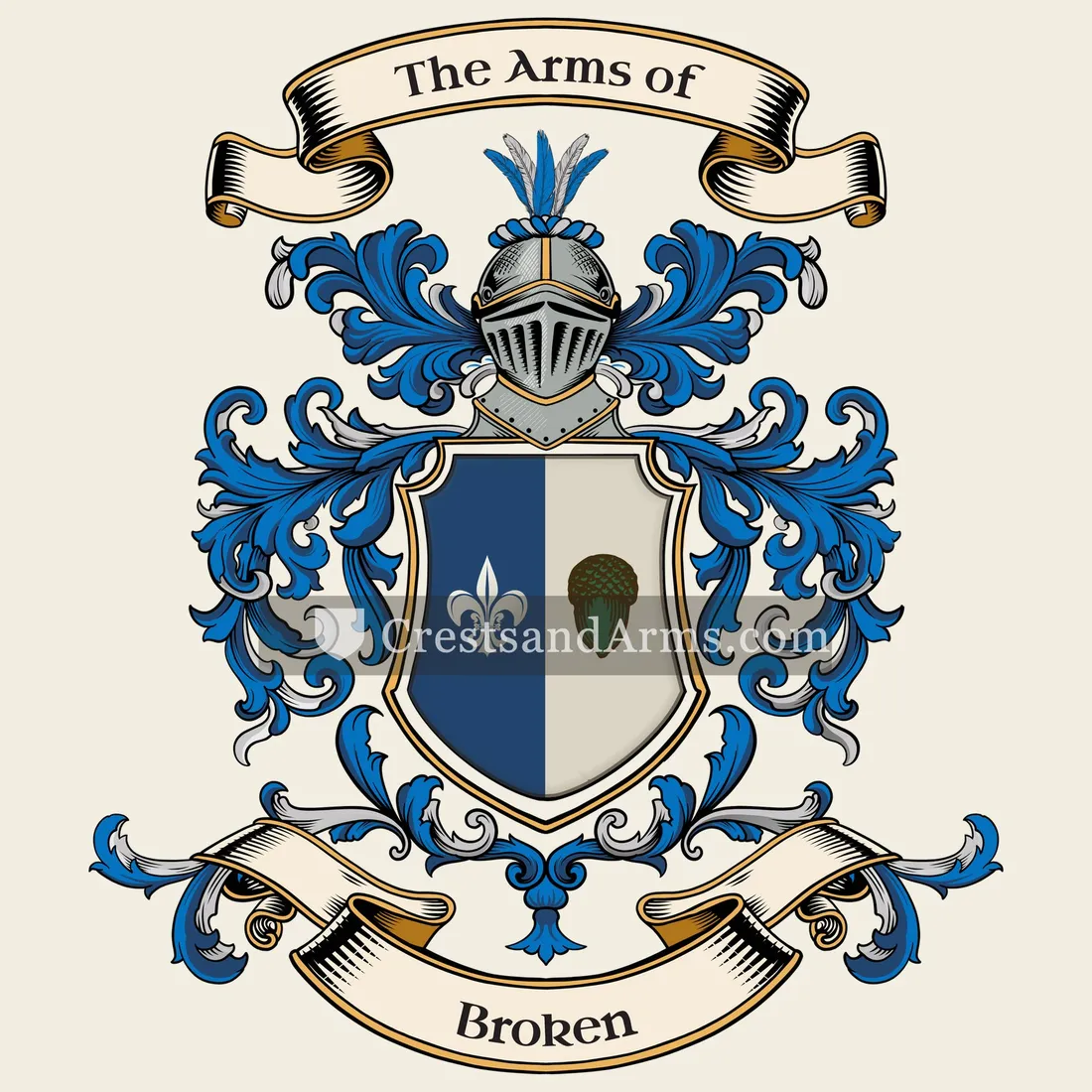
A record of documented arms, meaning and origin, researched for the Broken family of Germany.
Reg. 8840 · German, A–C
Meaning of the Broken family crest colors & symbols
Symbols on this shield
fleur de lisPurity, light, and the sixth son
oakGreat age, strength and steadfastness
Colours
Blue (Azure)Means: Loyalty and truth
Silver (Argent)Means: Peace and sincerity
Green (Vert)Means: Hope
Historical info
Source
J. B. Rietstap, Armorial Général, Gouda: G. B. van Goor Zonen, 1884–87
Blazon (the actual original written record)
“Parti: au 1 d'azur à la fleur-de-lis d'arg.; au 2 d'arg. à la branche de chêne de sin., englantée au nat. Cq. cour. C.: une fleur-de-lis d'arg., entre un vol d'azur. L. d'arg. et d'azur.”
MecklenburgMecklenburg, c. 1765
Digital archive packCoat of arms PNG, gold border print PDF, vector SVG and the certificate of authenticity. Sent to your email in minutes.
Map of Germany showing where the Broken arms are recorded
The Broken arms were recorded in Mecklenburg, c. 1765.
Mecklenburg was farming country in the north of Germany, held by a small number of families who kept their estates for generations. Owning land was what entitled a family to arms, so a great many Mecklenburg names ended up in the registers.
This is where the arms were entered in the register. Families often moved to other parts of the country, so the same name can turn up in more than one region.
The body that granted and recorded arms in Germany in this period.
Francis I, Holy Roman Emperor
Sovereign of the period
Francis I, Holy Roman Emperor
1745–1765
Reigning in Germany when the Broken arms are first recorded.
How Arms Worked in Germany
In the Holy Roman Empire, coats of arms were often granted to individuals by the Emperor or his representatives. These arms were then passed down through the generations to all legitimate descendants of the original holder. Younger branches of a family usually kept the same shield design without needing to change it, as the arms belonged to the entire lineage.
Granting authority
The Holy Roman Emperor held the sole power to grant new coats of arms throughout his vast imperial territories.
How they got arms
Families typically obtained their coats of arms through a formal imperial grant or by proving their noble status to the authorities.
Where arms were recorded
These grants were officially recorded in the Imperial Chancery registers, which began keeping formal records of such honors during the Middle Ages.
The family's standing
Recorded among the armigerous families of Mecklenburg.
Origin & History of the Broken Family in Germany
The history of the Broken family is rooted in the rural landscapes of Mecklenburg, where records confirm their presence as early as 1765. During this period, the name likely functioned as a descriptive identifier for individuals who lived near a specific landmark or worked on land that had been cleared or broken for agricultural use. In the eighteenth century, families in this region were often tied to the rhythms of village life and local farming estates. As members of the community, the early Broken family would have navigated the social and economic shifts of the Mecklenburg duchies, contributing to the development of the local agrarian economy. Their presence in these historical records suggests a long-standing connection to the soil and the steady growth of a lineage that remained embedded in the traditions of northern German society for generations.
Broken Meaning & Related Branches
Root word
Brach
Old High German term referring to fallow or uncultivated land.
This name
BrokenA topographic name for someone who lived on or worked on uncultivated or broken land.
also spelled
Broken
Broccken
Brockenn
Documented Sources
J. B. Rietstap, Armorial Général, Gouda: G. B. van Goor Zonen, 1884–87


 fleur de lisPurity, light, and the sixth son
 oakGreat age, strength and steadfastness
 fleur de lisPurity, light, and the sixth son
 oakGreat age, strength and steadfastness