Map of Britain showing where the Bromfield arms are recorded
The Bromfield arms were recorded in Sussex, c. 1660.
Sussex had ironworks in its woods and good farmland on its downs. Both made money, and families who made it bought manors, which is what put their names in the heraldic records.
This is where the arms were entered in the register. Families often moved to other parts of the country, so the same name can turn up in more than one region.
The body that granted and recorded arms in Britain in this period.
Charles II of England
Sovereign of the period
Charles II of England
1660–1685
Reigning in Britain when the Bromfield arms are first recorded.
How Arms Worked in Britain
English heraldry allowed arms to be shared by all legitimate descendants of the original owner. These symbols were treated as personal property that moved through the generations to all children. While the eldest son kept the original design, other family members could use the same shield without needing to change it or register their own unique versions.
Granting authority
The College of Arms in London has regulated the use of coats of arms throughout England and Wales since 1484.
How they got arms
Families typically obtained their coats of arms through a formal grant from the Crown or by proving their ancient right to them.
Where arms were recorded
All official coats of arms are recorded in the registers kept at the College of Arms, which date back to the fifteenth century.
The family's standing
Recorded among the armigerous families of Sussex.
Origin & History of the Bromfield Family in Britain
The surname Bromfield is a locative name, meaning it originated from people who lived near a field of broom, which is a common yellow-flowering shrub found across the British landscape. While the name appears in various regions, the branch of the family established in Sussex by 1660 reflects the broader movement of families during the seventeenth century. At this time, England was undergoing significant political and social changes following the restoration of the monarchy. Families like the Bromfields often settled in rural areas to manage land or participate in local trade, helping to solidify their presence in the county records. By settling in Sussex, these early family members became part of the local fabric of the region, contributing to the agricultural and social life of the community during a period of national transition.
Coat of Arms & Family Crest Details
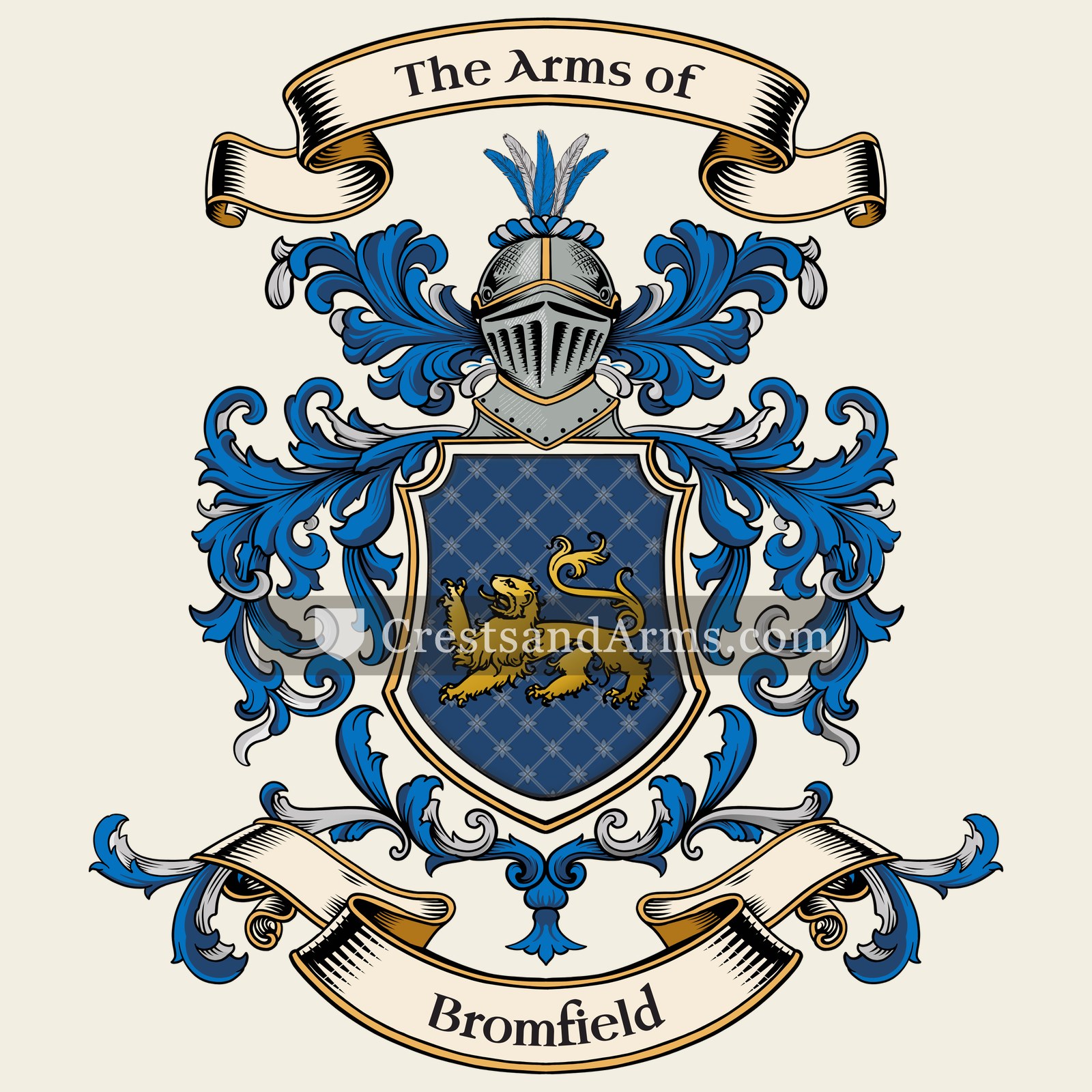
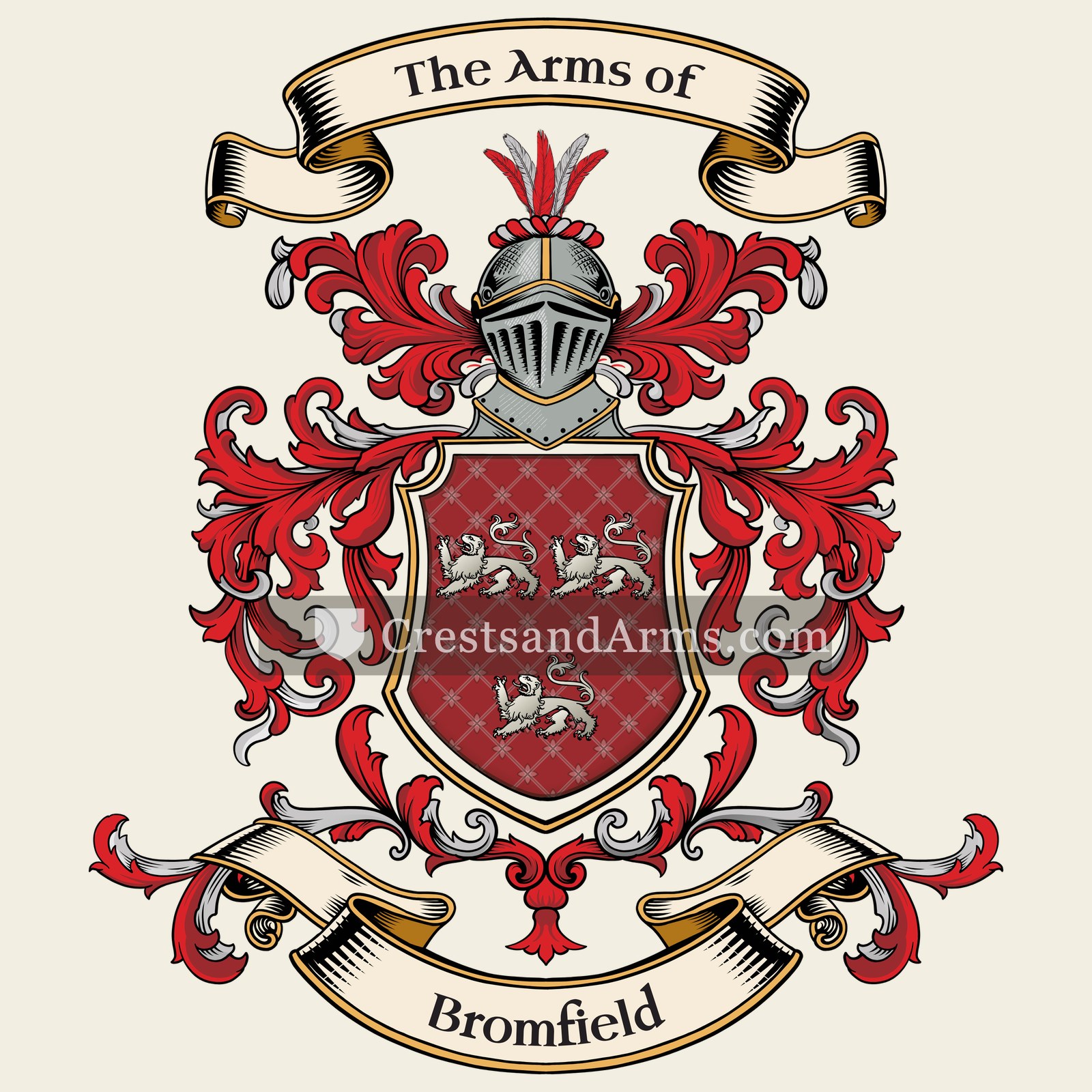
Symbols on this shield
lionCourage, strength and royalty
Colours
Red (Gules)Means: Military strength
Silver (Argent)Means: Peace and sincerity
Historical info
Source
Sir Bernard Burke, The General Armory of England, Scotland, Ireland and Wales, London: Harrison & Sons, 1884
Blazon (the actual original written record)
“Gu. three lions pass. guard. ar”
LincolnshireLincolnshire, c. 1620
Digital archive packCoat of arms PNG, gold border print PDF, vector SVG and the certificate of authenticity. Sent to your email in minutes.
Map of England showing where the Bromfield arms are recorded
The Bromfield arms were recorded in Lincolnshire, c. 1620.
This is where the arms were entered in the register. Families often moved to other parts of the country, so the same name can turn up in more than one region.
The body that granted and recorded arms in England in this period.
James VI and I
Sovereign of the period
James VI and I
1603–1625
Reigning in Britain when the Bromfield arms are first recorded.
How Arms Worked in England
English heraldry allowed arms to be shared by all legitimate descendants of the original owner. These symbols were treated as personal property that moved through the generations to all children. While the eldest son kept the original design, other family members could use the same shield without needing to change it or register their own unique versions.
Granting authority
The College of Arms in London has regulated the use of coats of arms throughout England and Wales since 1484.
How they got arms
Families typically obtained their coats of arms through a formal grant from the Crown or by proving their ancient right to them.
Where arms were recorded
All official coats of arms are recorded in the registers kept at the College of Arms, which date back to the fifteenth century.
The family's standing
Recorded among the armigerous families of Lincolnshire.
Origin & History of the Bromfield Family in England
The surname Bromfield is a locative name, meaning it originated from people who lived near a specific geographic feature or a place bearing that name. In Old English, the name is derived from the words "brom," meaning broom or gorse, and "feld," meaning an open field or clearing. This suggests that the earliest ancestors to adopt the name likely resided on or near a patch of land covered in broom shrubs. By the early 17th century, the family had established a notable presence in the county of Lincolnshire. Records from 1620 confirm that members of the Bromfield family were active in this region during a time of significant social and agricultural change in England. As the family grew, they became part of the local fabric of Lincolnshire, living and working within the rural landscape that had originally inspired their surname.
Bromfield Meaning & Related Branches
Root word
Brom-feld
Old English words for broom plant and an open field.
This name
BromfieldA topographical name for someone who lived near a field overgrown with broom shrubs.
also spelled
Bromfeild
Broomfield
Brumfield
Related arms
Brumfieldvariant spelling
Documented Sources
J. B. Rietstap, Armorial Général, Gouda: G. B. van Goor Zonen, 1884–87
Bardsley, Charles Wareing, A Dictionary of English and Welsh Surnames, 1901
Lower, Mark Antony, Patronymica Britannica: A Dictionary of the Family Names of the United Kingdom, 1860
The National Archives, State Papers Domestic: Charles II, 1660
Digital archive packCoat of arms PNG, gold border print PDF, vector SVG and the certificate of authenticity. Sent to your email in minutes.


 lionCourage, strength and royalty
 lionCourage, strength and royalty