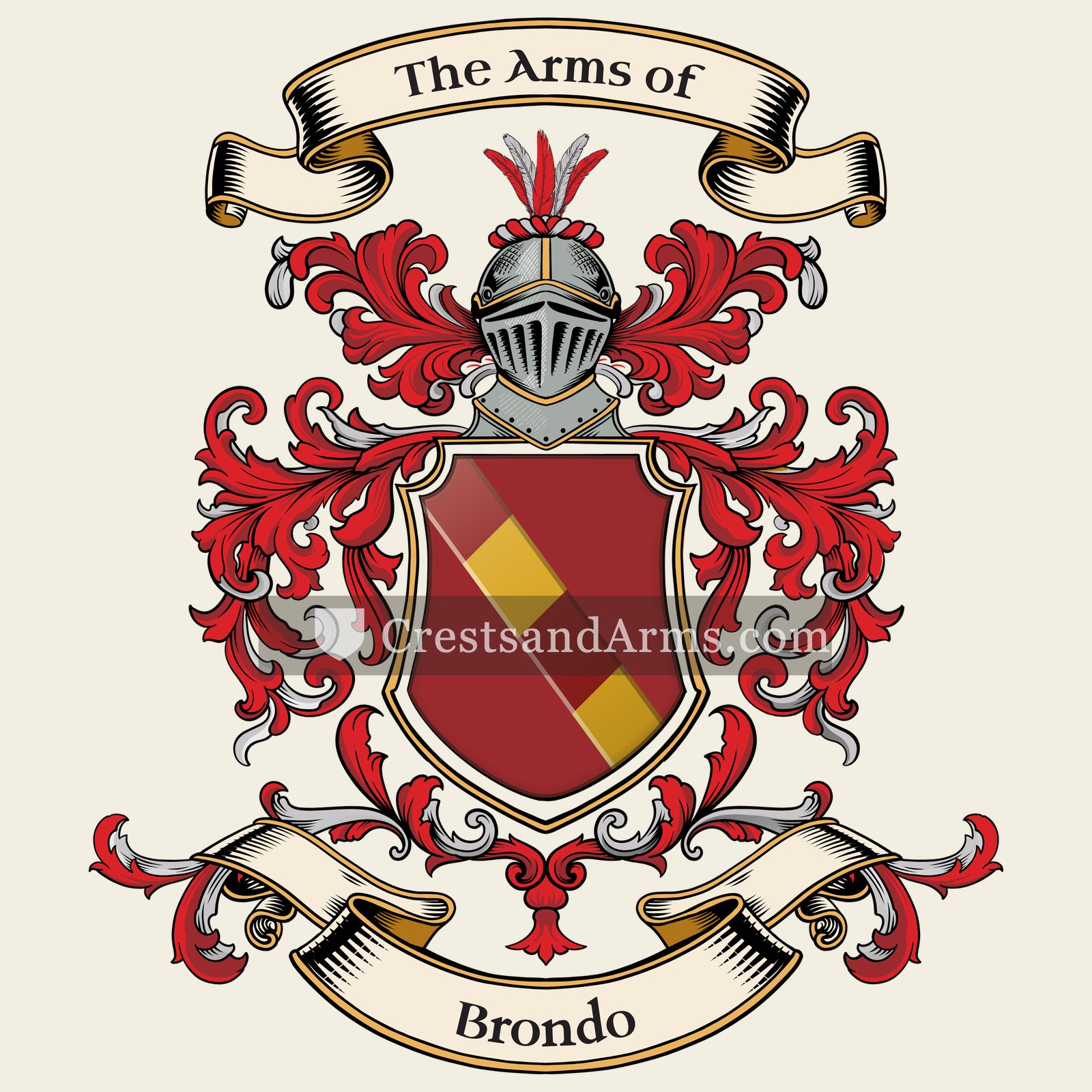
A record of documented arms, meaning and origin, researched for the Brondo family lines. Documented in 2 countries.
Reg. 8029 · Spanish, A–C
Coat of Arms & Family Crest Details
Symbols on this shield
bendDefence, and the scarf of a commander
Colours
Red (Gules)Means: Military strength
Gold (Or)Means: Generosity
Historical info
Source
J. B. Rietstap, Armorial Général, Gouda: G. B. van Goor Zonen, 1884–87
Blazon (the actual original written record)
“De gu. à trois bandes entées d'or. D.: EO QUOD ORE SINE LABIIS NASCERETUR.”
SpainIles Baléares, c. 1725
Where the Brondo Arms Were Recorded
Iles Baléares
Map of Spain showing where the Brondo arms are recorded
The Brondo arms were recorded in Iles Baléares, c. 1725.
This is where the arms were entered in the register. Families often moved to other parts of the country, so the same name can turn up in more than one region.
The body that granted and recorded arms in Spain in this period.
Philip V of Spain
Sovereign of the period
Philip V of Spain
1724–1746
Reigning in Spain when the Brondo arms are first recorded.
How Arms Worked in Spain
In Spain, a coat of arms was considered a form of property that belonged to the entire family line. These arms were passed down from a father to all his children equally. Younger branches of the family usually kept the original design without needing to add any special marks to distinguish their specific line.
Granting authority
The Cronista Rey de Armas was the official body that regulated and granted coats of arms throughout Spain.
How they got arms
Families often obtained their arms through royal grants or by proving their noble status to the official heraldic authority.
Where arms were recorded
Coats of arms were officially recorded in the registers of the Cronista Rey de Armas starting in 1496.
The family's standing
Recorded among the armigerous families of Spain.
Origin & History of the Brondo Family in Spain
The Brondo family name has deep roots in the Balearic Islands, where members of the lineage were firmly established by the early eighteenth century. Historical records from 1725 indicate that the family was active in the social and administrative life of Mallorca during this period. The name is closely linked to the unique cultural landscape of the Balearic region, which served as a crossroads for Mediterranean trade and influence. As the family grew, they became integrated into the local community, participating in the agricultural and civic developments that defined island life under the Spanish Crown. By maintaining a consistent presence in these territories, the Brondo family helped shape the regional identity of the islands while adapting to the shifting political climate of eighteenth-century Spain.
Coat of Arms & Family Crest Details
Symbols on this shield
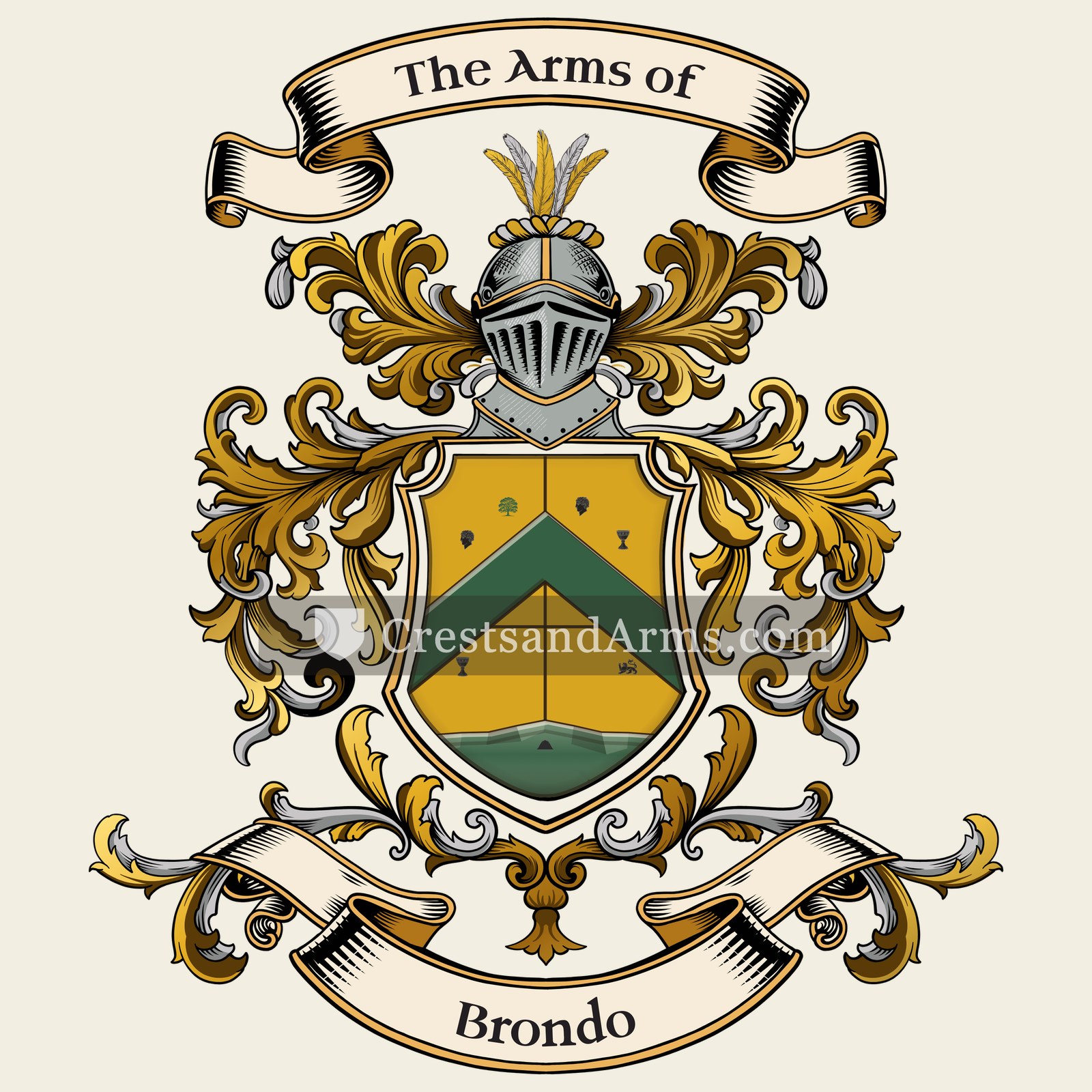
mountThe ground held, and steadfastness upon it
chevronProtection, and faithful service completed
treeLife, endurance and deep roots
savages head affrontyAn enemy overcome
cupFaith, office, and a trust discharged
lionCourage, strength and royalty
Colours
Gold (Or)Means: Generosity
Green (Vert)Means: Hope
Black (Sable)Means: Constancy
Historical info
Source
J. B. Rietstap, Armorial Général, Gouda: G. B. van Goor Zonen, 1884–87
Blazon (the actual original written record)
“Ec.: au 1 d'or à l'arbre terrassé de sin., accosté de deux têtes de More affr., coiffées de turbans d'arg., mouv. de la terrasse; au 2 de gu. au chev. d'or, acc. de deux barillets couchés du même, 1 en chef et 1 en p.; au 3 de gu. au lion d'or; au 4 d'azur à une montagne de trois coupeaux au nat., surm. d'une scie montée d'or.”
Francec. 1725
Where the Brondo Arms Were Recorded
Bretagne
Map of France showing where the Brondo arms are recorded
The Brondo arms were recorded in France, c. 1725.
Arms such as these were typically recorded in Bretagne.
More families held coats of arms in Bretagne than anywhere else in France. The land was divided into many small estates rather than a few large ones, so far more households counted as gentry, and each needed a shield of its own to be told apart.
This is where the arms were entered in the register. Families often moved to other parts of the country, so the same name can turn up in more than one region.
The body that granted and recorded arms in France in this period.
Louis XV of France
Sovereign of the period
Louis XV of France
1715–1774
Reigning in Spain when the Brondo arms are first recorded.
How Arms Worked in France
In France, a coat of arms was a mark of honor that passed down through the male line to all legitimate descendants. Families often used the same shield without changes to show their shared heritage. If a branch wanted to stand out, they could add a small mark to their shield to show their specific place in the family tree.
Granting authority
The Juge d'armes de France acted as the official authority that regulated and verified coats of arms across the country.
How they got arms
Families typically inherited their arms from ancestors, though they could also receive them through royal grants or by proving their noble status.
Where arms were recorded
Coats of arms were officially recorded in the Armorial Général de France, which began its main collection in the year 1696.
The family's standing
Recorded among the armigerous families of France.
Origin & History of the Brondo Family in France
The history of the Brondo family in France is deeply rooted in the cultural landscape of the Brittany region during the early eighteenth century. By 1725, records confirm that members of the family were well-established within this coastal province, a time when Brittany functioned as a distinct territory with its own unique traditions and social structures. The name itself likely evolved from local linguistic patterns common to the area, reflecting the way families were identified in small, tightly knit rural communities. During this period, the Brondo family would have navigated the complexities of life under the French monarchy, likely engaging in the agricultural or maritime trades that defined the Breton economy. Their presence in the region suggests a long-standing connection to the land, as families in this era often remained in the same parishes for generations, passing down their names and local customs through parish registers and community ties.
Related Branches & Arms
Root word
brondir
Old Germanic term meaning to burn or to shine brightly.
This name
BrondoRefers to a person who lived near a place cleared by fire or a bright location.
also spelled
Brondoo
Brondos
Documented Sources
J. B. Rietstap, Armorial Général, Gouda: G. B. van Goor Zonen, 1884–87
Archivo del Reino de Mallorca, Protocolos Notariales
Archivo Histórico Nacional, Sección Nobleza
Bover de Rosselló, Joaquín María, Nobiliario Mallorquín, 1850
Pascual, Aina, La sociedad mallorquina en el siglo XVIII, 1992
Digital archive packCoat of arms PNG, gold border print PDF, vector SVG and the certificate of authenticity. Sent to your email in minutes.


 bendDefence, and the scarf of a commander
 bendDefence, and the scarf of a commander

 mountThe ground held, and steadfastness upon it
 chevronProtection, and faithful service completed
 treeLife, endurance and deep roots
 savages head affrontyAn enemy overcome
 cupFaith, office, and a trust discharged
 lionCourage, strength and royalty