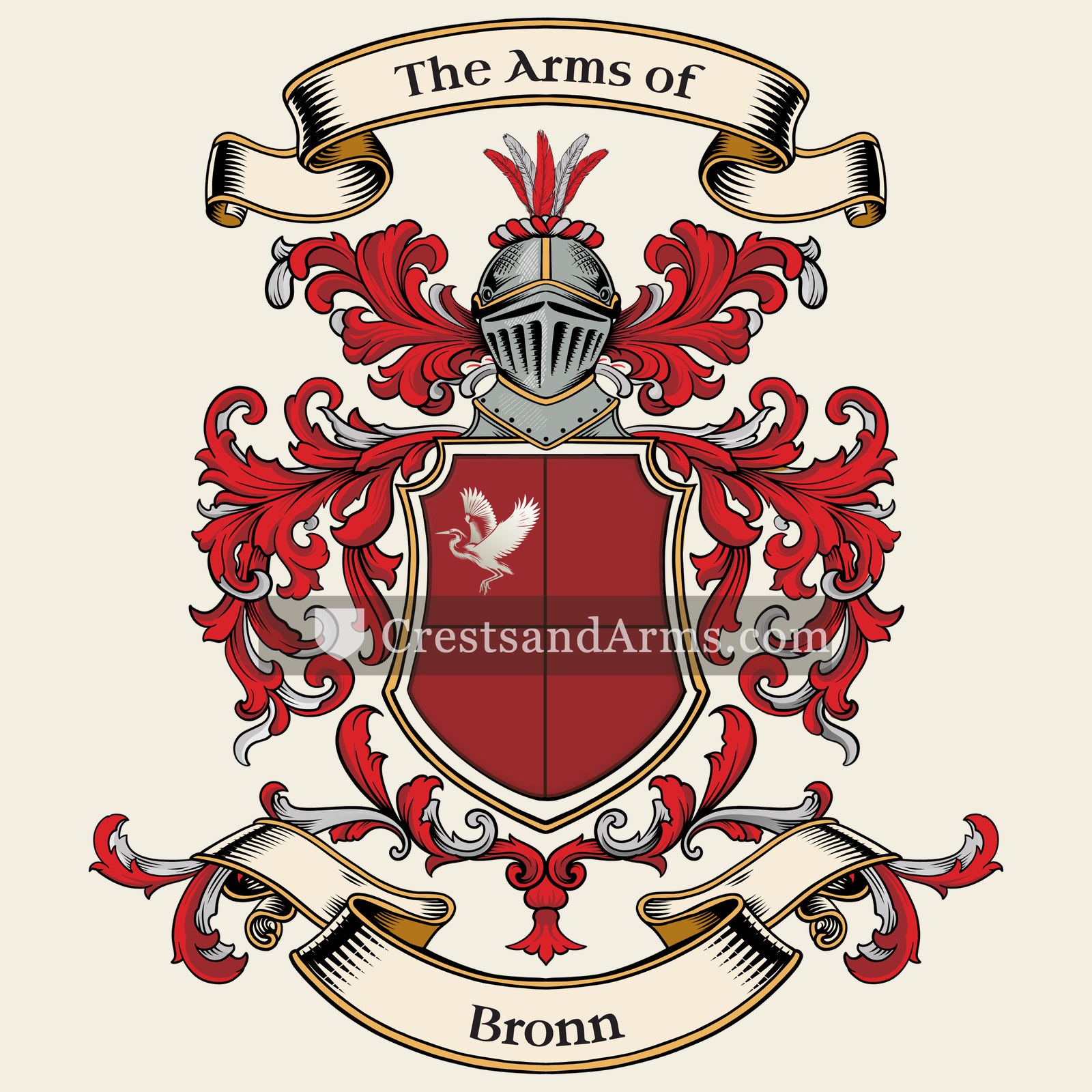
A record of documented arms, meaning and origin, researched for the Bronn family of Germany.
Reg. 4867 · German, A–C
Coat of Arms & Family Crest Details
Symbols on this shield
heronPatience and quiet watchfulness
Colours
Red (Gules)Means: Military strength
Silver (Argent)Means: Peace and sincerity
Historical info
Source
J. B. Rietstap, Armorial Général, Gouda: G. B. van Goor Zonen, 1884–87
Blazon (the actual original written record)
“Ec.: aux 1 et 4 de gu. à un puits d'arg.; au 2 d'azur à une grue d'arg.; au 3 d'azur à la bande ondée d'arg. Cq. cour. C.: un vol coupé alt. de gu. et d'arg. L. d'arg. et de gu.”
WurttembergWurttemberg, c. 1862
Digital archive packCoat of arms PNG, gold border print PDF, vector SVG and the certificate of authenticity. Sent to your email in minutes.
Map of Germany showing where the Bronn arms are recorded
The Bronn arms were recorded in Wurttemberg, c. 1862.
Wurttemberg was southern German country of small estates and well-off market towns. Both landowners and leading townsmen kept arms there, so the region carries far more names than its size suggests.
This is where the arms were entered in the register. Families often moved to other parts of the country, so the same name can turn up in more than one region.
The body that granted and recorded arms in Germany in this period.
Wilhelm I
Sovereign of the period
Wilhelm I
1861–1888
Reigning in Germany when the Bronn arms are first recorded.
How Arms Worked in Germany
Prussian heraldry was strictly tied to social rank and noble status rather than being a free choice for every citizen. These symbols were treated as permanent family property that moved through the generations to all legitimate heirs. If a family branch wanted to change their design to stand out, they had to apply for official permission to alter their specific version of the shield.
Granting authority
The Prussian Heroldsamt acted as the central state office that managed and strictly controlled all noble titles and coats of arms.
How they got arms
Families usually obtained their arms through formal royal grants or by proving their long-standing noble status to the state authorities.
Where arms were recorded
All official coats of arms were kept in the rolls of the Prussian Heroldsamt, which functioned from 1706 until 1918.
The family's standing
Recorded among the armigerous families of Wurttemberg.
Origin & History of the Bronn Family in Germany
The surname Bronn is deeply rooted in the historical landscape of southwestern Germany, particularly within the region of Württemberg. Linguists often trace the name back to Middle High German terms related to the color brown, which likely served as a descriptive nickname for an ancestor with dark hair or a tanned complexion. By the mid-19th century, families bearing this name were well-established members of local communities in Württemberg, where they often worked as skilled tradespeople or farmers. These early generations lived through a time of significant social change as the region transitioned into the German Empire. Because the name was tied to a common physical trait, it emerged independently in several different villages, meaning that not all people named Bronn share a single common ancestor. Instead, the name reflects the way that ordinary people in the 1800s were identified by their neighbors based on their appearance and daily contributions to village life.
Bronn Meaning & Related Branches
Root word
brun
Old High German word meaning brown or dark-colored.
This name
BronnA descriptive nickname for someone with brown hair, a dark complexion, or wearing brown clothing.
also spelled
Bron
Related arms
Bronvariant spelling
Documented Sources
J. B. Rietstap, Armorial Général, Gouda: G. B. van Goor Zonen, 1884–87
Bahlow, Hans, Deutsches Namenlexikon: Familien- und Vornamen nach Ursprung und Sinn erklärt, 1967
Kohlheim, Rosa and Volker Kohlheim, Duden Familiennamen: Herkunft und Bedeutung von 20.000 Nachnamen, 2005
Landesarchiv Baden-Württemberg, Bestand E 157: Württembergische Standesämter, 1862
Digital archive packCoat of arms PNG, gold border print PDF, vector SVG and the certificate of authenticity. Sent to your email in minutes.


 heronPatience and quiet watchfulness
 heronPatience and quiet watchfulness