Map of Scotland showing where the Bronnimann arms are recorded
The Bronnimann arms were recorded in Scotland, c. 1748.
Arms such as these were typically recorded in Edinburgh.
Edinburgh was the seat of Scotland's government, its courts and its heralds. Families with business there settled nearby, and being close to where arms were recorded is exactly why so many of them appear.
This is where the arms were entered in the register. Families often moved to other parts of the country, so the same name can turn up in more than one region.
The body that granted and recorded arms in Scotland in this period.
George II of Great Britain
Sovereign of the period
George II of Great Britain
1727–1760
Reigning in Scotland when the Bronnimann arms are first recorded.
How Arms Worked in Scotland
Scottish heraldry is unique because it treats a coat of arms as a piece of personal property protected by law. Only one person can own a specific design at any given time. When a family grows, the head keeps the original shield while other relatives must apply for their own distinct version with slight changes to prove their specific identity.
Granting authority
The Court of the Lord Lyon acts as the official body that regulates and controls all heraldic matters throughout Scotland.
How they got arms
Individuals obtain a legal right to their arms through a formal petition process that confirms their identity and family connection.
Where arms were recorded
All valid coats of arms are officially entered into the Public Register of All Arms and Bearings starting from 1672.
The family's standing
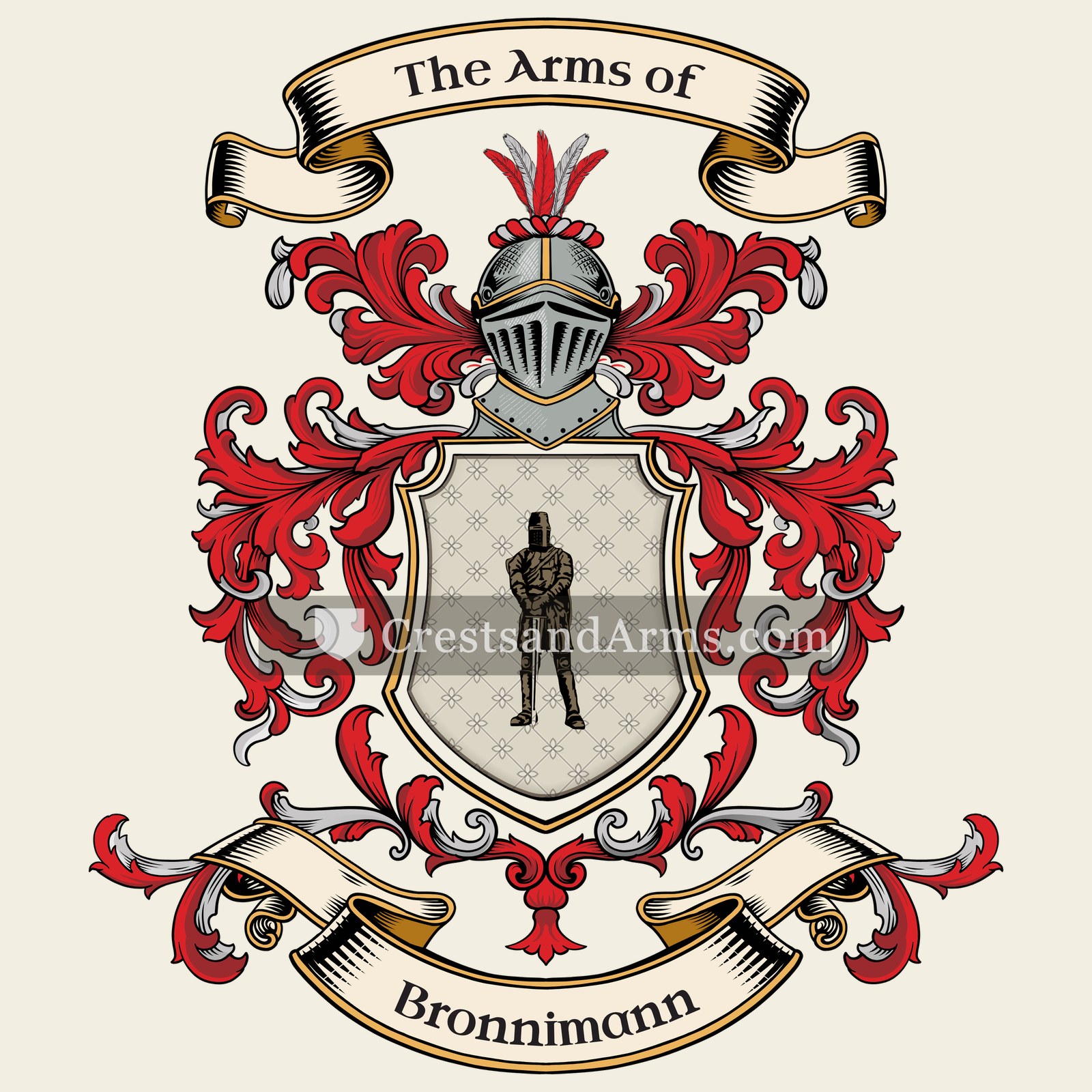
Recorded among the armigerous families of Scotland.
Origin & History of the Bronnimann Family in Scotland
The surname Brönnimann originates from the German-speaking regions of Switzerland, specifically within the cantons of Bern and Basel. The name is topographical in nature, likely derived from the Middle High German words for a fountain or a well, suggesting that the earliest ancestors lived near a prominent water source. While the family maintained deep roots in the Swiss countryside for centuries, members of the lineage began to migrate across Europe during the eighteenth century in search of new opportunities. By 1748, records confirm that individuals bearing the name had established a presence in Edinburgh, Scotland. This migration was often driven by the movement of skilled craftsmen and merchants who sought to integrate into the growing urban economies of the British Isles. These early settlers helped bridge the gap between their traditional Alpine heritage and the rapidly changing society of Enlightenment-era Scotland.
Related Branches & Arms
Root word
Brun
Derived from the Germanic word for the color brown.
This name
BronnimannA topographic name for someone living near a brown-colored hill or mountain.
also spelled
Bonneman
Boneman
Documented Sources
Sir Bernard Burke, The General Armory of England, Scotland, Ireland and Wales, London: Harrison & Sons, 1884
Familiennamenbuch der Schweiz, Familiennamenbuch der Schweiz, 1989
National Records of Scotland, Register of Marriages, Edinburgh, 1748
Bahlow, Hans, Deutsches Namenlexikon, 1967
Digital archive packCoat of arms PNG, gold border print PDF, vector SVG and the certificate of authenticity. Sent to your email in minutes.


 knightChivalry and service in arms
 knightChivalry and service in arms