Map of Germany showing where the Brook arms are recorded
The Brook arms were recorded in Germany, c. 1765.
Arms such as these were typically recorded in Bavaria.
Bavaria was a country of old landed families and walled market towns. Estates passed down the same line for centuries, and both the landowners and the leading townsmen kept arms, which is why so many Bavarian names sit in the registers.
This is where the arms were entered in the register. Families often moved to other parts of the country, so the same name can turn up in more than one region.
The body that granted and recorded arms in Germany in this period.
Francis I, Holy Roman Emperor
Sovereign of the period
Francis I, Holy Roman Emperor
1745–1765
Reigning in Germany when the Brook arms are first recorded.
How Arms Worked in Germany
In the Holy Roman Empire, coats of arms were often granted to individuals by the Emperor or his representatives. These arms were then passed down through the generations to all legitimate descendants of the original holder. Younger branches of a family usually kept the same shield design without needing to change it, as the arms belonged to the entire lineage.
Granting authority
The Holy Roman Emperor held the sole power to grant new coats of arms throughout his vast imperial territories.
How they got arms
Families typically obtained their coats of arms through a formal imperial grant or by proving their noble status to the authorities.
Where arms were recorded
These grants were officially recorded in the Imperial Chancery registers, which began keeping formal records of such honors during the Middle Ages.
The family's standing
Recorded among the armigerous families of Germany.
Origin & History of the Brook Family in Germany
The family name Brook, often appearing in German records as Bruck or Brück, is a topographical surname that identifies people who lived near a bridge or a marshy area. By the mid-eighteenth century, the family established a notable presence in the region of Bavaria. During this period, the social structure of Bavaria was deeply tied to local land management and agricultural traditions. Families with this name were likely integrated into the rural communities of the Bavarian countryside, where they worked as farmers or tradespeople. The name itself reflects the importance of geography in early German naming conventions, as it served as a practical way to distinguish individuals based on their proximity to specific natural or man-made landmarks. As the family grew in 1765 and beyond, they became part of the long-standing demographic history of southern Germany, contributing to the local culture and economy of their home province.
Meaning of the Brook family crest colors & symbols
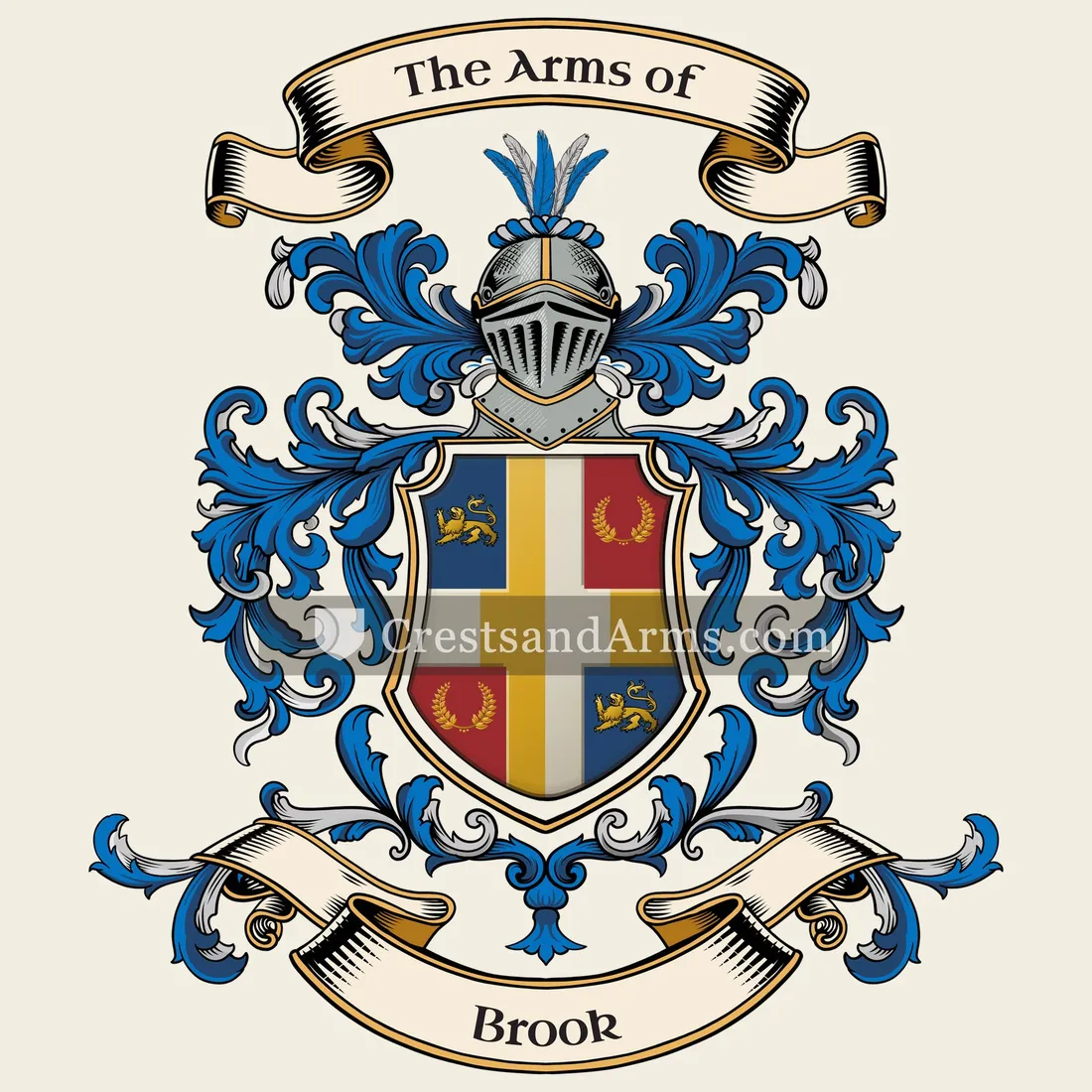
Symbols on this shield
cross symbolChristian faith and service
paleMilitary strength, and a fortified defence
lionCourage, strength and royalty
wreathHonour, and a victory crowned
Colours
Blue (Azure)Means: Loyalty and truth
Red (Gules)Means: Military strength
Gold (Or)Means: Generosity
Silver (Argent)Means: Peace and sincerity
Historical info
Source
Sir Bernard Burke, The General Armory of England, Scotland, Ireland and Wales, London: Harrison & Sons, 1884
Blazon (the actual original written record)
“Quarterly, az. and gu. a cross engr. per pale or and ar. in the 1st and 4th quarters a leopard's face, and in the 2nd and 3rd a chaplet of gold”
Englandc. 1620
Digital archive packCoat of arms PNG, gold border print PDF, vector SVG and the certificate of authenticity. Sent to your email in minutes.
Map of England showing where the Brook arms are recorded
The Brook arms were recorded in England, c. 1620.
Arms such as these were typically recorded in York.
Yorkshire is the largest of the English counties, and it held more gentry families than any other. Land there was split among a great many households rather than a few, so a great many of them carried arms.
This is where the arms were entered in the register. Families often moved to other parts of the country, so the same name can turn up in more than one region.
The body that granted and recorded arms in England in this period.
James VI and I
Sovereign of the period
James VI and I
1603–1625
Reigning in Germany when the Brook arms are first recorded.
How Arms Worked in England
English heraldry allowed arms to be shared by all legitimate descendants of the original owner. These symbols were treated as personal property that moved through the generations to all children. While the eldest son kept the original design, other family members could use the same shield without needing to change it or register their own unique versions.
Granting authority
The College of Arms in London has regulated the use of coats of arms throughout England and Wales since 1484.
How they got arms
Families typically obtained their coats of arms through a formal grant from the Crown or by proving their ancient right to them.
Where arms were recorded
All official coats of arms are recorded in the registers kept at the College of Arms, which date back to the fifteenth century.
The family's standing
Recorded among the armigerous families of England.
Origin & History of the Brook Family in England
The surname Brook is a classic example of a topographic name, which was given to people who lived near a prominent physical feature in the landscape. In medieval England, individuals were often identified by their surroundings, so someone dwelling near a small stream or brook would be known by that location. By the time the family was recorded in York in 1620, the name had already been established for centuries as a way to distinguish families living in rural or semi-rural settings. During this era, York served as a vital northern hub for trade and administration, suggesting that the family had likely transitioned from their original rural roots into the urban life of a growing city. This movement reflects a broader trend in English history where families moved from small villages to larger towns to pursue new occupations and social stability. As the name spread across the region, it became a permanent marker of the family’s long-standing connection to the English countryside and their eventual integration into the civic life of northern England.
Brook Meaning & Related Branches
Root word
Bruok
A Middle Low German term referring to a marsh or swamp.
This name
BrookA topographic name for someone who lived near a marsh or brook.
also spelled
Brooke
Brooks
Broke
Broock
Related arms
Broekvariant spelling
van den Broeckvariant spelling
Brokevariant spelling
Documented Sources
J. B. Rietstap, Armorial Général, Gouda: G. B. van Goor Zonen, 1884–87
Bahlow, Hans, Deutsches Namenlexikon: Familien- und Vornamen nach Ursprung und Sinn erklärt, 1967


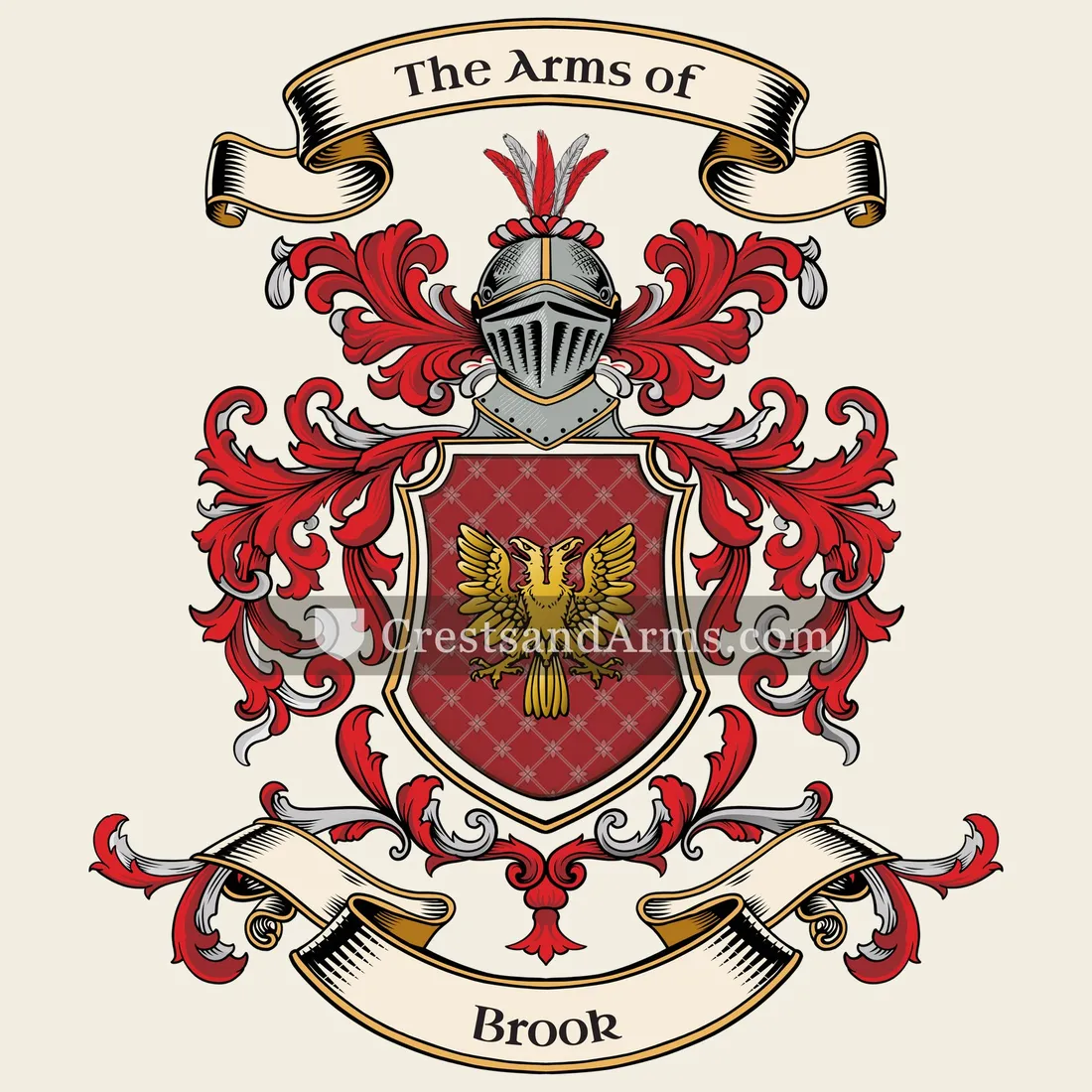
 eagleNobility, strength and a keen mind
 eagleNobility, strength and a keen mind


 cross symbolChristian faith and service
 paleMilitary strength, and a fortified defence
 lionCourage, strength and royalty
 wreathHonour, and a victory crowned