Map of France showing where the Bross arms are recorded
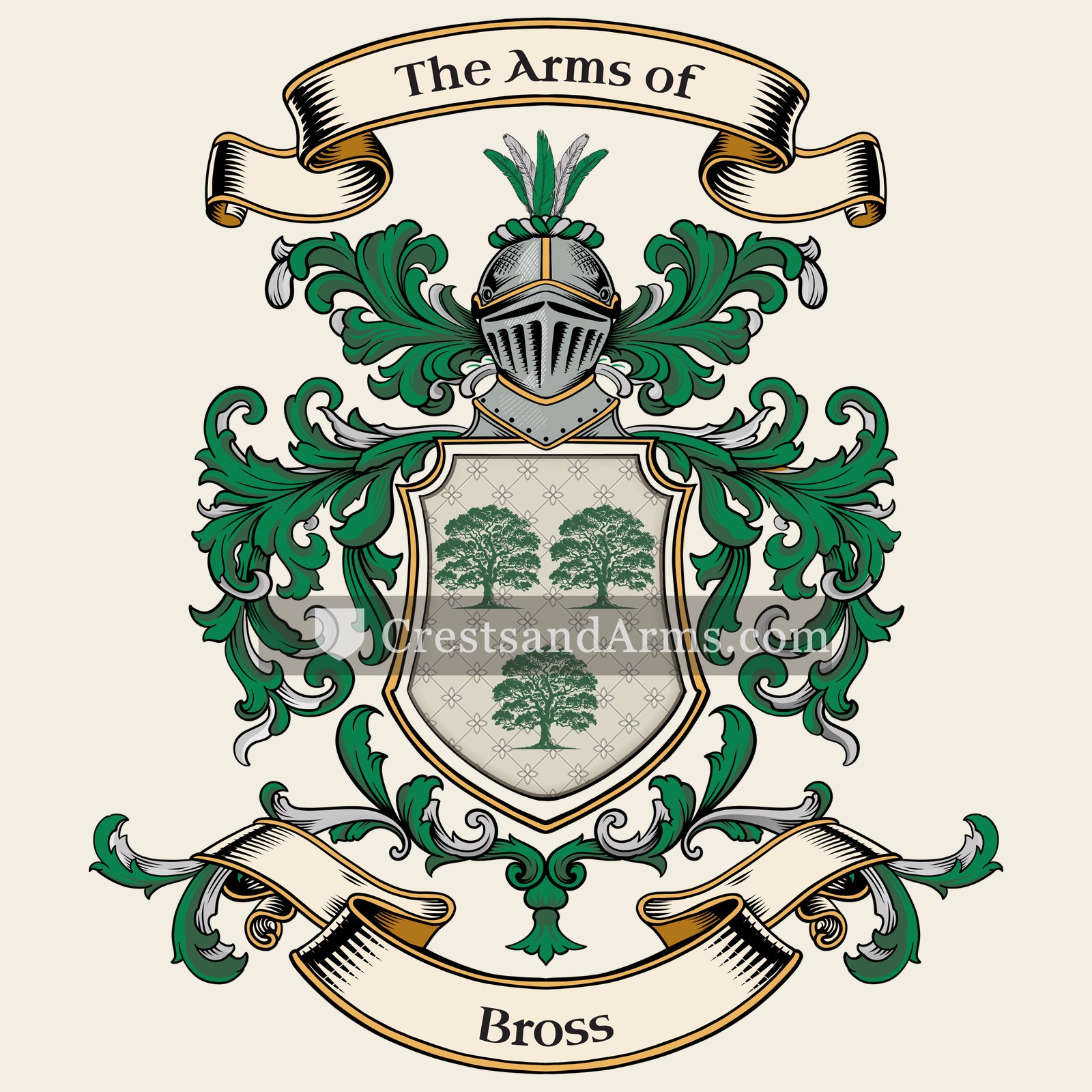
The Bross arms were recorded in France, c. 1663.
Arms such as these were typically recorded in Bretagne.
More families held coats of arms in Bretagne than anywhere else in France. The land was divided into many small estates rather than a few large ones, so far more households counted as gentry, and each needed a shield of its own to be told apart.
This is where the arms were entered in the register. Families often moved to other parts of the country, so the same name can turn up in more than one region.
The body that granted and recorded arms in France in this period.
Louis XIV of France
Sovereign of the period
Louis XIV of France
1643–1715
Reigning in France when the Bross arms are first recorded.
How Arms Worked in France
In France, a coat of arms was a mark of honor that passed down through the male line to all legitimate descendants. Families often used the same shield without changes to show their shared heritage. If a branch wanted to stand out, they could add a small mark to their shield to show their specific place in the family tree.
Granting authority
The Juge d'armes de France acted as the official authority that regulated and verified coats of arms across the country.
How they got arms
Families typically inherited their arms from ancestors, though they could also receive them through royal grants or by proving their noble status.
Where arms were recorded
Coats of arms were officially recorded in the Armorial Général de France, which began its main collection in the year 1696.
The family's standing
Recorded among the armigerous families of France.
Origin & History of the Bross Family in France
The surname Bross is deeply rooted in the historical landscape of the Brittany region of France, where records confirm the family was established by at least 1663. The name likely originated as a descriptive term, as the word "brosse" in Old French and local dialects often referred to thickets, brushwood, or uncultivated land covered in dense vegetation. Families living near these distinct geographical features were frequently identified by their proximity to the landscape, eventually adopting the name as a permanent family identifier. By the mid-seventeenth century, the Bross family was part of the agrarian social fabric of Brittany, living in a period defined by the transition from feudal traditions to the centralized administration of the French monarchy. Their presence in the region during this time suggests they were likely local farmers or tradespeople who played a role in the daily economic life of their rural parishes.
Bross Meaning & Related Branches
Root word
Brosse
Old French term for brushwood, thicket, or scrubland.
This name
BrossA topographic name for someone who lived near a thicket or brushwood area.
also spelled
Brooe
Related arms
Brooevariant spelling
Documented Sources
Sir Bernard Burke, The General Armory of England, Scotland, Ireland and Wales, London: Harrison & Sons, 1884
Archives départementales d’Ille-et-Vilaine, Registres paroissiaux et d'état civil
Dauzat, Albert, Dictionnaire étymologique des noms de famille et prénoms de France, 1951
Morlet, Marie-Thérèse, Dictionnaire étymologique des noms de famille, 1991
Digital archive packCoat of arms PNG, gold border print PDF, vector SVG and the certificate of authenticity. Sent to your email in minutes.


 treeLife, endurance and deep roots
 treeLife, endurance and deep roots