Map of Germany showing where the Bruck arms are recorded
The Bruck arms were recorded in Brandenburg, c. 1765.
Brandenburg was sandy farming country around Berlin, held in large estates by families who served as officers. Land and military service each brought arms, and most families there had both.
This is where the arms were entered in the register. Families often moved to other parts of the country, so the same name can turn up in more than one region.
The body that granted and recorded arms in Germany in this period.
Francis I, Holy Roman Emperor
Sovereign of the period
Francis I, Holy Roman Emperor
1745–1765
Reigning in Germany when the Bruck arms are first recorded.
How Arms Worked in Germany
In the Holy Roman Empire, coats of arms were often granted to individuals by the Emperor or his representatives. These arms were then passed down through the generations to all legitimate descendants of the original holder. Younger branches of a family usually kept the same shield design without needing to change it, as the arms belonged to the entire lineage.
Granting authority
The Holy Roman Emperor held the sole power to grant new coats of arms throughout his vast imperial territories.
How they got arms
Families typically obtained their coats of arms through a formal imperial grant or by proving their noble status to the authorities.
Where arms were recorded
These grants were officially recorded in the Imperial Chancery registers, which began keeping formal records of such honors during the Middle Ages.
The family's standing
Recorded among the armigerous families of Brandenburg.
Origin & History of the Bruck Family in Germany
The surname Bruck is a topographical name that originated in the German-speaking regions of Europe. It comes from the Middle High German word *brucke*, which translates to bridge. In the medieval period, people often took on surnames based on the landscape features near their homes or their specific occupations. Families living near a bridge or those responsible for maintaining one were frequently identified by this name. By the time the family was documented in the Brandenburg region in 1765, the name had already been established for centuries across various German states. During this era, Brandenburg was a central part of the Kingdom of Prussia, and families like the Brucks were often involved in the agricultural or trade-based life of the local villages. The name reflects a long history of people settling near vital infrastructure that connected communities across the German countryside.
Coat of Arms & Family Crest Details
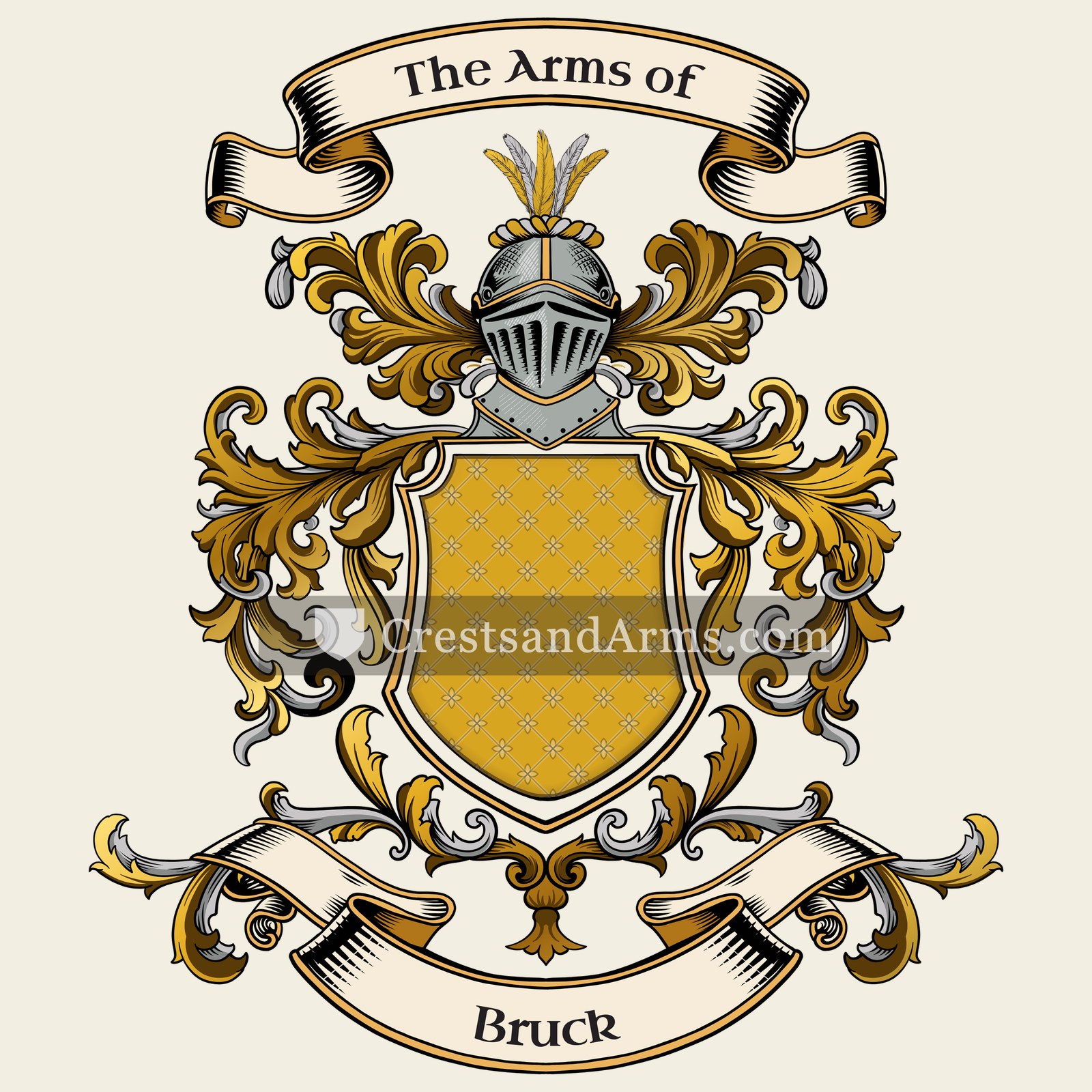
Colours
Gold (Or)Means: Generosity
Historical info
Source
J. B. Rietstap, Armorial Général, Gouda: G. B. van Goor Zonen, 1884–87
Blazon (the actual original written record)
“D'or à une vertenelle de gu., posée en bande. Cq. cour. C.: un cerf iss. de gu.”
AlsaceAlsace, c. 1663
Digital archive packCoat of arms PNG, gold border print PDF, vector SVG and the certificate of authenticity. Sent to your email in minutes.
Map of France showing where the Bruck arms are recorded
The Bruck arms were recorded in Alsace, c. 1663.
Alsace lay between France and the German lands and belonged to both at different times. Its families held small estates and served whichever side ruled, and men who served in arms carried arms of their own.
This is where the arms were entered in the register. Families often moved to other parts of the country, so the same name can turn up in more than one region.
The body that granted and recorded arms in France in this period.
Louis XIV of France
Sovereign of the period
Louis XIV of France
1643–1715
Reigning in Germany when the Bruck arms are first recorded.
How Arms Worked in France
In France, a coat of arms was a mark of honor that passed down through the male line to all legitimate descendants. Families often used the same shield without changes to show their shared heritage. If a branch wanted to stand out, they could add a small mark to their shield to show their specific place in the family tree.
Granting authority
The Juge d'armes de France acted as the official authority that regulated and verified coats of arms across the country.
How they got arms
Families typically inherited their arms from ancestors, though they could also receive them through royal grants or by proving their noble status.
Where arms were recorded
Coats of arms were officially recorded in the Armorial Général de France, which began its main collection in the year 1696.
The family's standing
Recorded among the armigerous families of Alsace.
Origin & History of the Bruck Family in France
The family name Bruck has deep roots in the Alsace region, a territory that has long served as a cultural bridge between France and Germany. By 1663, records confirm that members of the Bruck family were well-established in this area, living during a time when Alsace was transitioning under the influence of the French Crown. The name itself is derived from the Germanic word for bridge, which suggests that the earliest ancestors likely lived near a prominent river crossing or a stone bridge that served as a vital point for local trade and travel. Because Alsace was a crossroads for armies and merchants, the family would have experienced a unique blend of French and Germanic customs. This environment shaped their identity as they navigated the shifting political borders of the seventeenth century, eventually becoming part of the diverse social fabric of eastern France.
Coat of Arms & Family Crest Details
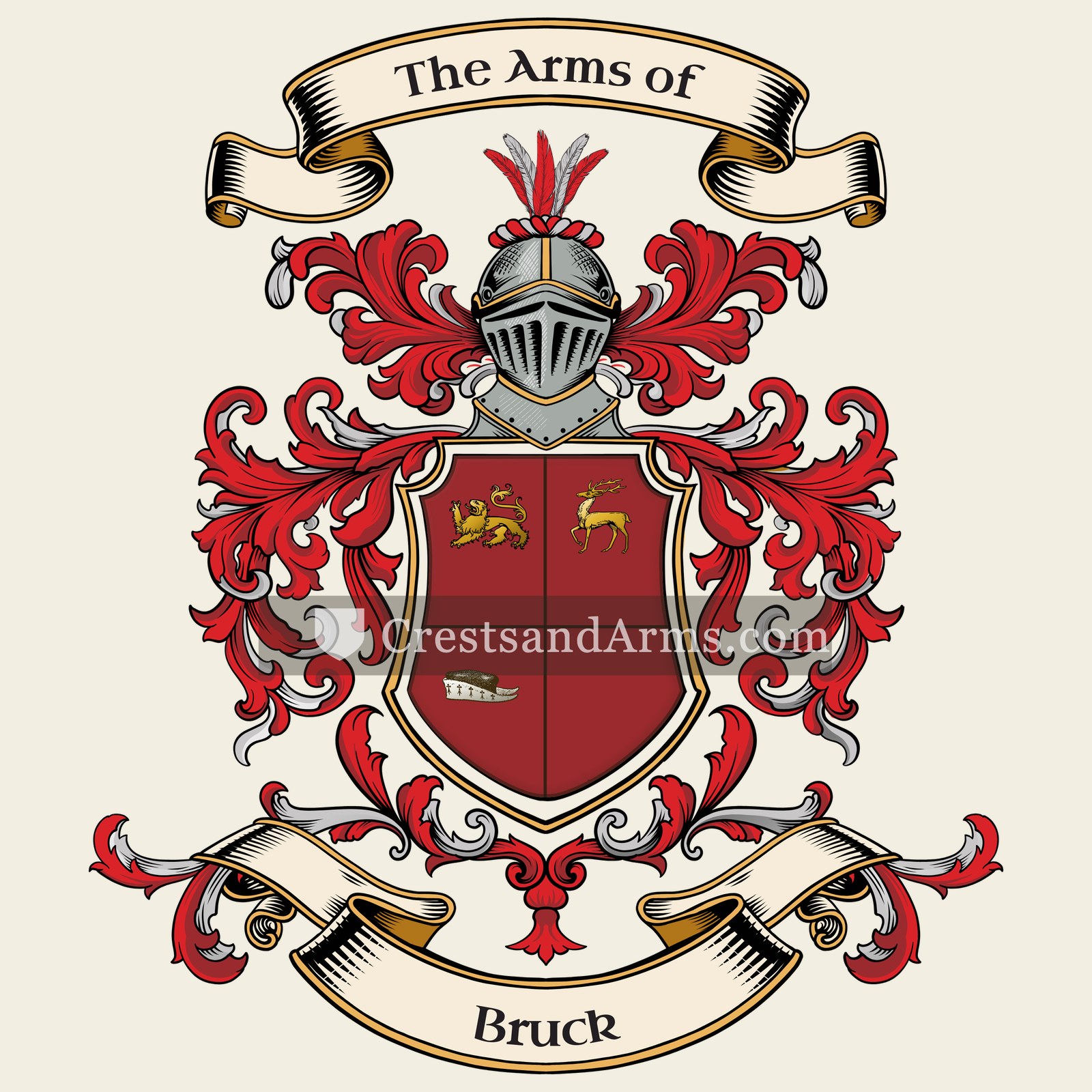
Symbols on this shield
lionCourage, strength and royalty
stagPeace and harmony, and one who will not fight unprovoked
hat or capDignity, and the honour of office
Colours
Red (Gules)Means: Military strength
Gold (Or)Means: Generosity
Silver (Argent)Means: Peace and sincerity
Historical info
Source
J. B. Rietstap, Armorial Général, Gouda: G. B. van Goor Zonen, 1884–87
Blazon (the actual original written record)
“Ec.: au 1 de gu. au lion d'or, tenant de sa patte dextre un fer de lance d'arg. et de sa. une palme de sin.; aux 2 et 3 d'or, à un fer de lance d'arg. en barre, br. sur ces deux quartiers; au 4 d'azur à une tête et col de cerf d'or. Sur le tout de sa. à un bonnet renv. d'arg., retr. d'herm., doublé de gu. Trois cq. cour. C.: 1º le lion du 1, iss. et cont.; l. d'or et de gu.; 2º le bonnet, entre un vol coupé d'arg. sur sa.; 1. d'arg. et de sa.; 3º un cerf iss. d'or; l. d'or et d'azur. S.: à dextre un léopard lionné d'or; à sen. un cerf au nat. D.: QUOD SIS, ESSE VELIS.”
AustriaVienne, c. 1772
Digital archive packCoat of arms PNG, gold border print PDF, vector SVG and the certificate of authenticity. Sent to your email in minutes.
Map of Austria showing where the Bruck arms are recorded
The Bruck arms were recorded in Vienne, c. 1772.
This is where the arms were entered in the register. Families often moved to other parts of the country, so the same name can turn up in more than one region.
Region
Vienne
Town
Vienne
First recorded
1772
Granting Authority for the Bruck Arms
Imperial and Royal chancery
Sodacan · CC BY-SA 3.0
The body that granted and recorded arms in Austria in this period.
Joseph II, Holy Roman Emperor
Sovereign of the period
Joseph II, Holy Roman Emperor
1765–1790
Reigning in Germany when the Bruck arms are first recorded.
How Arms Worked in Austria
Austrian coats of arms were often linked directly to noble titles granted by the Emperor. These symbols belonged to the entire family line rather than just one individual. When a family grew, new branches kept the original design without needing to change it. This system allowed all members of a noble house to share the same identity across many generations.
Granting authority
The Imperial and Royal chancery managed all heraldic matters and controlled the official granting of arms throughout the Austrian lands.
How they got arms
Families typically received their arms through a formal imperial decree that often accompanied the elevation of a person to noble status.
Where arms were recorded
Official records of these grants were kept in the Imperial Register of Nobility which began its formal documentation process in 1453.
The family's standing
Recorded among the armigerous families of Austria.
Origin & History of the Bruck Family in Austria
The surname Bruck is a topographical name that originated from the German word for bridge. In the context of Austria, it likely identified families who lived near a prominent bridge or a town named Bruck, such as Bruck an der Mur. By the time the family was documented in Vienna in 1772, the name had already established itself as a marker of those living near vital infrastructure or trade routes. During the late 18th century, Vienna was a rapidly growing imperial capital, and families moving into the city often carried names that described their ancestral connection to the landscape. The presence of the Bruck family in the city during this period suggests they were part of the urban migration that helped shape the administrative and social life of the Habsburg Empire. As the family settled into Viennese life, they became part of the broader history of citizens who helped build the modern identity of the city.
Bruck Meaning & Related Branches
Root word
Brücke
A structure built to span a physical obstacle like a river.
This name
BruckA topographic name for someone who lived near a bridge or worked as a bridge keeper.
also spelled
Bruc
Brook
Related arms
Brucvariant spelling
Brucevariant spelling
Bruchvariant spelling
Documented Sources
J. B. Rietstap, Armorial Général, Gouda: G. B. van Goor Zonen, 1884–87
Bahlow, Hans, Deutsches Namenlexikon: Familien- und Vornamen nach Ursprung und Sinn erklärt, 1967
Heintze, Albert, Die deutschen Familiennamen: geschichtlich, geographisch, sprachlich, 1903
Geheimes Staatsarchiv Preußischer Kulturbesitz, I. Hauptabteilung Repositur 9: General-Direktorium
Digital archive packCoat of arms PNG, gold border print PDF, vector SVG and the certificate of authenticity. Sent to your email in minutes.


 savages head affrontyAn enemy overcome
 savages head affrontyAn enemy overcome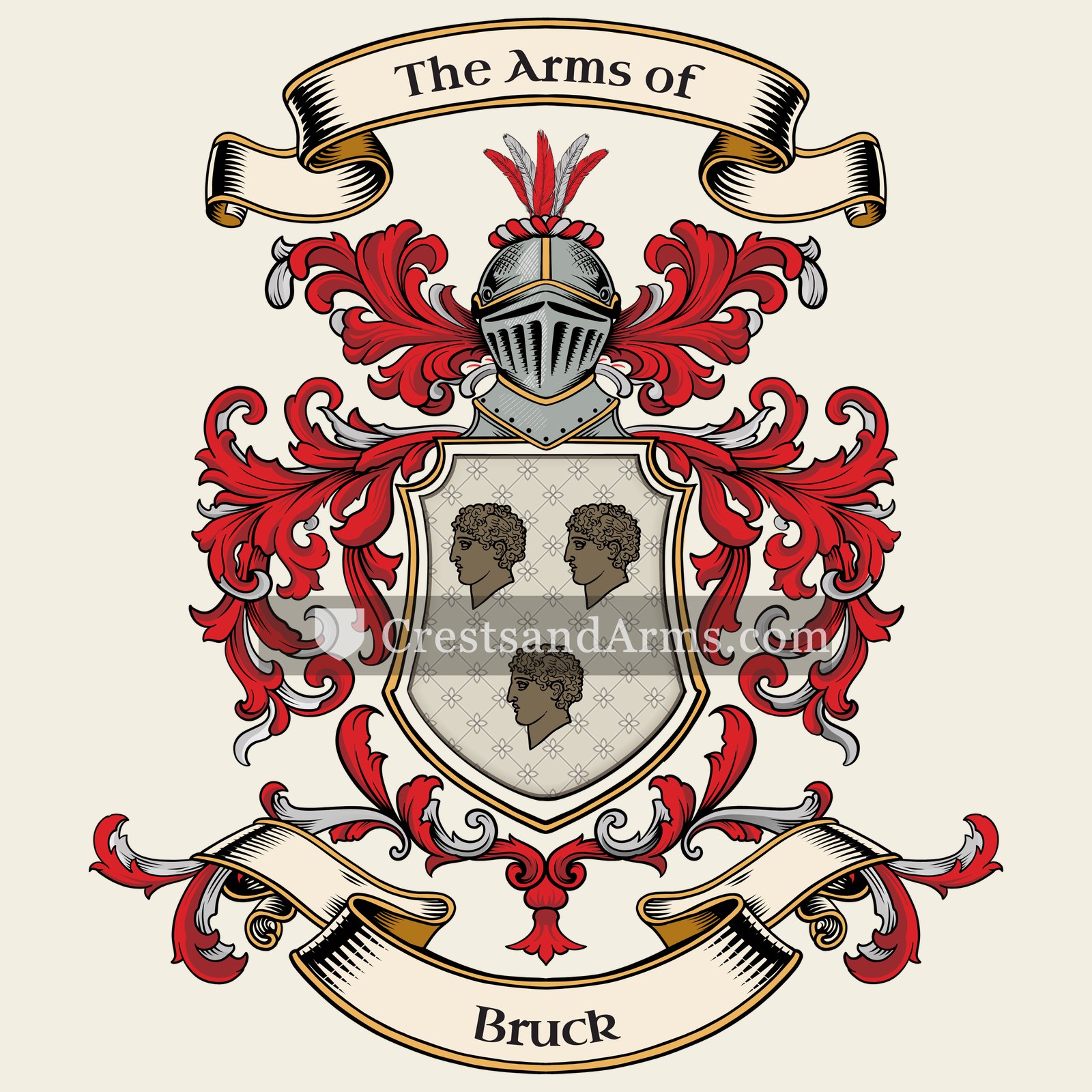




 lionCourage, strength and royalty
 stagPeace and harmony, and one who will not fight unprovoked
 hat or capDignity, and the honour of office