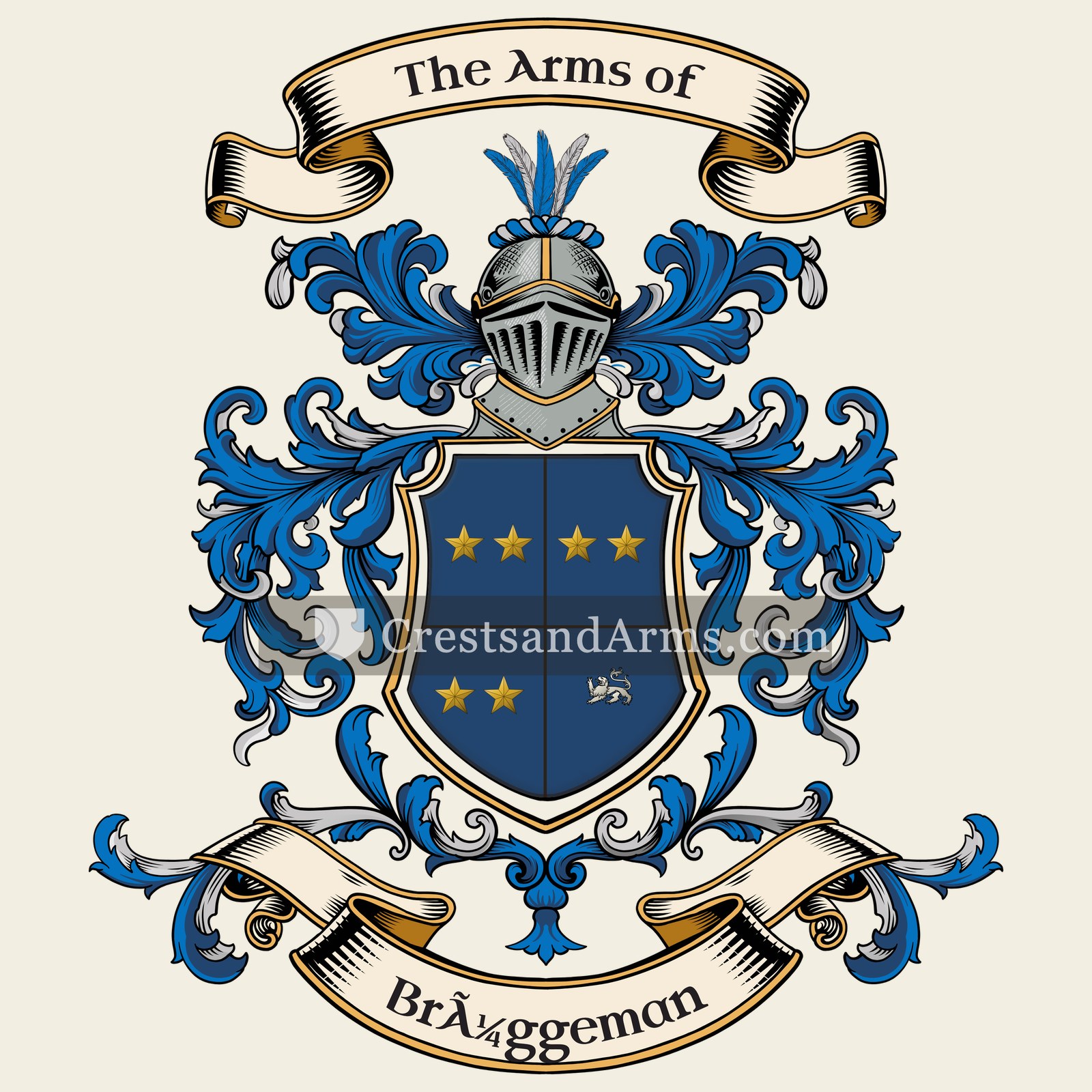
A record of documented arms, meaning and origin, researched for the Brüggeman family of Denmark.
Reg. 4583 · Danish, A–C
Coat of Arms & Family Crest Details
Symbols on this shield
mulletThe third son, and a divine quality from above
lionCourage, strength and royalty
Colours
Blue (Azure)Means: Loyalty and truth
Gold (Or)Means: Generosity
Silver (Argent)Means: Peace and sincerity
Historical info
Source
J. B. Rietstap, Armorial Général, Gouda: G. B. van Goor Zonen, 1884–87
Blazon (the actual original written record)
“Ec.: aux 1 et 4 d'azur à trois étoiles d'or; aux 2 et 3 de sa. à trois pals d'arg. A une tête de léopard d'arg., cour. d'or, br. sur les écartelures. C.: un sauvage iss. de carn., ceint et cour. de lierre, tenant une massue posée sur son épaule.”
Denmarkc. 1680
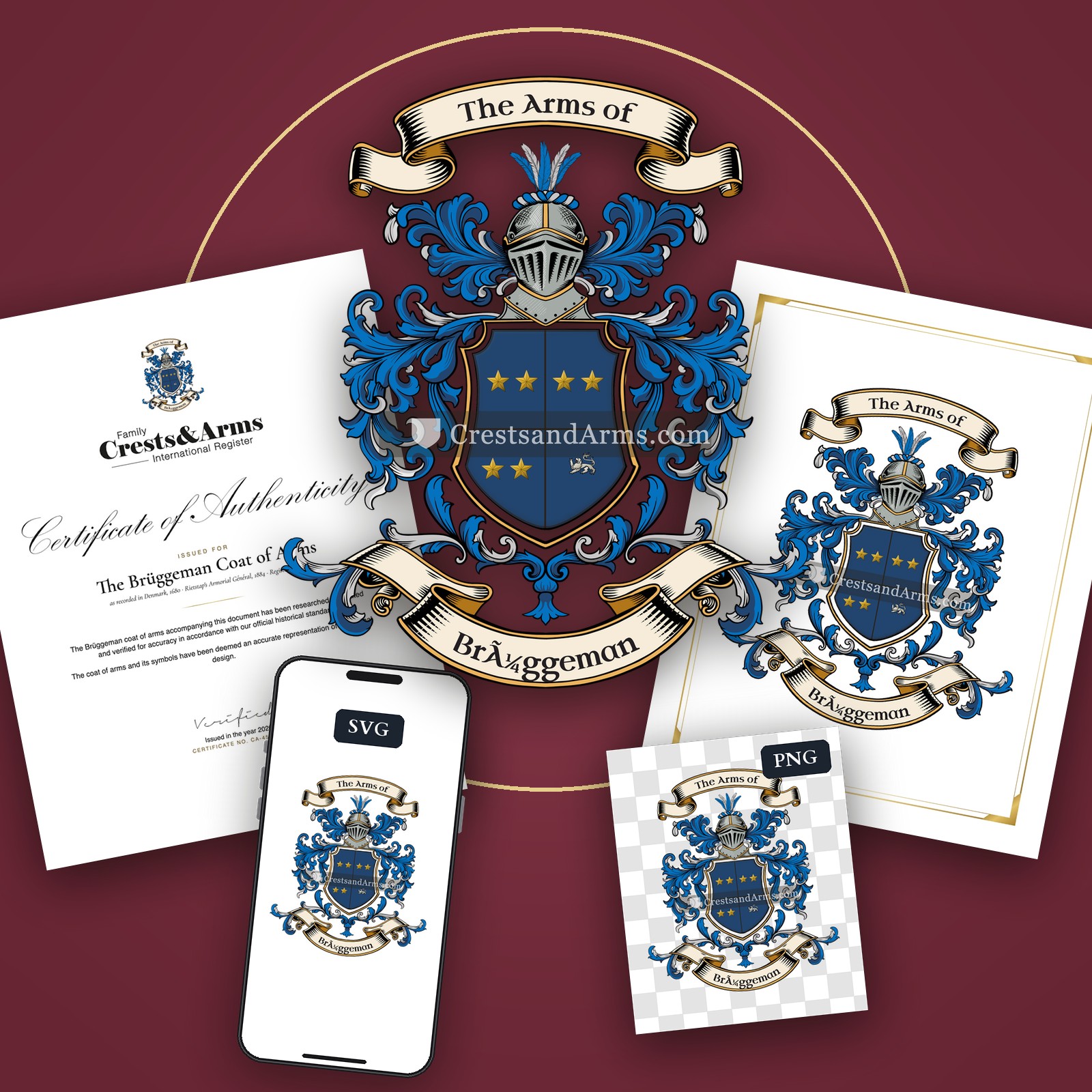
Digital archive packCoat of arms PNG, gold border print PDF, vector SVG and the certificate of authenticity. Sent to your email in minutes.
Map of Denmark showing where the Brüggeman arms are recorded
The Brüggeman arms were recorded in Denmark, c. 1680.
Arms such as these were typically recorded in Sjaælland.
Zealand held the Danish court, the crown's offices and Copenhagen itself. Families who served the king kept estates within reach of it, and royal service was the ordinary route to a coat of arms.
This is where the arms were entered in the register. Families often moved to other parts of the country, so the same name can turn up in more than one region.
The body that granted and recorded arms in Denmark in this period.
Christian V of Denmark
Sovereign of the period
Christian V of Denmark
1670–1699
Reigning in Denmark when the Brüggeman arms are first recorded.
How Arms Worked in Denmark
Danish heraldry during this period was closely tied to noble status and royal favor rather than being open to all citizens. Arms were typically granted by the monarch to individuals, and these symbols were then shared by all members of the noble house. If a family line died out, the right to use those specific arms ended with them.
Granting authority
The Danish royal chancery held the power to issue and regulate official coats of arms for the kingdom.
How they got arms
Families usually received their arms through a formal royal grant that confirmed their noble status and rights.
Where arms were recorded
These grants were officially recorded in the Danish Royal Chancery records starting in the sixteenth century.
The family's standing
Recorded among the armigerous families of Denmark.
Origin & History of the Brüggeman Family in Denmark
The name Brüggeman is a topographical surname that originated in the Low German-speaking regions of Northern Europe. It translates literally to bridge man, which suggests that the earliest ancestors likely held the important role of maintaining a bridge or collecting tolls at a river crossing. By the late 17th century, the family had established a presence in the region of Sjælland, Denmark. During this period, the name was often associated with individuals who lived near vital infrastructure or served as local caretakers for transit points. As the family settled into Danish life, the name evolved to reflect their transition from rural laborers to established members of the local community. This history highlights how surnames were once used to identify a person by their specific trade or their location in the landscape.
Brüggeman Meaning & Related Branches
Root word
Brügge
A bridge or a crossing point over a body of water.
This name
BrüggemanA person who lived near a bridge or worked as a bridge keeper.
also spelled
Bruggemann
Brueggeman
Brugeman
Documented Sources
J. B. Rietstap, Armorial Général, Gouda: G. B. van Goor Zonen, 1884–87
Bahlow, Hans, Deutsches Namenlexikon: Familien- und Vornamen nach Ursprung und Sinn erklärt, 1967
Danish National Archives (Rigsarkivet), Kirkebøger fra Sjællands Stift, 1680
Gottschald, Max, Deutsche Namenkunde: Unsere Familiennamen, 1954
Digital archive packCoat of arms PNG, gold border print PDF, vector SVG and the certificate of authenticity. Sent to your email in minutes.


 mulletThe third son, and a divine quality from above
 lionCourage, strength and royalty
 mulletThe third son, and a divine quality from above
 lionCourage, strength and royalty