Map of Germany showing where the Bruins arms are recorded
The Bruins arms were recorded in Ostfrise, c. 1765.
This is where the arms were entered in the register. Families often moved to other parts of the country, so the same name can turn up in more than one region.
The body that granted and recorded arms in Germany in this period.
Francis I, Holy Roman Emperor
Sovereign of the period
Francis I, Holy Roman Emperor
1745–1765
Reigning in Germany when the Bruins arms are first recorded.
How Arms Worked in Germany
In the Holy Roman Empire, coats of arms were often granted to individuals by the Emperor or his representatives. These arms were then passed down through the generations to all legitimate descendants of the original holder. Younger branches of a family usually kept the same shield design without needing to change it, as the arms belonged to the entire lineage.
Granting authority
The Holy Roman Emperor held the sole power to grant new coats of arms throughout his vast imperial territories.
How they got arms
Families typically obtained their coats of arms through a formal imperial grant or by proving their noble status to the authorities.
Where arms were recorded
These grants were officially recorded in the Imperial Chancery registers, which began keeping formal records of such honors during the Middle Ages.
The family's standing
Recorded among the armigerous families of Germany.
Origin & History of the Bruins Family in Germany
The family name Bruins originates from the northern regions of the Netherlands and Germany, specifically within the area known as East Frisia. The name is a patronymic, which means it was derived from the given name of a father or ancestor. In this case, Bruins is a variation of the name Bruno, which carries the ancient Germanic meaning of brown. By the year 1765, families bearing this name were well-established in the rural landscapes of East Frisia. During this period, the region was characterized by small farming communities and tight-knit social structures where people often identified themselves based on their family lineage. Because record-keeping in the eighteenth century focused heavily on church baptisms and local land ownership, the presence of the Bruins name in these archives confirms that the family was deeply integrated into the agricultural and social life of the Frisian coast long before the modern era.
Bruins Meaning & Related Branches
Root word
Brun
A Germanic term meaning brown or dark-colored.
This name
BruinsA patronymic surname indicating a descendant of someone with brown hair or a dark complexion.
also spelled
Bruinz
Bruns
Bruin
Related arms
Bruyns de Blankenasimilar arms
Bruynsvariant spelling
Documented Sources
J. B. Rietstap, Armorial Général, Gouda: G. B. van Goor Zonen, 1884–87


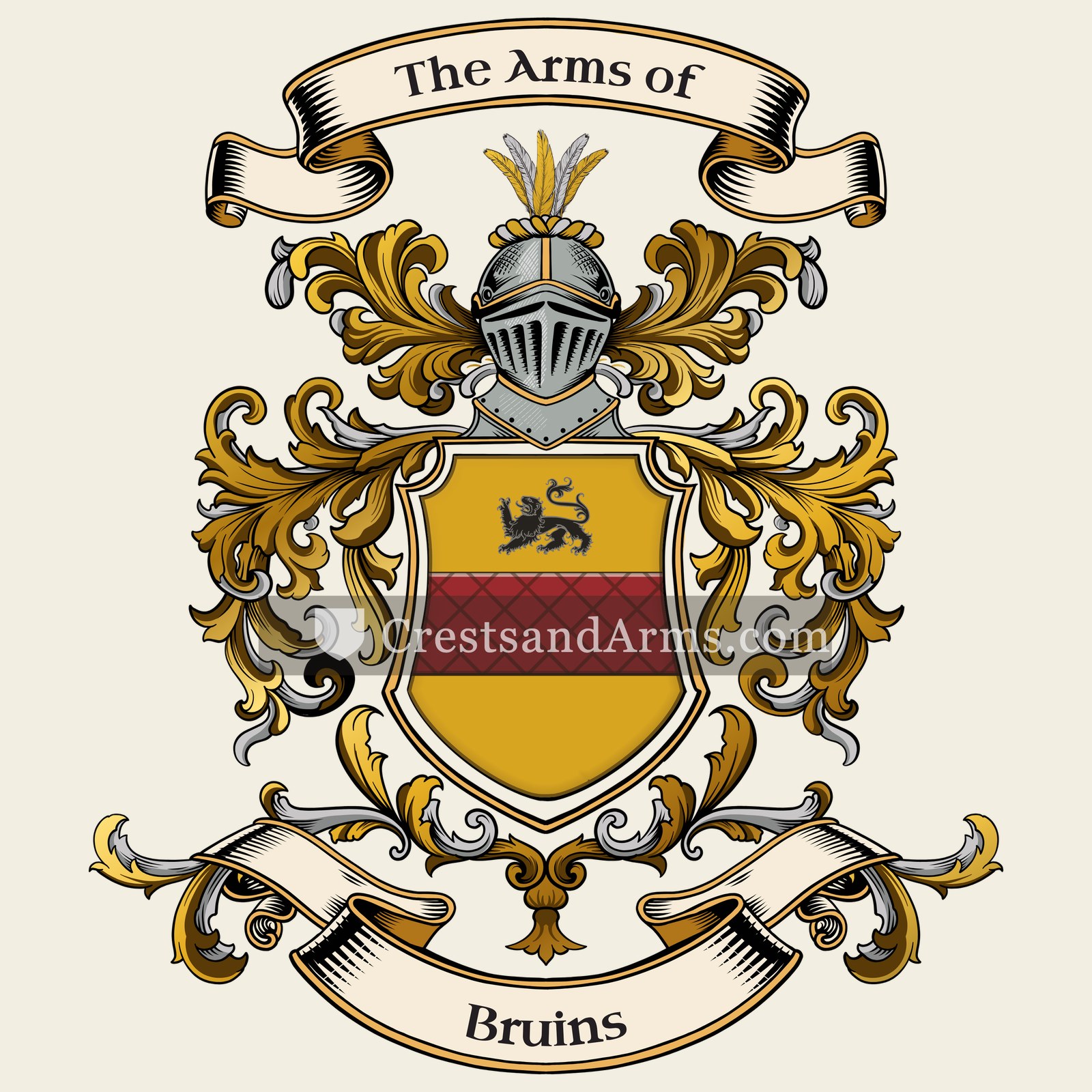
 fessThe military belt, and readiness to serve
 lionCourage, strength and royalty
 fessThe military belt, and readiness to serve
 lionCourage, strength and royalty