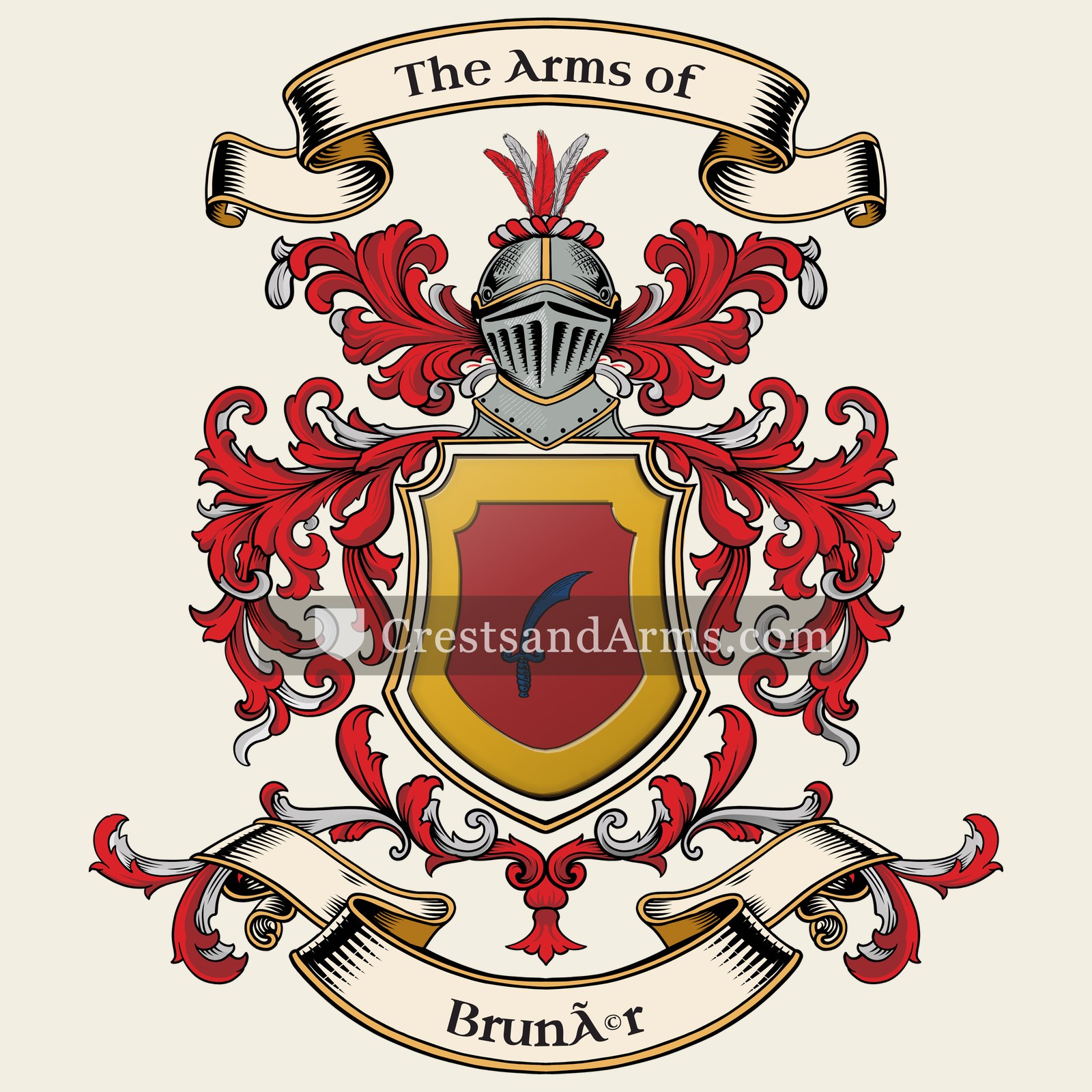
A record of documented arms, meaning and origin, researched for the Brunér family of Finland.
Reg. 3582 · Finnish, A–C
Coat of Arms & Family Crest Details
Symbols on this shield
swordJustice, and military honour
Colours
Red (Gules)Means: Military strength
Gold (Or)Means: Generosity
Blue (Azure)Means: Loyalty and truth
Historical info
Source
J. B. Rietstap, Armorial Général, Gouda: G. B. van Goor Zonen, 1884–87
Blazon (the actual original written record)
“De gu. à l'épée d'azur, garnie d'or, en pal, br. sur un rameau d'olivier de sin., en bande, et une branche de chêne du même, en barre, passés en saut.; l'écu bordé d'or. Cq. cour. C.: un faisceau des licteurs romains, au nat., entre deux pl. d'aut. d'arg.”
Finlandc. 1840
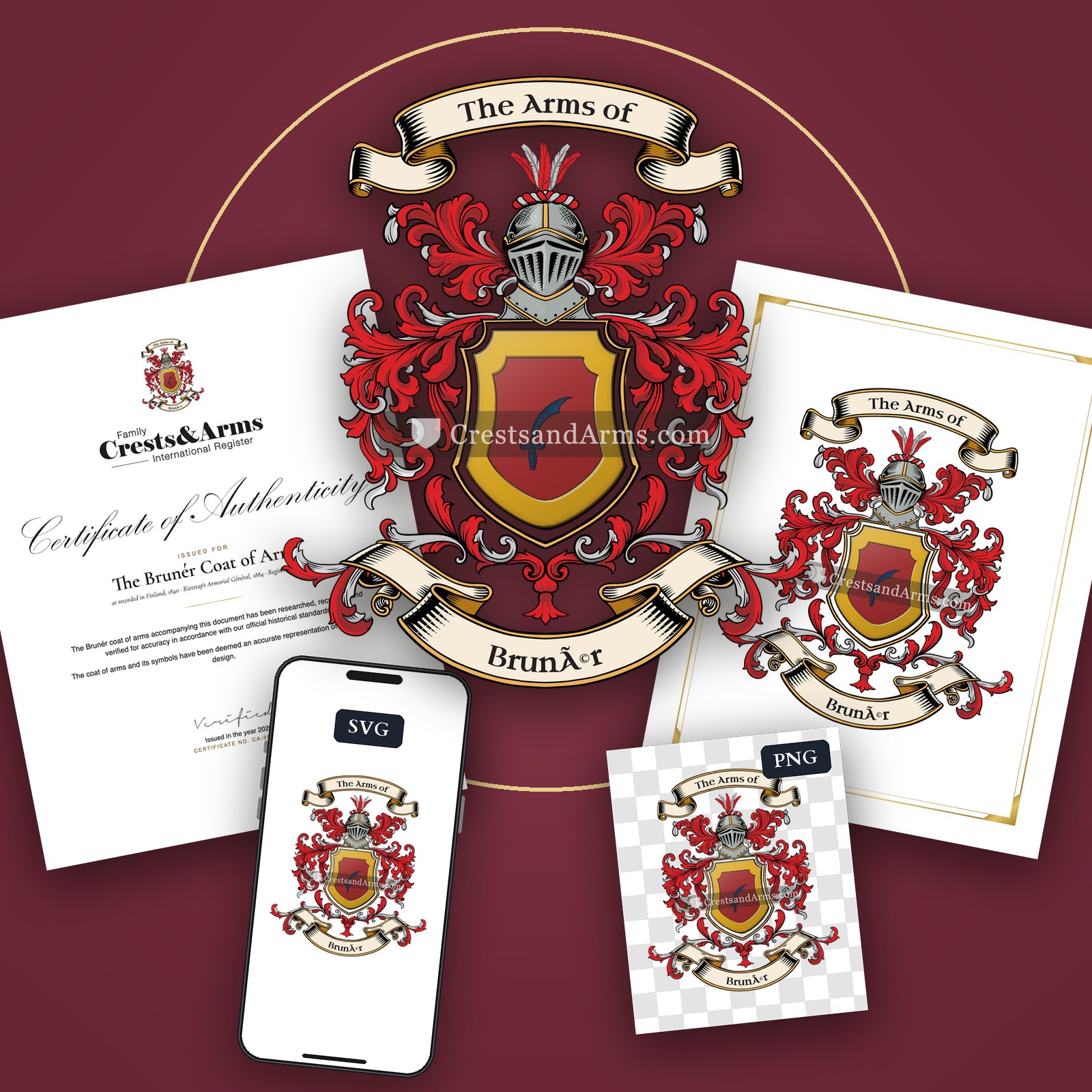
Digital archive packCoat of arms PNG, gold border print PDF, vector SVG and the certificate of authenticity. Sent to your email in minutes.
Map of Finland showing where the Brunér arms are recorded
The Brunér arms were recorded in Finland, c. 1840.
Arms such as these were typically recorded in Uusimaa.
Uusimaa was the Finnish coast facing Sweden, and the part of the country most closely tied to Stockholm. Its landowners and officers served the Swedish crown, and that service is what put their arms on record.
This is where the arms were entered in the register. Families often moved to other parts of the country, so the same name can turn up in more than one region.
The body that granted and recorded arms in Finland in this period.
How Arms Worked in Finland
Nobility in Finland held the exclusive right to register their coats of arms with the House of Nobility. These symbols were tied to the family name and were inherited by all members of the noble house. If a family branch moved or changed status, they kept their original design to maintain their identity within the official records.
Granting authority
The Finnish House of Nobility served as the official body that managed and protected all noble coats of arms.
How they got arms
Families received their arms through formal letters of nobility or by having their existing ancestral symbols confirmed by the House.
Where arms were recorded
All approved coats of arms were officially recorded in the Finnish House of Nobility Armorial starting in 1818.
The family's standing
Recorded among the armigerous families of Finland.
Origin & History of the Brunér Family in Finland
The Brunér family name has deep roots in the Uusimaa region of Finland, where members of the family were well-established by the mid-19th century. The name itself follows a tradition common among Swedish-speaking families in Finland during that era, often derived from geographic locations or descriptive traits. By 1840, the family was integrated into the social and professional fabric of the coastal areas, likely participating in the local administrative or agricultural life that defined the region at the time. As the 1800s progressed, the name became associated with families who moved between rural estates and growing urban centers. This period was a time of significant cultural change in Finland, and the Brunér family was part of the demographic shift that helped shape the local community through their work and daily lives.
Brunér Meaning & Related Branches
Root word
Brun
A Germanic term referring to the color brown or dark.
This name
BrunérA topographic surname denoting someone who lived near a brown-colored stream or area.
also spelled
Bruener
Brunere
Related arms
Brunnervariant spelling
Documented Sources
J. B. Rietstap, Armorial Général, Gouda: G. B. van Goor Zonen, 1884–87
National Archives of Finland (Kansallisarkisto), Church records of the Evangelical Lutheran Church of Finland (Suomen evankelis-luterilaisen kirkon arkistot)
National Archives of Finland (Kansallisarkisto), Census records (Henkikirjat)
Pirjo Mikkonen and Sirkka Paikkala, Sukunimet, 2000
Digital archive packCoat of arms PNG, gold border print PDF, vector SVG and the certificate of authenticity. Sent to your email in minutes.


 swordJustice, and military honour
 swordJustice, and military honour