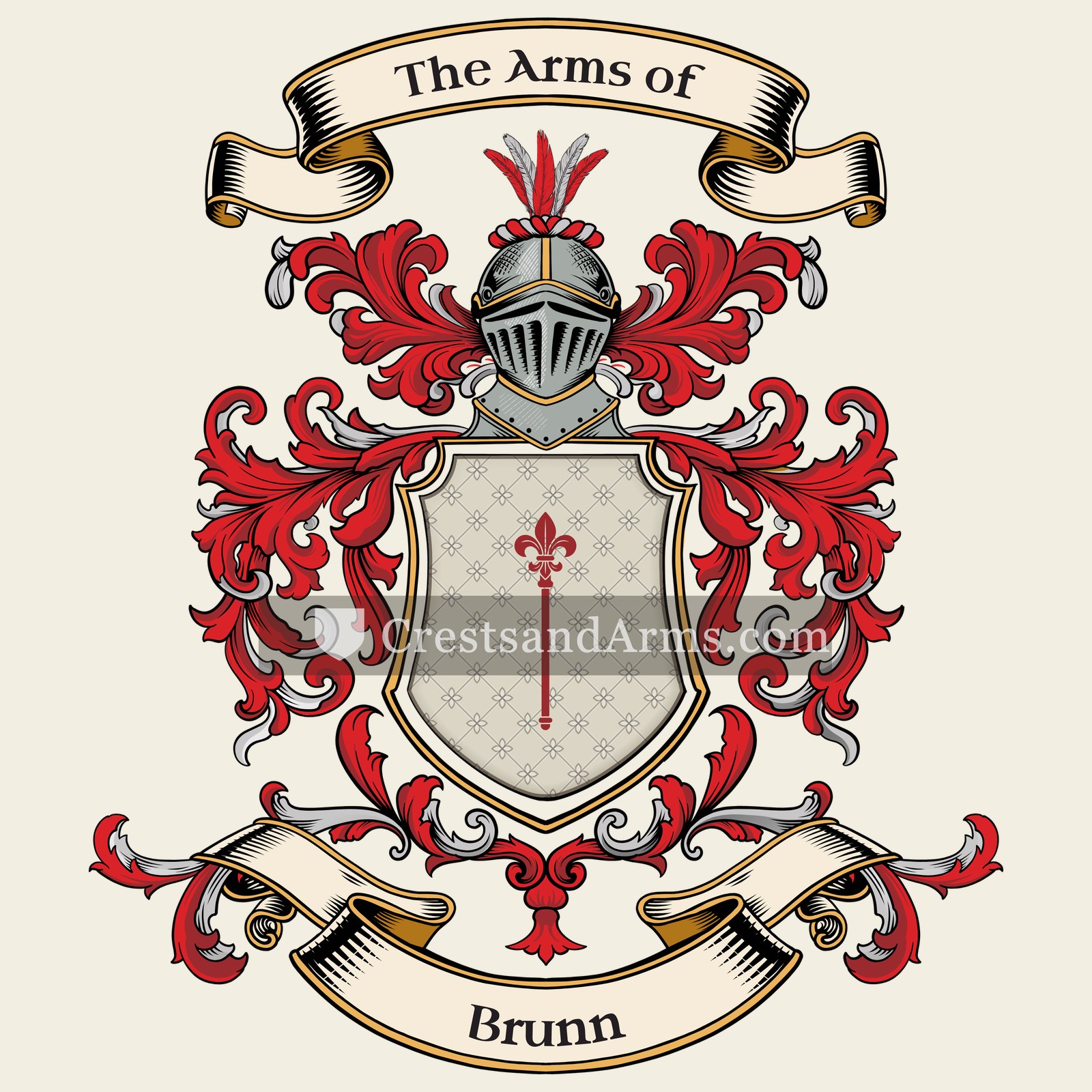
A record of documented arms, meaning and origin, researched for the Brunn family lines. Documented in 2 countries.
Reg. 8572 · German, A–C
Coat of Arms & Family Crest Details
Symbols on this shield
bendDefence, and the scarf of a commander
bearStrength, cunning and protection of kin
Colours
Red (Gules)Means: Military strength
Silver (Argent)Means: Peace and sincerity
Black (Sable)Means: Constancy
Historical info
Source
J. B. Rietstap, Armorial Général, Gouda: G. B. van Goor Zonen, 1884–87
Blazon (the actual original written record)
“De gu. à la bande d'arg., ch. de trois têtes d'ours de sa., coll. d'or. Cq. cour. C.: un ours iss. de sa., coll. d'or, devant un panache de six pl. d'aut., alt. de gu. et d'arg. L.: d'arg. et de gu.”
BrandenburgBrandenburg, c. 1765
Digital archive packCoat of arms PNG, gold border print PDF, vector SVG and the certificate of authenticity. Sent to your email in minutes.
Map of Germany showing where the Brunn arms are recorded
The Brunn arms were recorded in Brandenburg, c. 1765.
Brandenburg was sandy farming country around Berlin, held in large estates by families who served as officers. Land and military service each brought arms, and most families there had both.
This is where the arms were entered in the register. Families often moved to other parts of the country, so the same name can turn up in more than one region.
The body that granted and recorded arms in Germany in this period.
Francis I, Holy Roman Emperor
Sovereign of the period
Francis I, Holy Roman Emperor
1745–1765
Reigning in Germany when the Brunn arms are first recorded.
How Arms Worked in Germany
In the Holy Roman Empire, coats of arms were often granted to individuals by the Emperor or his representatives. These arms were then passed down through the generations to all legitimate descendants of the original holder. Younger branches of a family usually kept the same shield design without needing to change it, as the arms belonged to the entire lineage.
Granting authority
The Holy Roman Emperor held the sole power to grant new coats of arms throughout his vast imperial territories.
How they got arms
Families typically obtained their coats of arms through a formal imperial grant or by proving their noble status to the authorities.
Where arms were recorded
These grants were officially recorded in the Imperial Chancery registers, which began keeping formal records of such honors during the Middle Ages.
The family's standing
Recorded among the armigerous families of Brandenburg.
Origin & History of the Brunn Family in Germany
The surname Brunn is a classic example of a topographic name, which means it was originally chosen to describe the landscape where a family lived. In the German language, the word *Brunn* is a shortened form of *Brunnen*, which translates to a well, a spring, or a water source. During the Middle Ages, families often adopted these names to identify themselves based on their proximity to a local landmark, such as a village well or a natural mountain spring. By the time the family was documented in the Brandenburg region in 1765, the name had already been established for generations as a way to distinguish individuals within their rural communities. Because water sources were vital hubs for social and agricultural life, living near one often placed a family at the center of their local economy. Over time, as the family moved across German-speaking lands, the name evolved from a simple description of a home into a permanent family identifier that was passed down through the generations.
Coat of Arms & Family Crest Details
Symbols on this shield
batonAuthority and office held under the crown
Colours
Silver (Argent)Means: Peace and sincerity
Red (Gules)Means: Military strength
Historical info
Source
J. B. Rietstap, Armorial Général, Gouda: G. B. van Goor Zonen, 1884–87
Blazon (the actual original written record)
“D'arg. à un étui de crosse de gu. C.: le meuble de l'écu.”
AlsaceAlsace, c. 1663
Digital archive packCoat of arms PNG, gold border print PDF, vector SVG and the certificate of authenticity. Sent to your email in minutes.
Map of France showing where the Brunn arms are recorded
The Brunn arms were recorded in Alsace, c. 1663.
Alsace lay between France and the German lands and belonged to both at different times. Its families held small estates and served whichever side ruled, and men who served in arms carried arms of their own.
This is where the arms were entered in the register. Families often moved to other parts of the country, so the same name can turn up in more than one region.
The body that granted and recorded arms in France in this period.
Louis XIV of France
Sovereign of the period
Louis XIV of France
1643–1715
Reigning in Germany when the Brunn arms are first recorded.
How Arms Worked in France
In France, a coat of arms was a mark of honor that passed down through the male line to all legitimate descendants. Families often used the same shield without changes to show their shared heritage. If a branch wanted to stand out, they could add a small mark to their shield to show their specific place in the family tree.
Granting authority
The Juge d'armes de France acted as the official authority that regulated and verified coats of arms across the country.
How they got arms
Families typically inherited their arms from ancestors, though they could also receive them through royal grants or by proving their noble status.
Where arms were recorded
Coats of arms were officially recorded in the Armorial Général de France, which began its main collection in the year 1696.
The family's standing
Recorded among the armigerous families of Alsace.
Origin & History of the Brunn Family in France
The family name Brunn has deep roots in the Alsace region of France, where records confirm members of the family were established by 1663. During this period, Alsace was a unique cultural crossroads that transitioned between French and German influence, which shaped the lives of families living there. The name itself is often linked to the Old High German word for a spring or a well, suggesting that early ancestors likely lived near a prominent water source or a village well. Because the region was frequently affected by the shifting borders of the seventeenth century, the Brunn family had to adapt to changing administrative systems and local customs. These early settlers were often part of the hardworking rural population that defined the social fabric of the Rhine valley. By maintaining their presence in the region for generations, the family became a part of the long history of Alsatian resilience and community development.
Brunn Meaning & Related Branches
Root word
Brun
Old High German term referring to the color brown.
This name
BrunnA topographic name for someone who lived near a well or spring.
also spelled
Brunne
Brune
Brun
Related arms
Brunvariant spelling
Brunevariant spelling
**Albert**recorded with Brunn, same area
Behrrecorded with Brunn, same area
Documented Sources
J. B. Rietstap, Armorial Général, Gouda: G. B. van Goor Zonen, 1884–87
Bahlow, Hans, Deutsches Namenlexikon: Familien- und Vornamen nach Ursprung und Sinn erklärt, 1967
Heintze, Albert, Die deutschen Familien-Namen: geschichtlich, geographisch, sprachlich, 1903
Brandenburgisches Landeshauptarchiv, General-Designationen der Untertanen, 1765
Digital archive packCoat of arms PNG, gold border print PDF, vector SVG and the certificate of authenticity. Sent to your email in minutes.


 bendDefence, and the scarf of a commander
 bearStrength, cunning and protection of kin
 bendDefence, and the scarf of a commander
 bearStrength, cunning and protection of kin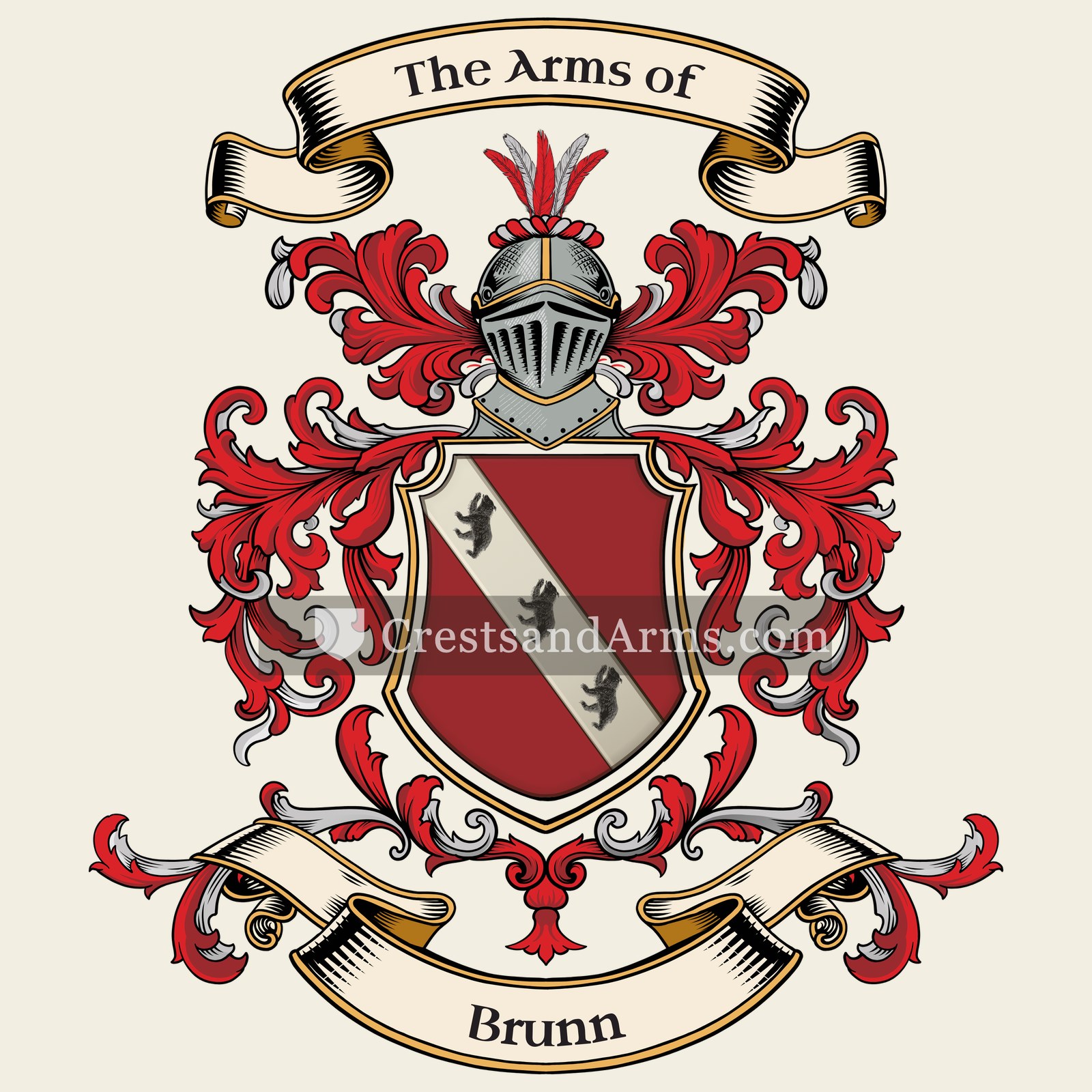


 batonAuthority and office held under the crown