Map of France showing where the Bruno arms are recorded
The Bruno arms were recorded in Dauphine, c. 1663.
Dauphine lay in the mountains of south-eastern France, a country of small estates and scattered valleys. Its gentry were many and mostly modest, and even a small landholding was enough to justify arms.
This is where the arms were entered in the register. Families often moved to other parts of the country, so the same name can turn up in more than one region.
The body that granted and recorded arms in France in this period.
Louis XIV of France
Sovereign of the period
Louis XIV of France
1643–1715
Reigning in France when the Bruno arms are first recorded.
How Arms Worked in France
In France, a coat of arms was a mark of honor that passed down through the male line to all legitimate descendants. Families often used the same shield without changes to show their shared heritage. If a branch wanted to stand out, they could add a small mark to their shield to show their specific place in the family tree.
Granting authority
The Juge d'armes de France acted as the official authority that regulated and verified coats of arms across the country.
How they got arms
Families typically inherited their arms from ancestors, though they could also receive them through royal grants or by proving their noble status.
Where arms were recorded
Coats of arms were officially recorded in the Armorial Général de France, which began its main collection in the year 1696.
The family's standing
Recorded among the armigerous families of Dauphine.
Origin & History of the Bruno Family in France
The family name Bruno has deep roots in the historical province of Dauphiné, where records confirm members of the family were established by 1663. The name itself is derived from the Old Germanic word "brun," which translates to brown and was likely used as a descriptive nickname for someone with brown hair or a dark complexion. During the seventeenth century, families in the mountainous regions of southeastern France often lived in small, tight-knit rural communities where they worked as farmers or artisans. As the name spread through the region, it became well-integrated into the local social fabric of the French Alps. Because the name was simple and easy to pronounce, it remained a consistent identifier for generations of families living in the valleys of Dauphiné. This geographic stability allowed the Bruno name to persist as a recognizable part of the local heritage long before modern census records were standardized.
Meaning of the Bruno family crest colors & symbols
Symbols on this shield
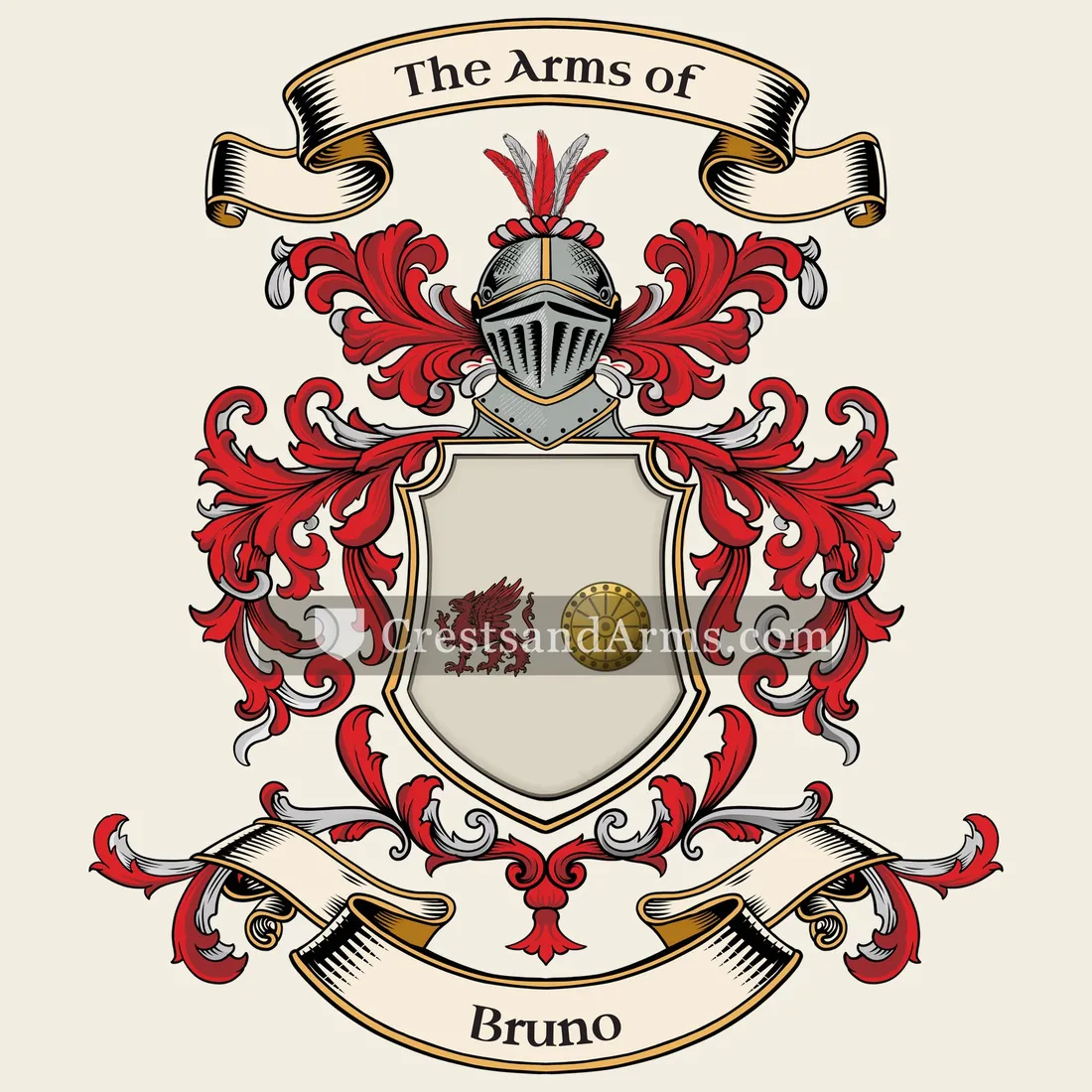
griffinValour and vigilance, guarding great treasure
roundelA coin, and one who has been to the crusades
Colours
Silver (Argent)Means: Peace and sincerity
Red (Gules)Means: Military strength
Gold (Or)Means: Generosity
Historical info
Source
J. B. Rietstap, Armorial Général, Gouda: G. B. van Goor Zonen, 1884–87
Blazon (the actual original written record)
“D'arg. au griffon de gu., supp. de ses pattes une fontaine jaillissante, en forme de coupe d'or, sommée d'une girouette de gu. Cq. cour. C.: la fontaine, entre un vol de gu.”
GermanyRatisbonne, c. 1765
Digital archive packCoat of arms PNG, gold border print PDF, vector SVG and the certificate of authenticity. Sent to your email in minutes.
Map of Germany showing where the Bruno arms are recorded
The Bruno arms were recorded in Ratisbonne, c. 1765.
This is where the arms were entered in the register. Families often moved to other parts of the country, so the same name can turn up in more than one region.
The body that granted and recorded arms in Germany in this period.
Francis I, Holy Roman Emperor
Sovereign of the period
Francis I, Holy Roman Emperor
1745–1765
Reigning in France when the Bruno arms are first recorded.
How Arms Worked in Germany
In the Holy Roman Empire, coats of arms were often granted to individuals by the Emperor or his representatives. These arms were then passed down through the generations to all legitimate descendants of the original holder. Younger branches of a family usually kept the same shield design without needing to change it, as the arms belonged to the entire lineage.
Granting authority
The Holy Roman Emperor held the sole power to grant new coats of arms throughout his vast imperial territories.
How they got arms
Families typically obtained their coats of arms through a formal imperial grant or by proving their noble status to the authorities.
Where arms were recorded
These grants were officially recorded in the Imperial Chancery registers, which began keeping formal records of such honors during the Middle Ages.
The family's standing
Recorded among the armigerous families of Germany.
Origin & History of the Bruno Family in Germany
The surname Bruno has deep roots in the German-speaking regions of Europe, where it originated as a descriptive name derived from the Old High German word "brun," meaning brown. This term was frequently used to describe a person with brown hair or a dark complexion, eventually becoming a fixed family name as surnames became common practice in the Middle Ages. By the eighteenth century, members of the Bruno family were well-established in the city of Ratisbonne, which is known today as Regensburg. Historical records from 1765 confirm their presence in this significant Bavarian center, where the family likely participated in the vibrant trade and civic life of the Holy Roman Empire. During this era, families with the name Bruno were often integrated into the local urban fabric, contributing to the cultural and economic development of the region as it transitioned through the complexities of the Enlightenment period.
Meaning of the Bruno family crest colors & symbols
Symbols on this shield
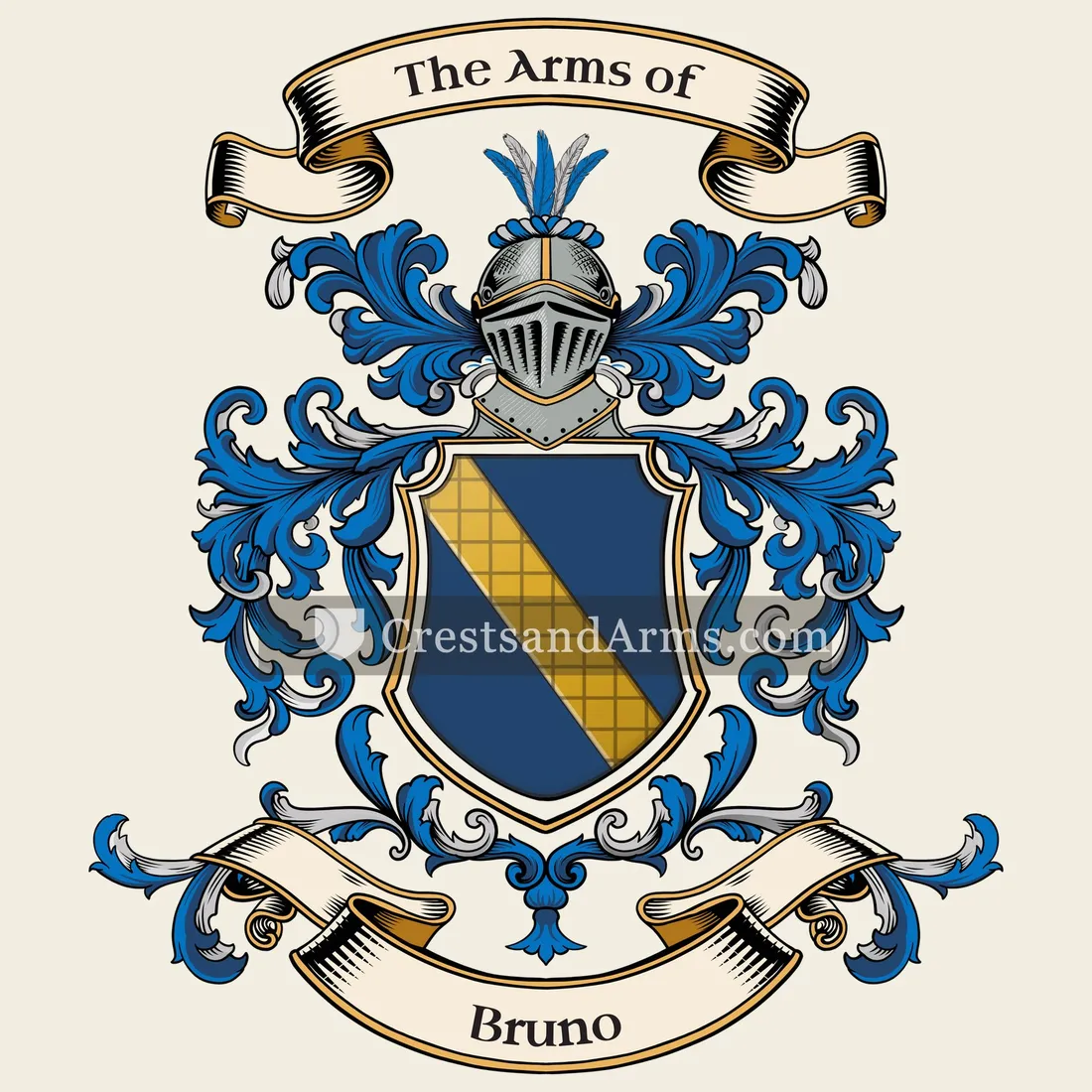
bendDefence, and the scarf of a commander
Colours
Blue (Azure)Means: Loyalty and truth
Gold (Or)Means: Generosity
Historical info
Source
J. B. Rietstap, Armorial Général, Gouda: G. B. van Goor Zonen, 1884–87
Blazon (the actual original written record)
“D'azur à la bande d'or.”
SicilySicily, c. 1775
Digital archive packCoat of arms PNG, gold border print PDF, vector SVG and the certificate of authenticity. Sent to your email in minutes.
Map of Italy showing where the Bruno arms are recorded
The Bruno arms were recorded in Sicily, c. 1775.
Sicily was ruled in turn by Normans, Germans, French and Spanish, and each left landed families behind. The island kept formal lists of its noble houses, which is why so many Sicilian names carry recorded arms.
This is where the arms were entered in the register. Families often moved to other parts of the country, so the same name can turn up in more than one region.
The body that granted and recorded arms in Italy in this period.
Alvise Giovanni Mocenigo
Sovereign of the period
Alvise Giovanni Mocenigo
1763–1778
Reigning in France when the Bruno arms are first recorded.
How Arms Worked in Italy
In the Italian states, coats of arms were often used by noble families to show their status and history. These symbols were passed down through the generations to all legitimate male descendants. Younger branches of a family usually kept the original design but sometimes added small changes to distinguish their specific line from the main branch.
Granting authority
Various local rulers and city governments controlled the use of coats of arms across the different Italian states.
How they got arms
Families often assumed their own arms or received them as official grants from local lords, popes, or city councils.
Where arms were recorded
Arms were recorded in local city archives or private family books rather than in one single national register.
The family's standing
Recorded among the armigerous families of Sicily.
Origin & History of the Bruno Family in Italy
The name Bruno has deep roots in the Italian language, originating from the Germanic word *brun*, which translates to brown. In the context of early Italian history, this name was often used as a descriptive nickname for individuals with brown hair or a dark complexion. By the time the family was firmly established in Sicily during the late 18th century, the name had evolved from a simple descriptor into a formal hereditary surname. Families living in Sicily in 1775 often navigated a complex social landscape shaped by centuries of shifting rule and agricultural traditions. As the Bruno family grew within these local communities, they became part of the fabric of Sicilian life, participating in the regional economy and the development of local customs. This transition from a personal nickname to a family name reflects the broader way that Italian surnames solidified during the period when record-keeping became more standardized across the peninsula.
Bruno Meaning & Related Branches
Root word
Brun
A Germanic word meaning brown or dark-colored.
This name
BrunoDerived from a nickname referring to a person with brown hair or a dark complexion.
also spelled
Brunno
Bruneau
Brunou
Related arms
Bruneauvariant spelling
Documented Sources
J. B. Rietstap, Armorial Général, Gouda: G. B. van Goor Zonen, 1884–87
Dauzat, Albert. Dictionnaire étymologique des noms et prénoms de France. 1951
Morlet, Marie-Thérèse. Dictionnaire étymologique des noms de famille. 1991
Archives Départementales de l'Isère, Collection de l'Intendance de Dauphiné
Digital archive packCoat of arms PNG, gold border print PDF, vector SVG and the certificate of authenticity. Sent to your email in minutes.


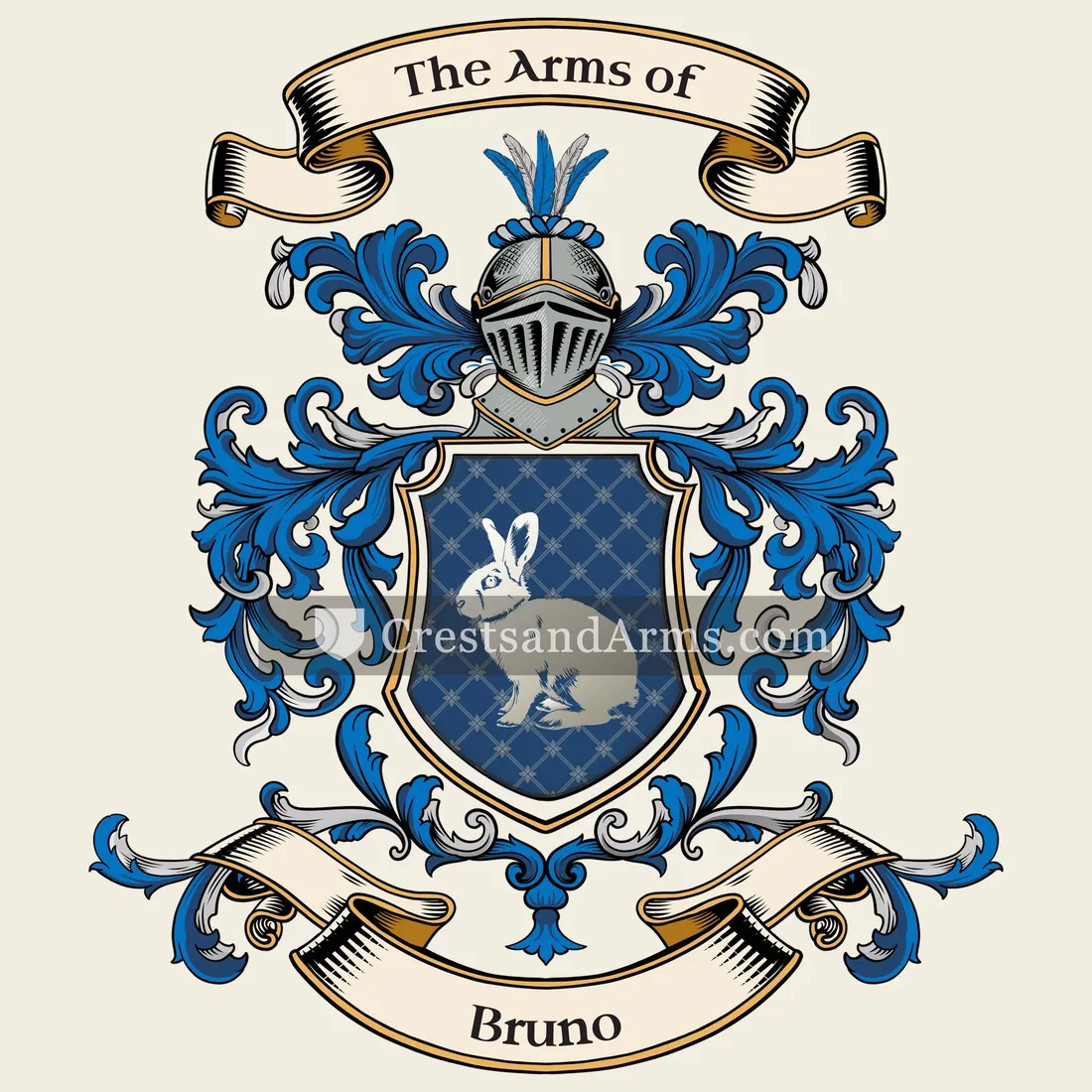
 rabbitOne who lives peaceably and well
 rabbitOne who lives peaceably and well


 griffinValour and vigilance, guarding great treasure
 roundelA coin, and one who has been to the crusades


 bendDefence, and the scarf of a commander