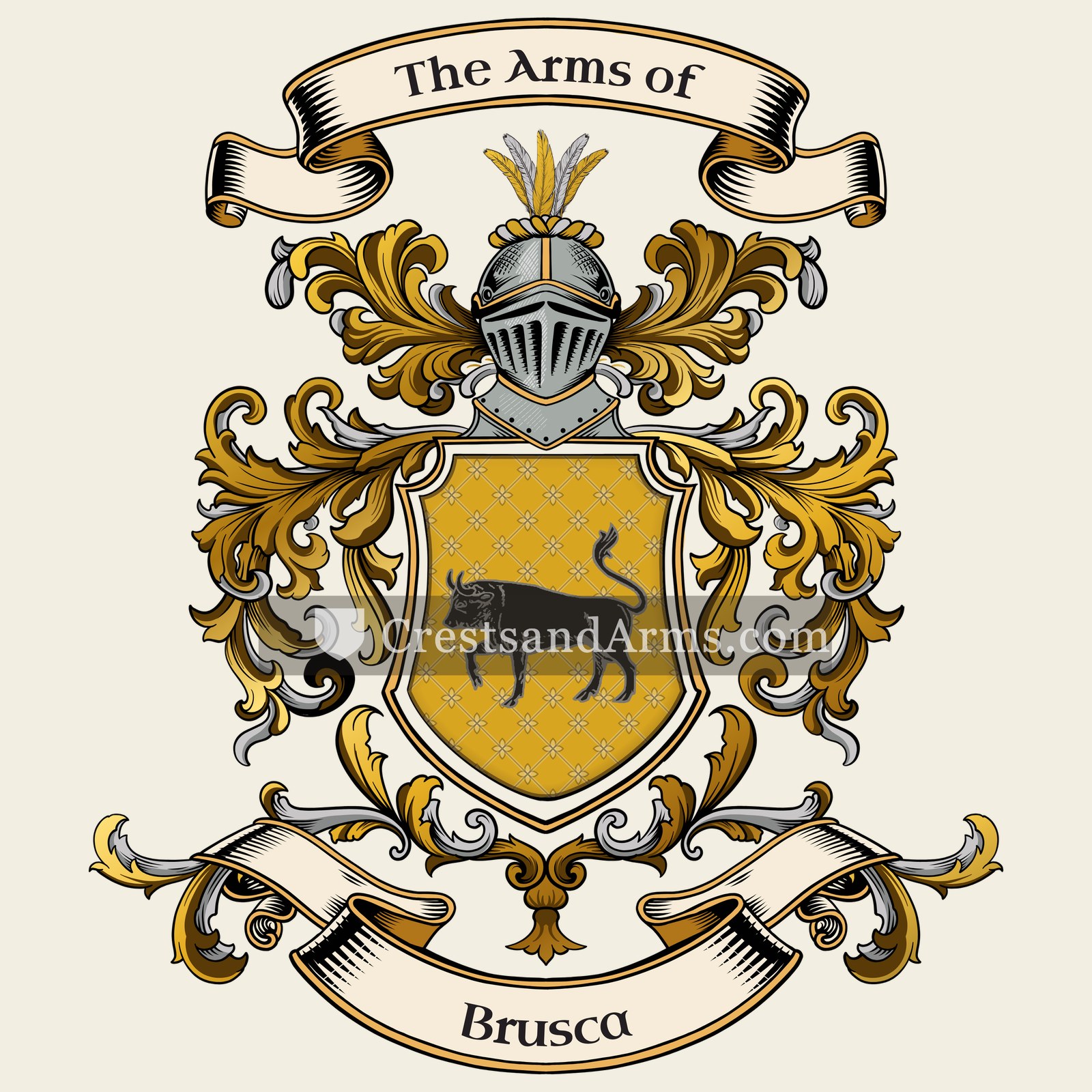
A record of documented arms, meaning and origin, researched for the Brusca family of Spain.
Reg. 0895 · Spanish, A–C
Coat of Arms & Family Crest Details
Symbols on this shield
bullValour and generosity
Colours
Gold (Or)Means: Generosity
Black (Sable)Means: Constancy
Historical info
Source
J. B. Rietstap, Armorial Général, Gouda: G. B. van Goor Zonen, 1884–87
Blazon (the actual original written record)
“D'or au buffle pass. de sa.”
CataloniaCatalonia, c. 1722
Where the Brusca Arms Were Recorded
Catalonia
Map of Spain showing where the Brusca arms are recorded
The Brusca arms were recorded in Catalonia, c. 1722.
Catalonia lived by sea trade, and its merchant houses were as powerful as its landowners. Both sorts of family took arms, and Barcelona kept records of the houses entitled to bear them.
This is where the arms were entered in the register. Families often moved to other parts of the country, so the same name can turn up in more than one region.
The body that granted and recorded arms in Spain in this period.
Philip V of Spain
Sovereign of the period
Philip V of Spain
1714–1724
Reigning in Spain when the Brusca arms are first recorded.
How Arms Worked in Spain
In Spain, a coat of arms was considered a form of property that belonged to the entire family line. These arms were passed down from a father to all his children equally. Younger branches of the family usually kept the original design without needing to add any special marks to distinguish their specific line.
Granting authority
The Cronista Rey de Armas was the official body that regulated and granted coats of arms throughout Spain.
How they got arms
Families often obtained their arms through royal grants or by proving their noble status to the official heraldic authority.
Where arms were recorded
Coats of arms were officially recorded in the registers of the Cronista Rey de Armas starting in 1496.
The family's standing
Recorded among the armigerous families of Catalonia.
Origin & History of the Brusca Family in Spain
The family name Brusca has deep roots in the Mediterranean region, with documented evidence placing the family in Catalonia as early as 1722. During the eighteenth century, Catalonia was a vibrant hub of trade and agricultural development, which likely influenced the daily lives and social standing of the early Brusca family members. The name itself is thought to be linked to regional linguistic patterns, possibly originating from descriptive terms used in the local dialect to identify individuals based on their occupation or physical traits. As the family established itself within the Catalan landscape, they became part of the local social fabric, participating in the customs and economic activities that defined life in northeastern Spain during the Enlightenment era. By settling in this region, the early bearers of the name contributed to the long history of Catalan society, leaving behind a legacy that persists through their descendants today.
Related Branches & Arms
Root word
Brusco
Derived from the Latin word bruscus meaning butcher's broom or rough.
This name
BruscaRefers to a person with a rough or brusque temperament or physical appearance.
also spelled
Bruska
Bruscaa
Brusck
Documented Sources
J. B. Rietstap, Armorial Général, Gouda: G. B. van Goor Zonen, 1884–87
Arxiu de la Corona d’Aragó, Catàleg de la Secció de Cancelleria Reial
Moll, Francesc de Borja, Els llinatges catalans: Catalunya, País Valencià i Illes Balears, 1959
Pujol i Hamelink, Marcel, Història de la societat catalana del segle XVIII, 1998
Digital archive packCoat of arms PNG, gold border print PDF, vector SVG and the certificate of authenticity. Sent to your email in minutes.


 bullValour and generosity
 bullValour and generosity