Map of Britain showing where the Bryan arms are recorded
The Bryan arms were recorded in Britain, c. 1700.
Arms such as these were typically recorded in Kent.
Kent sits between London and the short crossing to Europe, and the trade passing through made it wealthy. Merchant families bought land with that money, and it was landowners who took coats of arms.
This is where the arms were entered in the register. Families often moved to other parts of the country, so the same name can turn up in more than one region.
The body that granted and recorded arms in Britain in this period.
William III of England
Sovereign of the period
William III of England
1694–1702
Reigning in Britain when the Bryan arms are first recorded.
How Arms Worked in Britain
English heraldry allowed arms to be shared by all legitimate descendants of the original owner. These symbols were treated as personal property that moved through the generations to all children. While the eldest son kept the original design, other family members could use the same shield without needing to change it or register their own unique versions.
Granting authority
The College of Arms in London has regulated the use of coats of arms throughout England and Wales since 1484.
How they got arms
Families typically obtained their coats of arms through a formal grant from the Crown or by proving their ancient right to them.
Where arms were recorded
All official coats of arms are recorded in the registers kept at the College of Arms, which date back to the fifteenth century.
The family's standing
Recorded among the armigerous families of Britain.
Origin & History of the Bryan Family in Britain
The surname Bryan has deep roots in the British Isles, originating as a patronymic name that means descendant of Brian. The name is derived from an ancient Celtic word meaning high or noble. While the name is famously associated with early figures in Ireland and Wales, it spread across Britain through migration and trade over many centuries. By the time the family was firmly established in Kent during the early 1700s, the name had already become a common fixture in English parish records. Families living in Kent at this time were often part of the agricultural or merchant classes who helped shape the local economy of the region. These early ancestors likely lived in small rural communities where they were recorded in church registers during baptisms, marriages, and burials. This transition from a regional name to a widespread family identity reflects the movement of people across the English countryside as they sought new opportunities for work and land ownership.
Meaning of the Bryan family crest colors & symbols
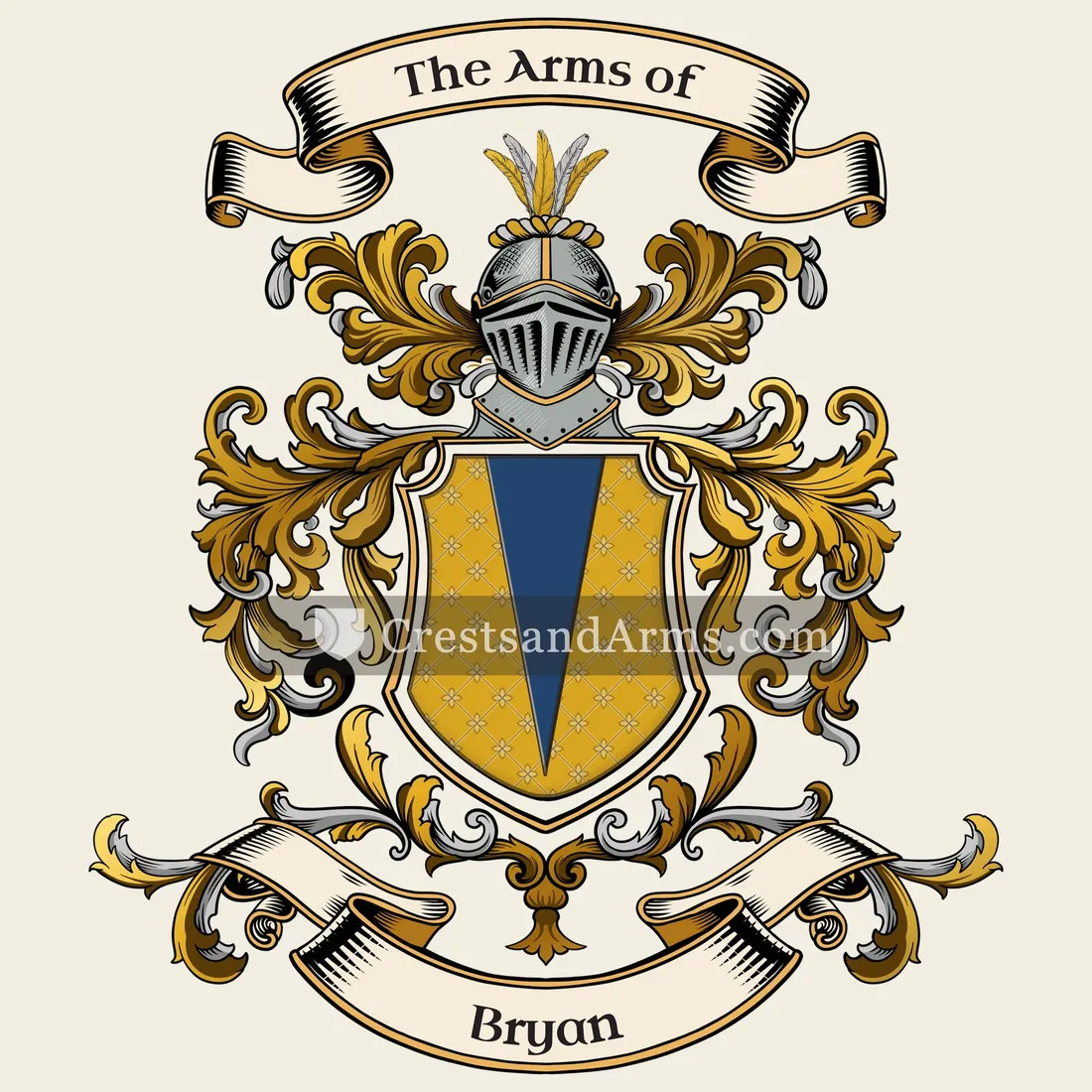
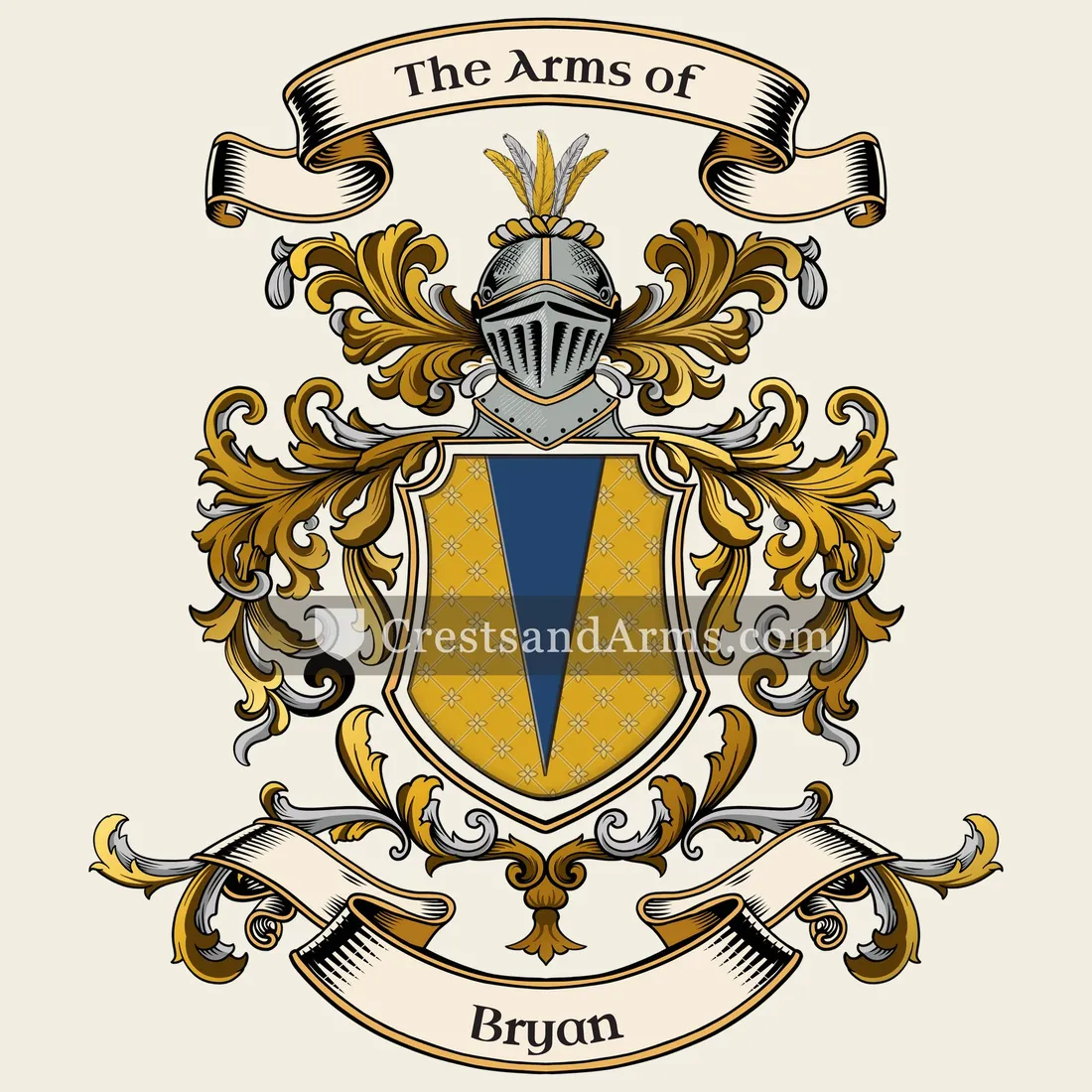
Symbols on this shield
pileWell-doing, and a mark of distinction
Colours
Gold (Or)Means: Generosity
Blue (Azure)Means: Loyalty and truth
Historical info
Source
Sir Bernard Burke, The General Armory of England, Scotland, Ireland and Wales, London: Harrison & Sons, 1884
Blazon (the actual original written record)
“Or, three piles conjoined in base az”
Englandc. 1350
Digital archive packCoat of arms PNG, gold border print PDF, vector SVG and the certificate of authenticity. Sent to your email in minutes.
Map of England showing where the Bryan arms are recorded
The Bryan arms were recorded in England, c. 1350.
Arms such as these were typically recorded in York.
Yorkshire is the largest of the English counties, and it held more gentry families than any other. Land there was split among a great many households rather than a few, so a great many of them carried arms.
This is where the arms were entered in the register. Families often moved to other parts of the country, so the same name can turn up in more than one region.
The body that granted and recorded arms in England in this period.
Edward III of England
Sovereign of the period
Edward III of England
1327–1377
Reigning in Britain when the Bryan arms are first recorded.
How Arms Worked in England
English heraldry allowed arms to be shared by all legitimate descendants of the original owner. These symbols were treated as personal property that moved through the generations to all children. While the eldest son kept the original design, other family members could use the same shield without needing to change it or register their own unique versions.
Granting authority
The College of Arms in London has regulated the use of coats of arms throughout England and Wales since 1484.
How they got arms
Families typically obtained their coats of arms through a formal grant from the Crown or by proving their ancient right to them.
Where arms were recorded
All official coats of arms are recorded in the registers kept at the College of Arms, which date back to the fifteenth century.
The family's standing
Recorded among the armigerous families of England.
Origin & History of the Bryan Family in England
The surname Bryan has deep roots in the English landscape, with historical evidence placing members of the family in the city of York as early as 1350. The name itself is derived from the Old Celtic word for high or noble, and it likely arrived in England through the influence of Breton settlers who crossed the channel following the Norman Conquest. During the fourteenth century, families like the Bryans were often identified by the trade they practiced or the specific village where they resided. In a bustling medieval center like York, the name would have been associated with the growing merchant class or skilled craftsmen who helped build the city into a major hub of commerce. As the family moved across the northern counties, they became part of the complex social fabric of late medieval England, contributing to the local economy and the development of regional identity during a time of significant change.
Meaning of the Bryan family crest colors & symbols
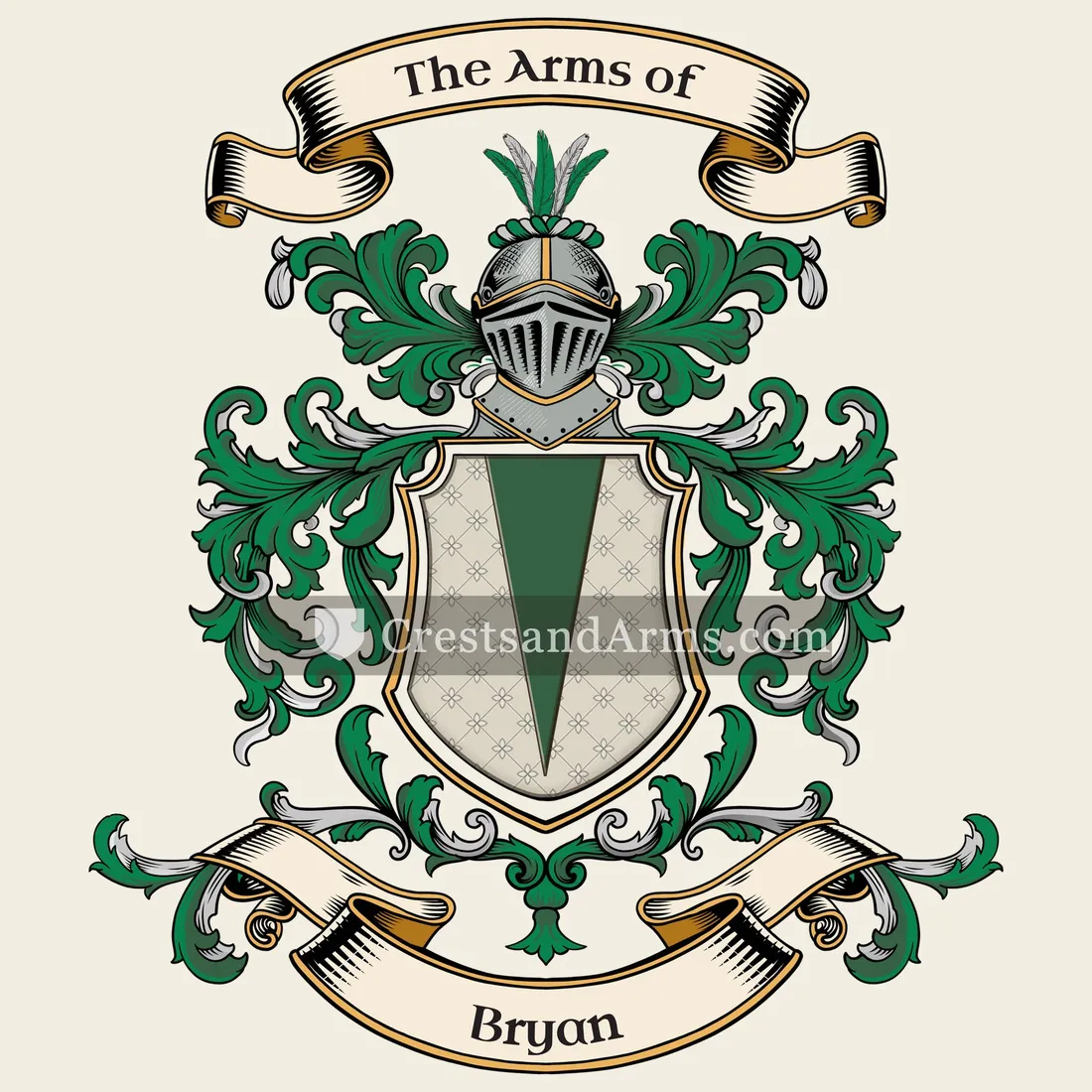
Symbols on this shield
pileWell-doing, and a mark of distinction
Colours
Silver (Argent)Means: Peace and sincerity
Green (Vert)Means: Hope
Historical info
Source
Sir Bernard Burke, The General Armory of England, Scotland, Ireland and Wales, London: Harrison & Sons, 1884
Blazon (the actual original written record)
“Ar. three piles vert”
Irelandc. 1645
Digital archive packCoat of arms PNG, gold border print PDF, vector SVG and the certificate of authenticity. Sent to your email in minutes.
Map of Ireland showing where the Bryan arms are recorded
The Bryan arms were recorded in Ireland, c. 1645.
Arms such as these were typically recorded in Dublin.
Dublin was the seat of government in Ireland and the place where grants were sought and recorded. Families with business at the castle or the courts settled nearby, and settling there put their arms on record.
This is where the arms were entered in the register. Families often moved to other parts of the country, so the same name can turn up in more than one region.
The body that granted and recorded arms in Ireland in this period.
Charles I of England
Sovereign of the period
Charles I of England
1625–1649
Reigning in Britain when the Bryan arms are first recorded.
How Arms Worked in Ireland
The Ulster King of Arms granted coats of arms to individuals who proved their social standing and good character. These symbols were typically inherited by all legitimate descendants of the original holder. If a family branch wanted a unique look, they could apply for a specific change to their design through the office to ensure their identity remained distinct.
Granting authority
The Ulster King of Arms acted as the official body that regulated and issued all coats of arms throughout Ireland.
How they got arms
Families obtained their arms through formal grants issued by the office after proving their eligibility and paying the required fees.
Where arms were recorded
All official grants were recorded in the registers held by the Ulster King of Arms starting from the year 1552.
The family's standing
Recorded among the armigerous families of Ireland.
Origin & History of the Bryan Family in Ireland
The surname Bryan has deep roots in the history of Ireland, where it evolved from the ancient Gaelic name O Briain. While the name is famously associated with the high king Brian Boru, families bearing this name established a significant presence in Dublin by 1645. During this period, the city served as a bustling center of trade and political activity, and families like the Bryans were often involved in the urban growth of the capital. As the seventeenth century progressed, the name became more common among both the native Irish population and the shifting social classes of the city. By settling in Dublin, these early family members became part of a complex era defined by changing land ownership and the expansion of Irish civic life. Their presence in the city records from the mid-1600s highlights how the family adapted to the urban environment during a time of great transition in Irish history.
Bryan Meaning & Related Branches
Root word
bri
Celtic element meaning high, noble, or hill.
This name
BryanDerived from an ancient Celtic term signifying someone of noble birth or high status.
also spelled
Brian
Bryen
Briane
Related arms
Brienvariant spelling
Prycerecorded with Bryan, same area
Rithersrecorded with Bryan, same area
Segarrecorded with Bryan, same area
Documented Sources
J. B. Rietstap, Armorial Général, Gouda: G. B. van Goor Zonen, 1884–87
Cottle, Basil. The Penguin Dictionary of Surnames. 1967
Reaney, Percy Hide. A Dictionary of British Surnames. 1958
The National Archives, Parish registers of Kent
Kent History and Library Centre, Archdeaconry of Canterbury marriage licenses
Digital archive packCoat of arms PNG, gold border print PDF, vector SVG and the certificate of authenticity. Sent to your email in minutes.


 pileWell-doing, and a mark of distinction
 pileWell-doing, and a mark of distinction