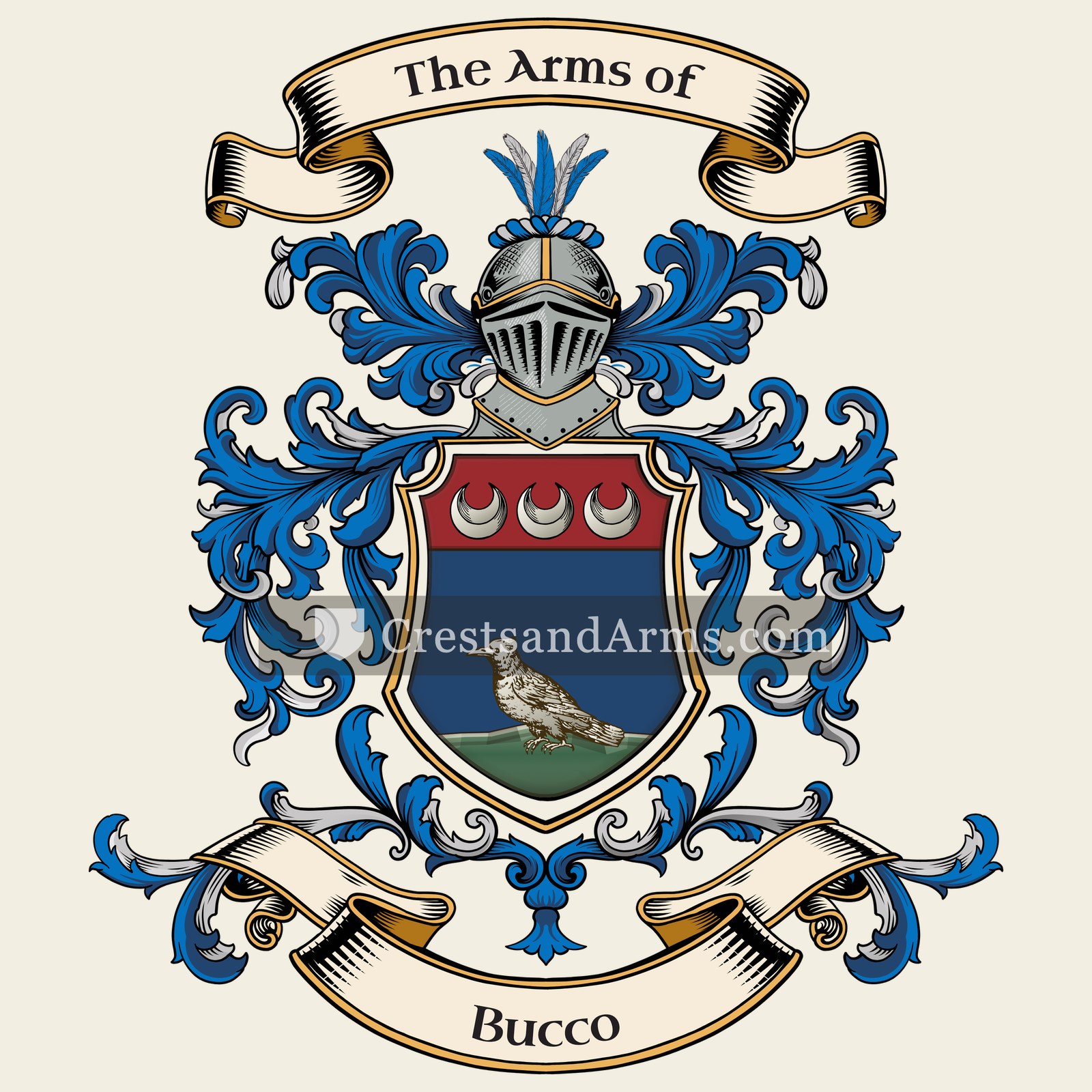
A record of documented arms, meaning and origin, researched for the Bucco family of Germany.
Reg. 6074 · German, A–C
Coat of Arms & Family Crest Details
Symbols on this shield
mountThe ground held, and steadfastness upon it
chiefAuthority, wisdom and dominion
dovePeace, love and the Holy Spirit
crescentHonour by the sovereign, and the second son
Colours
Blue (Azure)Means: Loyalty and truth
Red (Gules)Means: Military strength
Green (Vert)Means: Hope
Silver (Argent)Means: Peace and sincerity
Historical info
Source
J. B. Rietstap, Armorial Général, Gouda: G. B. van Goor Zonen, 1884–87
Blazon (the actual original written record)
“D'azur à une colombe d'arg., tenant en son bec un rameau d'olivier de sin. et posé sur un tertre d'or; au chef de gu., ch. de trois croiss. versés d'arg. C.: un croiss. d'arg. L. de gu., d'arg., d'azur et d'or.”
GermanyBrunswick, c. 1695
Digital archive packCoat of arms PNG, gold border print PDF, vector SVG and the certificate of authenticity. Sent to your email in minutes.
Map of Germany showing where the Bucco arms are recorded
The Bucco arms were recorded in Brunswick, c. 1695.
This is where the arms were entered in the register. Families often moved to other parts of the country, so the same name can turn up in more than one region.
The body that granted and recorded arms in Germany in this period.
Leopold I, Holy Roman Emperor
Sovereign of the period
Leopold I, Holy Roman Emperor
1658–1705
Reigning in Germany when the Bucco arms are first recorded.
How Arms Worked in Germany
In the Holy Roman Empire, coats of arms were often granted to individuals by the Emperor or his representatives. These arms were then passed down through the generations to all legitimate descendants of the original holder. Younger branches of a family usually kept the same shield design without needing to change it, as the arms belonged to the entire lineage.
Granting authority
The Holy Roman Emperor held the sole power to grant new coats of arms throughout his vast imperial territories.
How they got arms
Families typically obtained their coats of arms through a formal imperial grant or by proving their noble status to the authorities.
Where arms were recorded
These grants were officially recorded in the Imperial Chancery registers, which began keeping formal records of such honors during the Middle Ages.
The family's standing
Recorded among the armigerous families of Germany.
Origin & History of the Bucco Family in Germany
The family name Bucco finds its roots in the linguistic traditions of southern Europe, where it likely originated as a descriptive nickname. In the Italian language, the term relates to the mouth or facial features, often serving as a way to identify individuals within a growing community. By the late seventeenth century, members of the family had established a presence in Brunswick, Germany, by 1695. This migration suggests that the family was part of the broader movement of people across European borders during a time of significant social and economic change. Settling in a major administrative and cultural hub like Brunswick indicates that these early ancestors were likely integrated into the local trades or civic life of the region. Their ability to maintain a distinct family identity while adapting to a new environment highlights the resilience and mobility of the Bucco name during the early modern period.
Bucco Meaning & Related Branches
Root word
Bucca
Latin term referring to the cheek or a puffed-out mouth.
This name
BuccoA nickname for an individual with prominent or chubby cheeks.
also spelled
Buco
Buko
Documented Sources
J. B. Rietstap, Armorial Général, Gouda: G. B. van Goor Zonen, 1884–87
Stadtarchiv Braunschweig, Bürgerbuch der Stadt Braunschweig, 1695
Bahlow, Hans, Deutsches Namenlexikon: Familien- und Vornamen nach Ursprung und Sinn erklärt, 1967
Digital archive packCoat of arms PNG, gold border print PDF, vector SVG and the certificate of authenticity. Sent to your email in minutes.


 mountThe ground held, and steadfastness upon it
 chiefAuthority, wisdom and dominion
 dovePeace, love and the Holy Spirit
 crescentHonour by the sovereign, and the second son
 mountThe ground held, and steadfastness upon it
 chiefAuthority, wisdom and dominion
 dovePeace, love and the Holy Spirit
 crescentHonour by the sovereign, and the second son