Map of France showing where the Bucher arms are recorded
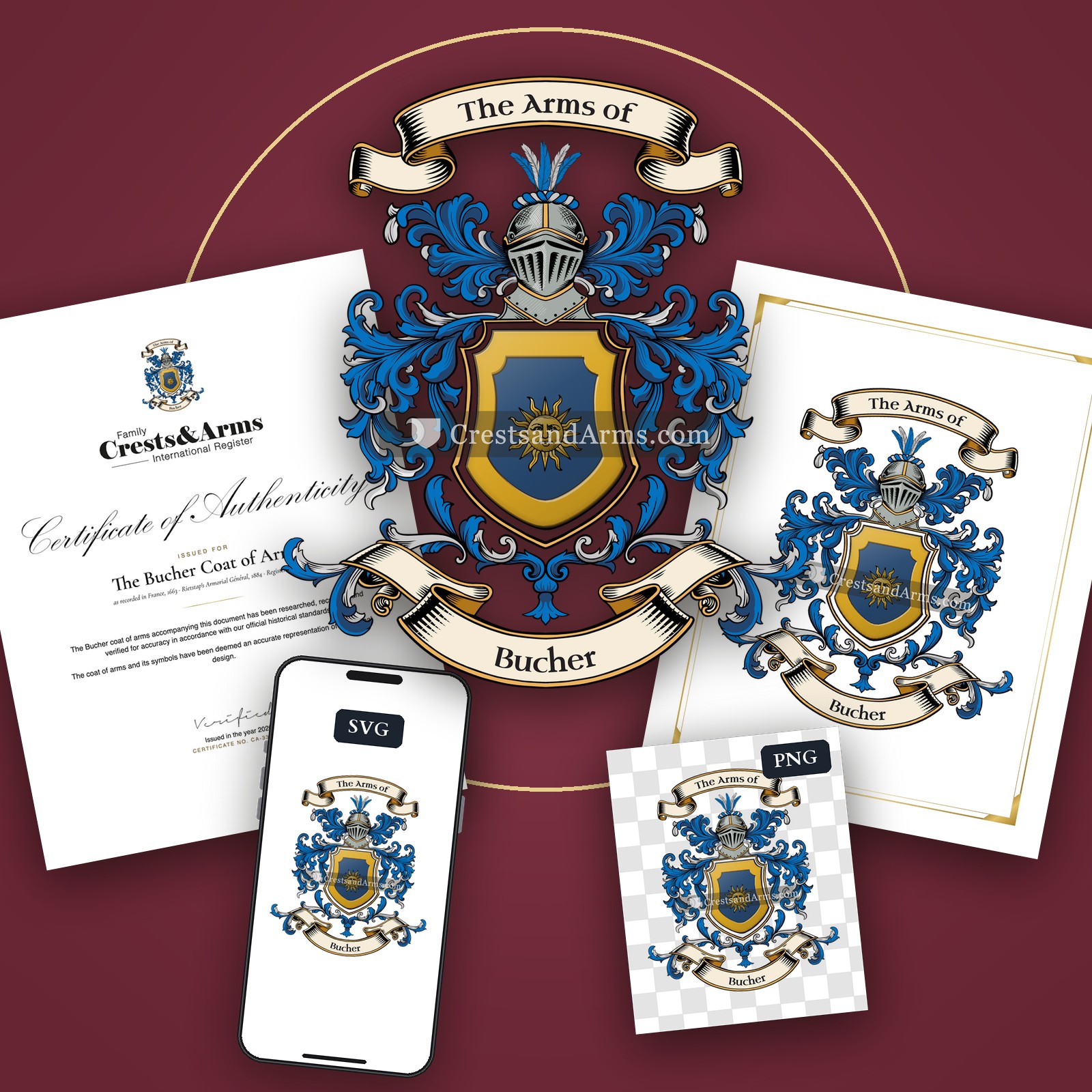
The Bucher arms were recorded in Dauphine, c. 1663.
Dauphine lay in the mountains of south-eastern France, a country of small estates and scattered valleys. Its gentry were many and mostly modest, and even a small landholding was enough to justify arms.
This is where the arms were entered in the register. Families often moved to other parts of the country, so the same name can turn up in more than one region.
The body that granted and recorded arms in France in this period.
Louis XIV of France
Sovereign of the period
Louis XIV of France
1643–1715
Reigning in France when the Bucher arms are first recorded.
How Arms Worked in France
In France, a coat of arms was a mark of honor that passed down through the male line to all legitimate descendants. Families often used the same shield without changes to show their shared heritage. If a branch wanted to stand out, they could add a small mark to their shield to show their specific place in the family tree.
Granting authority
The Juge d'armes de France acted as the official authority that regulated and verified coats of arms across the country.
How they got arms
Families typically inherited their arms from ancestors, though they could also receive them through royal grants or by proving their noble status.
Where arms were recorded
Coats of arms were officially recorded in the Armorial Général de France, which began its main collection in the year 1696.
The family's standing
Recorded among the armigerous families of Dauphine.
Origin & History of the Bucher Family in France
The surname Bucher carries a history deeply rooted in the rugged landscapes of southeastern France. By the year 1663, records confirm that families bearing this name were well-established in the Dauphiné region, a mountainous area known for its distinct local customs and proximity to the Alps. The name itself is occupational in origin, derived from the Old French word *boucher*, which identified individuals who worked as butchers or meat purveyors. During the seventeenth century, families in this region often lived in tight-knit rural communities where trade names served as a primary way to distinguish one household from another. As these families grew and moved through the valleys of the Dauphiné, they became integral parts of the local economy and social fabric, leaving behind a legacy that reflects the humble yet essential nature of their ancestral trade.
Coat of Arms & Family Crest Details
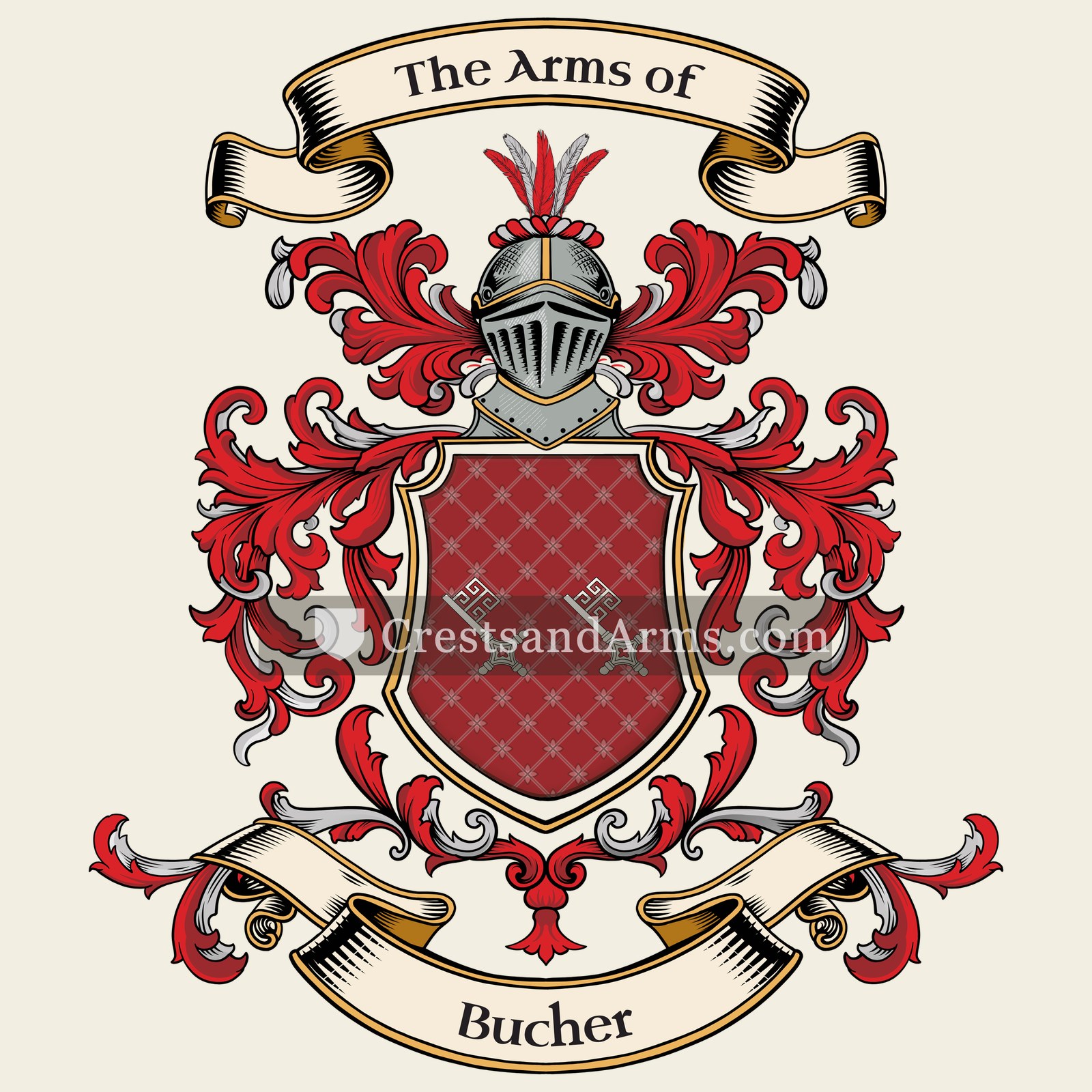
Symbols on this shield
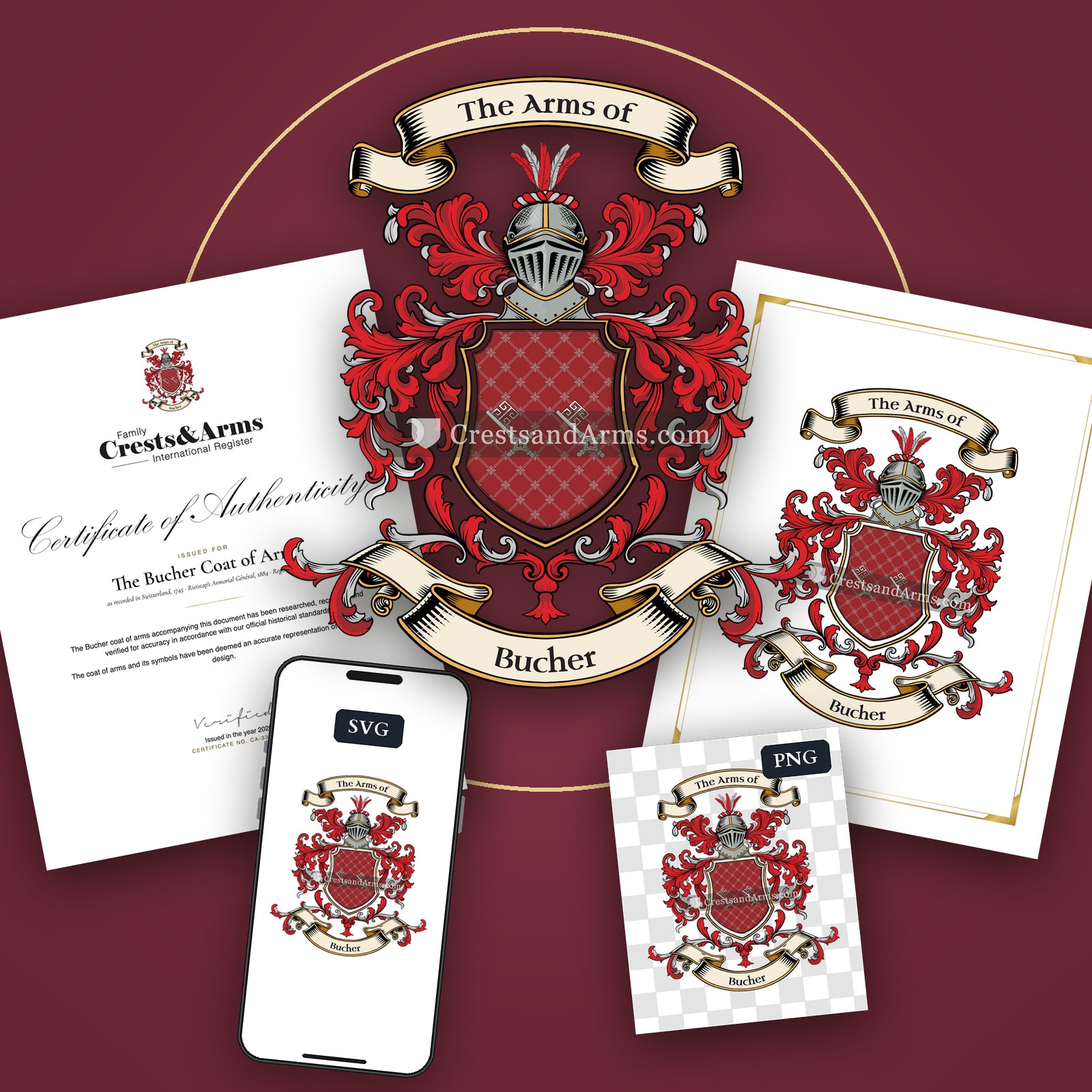
keyGuardianship, and the office of a steward
Colours
Red (Gules)Means: Military strength
Silver (Argent)Means: Peace and sincerity
Historical info
Source
J. B. Rietstap, Armorial Général, Gouda: G. B. van Goor Zonen, 1884–87
Blazon (the actual original written record)
“De gu. à deux clés d'arg., passées en saut. C.: les clés.”
SwitzerlandBâle, c. 1745
Digital archive packCoat of arms PNG, gold border print PDF, vector SVG and the certificate of authenticity. Sent to your email in minutes.
Map of Switzerland showing where the Bucher arms are recorded
The Bucher arms were recorded in Bâle, c. 1745.
This is where the arms were entered in the register. Families often moved to other parts of the country, so the same name can turn up in more than one region.
The body that granted and recorded arms in Switzerland in this period.
How Arms Worked in Switzerland
In Switzerland, coats of arms were not restricted to the nobility and were often adopted by common citizens and families. These symbols were passed down through generations to show family identity. When branches of a family grew, they often changed small details of the design to distinguish their own line from the original group.
Granting authority
Cantonal and civic authorities managed the use of coats of arms within their specific regions and local jurisdictions.
How they got arms
Families typically assumed their own coats of arms based on local custom rather than receiving them from a central monarch.
Where arms were recorded
Arms were recorded in various cantonal and civic registers starting from the fourteenth century throughout the Swiss region.
The family's standing
Recorded among the armigerous families of Switzerland.
Origin & History of the Bucher Family in Switzerland
The name Bucher is deeply rooted in the history of the German-speaking regions of Switzerland, where it functioned as a descriptive occupational surname. Derived from the Middle High German word *buoch*, which refers to a beech tree, the name was historically given to people who lived near a beech forest or worked as woodcutters and carpenters. By the mid-eighteenth century, the family had established a notable presence in the city of Bâle, which was a major center for trade and craftsmanship at the time. Records from 1745 confirm that members of the Bucher family were active participants in the local economy of this bustling Rhine River hub. As a family of commoners, their history is tied to the growth of Swiss urban life, where they likely contributed to the skilled labor and merchant guilds that defined the social structure of the era. Their transition from rural forest workers to established city residents reflects the broader movement of Swiss families seeking new opportunities in the growing intellectual and commercial centers of the eighteenth century.
Coat of Arms & Family Crest Details
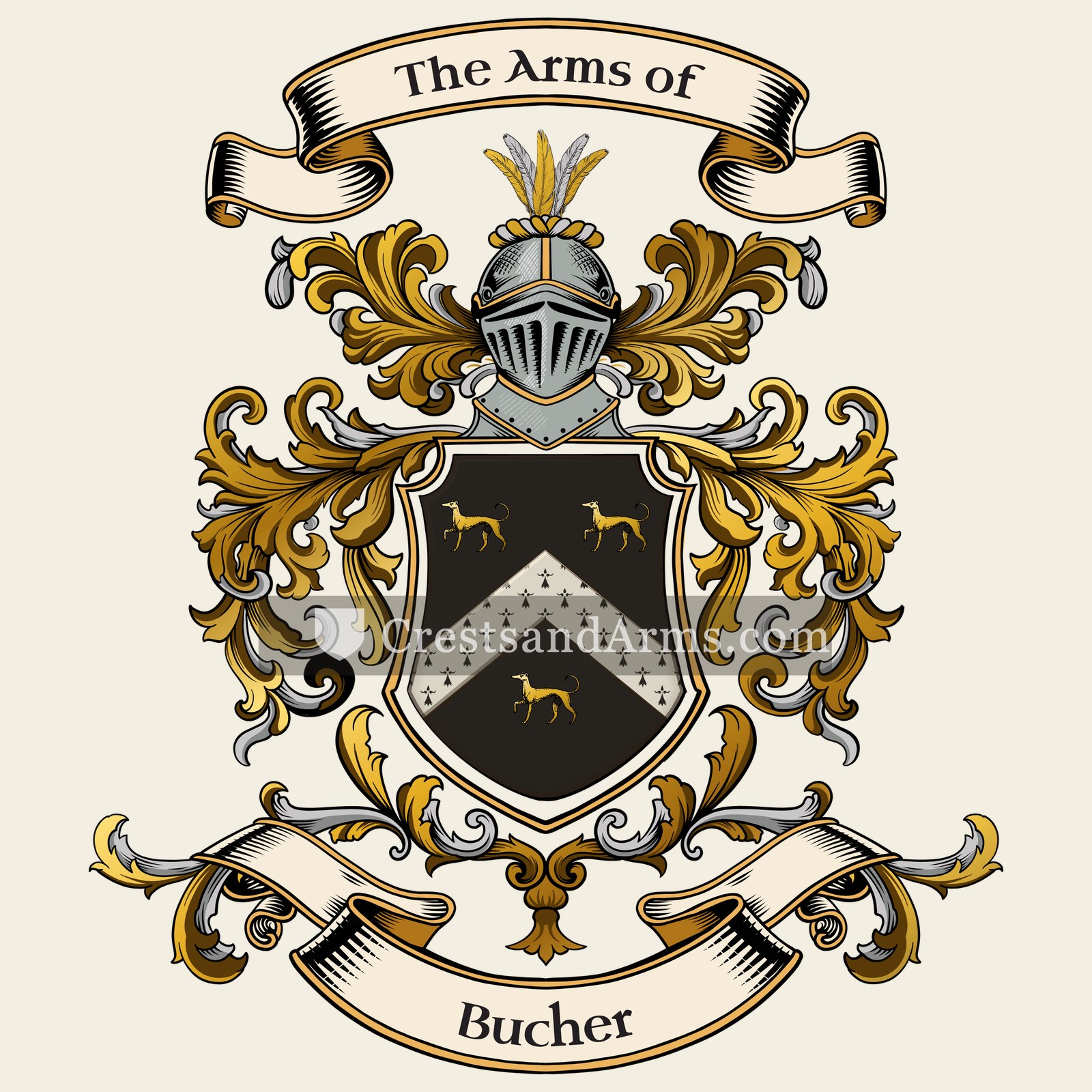
Symbols on this shield
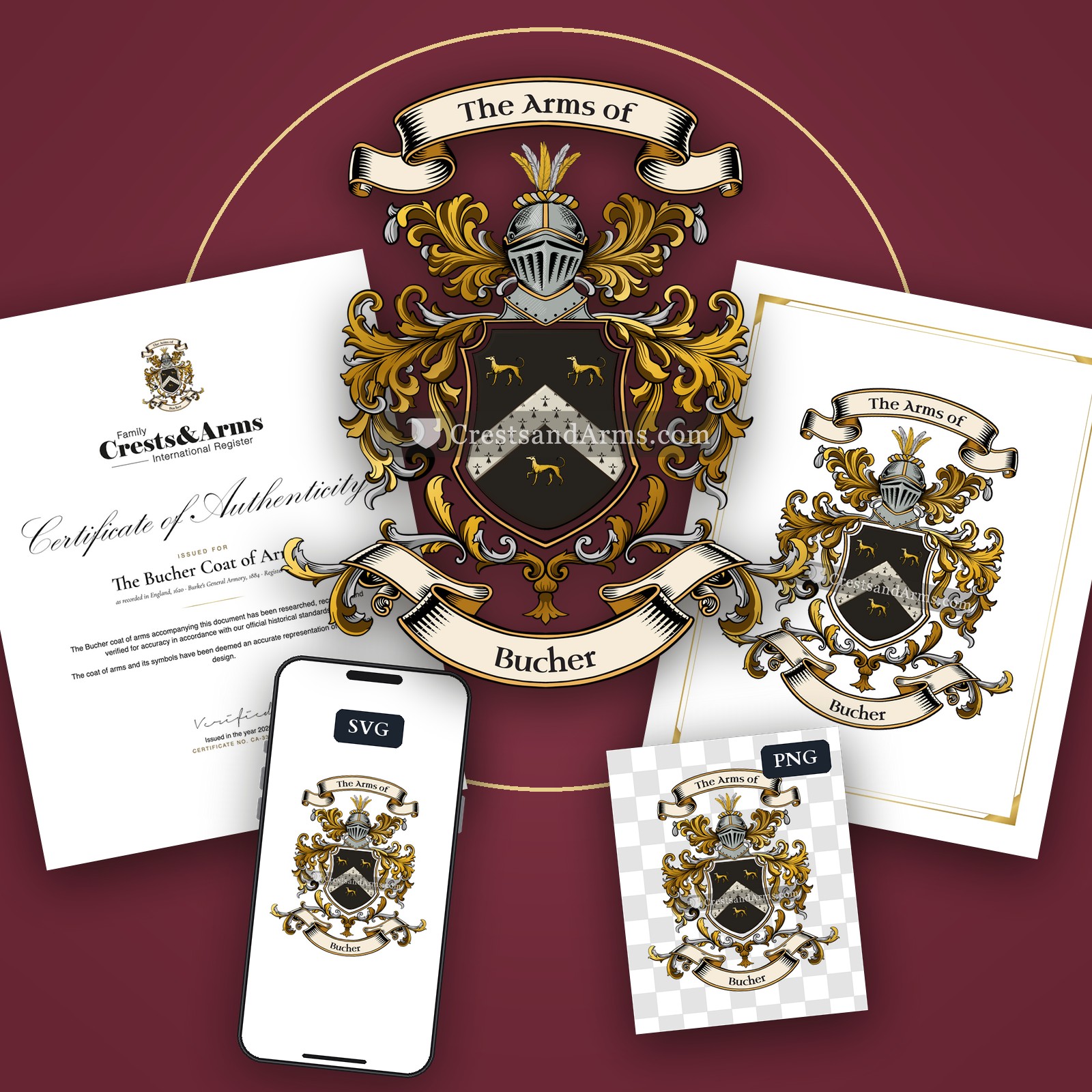
chevronProtection, and faithful service completed
greyhoundCourage, vigilance and loyalty
Colours
Black (Sable)Means: Constancy
ErmineMeans: Dignity
Gold (Or)Means: Generosity
Historical info
Source
Sir Bernard Burke, The General Armory of England, Scotland, Ireland and Wales, London: Harrison & Sons, 1884
Blazon (the actual original written record)
“Sa. a chev. erm. betw. three talbots pass. or”
MiddlesexMiddlesex, c. 1620
Digital archive packCoat of arms PNG, gold border print PDF, vector SVG and the certificate of authenticity. Sent to your email in minutes.
Map of England showing where the Bucher arms are recorded
The Bucher arms were recorded in Middlesex, c. 1620.
Middlesex was the county around London, and City money flowed straight into it. Merchants and officials bought estates within reach of the capital, and a new estate brought a coat of arms with it.
This is where the arms were entered in the register. Families often moved to other parts of the country, so the same name can turn up in more than one region.
The body that granted and recorded arms in England in this period.
James VI and I
Sovereign of the period
James VI and I
1603–1625
Reigning in France when the Bucher arms are first recorded.
How Arms Worked in England
English heraldry allowed arms to be shared by all legitimate descendants of the original owner. These symbols were treated as personal property that moved through the generations to all children. While the eldest son kept the original design, other family members could use the same shield without needing to change it or register their own unique versions.
Granting authority
The College of Arms in London has regulated the use of coats of arms throughout England and Wales since 1484.
How they got arms
Families typically obtained their coats of arms through a formal grant from the Crown or by proving their ancient right to them.
Where arms were recorded
All official coats of arms are recorded in the registers kept at the College of Arms, which date back to the fifteenth century.
The family's standing
Recorded among the armigerous families of Middlesex.
Origin & History of the Bucher Family in England
The surname Bucher carries a history deeply rooted in the practical trades of medieval Europe, eventually finding its way to the bustling landscape of seventeenth-century England. The name is occupational in origin, derived from the Middle High German word *buocher*, which historically referred to a person who worked as a bookbinder or a scribe. By the time members of the family were documented in Middlesex in 1620, the name had already transitioned from a description of a craftsman’s daily labor into a stable hereditary identifier. Settling in the region surrounding London during the early seventeenth century placed the family at the center of a rapidly changing society, where they likely participated in the growing urban economy of the period. This migration reflects a broader pattern of individuals moving across borders to seek new opportunities in trade and administration, carrying their ancestral professional titles with them as they integrated into English life.
Bucher Meaning & Related Branches
Root word
Bouche
Derived from the Old French word for mouth or opening.
This name
BucherAn occupational surname for a butcher or a person who dealt in meat.
also spelled
Buecher
Booker
Beecher
Buchir
Related arms
Cosandey Edle von Préfleurirecorded with Bucher, same area
Lutzrecorded with Bucher, same area
Ochsrecorded with Bucher, same area
Rangnerrecorded with Bucher, same area
Documented Sources
J. B. Rietstap, Armorial Général, Gouda: G. B. van Goor Zonen, 1884–87
Dauzat, Albert, Dictionnaire étymologique des noms de famille et prénoms de France, 1951
Morlet, Marie-Thérèse, Dictionnaire étymologique des noms de famille, 1991
Archives départementales de l'Isère, Registres paroissiaux et d'état civil de la province du Dauphiné, 1663
Digital archive packCoat of arms PNG, gold border print PDF, vector SVG and the certificate of authenticity. Sent to your email in minutes.


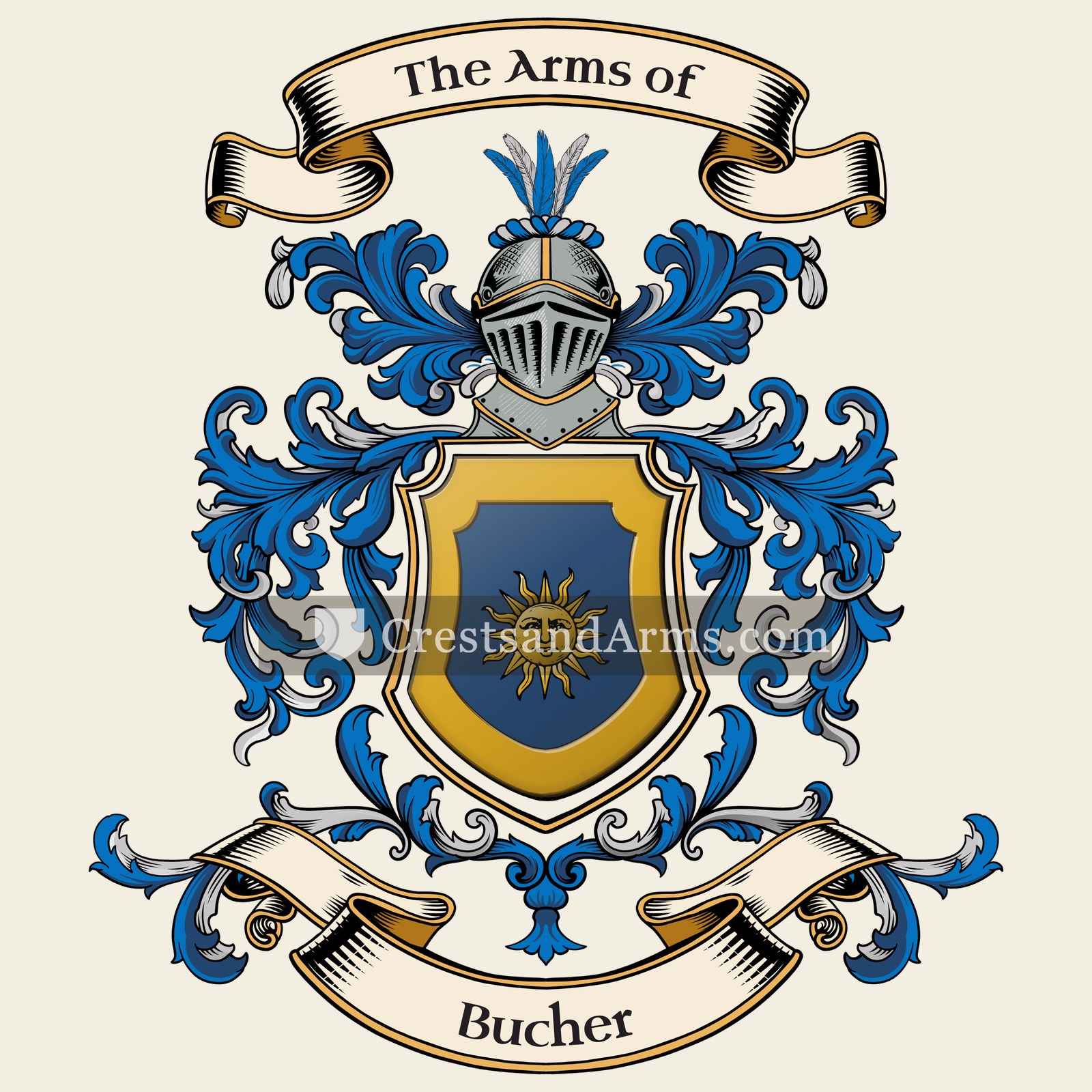
 sunGlory, splendour and the source of life
 sunGlory, splendour and the source of life


 keyGuardianship, and the office of a steward

 chevronProtection, and faithful service completed
 greyhoundCourage, vigilance and loyalty