A record of documented arms, meaning and origin, researched for the Budde family lines. Documented in 3 countries.
Reg. 9655 · German, A–C
Coat of Arms & Family Crest Details
Symbols on this shield
fessThe military belt, and readiness to serve
Colours
Gold (Or)Means: Generosity
Black (Sable)Means: Constancy
Historical info
Source
J. B. Rietstap, Armorial Général, Gouda: G. B. van Goor Zonen, 1884–87
Blazon (the actual original written record)
“D'or à deux fasces nebulées ou entées de sa. C.: un panache de plumes de coq de sa.; ou un écran circulaire aux armes de l'écu, sommé de plumes de coq de sa.”
GermanyOstfrise, c. 1765
Digital archive packCoat of arms PNG, gold border print PDF, vector SVG and the certificate of authenticity. Sent to your email in minutes.
Map of Germany showing where the Budde arms are recorded
The Budde arms were recorded in Ostfrise, c. 1765.
This is where the arms were entered in the register. Families often moved to other parts of the country, so the same name can turn up in more than one region.
The body that granted and recorded arms in Germany in this period.
Francis I, Holy Roman Emperor
Sovereign of the period
Francis I, Holy Roman Emperor
1745–1765
Reigning in Germany when the Budde arms are first recorded.
How Arms Worked in Germany
In the Holy Roman Empire, coats of arms were often granted to individuals by the Emperor or his representatives. These arms were then passed down through the generations to all legitimate descendants of the original holder. Younger branches of a family usually kept the same shield design without needing to change it, as the arms belonged to the entire lineage.
Granting authority
The Holy Roman Emperor held the sole power to grant new coats of arms throughout his vast imperial territories.
How they got arms
Families typically obtained their coats of arms through a formal imperial grant or by proving their noble status to the authorities.
Where arms were recorded
These grants were officially recorded in the Imperial Chancery registers, which began keeping formal records of such honors during the Middle Ages.
The family's standing
Recorded among the armigerous families of Germany.
Origin & History of the Budde Family in Germany
The family name Budde has deep roots in the northern regions of Germany, particularly within the flat, windswept landscapes of East Frisia. Historically, the name is linked to the Low German word "budde," which often referred to a person who was a messenger or a beadle. In the rural society of the eighteenth century, individuals carrying this name were frequently connected to the land as farmers or local officials who helped manage village affairs. By 1765, records confirm that families bearing the name were well-established in East Frisian communities, where they lived through the transition from feudal traditions to more modern agricultural practices. These early ancestors played a vital role in the social fabric of their districts, serving as the backbone of the local economy and maintaining the traditions of the Frisian coastal culture. Their presence in the region reflects a long history of resilience and steady integration into the evolving German state.
Coat of Arms & Family Crest Details
Symbols on this shield
chequyConstancy, and the counting-board
unicornPurity, and extreme courage in defence of honour
Colours
Silver (Argent)Means: Peace and sincerity
Black (Sable)Means: Constancy
Red (Gules)Means: Military strength
Historical info
Source
J. B. Rietstap, Armorial Général, Gouda: G. B. van Goor Zonen, 1884–87
Blazon (the actual original written record)
“Taillé: au 1 d'arg. à la licorne naiss. de gu., mouv. du taillé: au 2 échiq. en barre de sa. et d'arg. C.: la licorne iss. L. d'arg., d'azur et de gu.”
CourlandCourland, c. 1772
Digital archive packCoat of arms PNG, gold border print PDF, vector SVG and the certificate of authenticity. Sent to your email in minutes.
Map of Poland showing where the Budde arms are recorded
The Budde arms were recorded in Courland, c. 1772.
Courland was Baltic coast country held in large estates by a small number of families. They kept their land for generations and served as officers abroad, and both landholding and service brought arms with them.
This is where the arms were entered in the register. Families often moved to other parts of the country, so the same name can turn up in more than one region.
Region
Courland
First recorded
1772
Granting Authority for the Budde Arms
Ennoblement by the Sejm
Author: Olek Remesz · CC BY-SA 3.0
The body that granted and recorded arms in Poland in this period.
Stanisław August Poniatowski
Sovereign of the period
Stanisław August Poniatowski
1764–1795
Reigning in Germany when the Budde arms are first recorded.
How Arms Worked in Poland
Polish noble families shared a single coat of arms across many different surnames, creating large clans rather than individual designs. These symbols were held collectively by all members of the clan regardless of their specific family name. When a new family joined the nobility, they were adopted into an existing clan and began using that group's established shield.
Granting authority
The Sejm, which was the Polish parliament, held the power to grant noble status and the right to bear arms.
How they got arms
Families typically received their coat of arms through a formal act of ennoblement granted by the Sejm for distinguished service.
Where arms were recorded
These grants were officially recorded in the Crown Metrica, which served as the central archive for state documents starting in the sixteenth century.
The family's standing
Recorded among the armigerous families of Courland.
Origin & History of the Budde Family in Poland
The family name Budde has deep roots in the Baltic region, particularly within the historical territory of Courland. By the year 1772, members of the family were well-established in this area, which served as a crossroads for German, Polish, and Baltic cultures. The name itself is thought to originate from a Middle Low German word that refers to a messenger or a beadle, suggesting that early ancestors may have held administrative or official roles within their communities. As the borders of the Polish-Lithuanian Commonwealth shifted and interacted with the Duchy of Courland, families like the Buddes often moved between these regions to manage estates or serve in local government. Their presence in 18th-century records highlights a history of mobility and integration, as they adapted to the complex social structures of a region defined by its diverse linguistic and political landscape.
Coat of Arms & Family Crest Details
Symbols on this shield
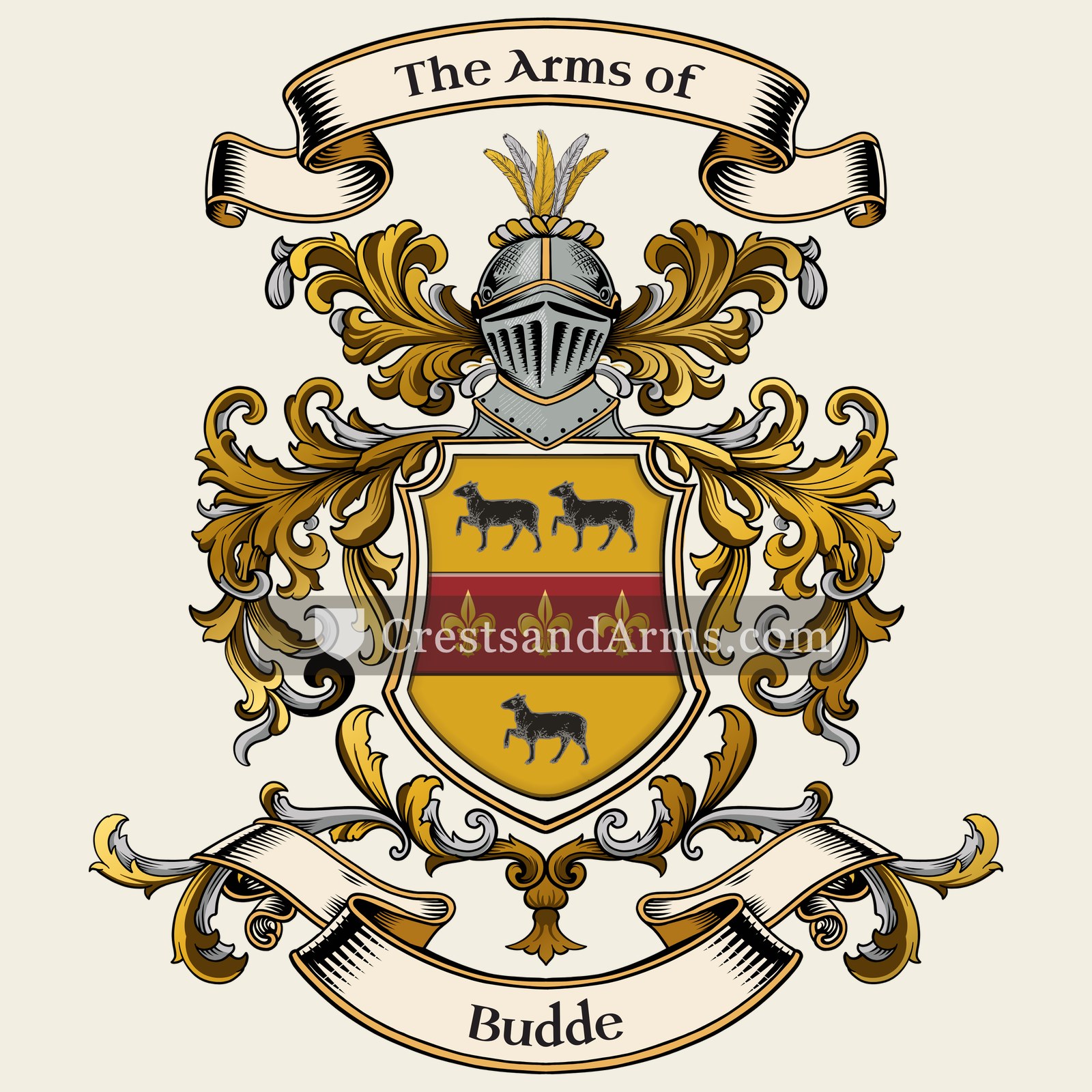
fessThe military belt, and readiness to serve
fleur de lisPurity, light, and the sixth son
lambGentleness, patience and faith
Colours
Gold (Or)Means: Generosity
Red (Gules)Means: Military strength
Black (Sable)Means: Constancy
Historical info
Source
J. B. Rietstap, Armorial Général, Gouda: G. B. van Goor Zonen, 1884–87
Blazon (the actual original written record)
“D'or à la fasce de gu., ch. de trois fleurs-de-lis du champ et acc. de trois têtes de mouton de sa.”
Netherlandsc. 1815
Digital archive packCoat of arms PNG, gold border print PDF, vector SVG and the certificate of authenticity. Sent to your email in minutes.
Map of Netherlands showing where the Budde arms are recorded
The Budde arms were recorded in Netherlands, c. 1815.
Arms such as these were typically recorded in Friesland.
Friesland was low, wet country on the northern coast of the Netherlands, farmed by families who had held the same land for centuries. Free landholders were unusually common there, and a free landholder could carry arms.
This is where the arms were entered in the register. Families often moved to other parts of the country, so the same name can turn up in more than one region.
Region
Friesland
First recorded
1815
Granting Authority for the Budde Arms
Hoge Raad van Adel
Photograph made by me · CC BY-SA 3.0
The body that granted and recorded arms in Netherlands in this period.
William I of the Netherlands
Sovereign of the period
William I of the Netherlands
1815–1840
Reigning in Germany when the Budde arms are first recorded.
How Arms Worked in Netherlands
In the Netherlands, coats of arms were often used by noble families and those who held specific public offices. These arms were passed down through the generations to legitimate descendants. Younger branches of a family usually kept the original design without needing to add special marks. This system ensured that the family identity remained clear and consistent over many years.
Granting authority
The Hoge Raad van Adel is the official body that regulates and manages noble titles and coats of arms in the Netherlands.
How they got arms
Families typically obtained their coats of arms through official royal grants or by proving their long-standing historical use of the symbols.
Where arms were recorded
Coats of arms are officially recorded in the registers held by the Hoge Raad van Adel, which began its work in 1814.
The family's standing
Recorded among the armigerous families of Netherlands.
Origin & History of the Budde Family in Netherlands
The surname Budde has deep roots in the northern regions of the Netherlands, particularly within the province of Friesland. By the early 19th century, records confirm that families bearing this name were well-established in Frisian communities. The name itself likely originated as a descriptive nickname or a shortened form of a personal name common in Northern Europe during the Middle Ages. In the context of Friesland, families with this name often integrated into the local agricultural or maritime sectors, which were the primary drivers of the regional economy at the time. As the Netherlands moved toward standardized civil registration in 1811, families like the Buddes helped solidify the use of fixed surnames across the Frisian countryside. This transition marked a shift from traditional patronymic naming customs to the permanent family names that are still recognized today.
Budde Meaning & Related Branches
Root word
Bodo
Derived from the Germanic word for messenger or herald.
This name
BuddeA patronymic surname originating from a short form of personal names containing the element bod.
also spelled
Bud
Budda
Related arms
Lennardsimilar arms
Lennard de West-Wickhamsimilar arms
Sagredosimilar arms
Documented Sources
J. B. Rietstap, Armorial Général, Gouda: G. B. van Goor Zonen, 1884–87
Bahlow, Hans, Deutsches Namenlexikon: Familien- und Vornamen nach Ursprung und Sinn erklärt, 1967
Kramer, P., Ostfriesische Familienkunde, 1982
Niedersächsisches Landesarchiv (Aurich), Kirchenbuch-Duplikate der Ämter und Städte Ostfrieslands
Digital archive packCoat of arms PNG, gold border print PDF, vector SVG and the certificate of authenticity. Sent to your email in minutes.


 fessThe military belt, and readiness to serve
 fessThe military belt, and readiness to serve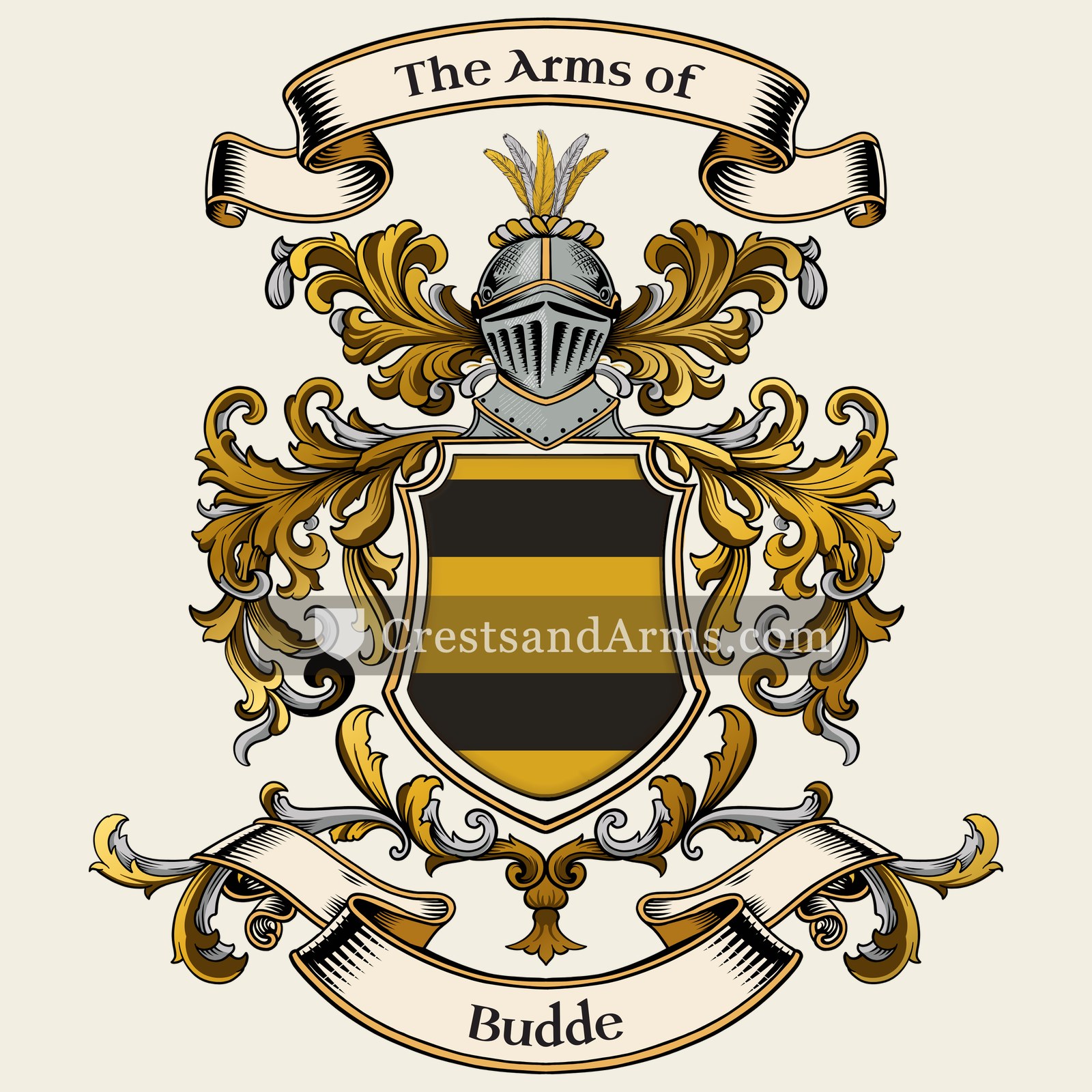


 chequyConstancy, and the counting-board
 unicornPurity, and extreme courage in defence of honour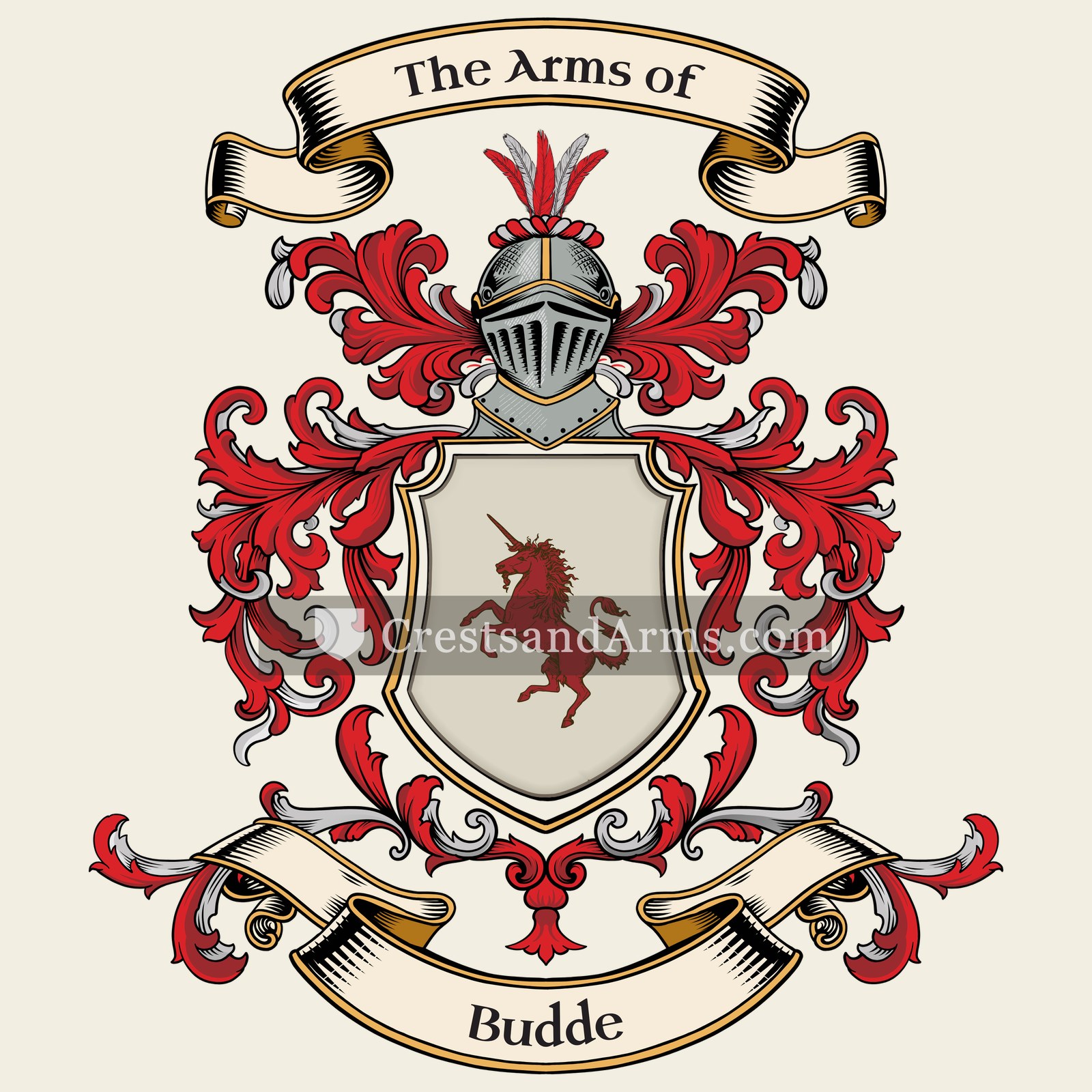


 fleur de lisPurity, light, and the sixth son
 lambGentleness, patience and faith