Map of Denmark showing where the Bude arms are recorded
The Bude arms were recorded in Denmark, c. 1722.
Arms such as these were typically recorded in Sjaælland.
Zealand held the Danish court, the crown's offices and Copenhagen itself. Families who served the king kept estates within reach of it, and royal service was the ordinary route to a coat of arms.
This is where the arms were entered in the register. Families often moved to other parts of the country, so the same name can turn up in more than one region.
The body that granted and recorded arms in Denmark in this period.
Frederik IV of Denmark
Sovereign of the period
Frederik IV of Denmark
1699–1730
Reigning in Denmark when the Bude arms are first recorded.
How Arms Worked in Denmark
Danish heraldry during this period was closely tied to noble status and royal favor rather than being open to all citizens. Arms were typically granted by the monarch to individuals, and these symbols were then shared by all members of the noble house. If a family line died out, the right to use those specific arms ended with them.
Granting authority
The Danish royal chancery held the power to issue and regulate official coats of arms for the kingdom.
How they got arms
Families usually received their arms through a formal royal grant that confirmed their noble status and rights.
Where arms were recorded
These grants were officially recorded in the Danish Royal Chancery records starting in the sixteenth century.
The family's standing
Recorded among the armigerous families of Denmark.
Origin & History of the Bude Family in Denmark
The history of the Bude family in Denmark begins with documented roots on the island of Sjælland in 1722. During this period, the name was associated with families living in a society that was transitioning from traditional rural life toward a more structured administrative system. Because the name appears in parish registers and local tax records from the early eighteenth century, it is clear that the family was well-established within the local community. These early ancestors likely worked as farmers or artisans, which were the most common occupations for families in the Sjælland region at that time. By remaining in the same geographic area for generations, the family became a consistent part of the local social fabric. Their presence in these early records provides a window into the lives of ordinary people who helped shape the rural history of Denmark during the eighteenth century.
Coat of Arms & Family Crest Details
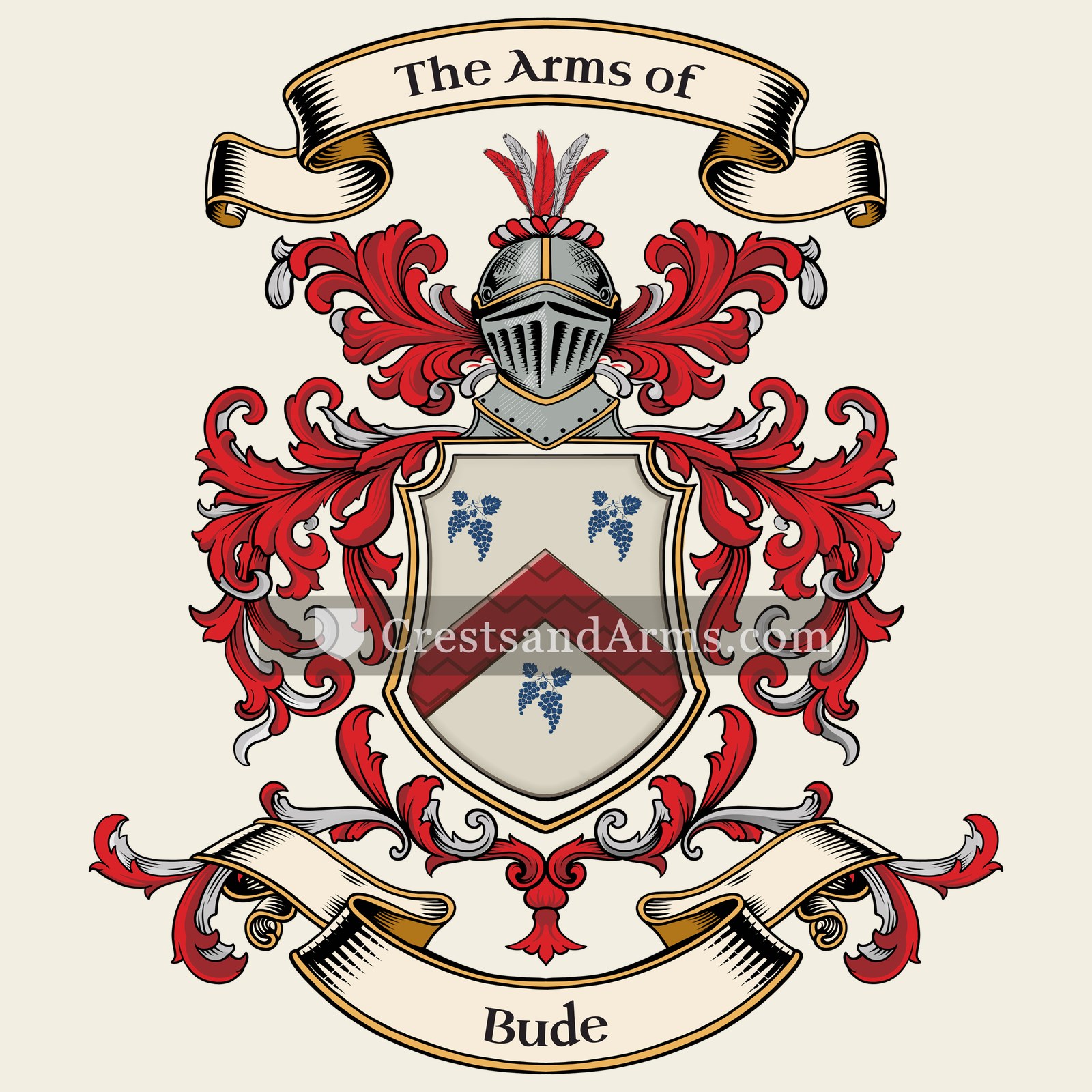
Symbols on this shield
chevronProtection, and faithful service completed
grapesPlenty, and the labour of the vine
Colours
Silver (Argent)Means: Peace and sincerity
Red (Gules)Means: Military strength
Blue (Azure)Means: Loyalty and truth
Historical info
Source
J. B. Rietstap, Armorial Général, Gouda: G. B. van Goor Zonen, 1884–87
Blazon (the actual original written record)
“D'arg. au chev. de gu., acc. de trois grappes de raisin d'azur, pamprées de sin. Brl. d'azur, de gu. et d'arg. C.: un Indien iss., au nat., cour. de plumages, tenant une massue posée sur son épaule; ou, un vol à l'antique d'arg. ch. d'un chev. de gu. L. d'arg. et de gu., ou de gu. et d'azur. T.: deux sauvages de carn., ceints de tabliers de gu. rayés de sa., cour. de feuilles de vigne et de grappes de raisin, arm. de massues.”
Ile-de-FranceBade · Ile-de-France, c. 1399
Digital archive packCoat of arms PNG, gold border print PDF, vector SVG and the certificate of authenticity. Sent to your email in minutes.
Map of France showing where the Bude arms are recorded
The Bude arms were recorded in Ile-de-France, c. 1399.
Ile-de-France is the country around Paris, and proximity to the court mattered. Families who served the crown were rewarded with land near it, and land near the capital carried arms almost as a matter of course.
This is where the arms were entered in the register. Families often moved to other parts of the country, so the same name can turn up in more than one region.
The body that granted and recorded arms in France in this period.
Charles VI of France
Sovereign of the period
Charles VI of France
1380–1422
Reigning in Denmark when the Bude arms are first recorded.
How Arms Worked in France
In France, a coat of arms was a mark of honor that passed down through the male line to all legitimate descendants. Families often used the same shield without changes to show their shared heritage. If a branch wanted to stand out, they could add a small mark to their shield to show their specific place in the family tree.
Granting authority
The Juge d'armes de France acted as the official authority that regulated and verified coats of arms across the country.
How they got arms
Families typically inherited their arms from ancestors, though they could also receive them through royal grants or by proving their noble status.
Where arms were recorded
Coats of arms were officially recorded in the Armorial Général de France, which began its main collection in the year 1696.
The family's standing
Recorded among the armigerous families of Ile-de-France.
Origin & History of the Bude Family in France
The history of the Bude family in France begins in the fertile region of the Île-de-France, where members of the family were firmly established by the year 1399. During this period, the family began to rise in social standing as they integrated into the administrative and intellectual circles of the French monarchy. By the time of the Renaissance, the name became synonymous with deep scholarship and public service, most notably through the work of Guillaume Budé. He was a prominent humanist and diplomat who served King Francis I and played a vital role in the founding of the Collège de France. The family’s influence grew as they moved between the royal courts and the academic centers of Paris, helping to shape the cultural landscape of the nation during a time of great transition. Their legacy is rooted in this early commitment to education and their long-standing connection to the heart of the French government.
Bude Meaning & Related Branches
Root word
Bude
Derived from the Middle Low German word for a small house or hut.
This name
BudeRefers to a person who lived in a small dwelling or worked as a stall keeper.
also spelled
Bude-de
Bude-von
Buday
Related arms
Albertini d'Ichtratzheimrecorded with Bude, same area
Berstettrecorded with Bude, same area
Böcklin von und zu Böcklinsaurecorded with Bude, same area
Gayling d'Altheimrecorded with Bude, same area
Documented Sources
J. B. Rietstap, Armorial Général, Gouda: G. B. van Goor Zonen, 1884–87
Rigsarkivet (The Danish National Archives), Kirkebøger for Sjællands Stift (Parish Registers for the Diocese of Sjælland), 1722
Rigsarkivet (The Danish National Archives), Ekstraskattemandtaller (Extraordinary Tax Census Records), 1722
Trap, J.P., Statistisk-topographisk Beskrivelse af Kongeriget Danmark, 1858
Digital archive packCoat of arms PNG, gold border print PDF, vector SVG and the certificate of authenticity. Sent to your email in minutes.


 fessThe military belt, and readiness to serve
 fessThe military belt, and readiness to serve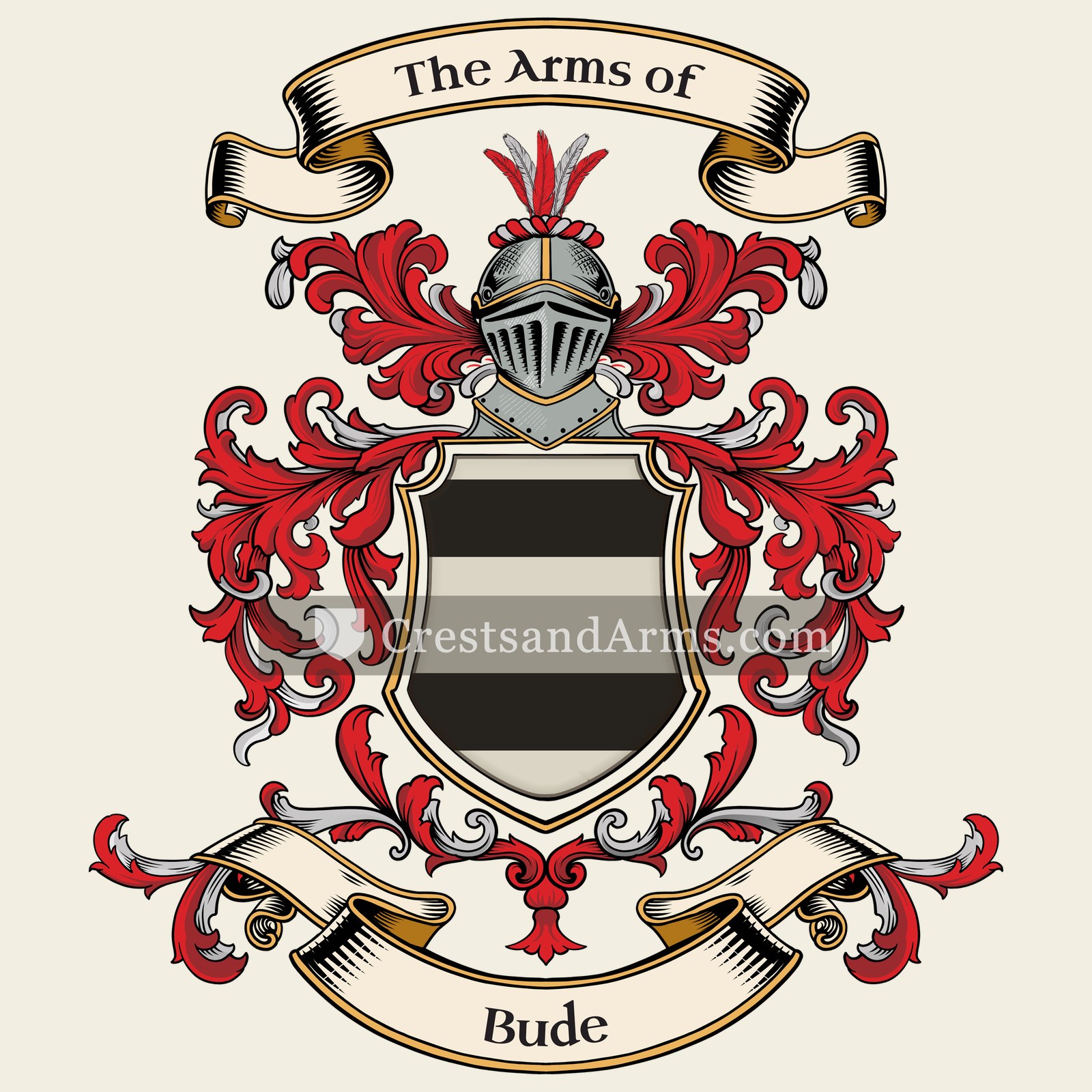


 chevronProtection, and faithful service completed
 grapesPlenty, and the labour of the vine