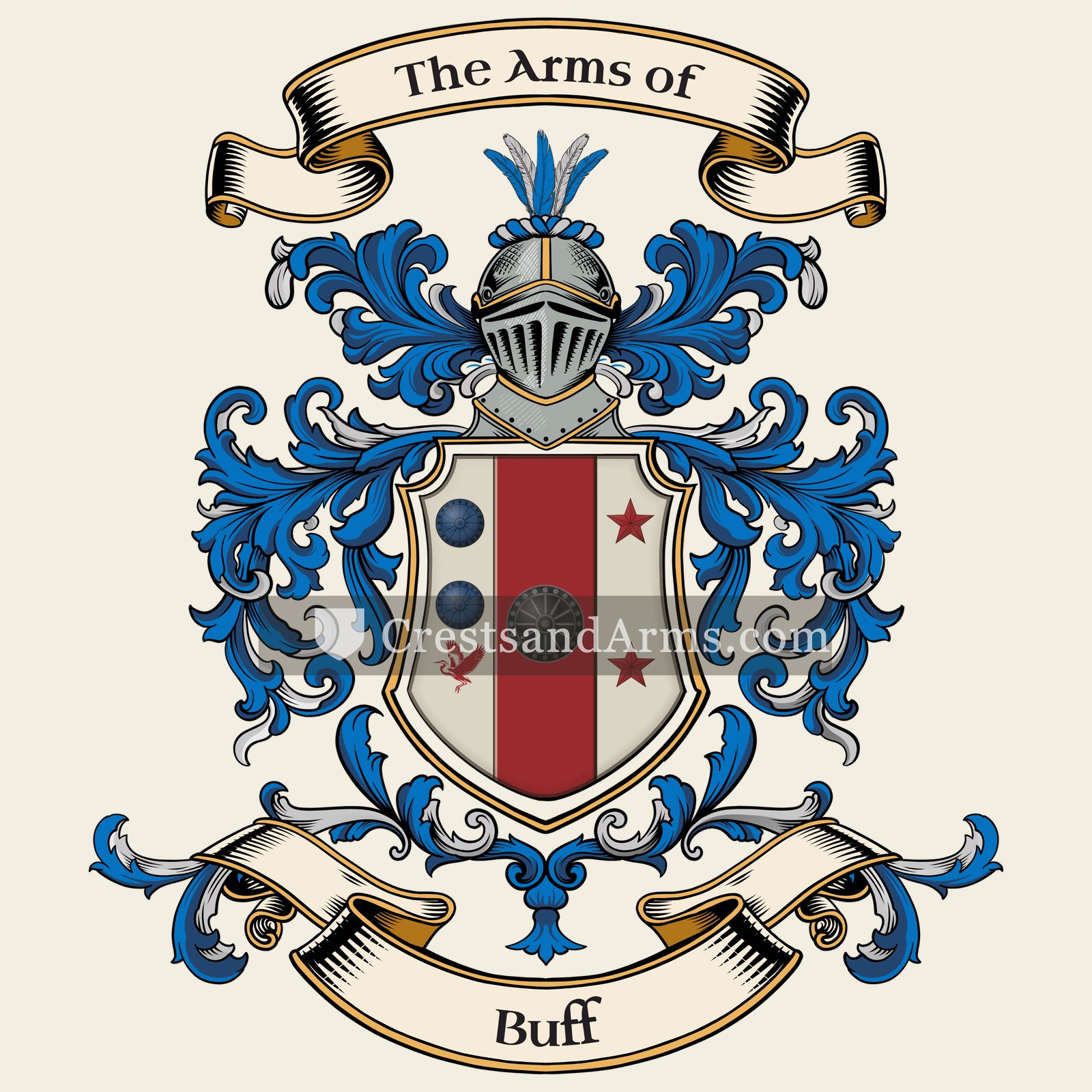
A record of documented arms, meaning and origin, researched for the Buff family of Germany.
Reg. 6234 · German, A–C
Coat of Arms & Family Crest Details
Symbols on this shield
paleMilitary strength, and a fortified defence
heronPatience and quiet watchfulness
roundelA coin, and one who has been to the crusades
mulletThe third son, and a divine quality from above
Colours
Silver (Argent)Means: Peace and sincerity
Blue (Azure)Means: Loyalty and truth
Red (Gules)Means: Military strength
Historical info
Source
J. B. Rietstap, Armorial Général, Gouda: G. B. van Goor Zonen, 1884–87
Blazon (the actual original written record)
“Coupé: au 1 d'arg. à la cigogne de gu.; le champ chaussé d'azur à deux bes. d'arg.; au 2 d'arg. au pal parti d'or et d'azur ch. d'un besant-tourteau de l'un en l'autre et accosté de deux étoiles de gu. C.: une étoile d'or, entre une ramure de cerf de gu. L.: à dextre d'or et de sa., à sen. d'arg. et de gu.”
HesseHesse, c. 1579
Digital archive packCoat of arms PNG, gold border print PDF, vector SVG and the certificate of authenticity. Sent to your email in minutes.
Map of Germany showing where the Buff arms are recorded
The Buff arms were recorded in Hesse, c. 1579.
Hesse was central German country, divided among a large number of small landowners and prosperous towns. So many separate households held ground there that the region produced an unusual number of coats of arms.
This is where the arms were entered in the register. Families often moved to other parts of the country, so the same name can turn up in more than one region.
The body that granted and recorded arms in Germany in this period.
Emperor Rudolf II
Sovereign of the period
Emperor Rudolf II
1576–1612
Reigning in Germany when the Buff arms are first recorded.
How Arms Worked in Germany
In the Holy Roman Empire, coats of arms were often granted to individuals by the Emperor or his representatives. These arms were then passed down through the generations to all legitimate descendants of the original holder. Younger branches of a family usually kept the same shield design without needing to change it, as the arms belonged to the entire lineage.
Granting authority
The Holy Roman Emperor held the sole power to grant new coats of arms throughout his vast imperial territories.
How they got arms
Families typically obtained their coats of arms through a formal imperial grant or by proving their noble status to the authorities.
Where arms were recorded
These grants were officially recorded in the Imperial Chancery registers, which began keeping formal records of such honors during the Middle Ages.
The family's standing
Recorded among the armigerous families of Hesse.
Origin & History of the Buff Family in Germany
The family name Buff traces its roots back to the central German region of Hesse, where records confirm members of the family were established as early as 1579. The name likely originated as a descriptive nickname or a shortened form of a personal name common in the Middle Ages. In the social structure of the sixteenth century, families like the Buffs were often part of the rising middle class, frequently serving as local officials, craftsmen, or scholars within their communities. As the family grew, they became deeply integrated into the cultural and administrative life of the Hessian landscape. Their presence in the region during this period reflects a time of significant transition in German society, where families began to solidify their identities through consistent naming practices and local community roles. Over the following centuries, the Buff family maintained a reputation for intellectual and professional contributions, helping to preserve their history within the historical fabric of the region.
Buff Meaning & Related Branches
Root word
Buffo
A Latin term meaning a toad or a swollen, puffed-up creature.
This name
BuffA nickname for a person with a round face or a jovial, clownish personality.
also spelled
Buffe
Buff-de
Buff-von
Buf
Related arms
Haehnelrecorded with Buff, same area
Roegnerrecorded with Buff, same area
Documented Sources
J. B. Rietstap, Armorial Général, Gouda: G. B. van Goor Zonen, 1884–87
Kallfelz, H., Die Buff: Eine hessische Familie, 1985
Hessisches Staatsarchiv Marburg, Bestand 300 I: Familienarchiv Buff, 1579–1900
Digital archive packCoat of arms PNG, gold border print PDF, vector SVG and the certificate of authenticity. Sent to your email in minutes.


 paleMilitary strength, and a fortified defence
 heronPatience and quiet watchfulness
 roundelA coin, and one who has been to the crusades
 mulletThe third son, and a divine quality from above
 paleMilitary strength, and a fortified defence
 heronPatience and quiet watchfulness
 roundelA coin, and one who has been to the crusades
 mulletThe third son, and a divine quality from above