Map of Britain showing where the Bugge arms are recorded
The Bugge arms were recorded in Britain, c. 1700.
Arms such as these were typically recorded in Kent.
Kent sits between London and the short crossing to Europe, and the trade passing through made it wealthy. Merchant families bought land with that money, and it was landowners who took coats of arms.
This is where the arms were entered in the register. Families often moved to other parts of the country, so the same name can turn up in more than one region.
The body that granted and recorded arms in Britain in this period.
William III of England
Sovereign of the period
William III of England
1694–1702
Reigning in Britain when the Bugge arms are first recorded.
How Arms Worked in Britain
English heraldry allowed arms to be shared by all legitimate descendants of the original owner. These symbols were treated as personal property that moved through the generations to all children. While the eldest son kept the original design, other family members could use the same shield without needing to change it or register their own unique versions.
Granting authority
The College of Arms in London has regulated the use of coats of arms throughout England and Wales since 1484.
How they got arms
Families typically obtained their coats of arms through a formal grant from the Crown or by proving their ancient right to them.
Where arms were recorded
All official coats of arms are recorded in the registers kept at the College of Arms, which date back to the fifteenth century.
The family's standing
Recorded among the armigerous families of Britain.
Origin & History of the Bugge Family in Britain
The surname Bugge has deep roots in Northern Europe, originating as a descriptive nickname derived from Old Norse terms that often referred to a person of significant stature or a haughty demeanor. While the name was well-established in Scandinavian and Germanic regions during the Middle Ages, its presence in Britain became more distinct over the following centuries. By the year 1700, records confirm that members of the Bugge family were settled in the county of Kent. During this era, families in Kent were frequently involved in local agriculture, trade, and the maritime industries that defined the coastal landscape of southeastern England. These early settlers helped establish the name within the local parish registers, marking the transition of the family from their continental origins into the social fabric of British village life.
Coat of Arms & Family Crest Details
Colours
Silver (Argent)Means: Peace and sincerity
Blue (Azure)Means: Loyalty and truth
Historical info
Source
J. B. Rietstap, Armorial Général, Gouda: G. B. van Goor Zonen, 1884–87
Blazon (the actual original written record)
“Coupé d'arg. sur azur. C.: deux prob., coupées alt. d'arg. et d'azur.”
Denmarkc. 1722
Digital archive packCoat of arms PNG, gold border print PDF, vector SVG and the certificate of authenticity. Sent to your email in minutes.
Map of Denmark showing where the Bugge arms are recorded
The Bugge arms were recorded in Denmark, c. 1722.
Arms such as these were typically recorded in Sjaælland.
Zealand held the Danish court, the crown's offices and Copenhagen itself. Families who served the king kept estates within reach of it, and royal service was the ordinary route to a coat of arms.
This is where the arms were entered in the register. Families often moved to other parts of the country, so the same name can turn up in more than one region.
The body that granted and recorded arms in Denmark in this period.
Frederik IV of Denmark
Sovereign of the period
Frederik IV of Denmark
1699–1730
Reigning in Britain when the Bugge arms are first recorded.
How Arms Worked in Denmark
Danish heraldry during this period was closely tied to noble status and royal favor rather than being open to all citizens. Arms were typically granted by the monarch to individuals, and these symbols were then shared by all members of the noble house. If a family line died out, the right to use those specific arms ended with them.
Granting authority
The Danish royal chancery held the power to issue and regulate official coats of arms for the kingdom.
How they got arms
Families usually received their arms through a formal royal grant that confirmed their noble status and rights.
Where arms were recorded
These grants were officially recorded in the Danish Royal Chancery records starting in the sixteenth century.
The family's standing
Recorded among the armigerous families of Denmark.
Origin & History of the Bugge Family in Denmark
The history of the Bugge family in Denmark is deeply rooted in the social and agricultural landscape of the eighteenth century. While the name itself carries older linguistic ties to the Old Norse word for a large or prominent person, the documented presence of the family in Sjælland by 1722 marks a significant chapter in their local heritage. During this period, families like the Bugges were often tied to the land and the evolving administrative structures of the Danish countryside. As the eighteenth century progressed, members of the family became part of the rural fabric of the island, living through a time when Denmark was transitioning toward major agrarian reforms. By settling in Sjælland, the early Bugge ancestors established a foundation that allowed their name to persist through generations of Danish history, reflecting the quiet resilience of common families who helped shape the nation’s local communities.
Coat of Arms & Family Crest Details
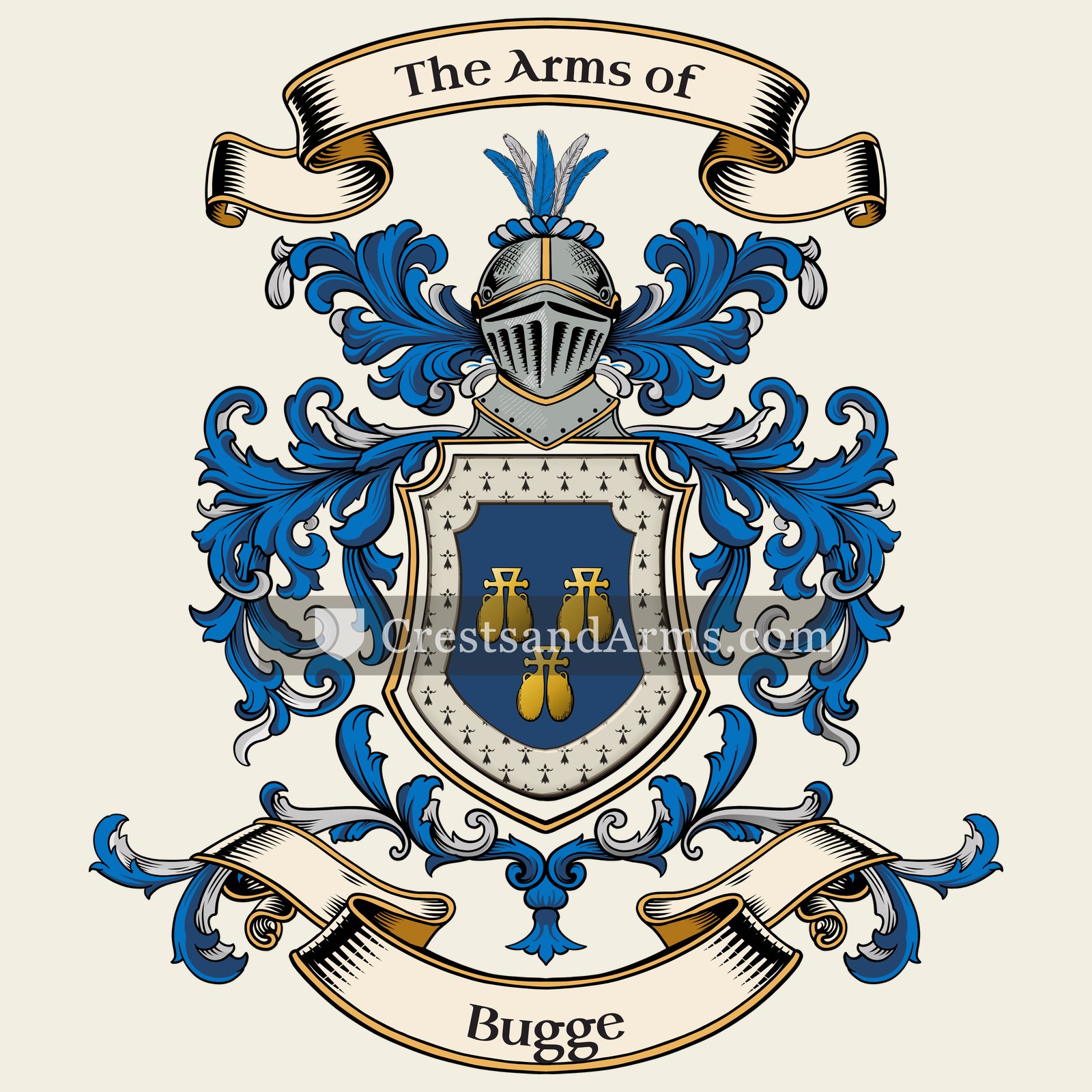
Symbols on this shield
bordureA difference between branches of one family
water bougetThe crusader's water carrier, and a journey made
Colours
Blue (Azure)Means: Loyalty and truth
ErmineMeans: Dignity
Gold (Or)Means: Generosity
Historical info
Source
Sir Bernard Burke, The General Armory of England, Scotland, Ireland and Wales, London: Harrison & Sons, 1884
Blazon (the actual original written record)
“Az. three water bougets or, within a bordure erm”
EssexHarlow · Essex, c. 1620
Digital archive packCoat of arms PNG, gold border print PDF, vector SVG and the certificate of authenticity. Sent to your email in minutes.
Map of England showing where the Bugge arms are recorded
The Bugge arms were recorded in Essex, c. 1620.
Essex lay close enough to London for City money to buy land there. Merchants who prospered moved out to estates within a day's ride, and a new landowner almost always wanted arms to go with the ground.
This is where the arms were entered in the register. Families often moved to other parts of the country, so the same name can turn up in more than one region.
The body that granted and recorded arms in England in this period.
James VI and I
Sovereign of the period
James VI and I
1603–1625
Reigning in Britain when the Bugge arms are first recorded.
How Arms Worked in England
English heraldry allowed arms to be shared by all legitimate descendants of the original owner. These symbols were treated as personal property that moved through the generations to all children. While the eldest son kept the original design, other family members could use the same shield without needing to change it or register their own unique versions.
Granting authority
The College of Arms in London has regulated the use of coats of arms throughout England and Wales since 1484.
How they got arms
Families typically obtained their coats of arms through a formal grant from the Crown or by proving their ancient right to them.
Where arms were recorded
All official coats of arms are recorded in the registers kept at the College of Arms, which date back to the fifteenth century.
The family's standing
Recorded among the armigerous families of Essex.
Origin & History of the Bugge Family in England
The surname Bugge has deep roots in medieval England, originating as a descriptive nickname that likely referred to a person’s perceived character or physical appearance. While the name appears in various regional records dating back to the thirteenth century, the branch of the family that settled in Essex by 1620 reflects the common pattern of internal migration during the early modern period. Families with this name were often involved in local agriculture or trade, moving through the English countryside to seek new opportunities in growing communities. By the time the name was firmly established in Essex, it had become a stable identifier for families participating in the social and economic life of the region. This transition from a simple nickname to a permanent family name illustrates how surnames evolved alongside the changing landscape of English society.
Bugge Meaning & Related Branches
Root word
Bugge
Old Norse term for a large, stout, or arrogant person.
This name
BuggeA nickname for a person of significant physical stature or a proud, haughty individual.
also spelled
Bug
Buga
Documented Sources
J. B. Rietstap, Armorial Général, Gouda: G. B. van Goor Zonen, 1884–87
Reaney, P.H. and Wilson, R.M., A Dictionary of English Surnames, 1997
Kent History and Library Centre, Parish Registers of Kent, 1700
Hanks, Patrick, Dictionary of American Family Names, 2003
Digital archive packCoat of arms PNG, gold border print PDF, vector SVG and the certificate of authenticity. Sent to your email in minutes.


 cross symbolChristian faith and service
 fretPersuasion, and the net that holds
 cross symbolChristian faith and service
 fretPersuasion, and the net that holds




 bordureA difference between branches of one family
 water bougetThe crusader's water carrier, and a journey made