A record of documented arms, meaning and origin, researched for the Buhl family lines. Documented in 2 countries.
Reg. 6782 · Russian, A–C
Coat of Arms & Family Crest Details
Symbols on this shield
towerGrandeur and solidity, and a stronghold defended
eagleNobility, strength and a keen mind
Colours
Silver (Argent)Means: Peace and sincerity
Red (Gules)Means: Military strength
Black (Sable)Means: Constancy
Historical info
Source
J. B. Rietstap, Armorial Général, Gouda: G. B. van Goor Zonen, 1884–87
Blazon (the actual original written record)
“Coupé d'arg. sur gu., le gu. ch. d'un château d'arg., ouv. et aj. de sa., les créneaux touchant le coupé et supp. une aigle de sa., bq. et m. d'or. Cq. cour. C.: un lion iss. d'or, tenant une bannière d'or ch. d'une aigle de sa., ladite bannière terminée en deux listels de gu., la hampe d'or. L.: à dextre d'arg. et de gu., à sen. d'arg. et de sa.”
RussiaEsthonie, c. 1711
Digital archive packCoat of arms PNG, gold border print PDF, vector SVG and the certificate of authenticity. Sent to your email in minutes.
Map of Russia showing where the Buhl arms are recorded
The Buhl arms were recorded in Esthonie, c. 1711.
Arms such as these were typically recorded in Moscow.
Moscow held the Russian court, and rank there came from service rather than land. Families who served the Tsar were entered in the registers of nobility, and that entry is where their arms are recorded.
This is where the arms were entered in the register. Families often moved to other parts of the country, so the same name can turn up in more than one region.
The body that granted and recorded arms in Russia in this period.
Peter the Great
Sovereign of the period
Peter the Great
1682–1721
Reigning in Russia when the Buhl arms are first recorded.
How Arms Worked in Russia
Russian heraldry was strictly tied to the nobility and the state service system. Families proved their ancient status or earned new rank to receive an official grant from the Tsar. These symbols were then inherited by all legitimate children of the noble line. If a family lacked proof of their status, they were often excluded from the official records entirely.
Granting authority
The Herald Master's Office acted as the central state body that strictly regulated and verified all noble heraldic symbols.
How they got arms
Families typically received their arms through a formal state grant or by proving their noble status to the government authorities.
Where arms were recorded
All approved coats of arms were officially recorded in the General Armorial of the Noble Families of the Russian Empire starting in 1797.
The family's standing
Recorded among the armigerous families of Russia.
Origin & History of the Buhl Family in Russia
The history of the Buhl family in Russia begins during the transformative era of Peter the Great, with records confirming their presence in Moscow by 1711. The name likely arrived in Russia through the migration of skilled professionals and craftsmen from German-speaking regions who were invited to help modernize the Russian Empire. During this period, Moscow served as a melting pot for foreign experts who brought new administrative and technical skills to the city. As the family settled into their new environment, they integrated into the developing social structures of the Russian capital. Over the following decades, members of the family became part of the growing community of expatriates who served the state in various professional capacities. Their early presence in Moscow suggests that the family was part of the significant cultural exchange that defined the transition of Russia into a major European power.
Coat of Arms & Family Crest Details
Symbols on this shield
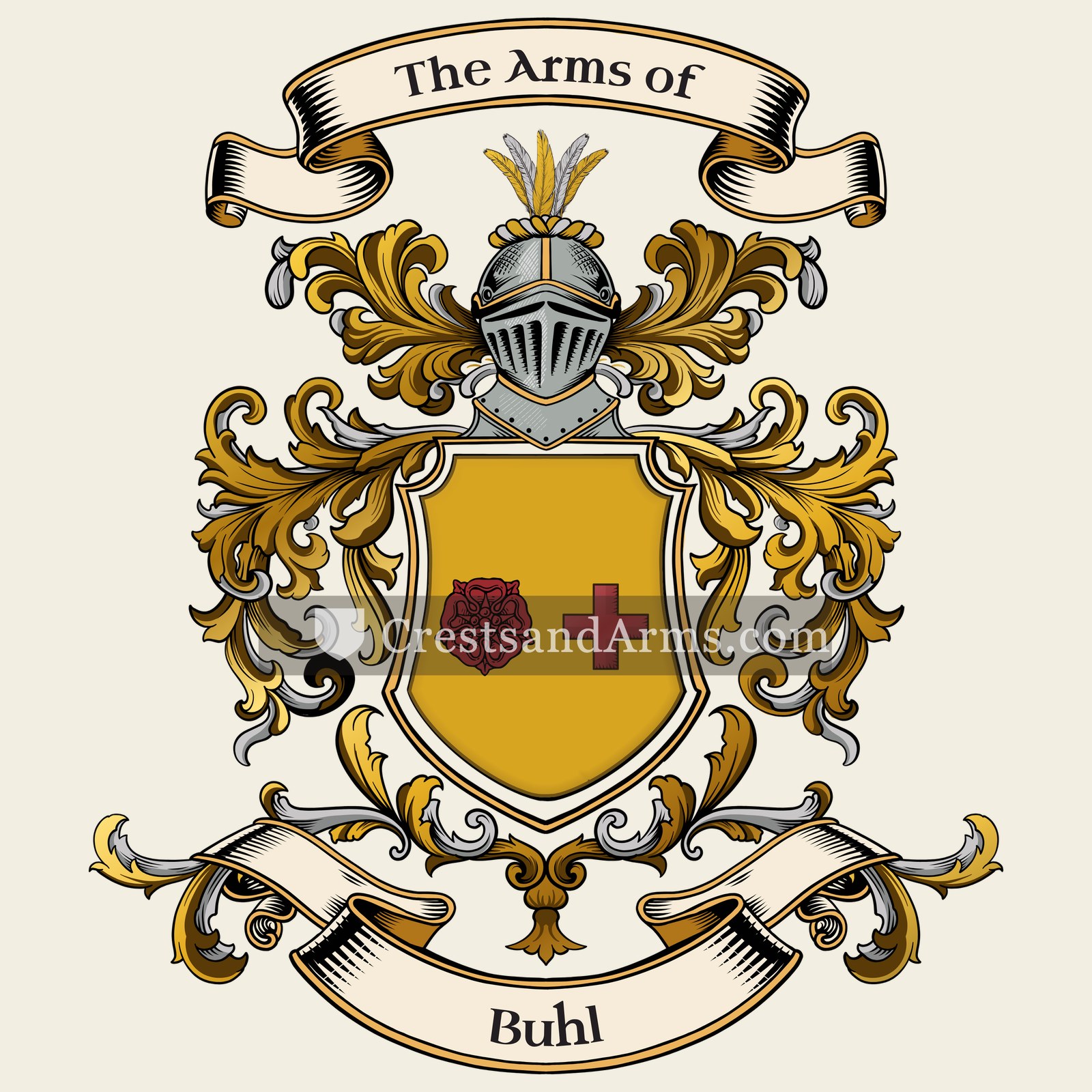
cross symbolChristian faith and service
roseThe seventh son, and beauty with grace
Colours
Gold (Or)Means: Generosity
Red (Gules)Means: Military strength
Historical info
Source
J. B. Rietstap, Armorial Général, Gouda: G. B. van Goor Zonen, 1884–87
Blazon (the actual original written record)
“Taillé: au 1 d'or à la rose de gu., bout. du champ, tigée, feuillée et barbée de sin., et posée en barre; au 2 de gu. à la croix de Lorraine d'or, posée en barre. C.: une femme iss., cour. d'un bandeau d'or, hab. d'azur, ceinte d'or, la main dextre levée et supp. un coeur de gu. dans lequel sont enfoncées deux flèches d'arg., la main sen. appuyée sur sa hanche; le tout entre un vol d'arg. L. d'or et de gu.”
WurttembergWurttemberg, c. 1765
Digital archive packCoat of arms PNG, gold border print PDF, vector SVG and the certificate of authenticity. Sent to your email in minutes.
Map of Germany showing where the Buhl arms are recorded
The Buhl arms were recorded in Wurttemberg, c. 1765.
Wurttemberg was southern German country of small estates and well-off market towns. Both landowners and leading townsmen kept arms there, so the region carries far more names than its size suggests.
This is where the arms were entered in the register. Families often moved to other parts of the country, so the same name can turn up in more than one region.
The body that granted and recorded arms in Germany in this period.
Francis I, Holy Roman Emperor
Sovereign of the period
Francis I, Holy Roman Emperor
1745–1765
Reigning in Russia when the Buhl arms are first recorded.
How Arms Worked in Germany
In the Holy Roman Empire, coats of arms were often granted to individuals by the Emperor or his representatives. These arms were then passed down through the generations to all legitimate descendants of the original holder. Younger branches of a family usually kept the same shield design without needing to change it, as the arms belonged to the entire lineage.
Granting authority
The Holy Roman Emperor held the sole power to grant new coats of arms throughout his vast imperial territories.
How they got arms
Families typically obtained their coats of arms through a formal imperial grant or by proving their noble status to the authorities.
Where arms were recorded
These grants were officially recorded in the Imperial Chancery registers, which began keeping formal records of such honors during the Middle Ages.
The family's standing
Recorded among the armigerous families of Wurttemberg.
Origin & History of the Buhl Family in Germany
The family name Buhl originates from the German word *Bühel*, which refers to a small hill or a mound of earth. In the medieval period, surnames often described the specific landscape where a family lived or worked. By the mid-eighteenth century, the Buhl family was well-established in the region of Württemberg, a territory known for its dense forests and rolling hills. Living in this area in 1765, your ancestors were likely part of a community deeply connected to agriculture and local trade. During this era, Württemberg was a collection of small duchies where families often stayed in the same village for generations. This stability allowed the Buhl name to become a recognized part of the local social fabric as families managed land and participated in the civic life of their rural parishes.
Buhl Meaning & Related Branches
Root word
Bul
Old Russian term referring to a bull or a stubborn person.
This name
BuhlA topographic or occupational surname likely denoting a person of strong, bull-like character.
also spelled
Buhel
Bul
Related arms
Bühelvariant spelling
Documented Sources
J. B. Rietstap, Armorial Général, Gouda: G. B. van Goor Zonen, 1884–87
Bauer, Friedrich Wilhelm, Nachrichten von der russischen Armee, 1776
Russian State Archive of Ancient Acts (RGADA), Fond 1261: Collection of documents regarding foreign residents in Moscow, 1711–1750
Erik-Amburger-Datenbank, Die Mitglieder der deutsch-russischen Oberschicht, 1990
Digital archive packCoat of arms PNG, gold border print PDF, vector SVG and the certificate of authenticity. Sent to your email in minutes.


 towerGrandeur and solidity, and a stronghold defended
 eagleNobility, strength and a keen mind
 towerGrandeur and solidity, and a stronghold defended
 eagleNobility, strength and a keen mind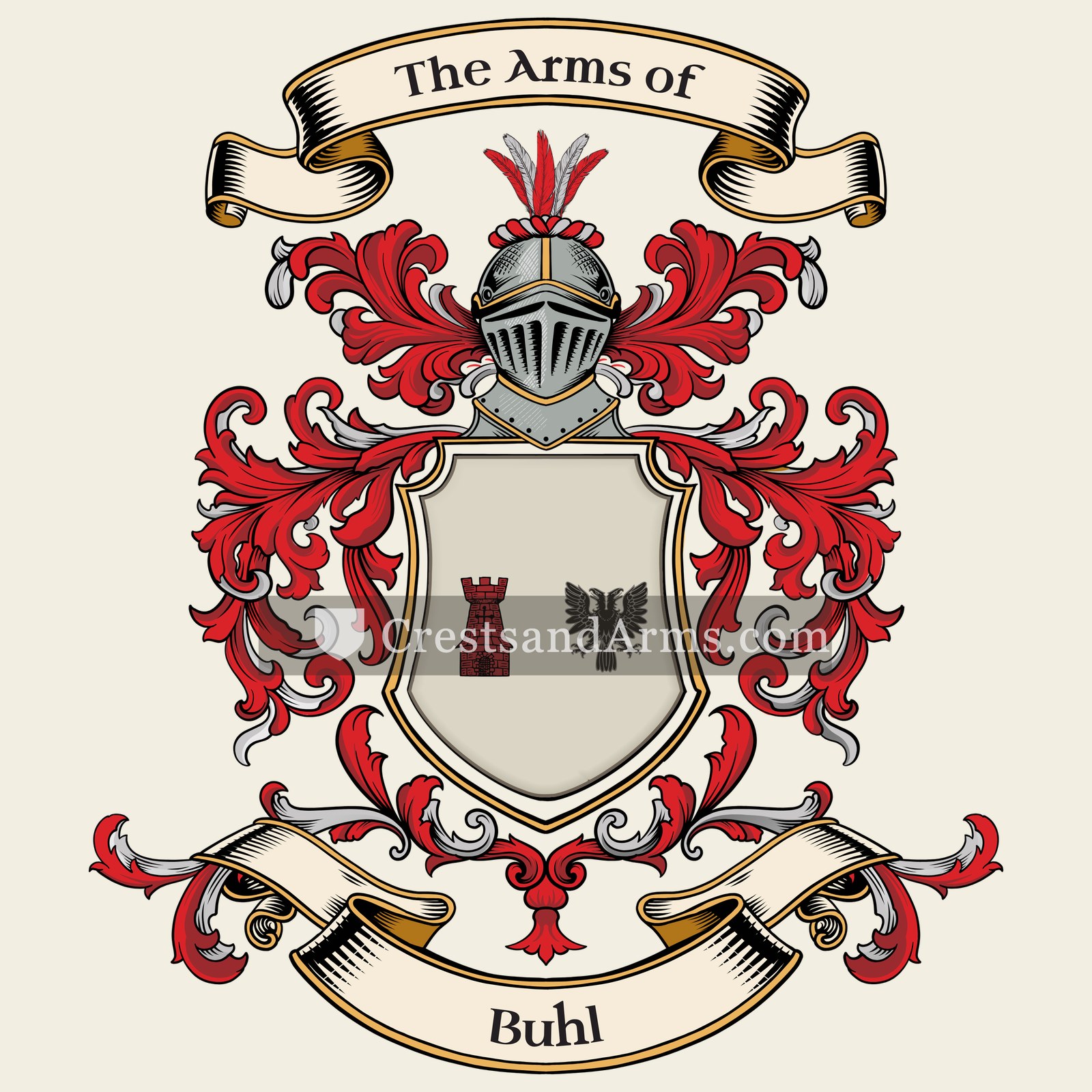


 cross symbolChristian faith and service
 roseThe seventh son, and beauty with grace